
How Michael Jackson Changed Modern Choreography Forever
Movement Branding, Narrative Dance, and the Blueprint Every Performer Still Follows
By Dance Mogul Magazine
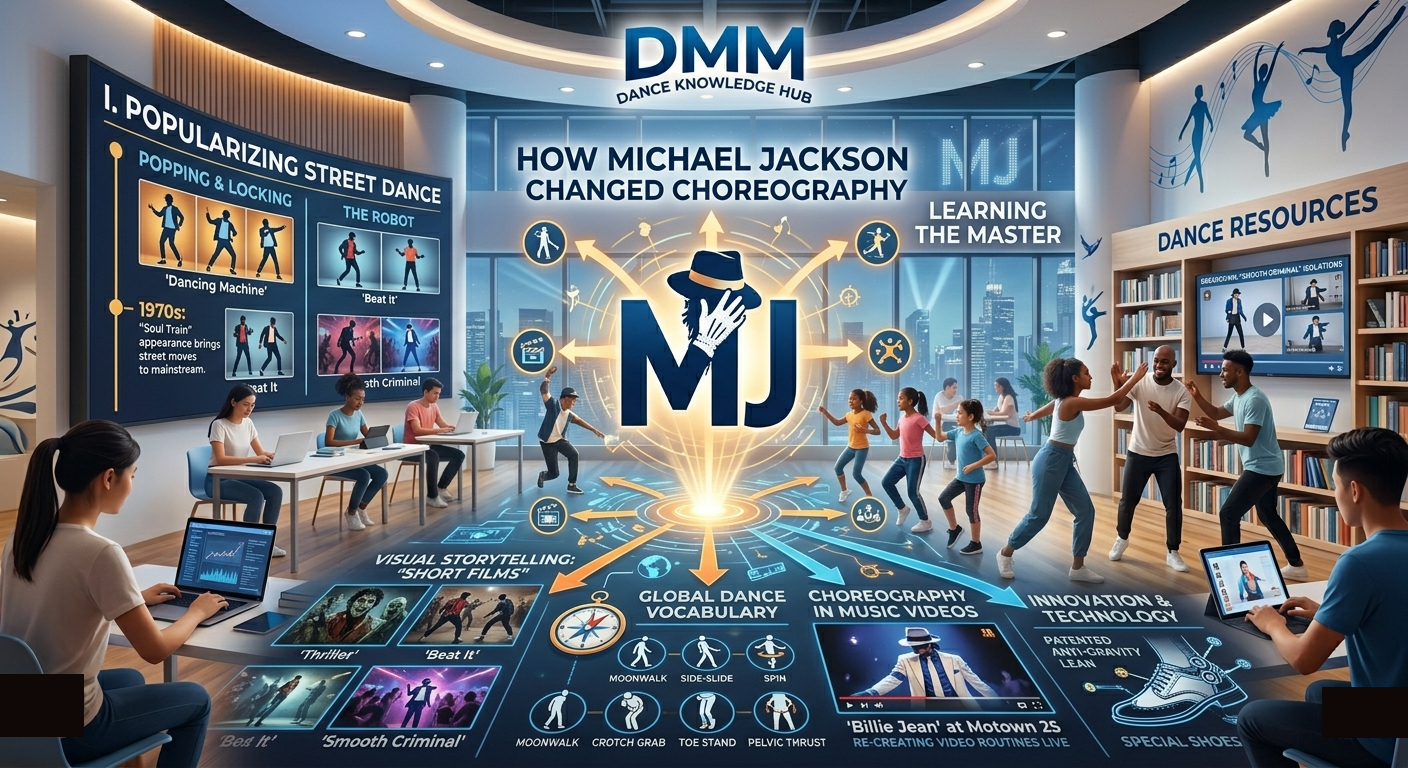
Before Michael Jackson, choreography in popular music was in the background. Dancers moved behind the singer. Routines were simple, repetitive, and forgettable. The music was the product. The movement was the wrapper. Michael Jackson inverted that equation. He made choreography the focal point of the performance, the reason people tuned in, the thing they replayed and studied and attempted in their bedrooms. In doing so, he did not just become the greatest performer of his era — he created the blueprint that every major pop performer has followed since.
The 2026 biographical film Michael — which has already grossed over $425 million worldwide — is a reminder of just how deep that influence runs. Audiences are not just watching a life story. They are watching the origin of a creative language that defines how commercial dance operates today. This article examines the specific ways Michael Jackson changed choreography forever and why his impact continues to shape how movement is created, consumed, and shared in 2026 and beyond.
Dance as Narrative: The Music Video Revolution
Prior to Michael Jackson's global rise, choreography in music videos was ornamental. Artists stood in front of cameras and sang while occasional movement happened in the frame. Jackson treated every video as a short film — a concept he insisted on — and positioned dance as the primary storytelling mechanism. In "Thriller," the choreography does not support the narrative. It is the narrative. The transformation from pedestrian to zombie, the ensemble formations, the unison sequences that build tension — every movement advances the plot.
"Beat It" did the same with its gang confrontation — Michael Peters' choreography staged a dance battle that represented real conflict and real resolution. "Smooth Criminal" functioned as a complete cinematic sequence, with Vincent Paterson's choreography creating a noir-inspired world where every hat tip, lean, and formation change communicated character and stakes.
This approach — dance as storytelling, not decoration — became the industry standard. When Beyoncé stages a music video with narrative choreography, when Missy Elliott builds a visual world around movement concepts, when a K-Pop group designs performance sequences with dramatic arcs, they are working inside the framework Michael Jackson established. The idea that a music video needs to be choreographed with the same intentionality as a stage play traces directly back to his work in the 1980s.
Movement Branding: How MJ Invented the Signature Move Economy
Michael Jackson introduced something to pop performance that had never existed at his scale: movement branding. Before Jackson, artists were recognized by their voices, their faces, their fashion. After Jackson, they could be recognized by a single gesture. The moonwalk was not just a dance step — it was a logo, a brand identifier as powerful as a voice or a costume. The toe stand, the spin, the glove-point, the lean — each was a deliberate, repeatable visual signature that audiences could identify instantly across any context.
Rich and Tone Talauega's codification of Jackson's movements into a formal syllabus is the clearest proof that this was not accidental. Jackson's movement vocabulary was a designed system — a set of gestures, transitions, and rhythmic patterns that functioned as a visual language. When the Talauega brothers catalogued these elements for MJ The Musical and later for the biopic, they were preserving not just moves but a methodology of performance branding.
Today, this concept is everywhere. Every major pop artist develops signature movements — from Drake's "Hotline Bling" sway to Rosalia's hand isolations to the viral TikTok routines that become inseparable from the songs they accompany. The entire economy of choreography-driven music performance rests on the foundation Michael Jackson laid.
"Billie Jean is probably Michael's most iconic dance performance, the one that changed space and time. If Jaafar could get that performance, we knew he could do it all."
— Tone Talauega, choreographer
The Triangular Formation and Ensemble Precision
One of Michael Jackson's most influential contributions to live choreography was the triangular formation — the artist positioned at the front apex of a V-shaped group of backup dancers. This staging was not new in an abstract sense, but Jackson perfected it as a performance standard. The viewer's eye goes first to the lead performer, but the ensemble behind creates depth, reinforces the rhythm, and amplifies the visual impact of every movement.
This formation became the default staging template for pop performance worldwide. When you watch a Beyoncé concert, a BTS stage show, a Super Bowl halftime performance, or even a well-produced TikTok dance video, the triangular formation is often the foundation. Jackson's insistence on ensemble precision — where backup dancers hit every beat, every angle, every isolation with the same exactness as the lead — raised the technical standard of commercial dance across the entire industry.
Clean Hits, Visual Clarity, and the TikTok Generation
Michael Jackson's choreography prioritized what modern dancers call "clean hits" — sharp, precisely timed movements that land exactly on the beat. His isolations were surgical. His transitions were seamless. His musicality — the relationship between his body and the rhythm — was so precise that viewers could feel the music through his movement even with the sound turned off.
This emphasis on visual clarity is the direct ancestor of TikTok dance culture. Short-form choreography on social media operates under the same principles Jackson championed: clean execution, strong musicality, and movements designed to be visually compelling on a small screen. When a TikTok choreographer designs a routine around a chorus, they are unconsciously following the same structural logic Jackson used when he placed the moonwalk at the dance break in "Billie Jean" — put the biggest visual moment where it will have the greatest impact.
The difference is scale and access. Jackson performed for stadium audiences through television broadcasts and music videos. Today's choreographers perform for billions through handheld screens. But the underlying design principles — precision, musicality, visual impact, repeatability — are identical. The language changed platforms. The grammar stayed the same.
Global Influence: From Bollywood to K-Pop to Afrobeats
Michael Jackson's choreographic influence is not limited to American pop culture. His impact is genuinely global. In India, the biopic has sparked a wave of fusion performances blending Jackson's rhythm patterns with classical and Bollywood dance traditions. K-Pop's entire performance infrastructure — the synchronized formations, the clean hits, the signature gestures designed for fan replication — follows a model that Jackson pioneered. Afrobeats choreography, while drawing from its own rich tradition, frequently integrates the visual storytelling and ensemble precision that Jackson brought to mainstream performance.
This global reach is not just cultural. It is educational. Dance studios on every continent teach Jackson's techniques. His movement vocabulary is studied in university dance programs. The syllabus created by Rich and Tone Talauega for MJ The Musical has become a reference point for how performance traditions can be preserved and transmitted across generations and geographies.
The Blueprint Still Stands
Michael Jackson changed choreography by proving that dance could be the most powerful element in a musical performance — more memorable than the vocal, more shareable than the melody, more durable than the production. He did not do this alone. He did it with choreographers like Michael Peters, Vincent Paterson, Jeffrey Daniel, Lavelle Smith Jr., Travis Payne, and Rich and Tone Talauega. But he was the engine, the standard, and the proof that the investment in movement was worth it.
The 2026 biopic is not just a film about a musician. It is a document of the moment when commercial dance became what it is today. And as long as choreographers are designing routines for stages, screens, and social media feeds, Michael Jackson's blueprint will be the foundation they are building on.
Explore the full Michael Jackson & Choreography Legacy hub. Read The Choreographers Behind Michael Jackson for the full profiles of the movement architects behind his legacy. And discover more about Black Creative Directors & Choreographers shaping dance culture today.
Michael Jackson & Choreography Legacy Hub | Dance Styles | The Legacy Archive | Store