
Dance Mogul Magazine Spotlight | The Legacy
Michael Peters Choreographer: The Structural Genius Who Built the MTV Aesthetic and Shaped the King of Pop’s Legacy
From Brooklyn housing projects to Broadway’s biggest stage, from “Thriller” to a 2026 biopic grossing over $400 million — Michael Peters’ choreography continues to define what it means to move the world.
By Dance Mogul Magazine | The Legacy | Dance Industry
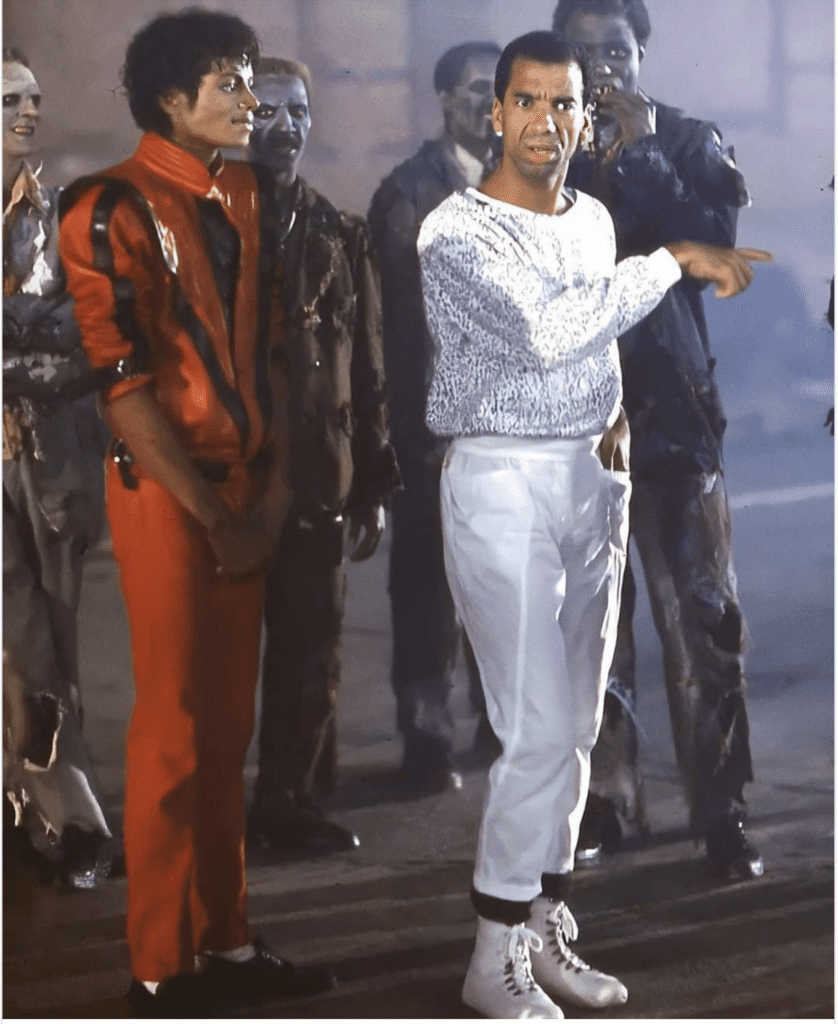
The Architect of the MTV Aesthetic
In the high-velocity world of modern entertainment, where dance moves go viral in seconds and choreography is often reduced to fleeting trends, it is essential to return to the source code of the commercial dance revolution. Long before the digital age reshaped how movement traveled across the globe, the visual language of pop culture was being written by a man who understood that dance was not just movement — it was architecture. That man was Michael Peters.
For Dance Mogul Magazine, Michael Peters represents the pinnacle of the “Culture Builder.” He was a visionary who synthesized the rigorous technicality of modern concert dance with the raw, visceral energy of the street, effectively creating the blueprint for the music video era. To understand the evolution of dance from the stage to the screen is to understand the hand of Michael Peters.
And in 2026, with the release of the blockbuster biopic Michael — starring Jaafar Jackson as his uncle and grossing over $435 million worldwide — Peters’ choreographic DNA is once again at the center of a global cultural moment. The film’s choreographers, Rich and Tone Talauega, have spoken publicly about their deep respect for Peters’ original work, calling his contributions foundational to everything audiences see on screen. His legacy is not just remembered. It is actively being rebuilt, frame by frame, for a new generation.
The Modern Foundation: Training the Observer
Born on August 6, 1948, in Williamsburg, Brooklyn, to an African American father and a Jewish mother, Michael Peters’ artistic DNA was a complex weave of diverse influences. His path was not that of a typical commercial “backup dancer.” At just four years old, his mother enrolled him in dance classes. Later, after watching the original Broadway production of West Side Story, Peters knew that dance was his calling. He told the Chicago Tribune that he came from a housing project where there were gang wars, and seeing that world translated into musical terms showed him what was possible.
Peters attended the High School of Performing Arts in Manhattan but ultimately learned his craft at the Bernice Johnson Cultural Arts Center in Queens. He immersed himself in the elite technical circles of 20th-century modern dance, training under legends including Alvin Ailey, Talley Beatty, and Fred Benjamin. This grounding in modern technique gave him a structural understanding of the body — what we might call the sacred geometry of movement. Peters did not view a dancer as simply a performer. He saw a technical resource capable of articulating complex narratives through physical intention.
Broadway and the Structural Shift
Peters’ first major systemic impact occurred on the Broadway stage. In 1982, he was co-recipient of the Tony Award for Best Choreography for Dreamgirls, alongside Michael Bennett. Peters was tasked with translating the soaring emotional arc of the R&B era into a physical language that could fill a Broadway theater.
In Dreamgirls, Peters demonstrated his ability to manage ensemble ecosystems. He did not simply give the lead actresses steps. He created a synchronized, efficient machine of movement that reflected the polished, high-pressure world of the music industry. His work brought a human element to the massive scale of the production, ensuring that dance served the narrative rather than providing empty spectacle. This principle — choreography as storytelling architecture — would become the signature of his entire career.
Creating the King of Pop: The Peters-Jackson Partnership
While his Broadway accolades established his prestige, it was his collaboration with Michael Jackson that altered the trajectory of global culture. When MTV began broadcasting in 1981, music videos were largely experimental or performance-based. Peters and Jackson changed that by treating the music video as a cinematic short film where choreography was the primary narrative driver.
“Beat It” (1983): The Street as a Stage
In “Beat It,” Peters translated the tension of street life into a structured showdown. He famously appeared in the video as one of the rival gang leaders, wearing the white ensemble. By blending the grit of urban reality with the technical precision of West Side Story — the very production that had inspired him as a child — Peters created a movement signature that was universally recognizable. He taught choreography to approximately 80 real gang members who had no prior dance experience, filming in the Skid Row section of Los Angeles. He proved that street dance could be as technically demanding and structurally sound as any ballet.
“Thriller” (1983): The Anatomy of an Icon
“Thriller” remains among the most-watched music videos in history, and its choreographic success belongs in large part to Peters. To make a group of undead creatures move in a way that was both frightening and rhythmic, Peters had to deconstruct human movement and rebuild it into something subhuman yet organized. This was not just funk — it was a sophisticated blend of African dance, jazz technique, and Jackson’s personal movement vocabulary. Peters also performed in the video as one of the zombies, embodying the work alongside his dancers. In 1984, he received the MTV Video Music Award for Best Choreography for “Thriller” and the American Video Award for Best Choreography for “Beat It.”
“Dance is the physical manifestation of the music’s structure.” — Michael Peters
The 2026 Biopic Michael: Peters’ Choreographic DNA Lives On
In April 2026, the Antoine Fuqua-directed biopic Michael opened in theaters worldwide, with Jaafar Jackson portraying his uncle in what has become one of the highest-grossing biographical films ever made. The film debuted to $97 million domestically and has earned over $435 million globally, breaking records for a musical biopic and surpassing the previous record held by Straight Outta Compton.
For the dance community, the film represents something deeper than box office numbers. The biopic’s choreographers, Rich and Tone Talauega, have spoken extensively about how Peters’ original vision informed their approach. They described building a multi-year training syllabus for Jaafar Jackson that went beyond technique into understanding the “soul and spirit” of the movement — the same philosophy Peters himself practiced. The choreography for the “Beat It” sequences in the biopic was crafted specifically to honor both Jackson’s performance and Peters’ original structural vision.
Rich and Tone Talauega noted that preparing Jaafar required integrating multiple movement languages — African dance, jazz dance, and Michael’s signature vocabulary — all of which trace directly back to the foundation Peters built in the early 1980s. The result was a performance that audiences have called uncanny, not because Jaafar copies his uncle, but because the movement lives authentically in his body. That authenticity is the direct inheritance of Peters’ choreographic philosophy: movement must come from intention, not imitation.
The biopic also brought renewed attention to a persistent issue in the entertainment industry. Peters choreographed two of the most watched music videos in history, yet outside of the dance community, his name remains largely unknown to the general public. The film’s release has created a rare moment of public visibility for the choreographers and creative directors who build the visual language that defines an artist’s brand — a cause that Dance Mogul Magazine has long championed.
Why This Matters Now
The 2026 Michael biopic has grossed over $435 million worldwide, introducing a new generation to the choreographic brilliance that Michael Peters pioneered. Yet most audiences still do not know his name. Dance Mogul Magazine is committed to ensuring the architects of dance culture are recognized alongside the performers they elevated.
The Michael Peters Choreographer Legacy: Training Icons Beyond Jackson
Peters’ genius extended far beyond his work with Jackson. He possessed a unique ability to function as a technical resource for performers who were not trained dancers, transforming them into physically compelling artists on screen.
His choreography for Angela Bassett’s portrayal of Tina Turner in What’s Love Got to Do with It (1993) is a masterclass in this skill. Peters had minimal time to prepare Bassett for the role, yet the intensity and authenticity of her physical performance became one of the film’s defining elements. He also choreographed for Donna Summer, bringing the visual identity of “Love to Love You Baby” to life in 1975 — one of his earliest breakthroughs. His work with Pat Benatar on “Love Is a Battlefield,” Lionel Richie on “Hello,” and Diana Ross further cemented his reputation as the choreographer who could make any artist move with purpose and precision.
Peters understood that every artist had a personal movement signature, and his role was to optimize that signature for the camera. This philosophy created a lineage. Vincent Paterson, who began as an assistant choreographer to Peters, went on to become a principal creative force for both Michael Jackson and Madonna, including the legendary “Blond Ambition” tour. The tree that Peters planted continues to bear fruit across the entire entertainment industry.
What Michael Peters Added to the Dance Industry: A Summary
Michael Peters did not simply choreograph dances. He restructured the relationship between movement, narrative, and visual media. His contributions to the dance industry can be understood across five foundational areas:
1. He invented the music video as a choreographic medium. Before Peters, music videos were promotional clips. After “Thriller” and “Beat It,” they became cinematic events where dance drove the story. Every choreographed music video produced since 1983 exists in the framework Peters established.
2. He bridged concert dance and commercial entertainment. Peters brought the structural rigor of Alvin Ailey and Talley Beatty into the world of pop music without diluting either tradition. He proved that commercial dance could be intellectually and technically sophisticated, and that concert dance could reach mass audiences.
3. He elevated street dance into mainstream legitimacy. By incorporating real gang members and authentic street movement into “Beat It,” Peters demonstrated that the streets held artistic value equal to any conservatory. This was a radical act in 1983 — and it opened the door for every street-trained dancer who has worked in commercial entertainment since.
4. He created the role of the choreographer as creative director. Peters did not simply provide steps for performers. He shaped their entire physical identity on screen. His work with Michael Jackson, Angela Bassett, and Donna Summer established the model for what we now call a creative director in the dance and music industry.
5. He built a lineage that continues today. Vincent Paterson, Rich and Tone Talauega, and generations of commercial choreographers trace their artistic DNA to Peters’ vision. The 2026 biopic Michael is the latest proof that his choreographic architecture remains the standard against which all others are measured.
“Michael Peters choreographed two of the most watched music videos in history — and most people have never heard his name. That is exactly the problem Dance Mogul Magazine exists to solve.”
Michael Peters at a Glance
Born: August 6, 1948 — Williamsburg, Brooklyn, New York
Died: August 29, 1994 — Los Angeles, California (age 46)
Tony Award: Best Choreography, Dreamgirls (1982, shared with Michael Bennett)
Emmy Awards: Outstanding Choreography for Liberty Weekend (1987) and The Jacksons: An American Dream (1993)
MTV VMA: Best Choreography, “Thriller” (1984)
American Choreography Award: Outstanding Achievement in a Feature Film, What’s Love Got to Do with It (1994)
Notable Works: “Thriller,” “Beat It,” Dreamgirls, What’s Love Got to Do with It, Sister Act 2, “Love Is a Battlefield,” Comin’ Uptown
Training: Alvin Ailey, Talley Beatty, Fred Benjamin, Bernice Johnson Cultural Arts Center
A Legacy That Demands to Be Named
Michael Peters passed away on August 29, 1994 — which was, in a detail too poignant for fiction, Michael Jackson’s birthday. He died from an AIDS-related illness at just 46 years old, leaving behind a body of work that remains the invisible infrastructure of every major pop tour, music video, and concert film produced today.
Peters was a man who understood the observer effect in performance — that the way an audience views a dancer changes the very nature of the dance. He was a bridge-builder between Brooklyn and Broadway, between the streets and the stage, between concert art and commercial entertainment. He proved that choreography is not decoration. It is the architecture of emotion.
For the readers of Dance Mogul Magazine, Peters serves as both inspiration and reminder: to be a leader in this industry, one must master the technical source code of dance while remaining open to the resonance of the culture. The 2026 biopic has put Jackson back on the world stage. But it is Peters’ choreographic vision — the zombie walk, the gang showdown, the ensemble formations — that makes the performance possible. Without Michael Peters, there is no King of Pop as the world knows him.
It is time the world learns his name.
Explore More from Dance Mogul Magazine
The Choreographers Behind Michael Jackson — The full legacy hub covering Peters, Paterson, Daniel, and more.
Celebrating Black Creative Directors & Choreographers — Honoring the architects of culture who work behind the scenes.
The Legacy Archive — Preserving the history and honoring the pioneers of dance culture.
Health & Empowerment Series — How dance, food, and movement build long-term wellness.
Why Dance Is Medicine — The science behind movement as a healing force.
Empowerment Workbooks — Tools for individuals, families, and young people ready to grow.
The Dance Knowledge Hub — Your encyclopedia of global dance styles and history.
© 2026 Dance Mogul Magazine LLC | dancemogul.com | Inspiring Self-Empowerment Through Dance Culture


