
The Choreographers Behind Michael Jackson
From Michael Peters to Rich + Tone — The Unsung Architects of the King of Pop's Movement Legacy
By Dance Mogul Magazine
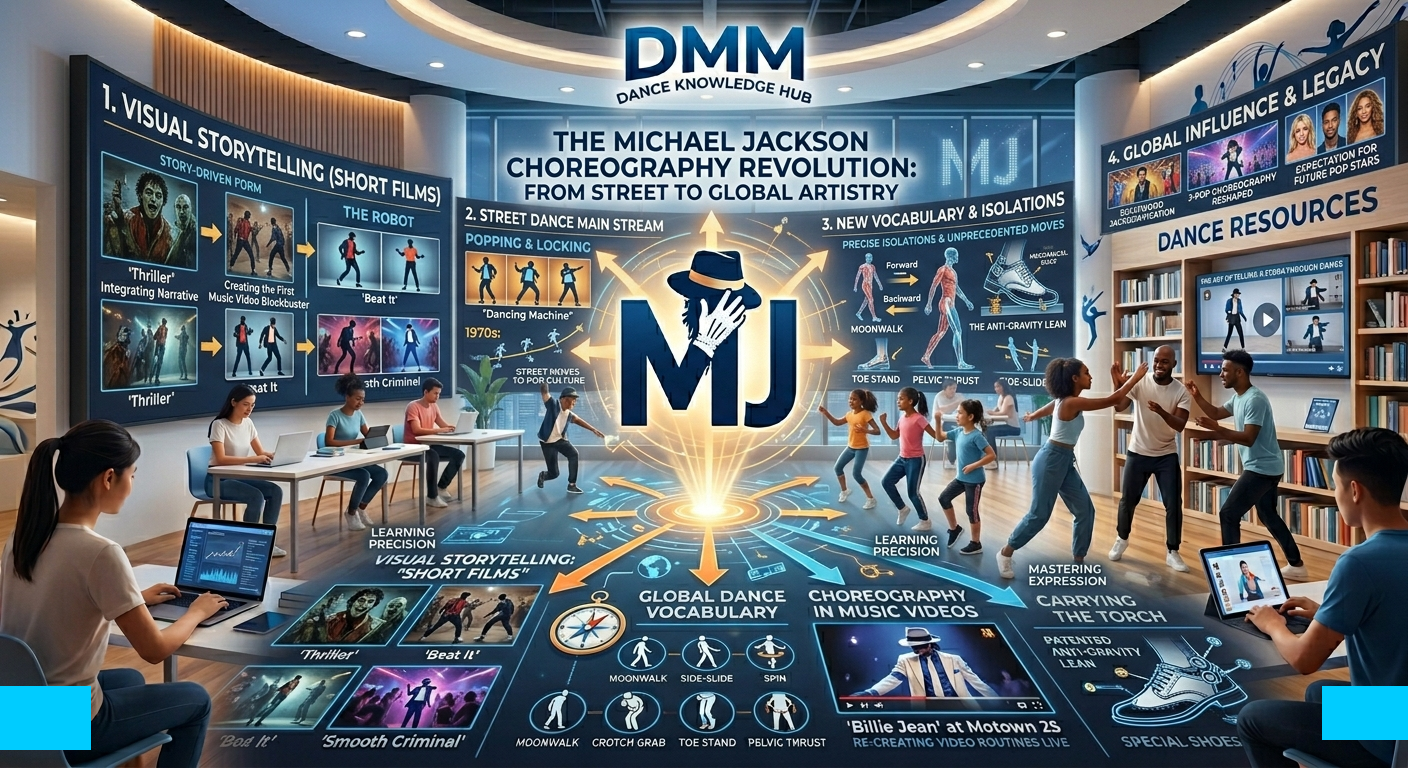
When people think of Michael Jackson's choreography, they think of Michael Jackson. The moonwalk, the Thriller zombie routine, the Smooth Criminal lean — these are stamped so deeply into his identity that the creative architects behind them often go unrecognized. But behind every iconic performance was a choreographer, a collaborator, or a movement coach whose contributions were essential to the final product. Understanding Michael Jackson's dance legacy means understanding the people who helped him build it.
With the 2026 release of the biographical film Michael, these figures are receiving renewed attention. Choreographers Rich and Tone Talauega, who brought the biopic's dance sequences to life, have spoken openly about the lineage they are continuing — a lineage that includes Michael Peters, Vincent Paterson, Jeffrey Daniel, Lavelle Smith Jr., and Travis Payne. Each of these individuals shaped a different era of Jackson's movement vocabulary, and together they represent one of the most significant collaborative traditions in commercial dance history.
Michael Peters: The Architect of Thriller and Beat It
Michael Peters is arguably the most important choreographer in music video history — and yet, outside of the dance community, his name is barely known. Peters choreographed the "Thriller" and "Beat It" videos, the two most influential music video dance sequences ever produced. His work did not just accompany the music. It told stories. In "Beat It," Peters staged a choreographic showdown between rival gangs that transformed the music video from a promotional tool into a narrative art form. In "Thriller," he created the zombie dance routine that would become the most imitated choreography in the world.
Peters was a Broadway veteran before he entered the music video world. He performed in productions of The Wiz, Purlie, and Raisin, developing a foundation in theatrical storytelling through movement. When he brought that sensibility to Michael Jackson's music videos, the result was a fusion of Broadway-level narrative structure with street dance energy and pop spectacle. Peters received two MTV Video Music Award nominations for his work and earned a Tony Award nomination for Broadway's Dreamgirls.
Peters passed away on August 29, 1994 — Michael Jackson's birthday. His contributions are still being honored. Rich and Tone Talauega, in creating the biopic's choreography, have described having deep respect for Peters' work and ensuring that his influence was woven into the fabric of the film's dance sequences. The choreography of "Beat It" in the biopic was crafted to honor both Jackson's performance and Peters' original vision.
"It took a lot of work with Jaafar because there are so many different elements: African dance, jazz dance, as well as Michael's signature moves. We had to make sure Jaafar had all of that language in his body."
— Rich and Tone Talauega, choreographers for the Michael biopic
Vincent Paterson: The Mind Behind Smooth Criminal
Vincent Paterson began as an assistant choreographer to Michael Peters before becoming a principal creative force in Michael Jackson's work. Paterson is best known for choreographing the "Smooth Criminal" music video and the legendary performance sequences of the Bad World Tour. His approach brought a cinematic quality to live performance — integrating props, stage mechanics, and ensemble choreography into unified visual narratives.
The "Smooth Criminal" video is a case study in how choreography can function as filmmaking. Every dancer in the scene moves with purpose, every formation shift advances the story, and Jackson's movements — including the famous anti-gravity lean, achieved with a patented shoe mechanism — are framed for maximum dramatic impact. Paterson's influence extended beyond Jackson as well. He went on to choreograph for Madonna, including the iconic "Blond Ambition" tour, and directed music videos and stage productions for decades.
Jeffrey Daniel: The Street Dance Bridge
Jeffrey Daniel occupies a unique position in Michael Jackson's choreography lineage. As a member of the R&B group Shalamar and a fixture on Soul Train, Daniel was one of the dancers who helped popularize the backslide — the precursor to the moonwalk — in televised performance. Jackson was a known admirer of Daniel's style and eventually brought him into his creative circle.
Daniel worked with Jackson on the "Bad" and "Smooth Criminal" videos, serving as a bridge between the street dance techniques that inspired Jackson and the polished, production-level choreography that defined his career. Daniel's influence represents something critical about Jackson's artistry: his willingness to learn from dancers who were innovating in real time on the ground level, and his ability to elevate those innovations onto the world stage.
Lavelle Smith Jr. and Travis Payne: Touring and the Later Era
As Michael Jackson's career evolved from music videos into massive world tours, a new generation of choreographers stepped in to manage the demands of live performance at stadium scale. Lavelle Smith Jr. served as choreographer for Jackson's world tours, translating the precision of his studio work into arena-level spectacle. Smith's challenge was preserving the intimacy of Jackson's movement while making it visible to audiences of 70,000 or more.
Travis Payne, who had been part of Jackson's creative team for years, became central to the final chapter of his performance career. In 2009, Payne was working alongside Jackson and director Kenny Ortega on This Is It — the series of fifty concerts at London's O2 Arena that were never performed. When Jackson passed away, Payne helped choreograph the memorial service at the Staples Center and contributed to the documentary film that preserved the rehearsal footage. His work represents the transition from performance to preservation — the point where choreography becomes historical record.
Rich and Tone Talauega: The Keepers of the Syllabus
Rich and Tone Talauega, brothers from the San Francisco Bay Area, first entered Michael Jackson's world as teenagers in the mid-1990s when they were discovered by one of his choreographers at an album release party in Oakland. They went on to dance for Jackson, Madonna, and numerous other artists, but their most significant contribution has been the preservation and codification of Jackson's movement vocabulary.
When Jackson passed in 2009, many assumed his movement language would die with him. Rich and Tone ensured it did not. Working first on MJ The Musical on Broadway — which won the 2022 Tony Award for Best Choreography — the brothers broke down every element of Jackson's style into a named, teachable syllabus. The moonwalk, the sidewalk, the toe stand, the spin, the isolation patterns, the rhythmic vocabulary — all of it was catalogued and structured so it could be passed on.
For the 2026 biopic, they applied this syllabus to Jaafar Jackson, training him over a period of years in rigorous dance sessions that went beyond technique into what they call understanding someone from the perspective of their "soul and spirit." The result is a performance that audiences have called "uncanny" — not because Jaafar copies his uncle, but because the movement lives authentically in his body.
Why Crediting Choreographers Matters
The story of Michael Jackson's choreography is inseparable from a broader conversation about how dance labor is valued in the entertainment industry. Choreographers create the visual language that defines an artist's brand, yet they are frequently uncredited, underpaid, and forgotten by the mainstream. Michael Peters choreographed two of the most watched music videos in history and most people have never heard his name.
Dance Mogul Magazine has long been committed to elevating the visibility of Black creative directors and choreographers who shape culture from behind the scenes. The MJ biopic has created a rare moment of public attention for this issue. When Tone Talauega describes how they built a syllabus to preserve Jackson's movement, he is describing an act of cultural stewardship — the kind of work that ensures future generations understand not just what a dancer did, but how and why they did it.
Explore the full Michael Jackson & Choreography Legacy hub for more on the moves, the minds, and the cultural impact. Read about The History of the Moonwalk to understand the street dance origins behind MJ's most famous technique. And visit the DMM Store to support independent dance media.
Michael Jackson & Choreography Legacy Hub | Dance Styles | The Legacy Archive | Store