
Trending Artist Feature
Parris Goebel: The Self-Made Queen Who Choreographed the World's Biggest Stages
From a garage in South Auckland to the Super Bowl halftime show — Parris Goebel built a global empire one step, one crew, and one groundbreaking performance at a time.
By Dance Mogul Magazine | Trending Artist Feature
Who Is Parris Goebel?
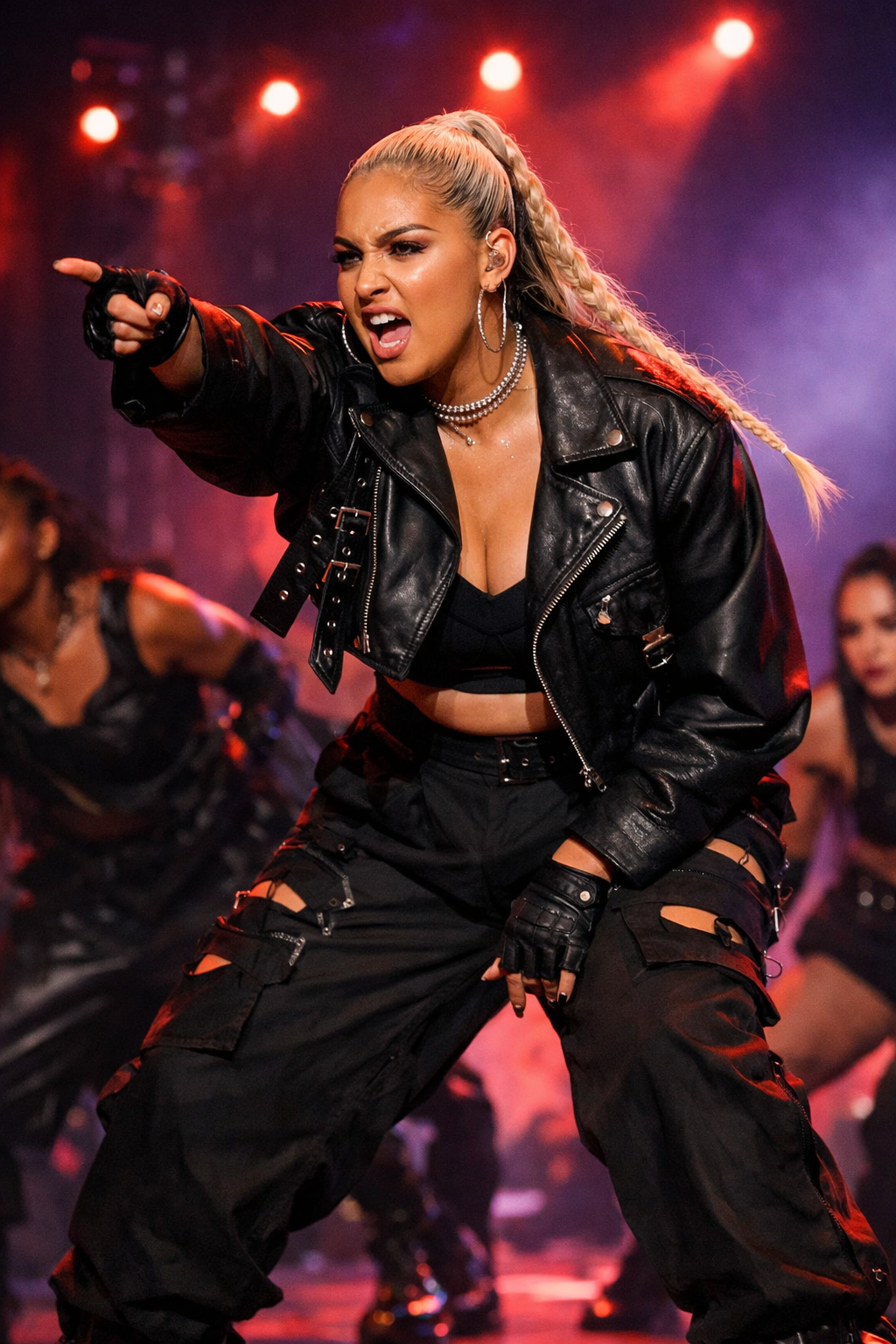
There are choreographers who work behind the scenes. And then there is Parris Goebel — a woman who stepped onto the global stage at fifteen years old and never asked for permission to stay. She is an Emmy Award-winning choreographer, creative director, dancer, singer, actress, and author from Auckland, New Zealand. She is the founder of The Palace Dance Studio and the architect behind some of the most-watched performances in modern entertainment history — from Justin Bieber's "Sorry" music video with over three billion YouTube views to the Super Bowl halftime shows for Jennifer Lopez and Rihanna, and the Beyoncé Bowl that captivated millions on Netflix.
What makes Goebel singular is not just her résumé — it is where she came from and how she built it. She dropped out of high school at fifteen. She rehearsed in her aunt's garage. She created her own dance style, founded her own crews, opened her own studio, and turned a small island nation into a global hip-hop dance powerhouse — all before turning twenty-five. Her story is not one of overnight success. It is a masterclass in vision, discipline, cultural pride, and the refusal to wait for someone else to open the door.
This is the story of a girl from South Auckland who conquered the world — and brought her community with her.
A South Auckland Girl with a Warrior's Heart
Parris Renee Goebel was born on October 29, 1991, in Manurewa, a neighborhood in South Auckland, New Zealand. She carries Samoan, Scottish, and Chinese heritage — a blend that would later become the foundation of the dance style that changed her life. She was the youngest of four children raised by her parents, Brett and LeeAnn Goebel, in a close-knit household filled with music, laughter, and Polynesian culture.
From the time she was a toddler, Goebel moved. Home videos show her strutting around the living room at three years old, mimicking the dancers she saw on MTV. By eight, she had started ballet and tap lessons, but neither form felt like her language. They felt too rigid, too constrained for the energy inside her. What spoke to her was hip-hop — the raw, expressive, unapologetic power of street dance. She began hip-hop lessons at ten and immediately stood out for the way she felt the music, not just followed it.
But school was a different story. Growing up brown-skinned and Polynesian in a system that did not always celebrate her identity, Goebel often felt like an outsider. She has spoken openly about feeling like she did not fit in. The dance floor was the one place where she felt completely herself.
At fifteen, she made a decision that would define everything that followed. Supported by her parents — particularly her father Brett, who would become her manager — she left Auckland Girls' Grammar School to pursue dance full-time. It was a gamble most families would not take. But the Goebels saw what Parris saw: a talent too powerful to be confined to a classroom.
“When you're 15 and you don't go to school, you have all the free time in the world. It made me really determined: I've gotten rid of my gateway to education. All I could do now was something with my talent.”
From a Garage to a Global Dance Empire
After leaving school, Goebel wanted to join a dance company. But in South Auckland, her options were limited — one all-male crew and one she felt was not at her level. So her father asked her a question that changed the trajectory of her life: Why not start your own?
In 2006, at just fifteen, she gathered four friends and formed ReQuest — an all-female dance crew. They rehearsed in her aunt's garage and later in her father's warehouse. They taught themselves by watching MTV and YouTube videos, building routines from scratch, developing a vocabulary of movement that blended hip-hop fundamentals with the fierce, rhythmic energy of Polynesian culture. After a year of relentless training, they fundraised enough to travel to the United States and compete at the Monsters of Hip Hop Dance Convention. Goebel was selected to perform in the finale — the first sign that the world was about to take notice.
By 2009, when Parris was just seventeen, the family founded The Palace Dance Studio in Penrose, Auckland, starting with eight students in a modest space. The name was intentional. Their mantra was "Crowns Up" — a philosophy of self-empowerment rooted in the belief that every dancer who walked through the door was royalty. The Palace quickly grew, reaching nearly one hundred students within two years and producing multiple competitive crews — ReQuest, Sorority, Bubblegum, and the crown jewel: The Royal Family.
The Royal Family went on to win the World Hip Hop Dance Championship three consecutive times — a feat no other crew in history had achieved. It was not just a victory for a studio. It was a statement from New Zealand, from South Auckland, from the Polynesian community, that world-class artistry could emerge from anywhere — if the vision was fearless enough.

Polyswagg: The Dance Style That Changed the Industry
What sets Parris Goebel apart from virtually every choreographer of her generation is that she did not just master a style — she invented one. She calls it Polyswagg: a fusion of hip-hop foundations, Polynesian cultural movement, dancehall energy, and what she describes as "sassy woman fire with aggressive inner strength." It is immediately recognizable — bold, rhythmic, deeply grounded, and unapologetically feminine.
Polyswagg is not a gimmick or a brand exercise. It is a philosophy of movement that prioritizes breathing, hearing, and living inside the music. Goebel has said that her choreography is about transmitting feelings, not executing steps. The style is rooted in the idea that women in hip-hop have been historically overlooked and underrated — and that the solution is not to ask for a seat at the table but to build your own.
This approach became her signature across every major project she touched. Whether choreographing a music video, a Super Bowl performance, a fashion show, or a world tour, the Polyswagg DNA runs through every count. It is what makes her work instantly identifiable — and it is why the biggest artists in the world come to her, not the other way around.
The Collaborations That Defined a Generation
Goebel's first major international breakthrough came in 2012, at just twenty years old, when Jennifer Lopez's team tapped her to choreograph the Dance Again World Tour. It was a turning point — the moment the industry realized this young woman from New Zealand was operating at a level that transcended geography. From there, the floodgates opened.
In 2014, she collaborated with Justin Bieber to create thirteen music videos for his album Purpose in just three weeks on a minimal budget. She brought in more than sixty dancers — including her own ReQuest crew — and directed, choreographed, and produced the visual content that would reshape how the world consumed music. The video for "Sorry," which featured Goebel's dancers without Bieber appearing at all, became one of the most-watched videos in YouTube history with over three billion views. It won Video of the Year at the American Music Awards and earned her an MTV Video Music Award nomination for Video of the Year as a director.
Her relationship with Rihanna became another defining chapter. Goebel served as choreographer and creative director for the Savage X Fenty fashion shows, transforming lingerie runways into groundbreaking theatrical spectacles that redefined inclusivity in fashion. She received three consecutive Emmy nominations for the series and won the Primetime Emmy Award for Outstanding Choreography for Variety or Reality Programming in 2022 for Savage X Fenty Vol. 3.
In February 2023, she choreographed Rihanna's Super Bowl LVII halftime show — after having already choreographed Jennifer Lopez's electrifying Super Bowl LIV performance alongside Shakira in 2020. The New York Times called her "the Super Bowl's hidden M.V.P." She had now choreographed two of the most-watched live performances in American television history before the age of thirty-two.
Then came Beyoncé. In December 2024, Goebel choreographed the "Sweet Honey Buckiin'" breakdown for the Beyoncé Bowl — the NFL Christmas Gameday halftime performance that streamed on Netflix and drew millions of viewers worldwide. In 2025, she continued her collaboration with Beyoncé on the Cowboy Carter Tour. Her work with three of the most powerful women in music — Lopez, Rihanna, and Beyoncé — cemented her status as the most in-demand choreographer of her era.
Her client list reads like a who's who of global entertainment: Janet Jackson, Nicki Minaj, Ariana Grande, Ciara, SZA, Doja Cat, Sam Smith, Little Mix, Normani, Lady Gaga, BLACKPINK, and BIGBANG. She has choreographed Dior's J'Adore campaign film, the 2024 Vogue World show in Paris, and contributed choreography to Cirque du Soleil's Michael Jackson tribute. In 2025, she was featured in the Sports Illustrated Swimsuit issue, photographed by Yu Tsai in Jamaica — expanding her presence beyond dance into the wider cultural conversation.
“I feel a responsibility to make changes where I feel it's lacking. I'm in a position to make a difference, so I need to do all that I can to change the future of our next generation.”
Awards, Honors, and Recognition
Parris Goebel's trophy case reflects the breadth of her impact across dance, television, and culture. She won the Primetime Emmy Award for Outstanding Choreography for Variety or Reality Programming in 2022 and received additional Emmy nominations in 2020 and 2021. She was named Female Choreographer of the Year at the World of Dance Industry Awards in 2014. In 2006, she received the inaugural Special Recognition Award at the Creative New Zealand Arts Pasifika Awards. In 2009, she earned both Choreographer of the Year and Dancer of the Year from Street Dance New Zealand.
She received the Top Variety Artist Award from the Variety Artists Club of New Zealand in 2015, the Young Leader category of the New Zealand Women of Influence Awards that same year, and the KEA World Class New Zealander Award in 2017. In the 2020 New Year Honours, she was appointed a Member of the New Zealand Order of Merit (MNZM) for her services to dance. In 2024, she received the Innovator Award at the Industry Dance Awards Gala.
In 2018, she published her autobiography, Young Queen: The Story of a Girl Who Conquered the World, chronicling her journey from South Auckland to the global stage — a book that has since become an educational resource and source of inspiration for Pasifika youth around the world.
Parris Goebel — Career Timeline
1991 — Born in Manurewa, Auckland, New Zealand
2001 — Begins hip-hop dance lessons at age 10
2006 — Drops out of school at 15; forms ReQuest dance crew
2006 — Wins inaugural Creative NZ Arts Pasifika Special Recognition Award
2009 — Founds The Palace Dance Studio in Auckland at age 17
2009–2013 — The Royal Family wins 3 consecutive World Hip Hop Dance Championships
2012 — Choreographs Jennifer Lopez's Dance Again World Tour; appears on America's Best Dance Crew
2014 — Choreographs and directs Justin Bieber's Purpose music videos (13 videos in 3 weeks)
2014 — Appears in Step Up: All In; named Female Choreographer of the Year (WOD)
2015 — Choreographs New Zealand's first hip-hop feature film, Born to Dance
2016 — Releases EP Vicious; tours Europe with The Royal Family
2018 — Publishes autobiography Young Queen
2019 — Choreographs Mylène Farmer's Paris La Défense Arena residency; J.Lo's It's My Party Tour
2020 — Choreographs Jennifer Lopez & Shakira's Super Bowl LIV halftime show; appointed MNZM
2020–2022 — Creative director and choreographer for Rihanna's Savage X Fenty Shows (Vols. 1–4)
2022 — Wins Primetime Emmy Award for Outstanding Choreography
2023 — Choreographs Rihanna's Super Bowl LVII halftime show
2024 — Choreographs Dior J'Adore campaign; 2024 Vogue World Paris; Beyoncé Bowl halftime
2024 — Receives Innovator Award at Industry Dance Awards Gala
2025 — Featured in Sports Illustrated Swimsuit issue; continues Beyoncé Cowboy Carter Tour collaboration

Why Parris Goebel's Legacy Matters to Dancers Everywhere
Parris Goebel's impact extends far beyond choreography. She represents a fundamental shift in who gets to lead in the global entertainment industry — and where that leadership can come from. She proved that a young Polynesian woman from South Auckland, without formal training or industry connections, could build an empire on talent, work ethic, and cultural authenticity. That proof matters enormously, especially for communities that have historically been underrepresented in the dance world.
Through The Palace Dance Studio, she has provided a home for hundreds of young dancers — many from backgrounds with limited access to arts education. The studio operates on the principle that hip-hop is not a lesser form of dance and that the kids from South Auckland deserve the same pathways to professional careers as anyone trained in a conservatory. She has spoken passionately about the lack of funding for hip-hop compared to classical forms like ballet, and she has used her platform to advocate for change.
Her influence on the visual language of pop culture is immeasurable. The choreography in "Sorry" alone shifted how music videos were conceived — proving that a dance-driven video without the artist on screen could outperform anything in the industry. Her Super Bowl work elevated the standard for live performance choreography worldwide. And her creation of Polyswagg gave dancers of Polynesian descent a movement vocabulary that honored their roots while competing at the highest commercial level.
For the global dance community, Parris Goebel is not just a choreographer. She is a case study in what happens when talent meets vision, when cultural pride meets commercial ambition, and when a young woman decides that the path does not exist — so she will build it herself.
“Passion never has a day off. I always speak my mind. In dance, the person you are is a part of your product — your personality, what you wear. You can't just be you half the time. You have to be you morning until night. It's not something you switch on; it's a lifestyle, a mindset.”
The Queen Is Still Building
Parris Goebel is thirty-four years old. She has already choreographed three Super Bowl-level halftime shows, won an Emmy, published an autobiography, founded a studio that produces world champions, invented a dance style, and collaborated with the biggest names in music. And by every indication, she is just getting started.
Her story matters because it is true. She was not discovered by a talent agent in a Manhattan studio. She was not groomed through an elite conservatory. She built herself — in a garage, on a dream, with a crew of friends from South Auckland who believed that their movement had value. And then she proved it to the entire world.
At Dance Mogul Magazine, we document the artists who define dance culture — not just those who follow it. Parris Goebel is not following anything. She is building the road others will walk on for decades to come. And if you are a dancer reading this, her message is clear: your background is not a limitation. It is your superpower. Crowns up.
About This Feature
Dance Mogul Magazine is the #1 Black Dance Magazine dedicated to bridging the gap between urban dance culture and mainstream media. Our artist profiles are designed to be comprehensive, one-stop resources that celebrate the full scope of each artist's journey — from first steps to lasting legacy. We believe that documenting dance history as it happens is not just journalism. It is preservation. www.dancemogul.com