
Trending Artist Feature
Les Twins: How Laurent and Larry Bourgeois Went from the Streets of Paris to the Center of Global Dance Culture
Self-taught, self-made, and unstoppable — the identical twin brothers who turned freestyle into a language the whole world learned to speak.
By Dance Mogul Magazine | Trending Artist Feature
Who Are Les Twins?
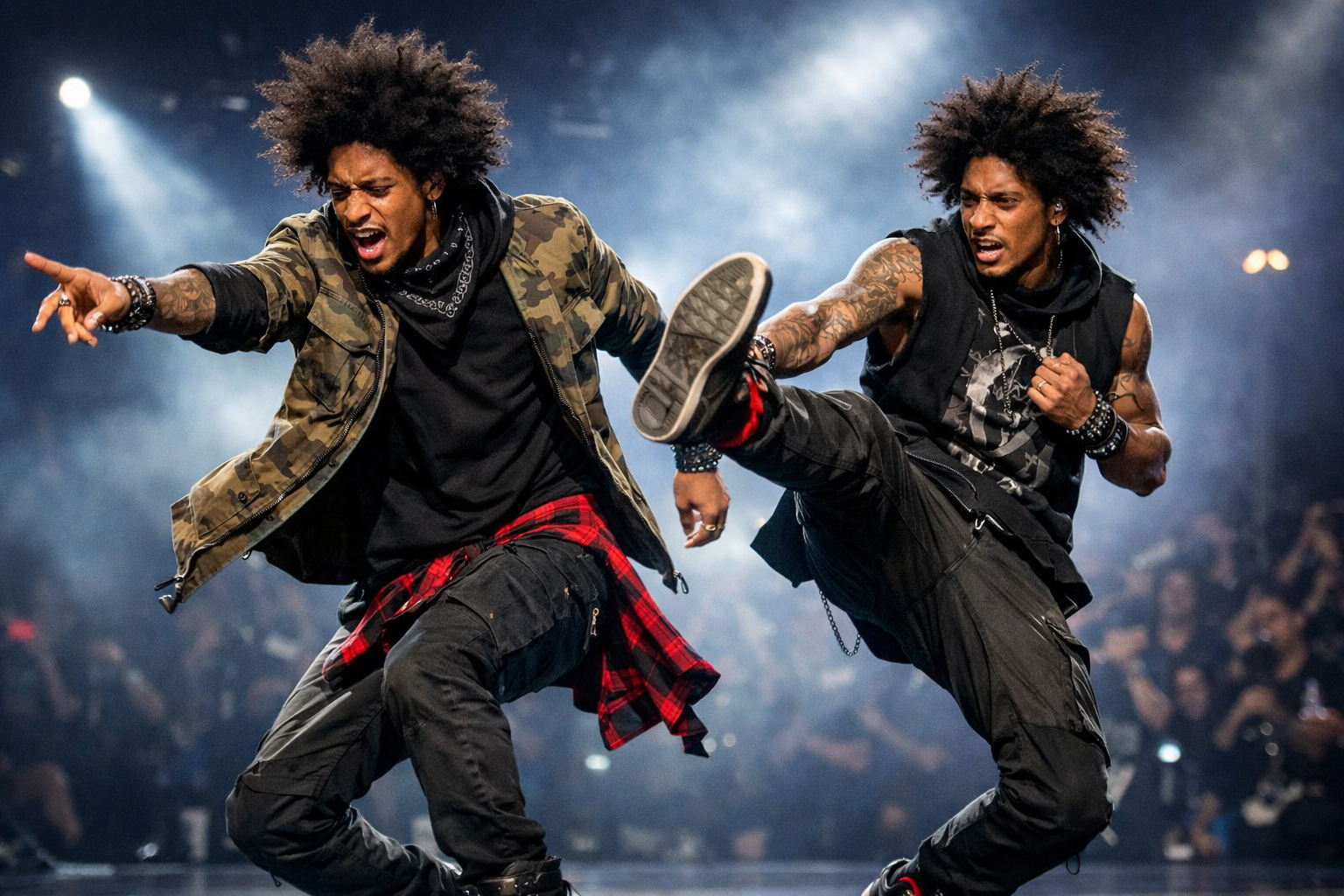
You can describe what Les Twins do, but words will always fall short. You have to see them. You have to watch how Laurent and Larry Bourgeois move through space — how they seem to defy gravity and physics simultaneously, how they anticipate each other's movements with an almost supernatural connection, how they make freestyle look more precise than choreography and choreography feel like pure improvisation. They are, by any measure, two of the most important dancers alive.
Laurent and Larry Nicolas Bourgeois, born December 6, 1988, in Sarcelles, France, are identical twin brothers known professionally as Les Twins. They are dancers, choreographers, producers, models, designers, actors, and creative directors. They are the founders of the Criminalz Crew and the creative brand Eleven Paris. They are the winners of the inaugural season of NBC's World of Dance, Beyoncé's go-to male dancers across three world tours, the first dancers ever signed to the Jordan Brand — handpicked by Michael Jordan himself — and the subjects of a cultural phenomenon that has spanned fifteen years, five continents, and billions of video views.
Their nicknames tell you everything you need to know about their energy. Laurent is "Lil Beast." Larry is "Ca Blaze." Together, they are the twin flame of modern street dance — born in poverty, raised in rhythm, and destined for a stage the world was not ready for until they arrived.
Born in the Banlieues: A Childhood Shaped by Music and Movement
Sarcelles is a commune in the northern suburbs of Paris — part of the banlieues, the housing projects on the outskirts of the French capital. It is a world away from the glamour of the Champs-Élysées. Laurent and Larry were the youngest in a large, extended Guadeloupean family of eighteen children. They grew up very poor. But they grew up dancing.
According to WAD Magazine, they were born dancers in the most literal sense: they walked at five months, were moving their bodies with intention at eighteen months, and by nine years old, they were performing steps they had invented to teenagers twice their age in their neighborhood. Their family was musical, expressive, and creative — a household where movement was not an extracurricular activity but a way of being.
Neither Laurent nor Larry ever received a single formal dance lesson. Not one class. Not one instructor. They learned by watching — studying breakers, lockers, and poppers on the streets of Paris, mimicking moves from music videos, and teaching themselves classical ballet techniques through sheer observation. Their inspirations were eclectic: Michael Jackson, Jackie Chan, Bruce Lee, Jim Carrey, and their coach Abibou "Playmo" Kébe, who connected with them around the age of ten and helped channel their raw talent into the competitive dance world.
By twelve, they were performing in concerts, musical soirées, and dance competitions. By their mid-teens, they were already fixtures in the Parisian underground dance battle scene — a scene that values authenticity, musicality, and raw improvisation above all else. The streets of Paris were their conservatory. The battles were their education. And they graduated at the top of every class they entered.
“We have really created a form of hip-hop that is truly individual to them. They are in perfect symbiosis. They look totally disjointed with their very jerky movements, although at the same time displaying an amazing fluidity. They undulate, bend and twist, impossible to assess where their center of gravity lies: both phenomenal and unreal.” — WAD Magazine
The Rise: From Underground Battles to Global Virality
In 2005, when they were sixteen, Laurent and Larry recruited five members and formed the Criminalz Crew — a dance collective that would spend the next several years competing in hip-hop tournaments, performing as street artists, and building a reputation as one of the most formidable battle crews in France. In 2007, they performed to sold-out audiences at the prestigious Avignon Festival in the musical Pas de Quartier.
Their first major competitive breakthrough came in March 2008 at Juste Debout — one of the most prestigious international street dance competitions in the world. They defeated French street dancers Joseph Go and Meech Onomo at the semi-finals, immediately gaining the attention of the global dance community. That same year, they competed on Season 3 of Incroyable Talent (France's Got Talent), dancing their way to the finals and becoming audience favorites.
But the moment that changed everything came in August 2010. A video of their performance at the San Diego leg of the World of Dance tour was uploaded to YouTube. It went viral — eventually accumulating over forty-six million views. The video captured everything that made Les Twins unique: their uncanny synchronization, their improvisational genius, their ability to make every second of movement feel completely spontaneous and completely intentional at the same time. Ellen DeGeneres saw the video and invited them to perform on her show in November 2010 — their first U.S. television appearance.
In 2011, they returned to Juste Debout and won the New Style Hip-Hop division, defeating more than 350 contestants. The underground crown was now officially theirs. And the commercial world was paying attention.
The Beyoncé Era: Six Years at the Center of Pop Culture
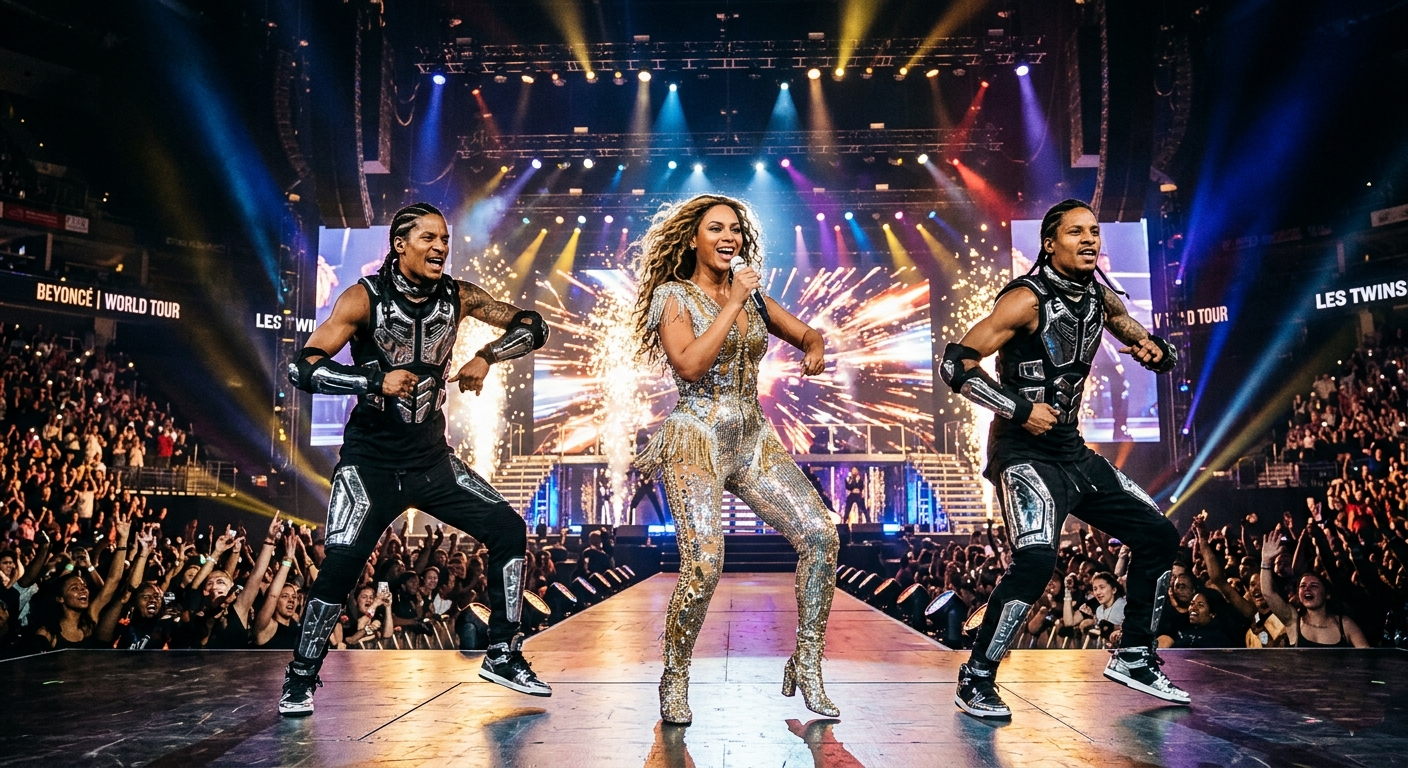
In 2011, Les Twins performed alongside Beyoncé at the Billboard Music Awards — and that single appearance launched a six-year creative partnership that would redefine both their careers and the role of male dancers in mainstream pop performances. They appeared with Beyoncé at the Glastonbury Festival, the BET Awards, and the Good Morning America Summer Concert Series, establishing themselves as her primary male dancers.
In 2013, they toured as the only male dancers on The Mrs. Carter Show World Tour — a massive global production that showcased Beyoncé at the height of her powers. They appeared in the music videos for "Jealous" and "Blow" from her self-titled visual album. In 2014, they joined Beyoncé and Jay-Z on the On the Run Tour, and returned for Coachella — performances that cemented their reputation as dancers who could hold the stage alongside the biggest entertainer in the world.
Their collaboration with Beyoncé was significant for reasons beyond the spectacle. It proved that street dancers — self-taught artists from the underground battle scene — could operate at the highest level of commercial entertainment without sacrificing their authenticity. Les Twins did not become backup dancers in the traditional sense. They brought their own energy, their own style, their own personality to every performance. Beyoncé did not hire them to blend in. She hired them to stand out.
In 2025, they reunited with Beyoncé during the European shows of her Cowboy Carter Tour — proving that the creative connection between them has only deepened with time.
World of Dance: Proving What the Streets Already Knew
In 2017, Les Twins entered the first season of NBC's World of Dance — a televised dance competition produced by Jennifer Lopez with a one-million-dollar grand prize. For many artists, this would have been a career-defining moment. For Les Twins, it was a coronation. They were already legends in the dance community. The competition simply allowed the rest of the world to see what the underground had known for a decade.
They won. Decisively. Their performances throughout the season showcased the full range of their artistry — the explosive power, the emotional depth, the humor, the otherworldly connection between two brothers who move as a single organism. The victory made international headlines and introduced Les Twins to millions of viewers who had never seen a dance battle or watched a freestyle cipher.
More importantly, the win validated the art form itself. New Style hip-hop, freestyle battle culture, and self-taught street dance — disciplines that had been historically dismissed by the mainstream — were proven on national television to be as technically demanding, as emotionally compelling, and as artistically sophisticated as any form of dance in the world.
“From day one, I've always put in the same amount of work. When you're working hard, you have no time to be big-headed. The only thing that's changed is the number of people who know my name.”
Beyond the Stage: Film, Fashion, and the Jordan Legacy
Les Twins have always understood that dance is a gateway, not a ceiling. Their careers have expanded into every corner of entertainment and culture, always anchored by the authenticity that made them famous in the first place.
In 2011, they served as star dancers on the Michael Jackson: The Immortal World Tour by Cirque du Soleil — a fitting collaboration given their lifelong reverence for the King of Pop. In 2019, they appeared in two major films: Men in Black: International and Cats, directed by Tom Hooper. In 2018, they became resident judges on the French Canadian dance competition Révolution TVA, and in 2020, they served as judges for the Juste Debout dance competition tour — returning to the battle that first gave them a global platform.
In 2024, they joined Jason Derulo on both his Nu King World Tour and his Las Vegas residency, choreographing the music video for "Bumpa" with KING & Jason Derulo.
Their fashion credentials are equally formidable. Signed with NEXT Model Management in Paris, they walked the runway at Paris Fashion Week for Jean Paul Gaultier in 2010 and have appeared in campaigns for YSL, Chanel, Gucci, Prada, Versace, Givenchy, Emporio Armani, H&M, Beats by Dre, Hewlett-Packard, Adidas, Hennessy, and Jay-Z's Rocawear.
But perhaps their most symbolically powerful achievement came in 2019, when they became the first dancers ever signed to the Jordan Brand — handpicked by Michael Jordan himself. They collaborated on the Air Jordan 1 Retro High "Les Twins — Fearless," a sneaker that sold out within minutes of release. The partnership was more than a brand deal. It was a statement: dancers belong in the same cultural conversation as athletes. Creativity is the equal of competition. And two self-taught brothers from the projects of Paris can stand alongside the greatest basketball player of all time.
The Artistic DNA of Les Twins
What sets Les Twins apart — what makes them not just popular but historically significant — is the dance style they created. Often categorized as New Style hip-hop, their movement vocabulary is in fact entirely their own. They call it "Twins-Style," and it defies easy description. It is equal parts animation, isolation, popping, locking, contemporary movement, and pure improvisational genius, delivered with a musicality that borders on telepathy.
Their twin connection is the foundation. Because they have moved together since infancy, they possess an ability to anticipate and finish each other's movements that makes their freestyle look choreographed and their choreography feel completely spontaneous. Their bodies seem to operate on the same nervous system — jerking, flowing, freezing, and exploding in perfect counterpoint.
Standing at six feet four inches tall, they command any space they enter. Their signature look — backwards pants, large afros, neck warmers, kneepads worn at the ankles, beaded accessories — is as much a part of their artistic identity as their movement. They have said that fashion is not separate from dance; it is an extension of the same creative impulse.
Their workshops draw thousands of attendees across the globe — crowds of up to five thousand in countries spanning every continent. They do not simply teach steps. They teach philosophy: breathe the music, live inside the rhythm, be completely and unapologetically yourself. That message, delivered through their movement, has resonated with a generation of dancers who see in Les Twins the proof that originality is the most powerful currency in the industry.
Les Twins — Career Timeline
1988 — Born December 6 in Sarcelles, France
2000 — Begin performing in concerts and dance competitions at age 12
2005 — Form Criminalz Crew with five additional dancers
2007 — Perform at the Festival d'Avignon in Pas de Quartier
2008 — Reach semi-finals of Juste Debout; finalists on Incroyable Talent Season 3
2010 — World of Dance San Diego video goes viral (46M+ views); U.S. TV debut on Ellen
2010 — Walk Paris Fashion Week for Jean Paul Gaultier
2011 — Win Juste Debout (New Style Hip-Hop); perform with Beyoncé at Billboard Music Awards
2011 — Star dancers on Cirque du Soleil's Michael Jackson: The Immortal World Tour
2013 — Tour as only male dancers on Beyoncé's The Mrs. Carter Show World Tour
2014 — Join Beyoncé & Jay-Z On the Run Tour; featured in music videos for Jealous and Blow
2017 — Win Season 1 of NBC's World of Dance ($1M grand prize)
2018 — Become resident judges on Révolution TVA (Canada)
2019 — First dancers signed to Jordan Brand; Air Jordan 1 "Fearless" collaboration
2019 — Appear in Men in Black: International and Cats
2024 — Join Jason Derulo's Nu King World Tour and Las Vegas residency
2025 — Rejoin Beyoncé for European Cowboy Carter Tour shows
Why Les Twins' Legacy Matters to Dancers Everywhere
The significance of Les Twins cannot be measured in YouTube views or competition titles alone — though both are staggering. Their real impact is in what they proved: that street dance, born in communities excluded from traditional arts institutions, is not a lesser form. It is not entertainment's minor league. It is, at its best, one of the most demanding, creative, and emotionally resonant art forms in the world.
Laurent and Larry came from a family of eighteen children in the housing projects of Sarcelles. They had no formal training, no institutional support, no industry connections. What they had was each other, an inexhaustible work ethic, and a belief that their movement — born from the streets, the battles, the ciphers — was worthy of the biggest stages on Earth. And they were right.
Their career has opened doors for an entire generation of street dancers. Before Les Twins, the path from underground battles to mainstream success was almost nonexistent. After Les Twins, it became a map that others could follow. Their Jordan Brand partnership alone shattered the invisible barrier between dance and the aspirational world of athlete endorsements. Their Beyoncé tours proved that freestyle artists could enhance — not compromise — the most polished productions in entertainment.
They have taught workshops in countries on every continent, passing on not just their technique but their philosophy: be original, be authentic, never apologize for who you are. That message resonates especially with dancers from marginalized communities who see in Les Twins the proof that where you start does not determine where you finish.
For the Afro-French and Afro-Caribbean diaspora, they are cultural heroes — proof that the art forms born in their communities can command global respect. For the broader dance world, they are a permanent reminder that the most revolutionary art almost always comes from the places the mainstream was not looking.
“We have changed consciousness about fashion. We have changed consciousness about dance. We show people that you can be completely yourself and still be accepted by the world.”
The Twins Are Forever
Laurent and Larry Bourgeois are thirty-seven years old. They have been dancing together for over thirty years — since before they could form complete sentences. In that time, they have gone from the streets of Sarcelles to the stages of Coachella, from YouTube virality to Hollywood films, from underground battle champions to Jordan Brand partners, from Beyoncé's most trusted collaborators to cultural ambassadors for an entire art form.
And they are not slowing down. Their 2025 return to the Cowboy Carter Tour confirmed what the dance world already knew: Les Twins are not a moment. They are an era. Their influence will be felt for decades — in every dancer who freestyles with conviction, in every battle competitor who believes their art deserves a bigger platform, in every kid from the projects who watches their videos and thinks, that could be me.
At Dance Mogul Magazine, we believe that the dancers who change culture deserve to be documented with the same depth and respect given to any artist in any medium. Les Twins have not just changed dance culture. They have expanded the definition of what a dancer can be — an athlete, a model, a designer, a brand, a movement. They are proof that when talent meets authenticity, there is no ceiling. Only sky.
About This Feature
Dance Mogul Magazine is the #1 Black Dance Magazine dedicated to bridging the gap between urban dance culture and mainstream media. Our artist profiles are designed to be comprehensive, one-stop resources that celebrate the full scope of each artist's journey — from first steps to lasting legacy. We believe that documenting dance history as it happens is not just journalism. It is preservation. www.dancemogul.com