
Industry Guide · Dancer Finances
Freelance Dancer Finances: Taxes, Invoicing & Getting Paid in 2026
No one teaches you the money side in dance class. Here is the plain-language guide every freelance dancer needs — taxes, deductions, and invoices that actually get paid.
By Dance Mogul Magazine | Industry Guide
The Money Side They Never Taught You
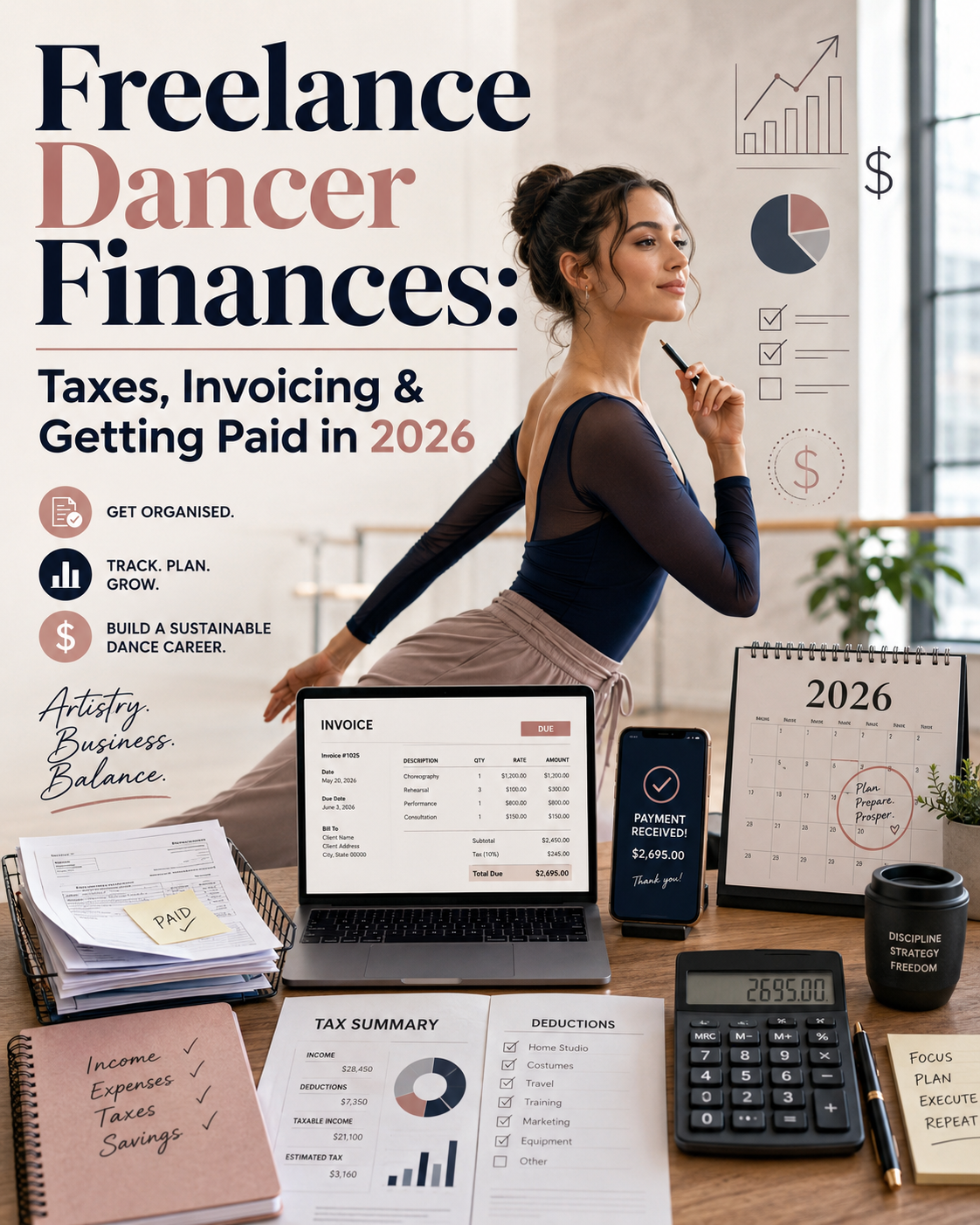
You can nail every count, master every style, and still lose money on the business of dance. Most dancers are never taught how freelance dancer taxes work, how to write an invoice that gets paid, or how to keep enough back so April does not become a crisis. The result is talented artists who book the work but never build the wealth. This guide fixes that — in plain language, with current 2026 figures, so you can keep more of what you earn and sleep better doing it.
When you dance for pay without taxes withheld — teaching, gigging, choreographing, creating content — the IRS treats you as self-employed. That means more freedom, more deductions, and more responsibility. Master these basics and the money side becomes one more thing you own with confidence. (This article is general educational guidance, not personalized tax or legal advice — consult a qualified professional for your specific situation.)
Step One: Separate Your Money
Before taxes, before invoices, before anything: separate your business money from your personal money. Open a dedicated business checking account and route every payment from teaching, gigs, and choreography through it. This single habit makes bookkeeping clean, makes deductions easy to prove, and keeps you from accidentally spending money that belongs to the IRS. A good rule is to move a percentage of every payment — many freelancers set aside roughly 25 to 30 percent — into a separate savings account the moment it lands, so tax money is never in play.
Understanding Self-Employment Tax
As a freelancer, you pay self-employment tax on top of regular income tax. For 2026, that rate is 15.3 percent — 12.4 percent for Social Security and 2.9 percent for Medicare — applied to about 92.35 percent of your net self-employment earnings. A W-2 employee splits this cost with an employer; as your own boss, you cover the full amount. You generally owe self-employment tax once your net earnings from dance work reach $400 or more in a year.
The good news: you can deduct half of your self-employment tax when calculating your adjusted gross income, which softens the blow. Knowing this number exists — and budgeting for it — is what separates dancers who get blindsided in April from those who are simply ready.
Quarterly Estimated Taxes: Pay as You Go
Because no employer withholds taxes for you, the IRS expects you to pay throughout the year in four installments — estimated quarterly taxes. If you expect to owe $1,000 or more in federal tax for the year, you are generally required to make these payments to avoid underpayment penalties. You estimate and pay using Form 1040-ES.
The 2026 Quarterly Deadlines
Estimated payments are typically due around April 15, June 15, September 15, and January 15 of the following year. If a date falls on a weekend or federal holiday, the deadline shifts to the next business day. Mark these on your calendar the same way you would a rehearsal you cannot miss — because missing them costs real money.
Quick Tax Facts for Dancers (2026)
Self-employment tax rate: 15.3% (12.4% Social Security + 2.9% Medicare).
You owe SE tax at: $400+ in net self-employment earnings.
Set aside: roughly 25–30% of income for taxes.
Quarterly due dates: Apr 15, Jun 15, Sep 15, Jan 15.
2026 standard mileage rate: $0.725 per business mile.
Deductions Dancers Routinely Miss
Every legitimate business expense you track lowers your taxable income. Dancers leave money on the table simply because they do not save receipts. Report your income and expenses on Schedule C, and keep records for everything. Commonly overlooked deductions include:
- Mileage and travel — driving between studios, gigs, and auditions, plus airfare and lodging for work travel (the 2026 standard mileage rate is $0.725 per business mile).
- Training and education — classes, workshops, conventions, and coaching that maintain or improve your craft.
- Equipment and wardrobe — gear, shoes, and performance wardrobe used specifically for work.
- Home studio or office — a portion of rent and utilities for a space used regularly and exclusively for your business.
- Software and subscriptions — editing tools, music licensing, scheduling, and bookkeeping apps.
- Health insurance premiums — often fully deductible for the self-employed.
- Professional services — what you pay an accountant, bookkeeper, or attorney.
The 1099-NEC and What Changed for 2026
When a client pays you as an independent contractor, they may issue a Form 1099-NEC reporting what they paid. For income earned starting in 2026, the reporting threshold rose from $600 to $2,000 — meaning clients are required to send a 1099-NEC only once they pay you $2,000 or more in the year. Here is the part dancers must not miss: you owe tax on all your income whether or not you receive a 1099. A missing form is not a free pass. Track every payment yourself, and your records will always tell the true story.
How to Invoice Like a Professional
A clean invoice is the difference between getting paid on time and chasing money for months. It also signals that you run a real business worth respecting. Every invoice you send should include:
- Your name or business name, contact details, and a unique invoice number.
- The client's name and contact information.
- The invoice date and a clear description of services (e.g., "Choreography for music video, 2 sessions").
- The amount due, broken down if there are multiple line items.
- Payment terms — when payment is due (Net 15 or Net 30 are common) and accepted payment methods.
- A late-payment policy, if you use one, stated up front.
Getting Paid on Time
Agree on the fee and payment terms in writing before the work begins — ideally in a short contract. Send your invoice promptly when the work is done, not weeks later. For larger projects, request a deposit up front. And follow up without apology: a polite, professional reminder a few days after the due date is simply good business. Knowing your rates and protecting your income is part of the same entrepreneurial skill set we explore in our companion guide, Dance Business & Entrepreneurship: How to Build a Career That Outlasts the Spotlight.
Pay Yourself First and Build for the Future
Freelance income rises and falls, so financial stability comes from systems, not luck. Build a cushion that can cover several months of expenses for the slow seasons every dancer knows. Once your tax savings and emergency fund are in place, look ahead: self-employed dancers can open retirement accounts and invest in their future selves with the same discipline they bring to training. Wealth, like artistry, is built one consistent rep at a time.
At Dance Mogul Magazine, we believe financial literacy is empowerment. When you understand your money, you can say no to exploitative gigs, invest in your craft, and build a career that supports the life and legacy you want. That is what owning your art truly looks like.
Resources & Further Reading
From Dance Mogul Magazine:
- Dance Business & Entrepreneurship: Build a Career That Lasts
- Dance Mogul Magazine Workbooks & Goal-Setting Tools
- The Dance Mogul Magazine Store & Publications
Trusted external resources:
- IRS Self-Employed Individuals Tax Center
- IRS Estimated Taxes (Form 1040-ES)
- U.S. Small Business Administration — Manage Your Finances
The Dance Mogul Mission
Dance Mogul Magazine exists to inspire self-empowerment, celebrate cultural excellence, and equip the global dance community with the tools to build lasting legacies. Financial literacy is part of that empowerment — because when you own your money, you own your future. Explore our workbooks and keep building.