
Dance Director Spotlight
Megan Thee Stallion's Dance Director: How JaQuel Knight Became the Most Important Choreographer in Hip-Hop
He created the choreography for Single Ladies at nineteen. He built the movement language for WAP and Body. He choreographed Megan Thee Stallion's historic Coachella 2025 performance. And he became the first commercial choreographer to copyright his work.
By Dance Mogul Magazine | Dance Director Spotlight
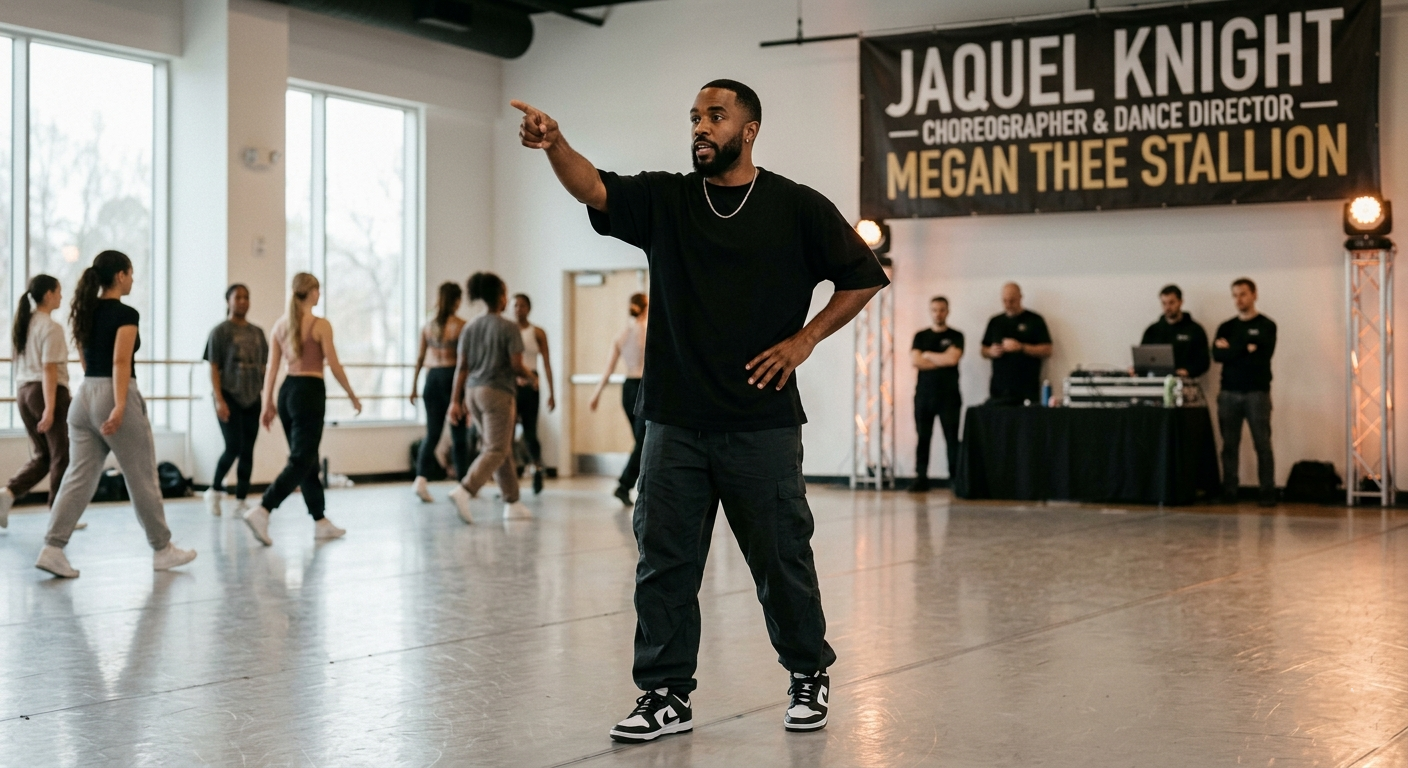
Who Is JaQuel Knight?
There are choreographers who create routines. And there are choreographers who create cultural moments. JaQuel Knight is the latter. Born on August 6, 1989, in North Carolina and raised in Atlanta, Georgia, Knight has spent the past seventeen years defining how the biggest stars in music move on stage, on screen, and in the collective imagination of a global audience. He is the man behind the "Single Ladies" routine — arguably the most iconic pop choreography of the twenty-first century. He is the creative force behind Megan Thee Stallion's visual identity as a live performer. He co-choreographed the Jennifer Lopez and Shakira Super Bowl LIV Halftime Show. And in 2020, he became the first commercial choreographer in pop music history to copyright his work — a move that is reshaping the legal and economic landscape for dance artists everywhere.
His partnership with Megan Thee Stallion represents one of the most significant artist-choreographer relationships in contemporary hip-hop. It is a collaboration that has produced some of the most-viewed dance content of the decade, powered a sold-out global tour, and delivered a 2025 Coachella performance that brought together generations of female hip-hop excellence on a single stage. Understanding JaQuel Knight is understanding the engine behind Megan's movement — and the future of choreographic artistry in the streaming age.
From Atlanta Marching Bands to Hollywood
Knight's origin story is deeply rooted in Black Southern culture. He grew up imitating choreography from MTV and BET music videos, absorbing the rhythmic language of TLC, MC Hammer, and the performance traditions of Atlanta's entertainment ecosystem. He took his first formal dance class at fourteen — an experience he has described as life-changing. Before that, his movement education came from the marching band at Tucker High School, where he played saxophone for seven years and simultaneously choreographed the band's routines. It was in that context — the precision of marching formations, the call-and-response energy of HBCU-influenced performance culture — that Knight first understood what choreography could do to an audience.
After high school, he started a dance group called TruStuylz, which performed at local talent shows and celebrity basketball games in Atlanta. One of those performances — dancing to "Walk It Out" at the BET Hip Hop Awards — caught industry attention. Knight moved to Los Angeles at eighteen, enrolled at Woodbury University (graduating in 2011 with a bachelor's degree), and almost immediately found himself in rooms that would change his life.
Choreographer Frank Gatson Jr. — Beyoncé's longtime creative collaborator — spotted Knight at an audition for a Michelle Williams video. Knight did not land the dancer role, but Gatson saw something in his freestyle: a house-meets-retro-meets-country sensibility that felt completely original. Gatson asked him to create a few counts of choreography, liked what he saw, and brought him on as a co-choreographer. The project that followed was "Single Ladies (Put a Ring on It)." Knight was nineteen years old.
“There's a part where you clap your hands and your arms go around your head, and you kind of stick your butt out like your grandmother would do when her favorite part of her favorite song would come on. That feeling is my grandmother all day.”
The Beyoncé Years: Building the Foundation
The "Single Ladies" video won Best Choreography at the 2009 MTV Video Music Awards and became one of the most imitated routines in history. From that moment, Knight became Beyoncé's go-to choreographer — a role that would define the first decade of his career and establish him as one of the most trusted movement architects in the music industry. He choreographed her I Am…World Tour, contributed to the self-titled visual album, created the formation work for Lemonade, shaped both Super Bowl performances, and served as a key creative force behind Homecoming — the 2018 Coachella performance that is widely regarded as one of the greatest live shows ever staged.
Along the way, he also choreographed for Britney Spears' Circus World Tour, served as associate choreographer for the film Burlesque, and worked with artists including Chris Brown, Kelly Rowland, Nicole Scherzinger, Tinashe, and Brandy. He earned a second MTV Award for "Formation" in 2016 and built a commercial portfolio that included campaigns for Maybelline, Pepsi, and Mattel. But it was his partnership with a rising rapper from Houston that would open the next chapter.
The Megan Thee Stallion Partnership
JaQuel Knight's collaboration with Megan Thee Stallion represents something rare in the relationship between hip-hop artists and choreographers: a true creative partnership where the choreographer functions not as a hired technician but as an equal creative voice. Knight serves as both choreographer and creative director for Megan — meaning he does not simply create steps but designs the entire visual and performative architecture of her live shows, music videos, and major event appearances.
The partnership has produced landmark moments. Knight's choreography for the "Body" music video in 2020 became an instant viral sensation, with the routine spreading across social media and becoming one of the most-recreated dances of the year. His work on the "WAP" video with Cardi B — a cultural event that dominated the summer of 2020 — demonstrated his ability to choreograph routines that were simultaneously provocative, precise, and deeply rooted in Black dance traditions. He choreographed Megan's virtual BET Awards performance, her Saturday Night Live appearance (which combined music with the message to "Protect Black Women"), and her "Cry Baby" video.
In 2024, Knight served as the choreographic and creative backbone of Megan's Hot Girl Summer Tour — her first headlining concert tour, which spanned 36 shows across North America and Europe, sold out seventeen of its initial thirty-four dates within hours, and established Megan as an arena-level live act. The tour, supported by GloRilla as an opening act, featured elaborate production design from The Playground Design Collective and showcased the kind of precision choreography that has become Megan's signature under Knight's direction.
Coachella 2025: A Generational Statement
On April 13, 2025, Megan Thee Stallion performed at Coachella in a set that JaQuel Knight had been designing for months. The performance was, by any measure, one of the defining live moments of the year. Megan opened with "Ungrateful" and "Thot Shit," flanked by dancers in leather jackets and cowboy hats — a nod to her Houston roots. The set featured guest appearances from Queen Latifah (who performed "U.N.I.T.Y." alongside Megan), Victoria Monét (who joined for "Spin" and "On My Mama"), and Ciara (who matched Megan step for step on "Roc Steady" and "Goodies"). Spiritbox's Courtney LaPlante also appeared for the genre-blending collaboration "TYG."
Knight's choreographic vision for the set was ambitious and purposeful. The show was designed as a celebration of women in hip-hop across generations, with each guest appearance building toward a cumulative statement about lineage, power, and sisterhood. The dancers executed precision movements that complemented rather than overshadowed Megan's own considerable dance abilities. Multiple costume changes — including a dramatic fur coat removal — created visual punctuation points that Knight had mapped into the choreographic structure.
Even when the performance was disrupted by technical difficulties — the microphone cutting out during "Mamushi" near the end of the set — Megan and her dance team continued performing the choreography in silence, a moment that epitomized the show-must-go-on professionalism that Knight instills in every production. As Billboard reported in a behind-the-scenes feature, Knight described the preparation process as beginning with a simple question: "What do you want to say?"
“Choreography isn't only about 'move, move, move' and '5, 6, 7, 8.' It's about the stillness and the power that one holds being still, standing strong, being present.”
Copyrighting Choreography: The Revolution That Knight Started
Perhaps JaQuel Knight's most consequential contribution to the dance industry has nothing to do with any specific routine. In 2020, Knight became the first commercial choreographer in pop music to successfully copyright his work — registering the "Single Ladies" choreography with the U.S. Copyright Office, a 40-page notation that documented every movement from beginning to end. The registration was approved on July 9, 2020, and Knight immediately began the process of copyrighting his entire catalog, including the choreography for "WAP."
In 2021, he launched Knight Choreography and Music Publishing Inc. — a company designed to provide the infrastructure, legal resources, and institutional support that choreographers need to protect their intellectual property. He partnered with Logitech to help ten BIPOC choreographers copyright their viral dances, including Keara Wilson's choreography for Megan Thee Stallion's "Savage" and Mya Johnson and Chris Cotter's "Up" dance. The initiative was launched in the wake of the #BlackTikTokStrike, which saw Black creators protesting the widespread use of their dances by others without credit or compensation.
Knight's advocacy has expanded into broader industry reform. He has supported the Choreographers Alliance — later incorporated into the Choreographers Guild — in efforts to standardize contracts and protections for dance professionals. His argument is as simple as it is powerful: if songwriters can copyright melodies, and photographers can copyright images, then choreographers should be able to copyright movement. As Knight told NPR: "It's about protecting the creator from these huge corporations that come in and take advantage." The implications of this work extend to every dancer who has ever had their choreography used without credit — and it connects directly to the evolving conversation around copyright and choreography that Dance Mogul Magazine has been tracking.
JaQuel Knight — Career Timeline
1989 — Born in North Carolina; raised in Atlanta, Georgia
2003 — Takes first formal dance class at age 14
2008 — Scouted by Frank Gatson Jr.; co-choreographs "Single Ladies" at age 19
2009 — Wins MTV VMA Best Choreography; joins Beyoncé's I Am…World Tour; choreographs Britney Spears' Circus Tour
2010 — Associate choreographer on film Burlesque
2013 — Launches production company in Los Angeles
2016 — MTV VMA for "Formation" choreography
2017 — Named Forbes 30 Under 30 for Music
2018 — Choreographs Beyoncé's Homecoming (Coachella)
2020 — Super Bowl LIV Halftime (J-Lo & Shakira); "WAP" and "Body" videos; first choreographer to copyright work; launches JaQuel Knight Foundation
2021 — Launches Knight Choreography & Music Publishing Inc.; Logitech partnership
2024 — Choreographs Megan Thee Stallion's Hot Girl Summer Tour (36 shows); directs Chris Stapleton video
2025 — Choreographs Megan's Coachella set; choreography for The Wiz national tour
Why JaQuel Knight's Work Matters Beyond Entertainment
Knight's legacy is not defined by any single performance or any single artist. It is defined by what he has done for the profession itself. He has demonstrated that a Black choreographer from Atlanta — who learned to dance by watching music videos and choreographing marching band formations — can reach the highest levels of the entertainment industry and then use that platform to restructure the economic and legal foundations beneath it. He teaches at Broadway Dance Center. He founded the JaQuel Knight Foundation to provide financial relief to dancers in crisis. He has spoken publicly about the pay disparities between Black and white artists in the commercial dance world, noting that his day rate for Britney Spears was nearly his weekly rate for Beyoncé early in his career — and that neither rate was adequate.
For the global dance community that Dance Mogul Magazine serves, Knight represents the convergence of artistry and advocacy — the understanding that creating beautiful work is not enough if the systems around that work remain broken. His partnership with Megan Thee Stallion has given him one of the largest platforms in the industry, and he has used it not just to create movement but to move the industry itself.
That is the definition of a dance mogul.
Read more profiles: Chris Brown's Choreographers Spotlight | Keone & Mari Madrid: Storytellers Who Changed Choreography Forever
Dance Mogul Magazine • Inspiring Self-Empowerment • dancemogul.com