
Industry Guide · Inclusive Dance
Adaptive Dance Is Not a Side Program: How Disability-Inclusive Dance Is Changing the Future of Movement
Dance was never meant for one type of body. A Dance Mogul Magazine guide to access, artistry, adaptive training, and the power of inclusive movement.
By Dance Mogul Magazine | Industry Guide
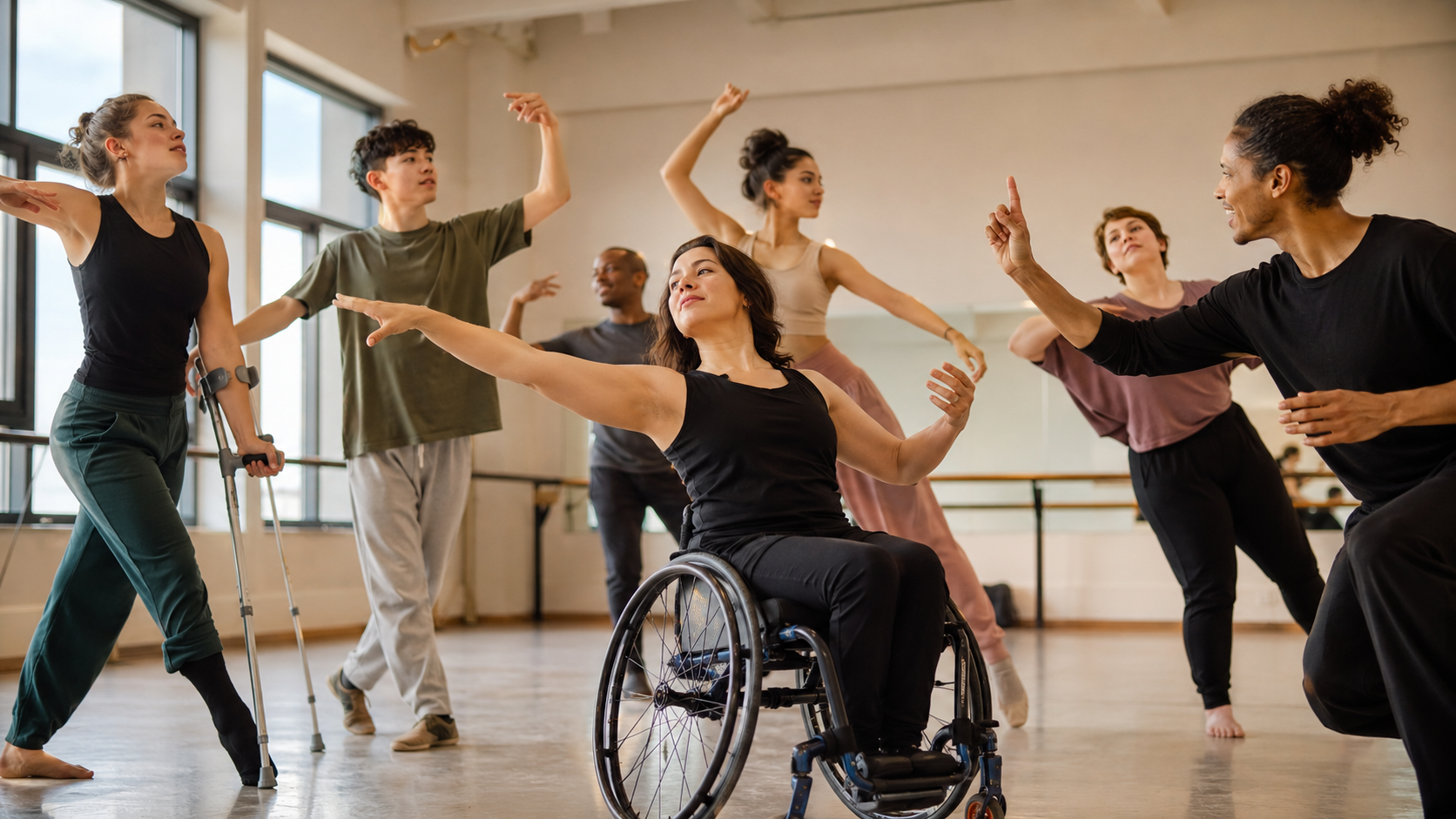
Dance Was Never Meant for One Type of Body
Dance has always been bigger than perfect lines, flexible backs, high jumps, or traditional stage standards. At its deepest level, dance is communication. It is identity. It is rhythm moving through a body and telling the world, “I am here.”
That truth matters more than ever as adaptive dance and disability-inclusive dance continue to grow. Across studios, schools, community programs, and professional stages, dancers with disabilities are challenging outdated ideas about who belongs in dance. They are reminding the industry that movement does not become less powerful because it is seated, supported, assisted, modified, interpreted, or expressed differently.
Adaptive dance is not a watered-down version of dance. It is not a side program. It is not charity. It is dance education, dance artistry, and dance culture expanding to include more of humanity.
What Is Adaptive Dance?
Adaptive dance is dance instruction or choreography designed to meet the needs of dancers with physical, intellectual, developmental, sensory, emotional, or health-related differences. It may include wheelchair users, dancers with autism, dancers with cerebral palsy, dancers with Down syndrome, visually impaired dancers, Deaf or hard-of-hearing dancers, dancers with chronic illness, and dancers with many other lived experiences.
Adaptive dance can include ballet, hip hop, modern, jazz, tap, ballroom, creative movement, cultural dance, improvisation, and performance-based training. The dance style does not have to disappear. The teaching approach becomes more flexible.
That may mean using seated movement, mobility aids, visual cues, sensory-friendly sound levels, flexible pacing, partner support, simplified transitions, verbal descriptions, tactile guidance, or choreography that honors each dancer's natural movement vocabulary.
Disability-Inclusive Dance Goes Beyond Accommodation
There is a difference between allowing a disabled dancer into a class and truly building an inclusive dance environment.
Accommodation says: "You can join, and we will adjust something for you."
Inclusion says: "You belong here from the beginning, and this space was built with you in mind."
A truly disability-inclusive dance space does not treat disabled dancers as exceptions. It considers accessibility before registration opens. It trains teachers before students arrive. It thinks about entrances, bathrooms, studio flooring, class length, sound levels, communication styles, choreography, recital expectations, costume needs, and emotional safety.
Inclusion also means representation. Students need to see disabled dancers not only as participants, but as leaders, teachers, choreographers, performers, and artistic voices.
Why Adaptive Dance Matters Now
Adaptive dance matters because people with disabilities have always existed in our communities, but many dance systems were not built with them in mind. According to the CDC, more than 1 in 4 adults in the United States have some type of disability. That means accessibility is not a small issue on the edge of the dance world. It is part of the community dance is supposed to serve.
A dancer may love music but avoid class because the studio has stairs. A child may have rhythm but struggle with loud environments. A teenager may want to perform but need movement modifications. An adult may use a wheelchair and assume ballet is no longer available to them. A senior may want to reconnect with movement but fear being judged.
Adaptive dance changes the answer from “You cannot” to “Let’s discover how.”
The Artistic Power of Different Bodies
One of the biggest misconceptions about adaptive dance is that modification weakens the art. In reality, adaptation can deepen it.
A wheelchair turn can carry the same musicality and drama as a pirouette. A hand gesture can hold the emotional weight of a leap. A dancer using a walker can create lines, rhythm, timing, and presence. A dancer who processes movement differently may offer unexpected phrasing that changes the entire feeling of a piece.
Different bodies create different movement possibilities. That is not a limitation. That is choreography.
What Studios Should Understand
Studios that want to offer disability-inclusive dance must go beyond good intentions. Inclusion requires planning, humility, and education.
The first step is listening. Families, dancers, caregivers, disability advocates, and adaptive dance educators can offer insight that studio owners may not have. The second step is teacher training. Instructors do not need to know everything, but they do need to be open, prepared, patient, and respectful.
A strong inclusive class should have structure without rigidity. It should have goals without pressure. It should give dancers the dignity of real dance education, not just entertainment or babysitting. Students deserve technique, creativity, corrections, encouragement, and performance opportunities when appropriate.
Inclusive Studio Checklist
1. Review entrances, bathrooms, waiting areas, parking, and studio flooring for accessibility.
2. Train teachers in adaptive movement, respectful language, and flexible class structure.
3. Offer seated, standing, assisted, and low-impact options without separating dancers unnecessarily.
4. Ask dancers and families what support helps instead of assuming every disability is the same.
5. Include disabled dancers in performances, photos, promotional materials, leadership, and choreography conversations.
What Teachers Can Do Immediately
Dance teachers can begin building more inclusive habits before launching a full adaptive program.
They can offer multiple ways to perform a movement. They can demonstrate standing and seated versions. They can use clearer verbal directions. They can reduce unnecessary sensory overload. They can give dancers more time to process instructions. They can ask respectful questions instead of making assumptions.
Teachers can also shift their language. Instead of saying, “Do it exactly like me,” they can say, “Find how this movement lives in your body.” Instead of focusing only on what a student cannot do, teachers can build from what the student can do.
This does not lower standards. It creates a better pathway toward growth.
Adaptive Dance and Mental Health
Dance can support confidence, connection, emotional release, and self-expression. For disabled dancers, those benefits can be especially meaningful because many have experienced exclusion, medical pressure, social misunderstanding, or limited access to recreational and artistic spaces.
A supportive dance environment can help a student feel seen beyond a diagnosis. It can give them a community where their body is not treated as a problem to fix, but as an instrument of expression. It can create moments of independence, joy, courage, and belonging.
This does not mean dance replaces medical care, therapy, or specialized support. It means dance can become part of a fuller life.
The Role of Parents and Caregivers
Parents and caregivers are often the bridge between dancers and access. They know what environments help their child thrive. They know what triggers stress. They know what communication style works. They know when a dancer needs support and when a dancer needs independence.
Studios should treat parents and caregivers as partners, not obstacles. At the same time, disabled dancers should be given as much voice and choice as possible. A dancer's preferences matter. Their comfort matters. Their goals matter. Inclusion should not only be designed around them; it should be designed with them.
Representation Matters
When disabled dancers are visible, other dancers begin to imagine new possibilities.
A young wheelchair user seeing wheelchair ballet may realize dance is still available to them. A child with autism watching another neurodivergent dancer perform may feel less alone. A studio owner seeing an adaptive class succeed may decide to open their doors wider.
Representation does not solve every access issue, but it changes what people believe is possible. The dance world needs more disabled dancers in promotional materials, class videos, auditions, teaching roles, magazine features, interviews, choreography credits, and leadership positions. Not as symbols. As artists.
The Business Case for Inclusive Dance
Disability-inclusive dance is not only morally right; it is also a smart community and business decision.
Studios are always looking for ways to grow enrollment, serve families, build stronger community relationships, and stand out. Adaptive dance can help a studio reach students who are often overlooked. It can also attract partnerships with schools, therapy centers, disability organizations, senior programs, recreation departments, and community agencies.
But the program must be real. Families can tell the difference between genuine inclusion and marketing language. A strong adaptive dance program can become one of a studio's most meaningful offerings when it is built with care, consistency, and respect.
Common Mistakes to Avoid
- Assuming adaptive dance is only for children. Adults, seniors, and professional artists also need access.
- Assuming every disabled dancer wants a separate class. Some dancers may benefit from specialized adaptive classes, while others may thrive in integrated classes with support.
- Using inspiration language too heavily. Disabled dancers do not exist to make others feel grateful. Their work should be respected as dance.
- Failing to train teachers properly. A kind teacher is important, but kindness alone is not enough. Teachers need tools.
- Making the class too easy. Accessibility does not mean removing depth. Disabled dancers deserve challenge, artistry, and growth.
The Future of Dance Is Inclusive
The future of dance will not be defined only by technology, viral trends, or major stages. It will also be defined by access.
Who gets to train? Who gets to perform? Who gets to be seen? Who gets to call themselves a dancer?
Adaptive dance answers those questions with a wider vision. It tells the industry that movement belongs to more people than tradition has allowed. It reminds us that the body does not need to look one way to carry rhythm, power, and story.
Dance becomes stronger when more people can enter the circle. Disability-inclusive dance is not a trend. It is a correction. It is a return to the truth that movement is a human birthright.
FAQ: Adaptive Dance and Disability-Inclusive Dance
What is adaptive dance?
Adaptive dance is dance instruction or choreography modified to support dancers with physical, intellectual, developmental, sensory, emotional, or health-related differences.
Is adaptive dance only for wheelchair users?
No. Adaptive dance can support wheelchair users, autistic dancers, dancers with cerebral palsy, Deaf dancers, visually impaired dancers, dancers with chronic illness, seniors, and many others.
Is adaptive dance real dance training?
Yes. Adaptive dance can include technique, musicality, creativity, performance, choreography, conditioning, and artistic development. It should not be treated as less serious than traditional dance education.
Can disabled dancers perform professionally?
Yes. Disabled dancers can and do perform professionally. The industry still needs more access, representation, casting opportunities, training pathways, and leadership roles for disabled artists.
How can a studio start an inclusive dance program?
A studio can start by learning from disabled dancers, families, caregivers, adaptive dance educators, and accessibility experts. It should review the physical space, train teachers, offer flexible teaching methods, and create a respectful environment where dancers are supported without being underestimated.
Resources & Further Reading
From Dance Mogul Magazine:
- Dance & Mental Health: The Healing Power and the Hidden Pressures
- Dance Studio Business Operations: How to Run a Studio That Thrives
- Adult Beginner Dance: How to Start When You Think You Have No Rhythm
- Freelance Dancer Finances: Taxes, Invoicing & Getting Paid
- Dance Grants & Funding: How to Fund Your Work
Related subject topics for SEO:
Trusted external resources:
- CDC — Disability Impacts All of Us
- People — Wheelchair Ballet and Inclusive Ballet Demand
- Community-Informed Recommendations for Inclusive Dance
- Dance Interventions and Psychological/Cognitive Health Outcomes
The Dance Mogul Mission
Dance Mogul Magazine exists to inspire self-empowerment, celebrate cultural excellence, and equip the global dance community with the tools to build lasting legacies. We don't just cover the culture — we invest in the people who move it forward. Explore our resources and keep building.