
Beginner Guide · Dance Education
Adult Beginner Dance: How to Start When You Think You Have No Rhythm
You are not too old, too stiff, too late, or too awkward. A Dance Mogul Magazine guide for adults who want to begin again through movement.
By Dance Mogul Magazine | Beginner Guide
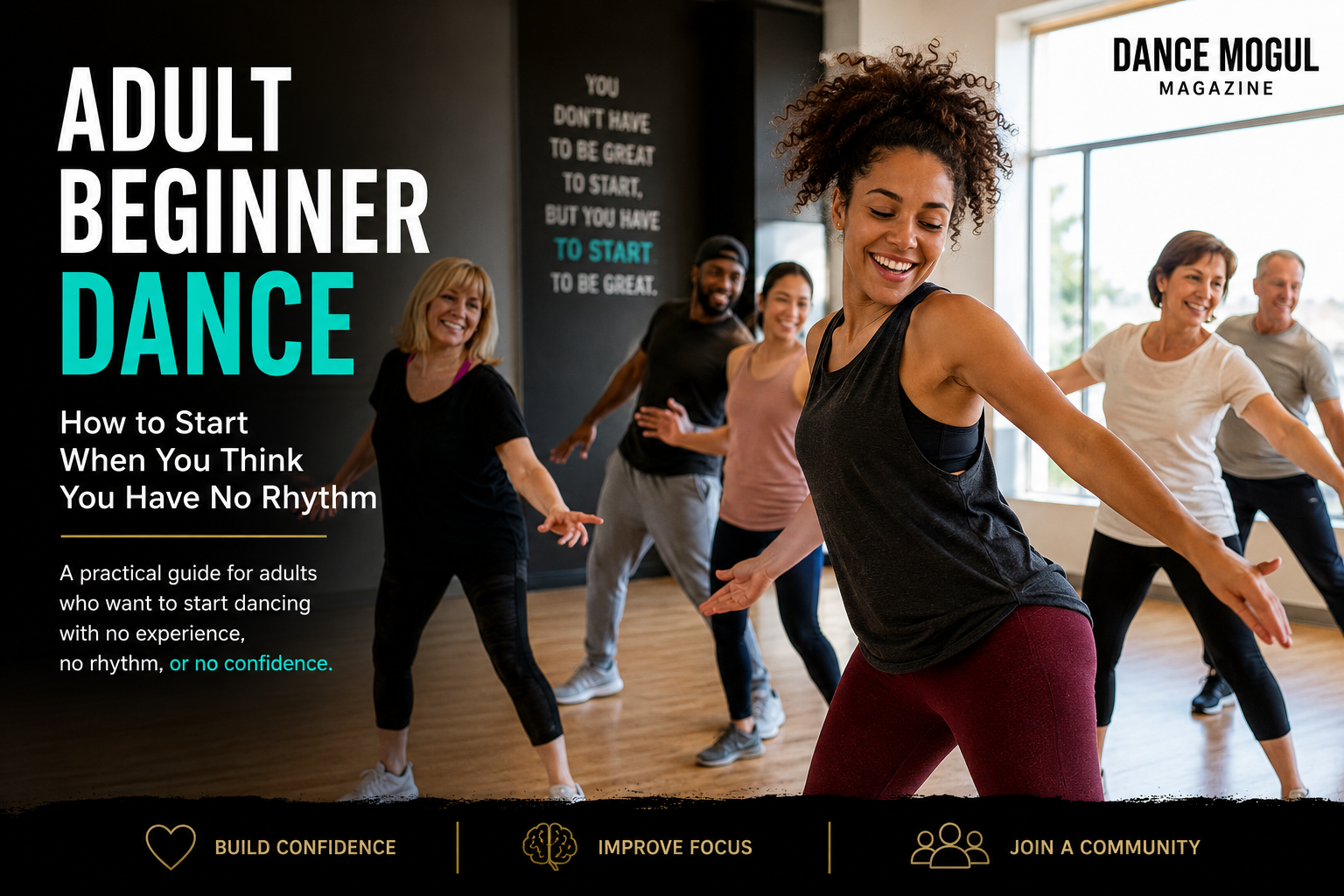
It Is Not Too Late to Start Dancing
Many adults want to dance, but they stop themselves before they ever step into a studio. They say, “I have no rhythm.” They say, “I am too stiff.” They say, “Everyone else already knows what they are doing.” They say, “I should have started when I was younger.”
The truth is simpler and more powerful: you can start now. Adult beginner dance is not about catching up to someone else’s timeline. It is about meeting your body where it is and giving yourself permission to learn.
Dance does not belong only to people who trained as children. It does not belong only to flexible bodies, professional performers, or people who naturally hear every beat. Dance belongs to anyone willing to move, listen, practice, and grow.
Why Adults Feel Nervous About Starting Dance
Adults often carry a different kind of fear than children. A child may walk into class with curiosity. An adult walks in with memories, self-judgment, body awareness, comparison, and the pressure to already be good.
That pressure can make the first class feel bigger than it really is. You may worry about being watched. You may fear turning the wrong way. You may feel embarrassed by stiffness, weight, age, coordination, or a lack of musical timing. None of that means you cannot dance. It means you are a beginner.
Being a beginner is not a weakness. It is the entrance point.
What Does Adult Beginner Dance Actually Mean?
Adult beginner dance means dance training designed for adults who are new, returning after years away, or starting a style they have never studied before. It should be slower, clearer, and more supportive than an open-level class.
A true beginner class should teach foundations: posture, rhythm, musical counts, direction changes, basic footwork, body awareness, and how to remember combinations. It should not assume that everyone already knows studio language. It should not rush through basics just to make the class look impressive.
If a class says “beginner” but moves too fast, that does not mean you failed. It may mean the class is not truly built for absolute beginners.
Look for These Class Labels
Best for first-timers: Absolute Beginner, Intro, Beginner Foundations, Fundamentals, Basics, Level 0, No Experience Required.
Use caution: Beginner/Intermediate, Open Level, All Levels, Choreography Class, Advanced Beginner.
A class can be welcoming and still move too quickly for a brand-new dancer. Start where the basics are taught clearly.
What If You Have No Rhythm?
Most people who say they have no rhythm are really saying they have not learned how to listen with their body yet. Rhythm is a skill. It can be trained.
Start by finding the steady pulse in a song. Do not worry about choreography yet. Tap your foot. Nod your head. Clap on the beat. Walk to the beat. Once your body can feel the timing, add simple movement.
The goal is not to become perfect overnight. The goal is to stop treating rhythm like magic and start treating it like practice.
The Best Dance Styles for Adult Beginners
There is no single best style for every beginner. The right style depends on your goals, personality, body, music taste, and comfort level.
- Hip hop foundations are great for musicality, confidence, groove, and social energy.
- Ballet basics can help with posture, alignment, balance, discipline, and body control.
- Jazz can help with coordination, performance quality, rhythm, and strength.
- Contemporary or modern can help with expression, fluidity, floorwork, and emotional release.
- Tap can help you understand rhythm because your feet become instruments.
- Ballroom, salsa, or social dance can help with partner connection, timing, and confidence in social settings.
- Dance fitness can be a low-pressure entry point if you want movement, sweat, and fun before technique.
Choose the style that makes you want to return. Consistency matters more than choosing the “perfect” first class.
What to Expect in Your First Dance Class
Your first class is not a test. It is an introduction. You may not remember every step. You may turn the wrong direction. You may feel awkward in the mirror. That is normal.
Most adult beginner classes include a warm-up, basic technique or rhythm exercises, short combinations, and a cool down. The teacher may break down counts, demonstrate slowly, and repeat movements several times. If the class is well designed, you should feel challenged but not humiliated.
Wear comfortable clothes you can move in. Bring water. Arrive early. Stand where you can see the teacher. Let the instructor know you are brand new. A good teacher will respect that.
How to Practice Without Feeling Overwhelmed
Adult beginners often try to learn too much at once. They want to fix the arms, feet, rhythm, posture, memory, style, and confidence all in the same moment. That is too much pressure.
Practice in layers. First, learn the foot pattern. Then add the arms. Then listen for the rhythm. Then add performance quality. Breaking movement into layers helps your brain and body work together instead of fighting each other.
Your First 30 Days as an Adult Beginner Dancer
Week 1: Take one class or follow one beginner tutorial. Focus only on showing up.
Week 2: Practice finding the beat in three songs. Tap, walk, or clap with the music.
Week 3: Repeat one short combination until it feels familiar, not perfect.
Week 4: Record yourself privately once. Watch for progress, not flaws.
The first goal is not mastery. The first goal is building a relationship with movement.
Body Confidence Comes From Repetition
Many adults avoid dance because they feel disconnected from their bodies. They do not like how they look in the mirror. They feel stiff, heavy, uncoordinated, or exposed. Dance can bring those feelings to the surface, but it can also help transform them.
Confidence does not come from pretending insecurity is gone. Confidence comes from returning to the work anyway. Every class gives your body new information. Every repetition teaches your nervous system that movement is safe. Every small improvement builds trust.
You do not need to love every part of your body to begin dancing. You can begin by respecting your body enough to let it move.
Online Classes vs. In-Person Classes
Online classes are useful because they let you practice privately, pause, repeat, slow down, and build confidence before entering a studio. They are especially helpful if you are nervous, live far from classes, or want to review basics at your own pace.
In-person classes offer feedback, community, energy, correction, and accountability. You learn how to move with other people in real space. You also learn that most people are too focused on their own progress to judge yours.
The best path may be both: use online practice for repetition and in-person classes for growth.
Common Adult Beginner Mistakes
- Starting too advanced. Choose foundations before choreography-heavy classes.
- Comparing yourself to trained dancers. Their chapter ten should not shame your chapter one.
- Expecting rhythm immediately. Timing improves through repetition.
- Quitting after one uncomfortable class. The first class often feels awkward because everything is new.
- Practicing only full routines. Basics build the body control that makes routines easier.
- Letting the mirror become the enemy. Use the mirror as information, not punishment.
Dance Is More Than a Skill
For adults, dance is not only about learning steps. It can support physical function, balance, coordination, memory, motivation, social connection, and emotional release. A 2024 review of dance interventions reported that most included studies showed improvements in physical function, balance, postural control, and quality of life. Another 2024 review found preliminary evidence that dance may improve motivation, aspects of memory, social cognition, and distress when compared with other physical activity interventions.
That matters because many adults are not only looking for a hobby. They are looking for a way back into their bodies. They are looking for joy, confidence, expression, community, and movement that does not feel like punishment.
Dance can become that doorway.
Modify Without Shame
Adult beginners come with different bodies, histories, injuries, energy levels, and mobility needs. Modification is not failure. It is smart training.
If jumping hurts, step instead. If turning makes you dizzy, mark the turn slowly. If floorwork is not accessible, ask for a standing version. If fast choreography overwhelms you, practice the rhythm first. A strong teacher will help you find a version that protects your body while still challenging your growth.
Your job is not to force your body into someone else’s movement. Your job is to learn how movement can live truthfully in you.
How to Know You Are Improving
Progress in dance does not always look dramatic. Sometimes it looks like remembering four counts instead of two. Sometimes it looks like hearing the beat sooner. Sometimes it looks like walking into class with less fear. Sometimes it looks like laughing when you make a mistake instead of shutting down.
Track small wins. Did you show up? Did you stay through the class? Did you ask a question? Did one movement feel better than last week? Did you practice for ten minutes at home? Those wins count.
Adult beginner dancers often underestimate the courage it takes to start. That courage is part of the training.
The Real Goal Is Freedom
The goal of adult beginner dance is not to become someone else. It is to become more connected to yourself.
Maybe you want to dance at a wedding without freezing. Maybe you want to try hip hop because the music has always moved you. Maybe you want to return to ballet after twenty years. Maybe you want to feel confident in your body again. Maybe you simply want joy.
All of those reasons are valid.
You are not too late. You are not too old. You are not too awkward. You are not disqualified because you are beginning as an adult.
The floor is still open.
FAQ: Adult Beginner Dance
Can I start dancing as an adult with no experience?
Yes. Many adults start dancing with no formal training. Look for absolute beginner, intro, or foundation-level classes that teach basic rhythm, movement, posture, and coordination.
What is the best dance style for adult beginners?
The best style depends on your goals. Hip hop foundations, ballet basics, jazz, tap, ballroom, dance fitness, and contemporary can all work for beginners when the class is taught at the right pace.
What if I have no rhythm?
Rhythm can be trained. Start by finding the steady beat in music through clapping, walking, tapping, or nodding before trying full choreography.
Am I too old to start dance classes?
No. Adults begin dance at many ages. The right class should respect your body, your pace, and your goals while still helping you grow.
Should I learn dance online or in person?
Both can help. Online classes are useful for private practice and repetition. In-person classes offer feedback, community, and real-time correction.
How long does it take to get better at dancing?
Progress depends on consistency, practice, class quality, and your starting point. Many beginners notice improvement in rhythm, memory, and confidence within a few weeks of regular practice.
Resources & Further Reading
From Dance Mogul Magazine:
- Adaptive Dance & Disability-Inclusive Dance Guide
- Dance & Mental Health: The Healing Power and the Hidden Pressures
- Dance Studio Business Operations: How to Run a Studio That Thrives
- Freelance Dancer Finances: Taxes, Invoicing & Getting Paid
- Explore the Dance Mogul Magazine Dance Styles Hub
Related subject topics for SEO:
Trusted external resources:
- Dance Interventions, Physical Function, Balance, and Quality of Life
- Dance Interventions and Psychological/Cognitive Health Outcomes
- Make it Simple, Make it Dance: Supporting Novice Dance Learning
The Dance Mogul Mission
Dance Mogul Magazine exists to inspire self-empowerment, celebrate cultural excellence, and equip the global dance community with the tools to build lasting legacies. We don't just cover the culture — we invest in the people who move it forward. Explore our resources and keep building.