
Editor’s Note: This Dance Mogul Magazine feature on Arch Contemporary Ballet and the world premiere of “Château” was originally published June 12, 2016, capturing a pivotal moment for this rising New York City contemporary ballet company. This updated archive edition revisits that conversation with context on the company’s continued artistic evolution, expanded educational reach, and ten years of persistent innovation since that premiere season. Rather than replacing the original interview, this update frames it as part of a larger story about artistic growth, mentorship, institutional resilience, and the role of independent companies in shaping contemporary ballet discourse.
ARCH CONTEMPORARY BALLET | Château: A 2016 Premiere and the Decade of Creation That Followed — Updated Archive Edition
DMM Archive Perspective: Why This 2016 Conversation Still Matters
Dance exists in the moment. A performance unfolds, the lights fade, the audience disperses, and the work continues to live through memory, documentation, review, and the artists who carry it forward. That is why interviews matter. That is why independent dance media matters. And that is why the Dance Mogul Magazine archive represents more than a collection of old event announcements. It is a living record of how contemporary dance moves through time, how artists think about their craft at specific moments, and how those moments connect to larger patterns of cultural work.
When Dance Mogul Magazine first connected with Arch Contemporary Ballet in June 2016, the company was celebrating the world premiere of “Château,” a boldly conceived work that tested the boundaries of what contemporary ballet could be. Artistic Director and choreographer Sheena Annalise had established the company just three years earlier with a clear artistic mission: to create an innovative process that deepened the connection between ballet and music through unconventional collaboration. “Château” embodied that mission. The choreography was written in silence, before the music. Female dancers partnered on pointe with one another. Live musicians shared the stage as part of the visual and spatial design, not as accompaniment relegated to a pit. One hundred yards of fabric transformed the stage into an architectural space that was simultaneously a costume, a set, and a sculptural element.
At that moment in 2016, Arch Contemporary Ballet was a young company navigating the precarious ecosystem of independent dance creation in New York City. The interview captured not just a production, but a company making choices about how to survive, how to create, and how to think about ballet in ways that challenged convention. Sheena Annalise spoke about process. The dancers spoke about inspiration and discipline. The composer, Concetta Abbate, described the unusual workflow of composing after choreography was set. The violist Kate Barmotina explained how musicians on stage became collaborators rather than accompaniment.
What was once a timely preview of an immediate performance has taken on different meaning a decade later. That 2016 moment was not the endpoint of the story—it was a marker along a longer arc. Arch Contemporary Ballet did not simply premiere “Château” and move on to the next project. The company continued. It grew. It deepened its roots in the New York dance ecosystem. It expanded its reach beyond the theater stage into schools and community spaces. It developed mentorship programs. It built infrastructure. It weathered economic uncertainty, pandemic disruptions, and shifting cultural conversations. In 2026, when readers discover this updated archive feature, they are not just reading about what happened in June 2016. They are reading about a company at a specific inflection point, a moment of artistic risk that led to sustained creative practice.
This is the value of archive journalism. It preserves not just what was said, but what those words reveal about artistic commitment, process, vision, and the unglamorous work of building something that lasts. For readers today, this 2016 interview now reads as part of a larger legacy story. The company’s continued existence, growth, and deepening impact give that original conversation new resonance.
The Original DMM Conversation: June 2016
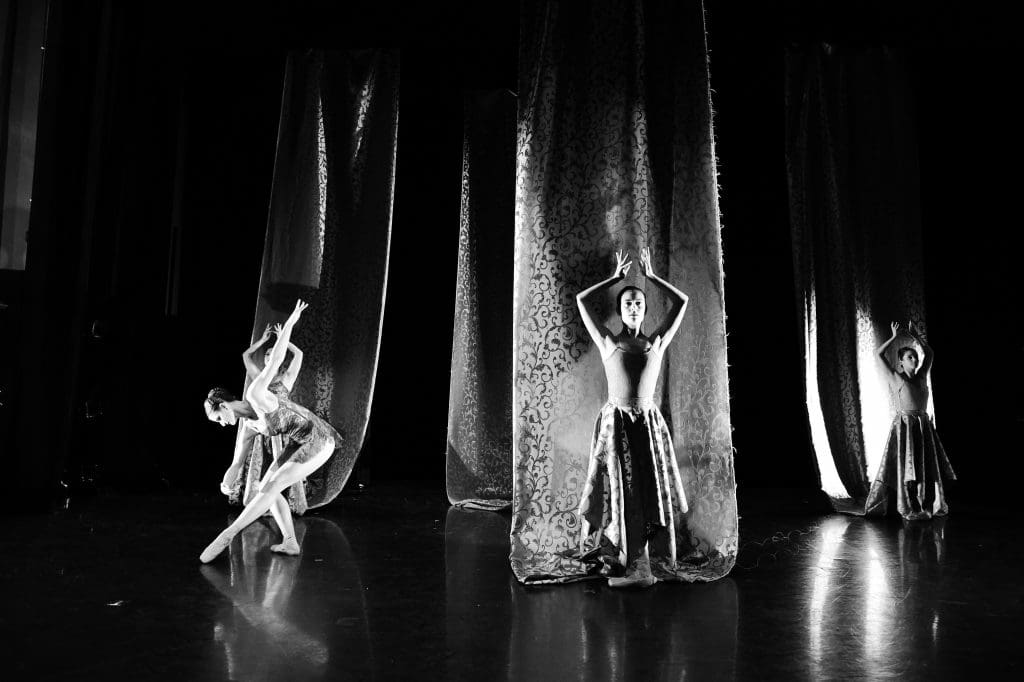
Photo by Eduardo Patino, NYC
Dance Mogul: What is the purpose of your current production?
Arch Contemporary Ballet (ACB) challenges the past and launches into the future with new pointe work, new music, and new ideas about what ballet can be. Château pays homage to French Architecture of Chateau de Fontainebleau and the historical figures that play a part in the creation of the Château. The choreography tests the framework of what a body can do, questioning classicism with partnering and pointe work, and explores the creative process by setting the dance before the music. With the Arch Sound Ensemble sharing the stage with the dancers, they are essential to the ballet’s setting, spotlighting female partnering, and forming metaphorical walls of the Château. As the movement progresses, the quartet establishes different chambers for the dancers to explore creating powerful symmetry and visual lines. Additionally, the work is embellished with lavish fabrics, draped from the rafters to the skirts of the dancers. This creates an additional dimension to the Parisian and historical backdrop layering the audience experience and the overall temperature and setting of the work. —Sheena Annalise (Artistic Director and Founder)
Dance Mogul: What are some of the behind the scenes work ethic, inspiration, and empowerment that went into production?
Arch: Behind the scenes, rehearsing begins the moment you wake up and ends right before you go to bed. This means taking time outside of set rehearsals to practice on your own and put good thought into characters, storyline, movement, spacing, timing. Etc. you don’t just pack up your bag and leave when rehearsal is over — something that I believe non-dancers are unaware of. Not only does each dancer need to constantly be thinking of the story and choreography, but each dancer needs to stay inspired. Watching my fellow Arch dancers in rehearsal keeps me inspired, as well as listening to the music over and over again. Every time I hear it, I find different sounds that affect my emotions and the dynamics of my movement every time I perform it in rehearsal. —Hope Parker (dancer)
To get ready for the piece to take the stage, the music plays a big part in Arch Contemporary Ballet. The process for composing this piece was the opposite of what is the norm for dance. The choreography was written before the music. In order for this to work it was necessary for me to have a video of the dance in silence, and really understand the story the dancers were telling. The process of composing was then like setting music to a movie. Some adjustments to tempo were made through rehearsal but generally, I tried to stay in tune with the feel the dancers were going for. It has been an interesting process— an interdisciplinary exchange of ideas. Rather than dancers always using music as a cue there are many times where the musicians are being cued by the movement of the dancers. This requires working with musicians who are comfortable with spontaneity and not always reading everything off the page. You’ll see Arch Sound Ensemble take the stage for this upcoming performance June 14th – 16th. —Concetta Abbate (composer)
Dance Mogul: How were you able to find the balance between live musicians and dancers so that they both would shine?
Arch: A major component of making sure both dancers and musicians shine is the manipulation of space. Throughout the production, we move to various points on stage and make different formations that change how the dancers use the stage. We ourselves become the staging. What usually happens is that the musicians are in a pit off in the corner and we’re thought of as an accompaniment. I once heard a conductor say “if the audience notices the pit, we’re doing a bad job,” meaning that if an audience member is taken away from the stage and to the pit, then we’ve distracted them (usually with a sour note). The dancers in a dance performance are always going to be noticed; they’re dancers. With this production, the string quartet becomes part of a live on-stage collaboration for ballet and music, rather than an afterthought. —Kate Barmotina (violist)
Having the musicians right on stage with us makes it more powerful. It feels like we are immersed right in the music!—Fallon Gannon (dancer)
Even though in the first minute it feels really odd, when the music and the dance merge together with practice it creates a perfect marriage that also allows the dancers and musicians to express the best of ourselves individually and harmoniously on stage together. —Patrick Piras (Soloist dancer)
Dance Mogul: What do you hope the audience takes away from the performance?
Arch: Each audience member has the opportunity to create their own experiences with our movement, feel their own emotions, and connect in their own unique way, that is what makes seeing our performances so special. Yes, there is a theme, and we had inspiration from certain events, but if the audience finds their own connection, so be it, that is all we hope for. —Adrienne Riter (Soloist Dancer)
I hope that the audience can see the choreography as a visual embodiment of Concetta’s score. —Kate Barmotina (violist)
I always imagine a perfect show where the audience merges with the dancers in a fantastic exchange of feelings and emotions. —Patrick Piras (Soloist dancers)
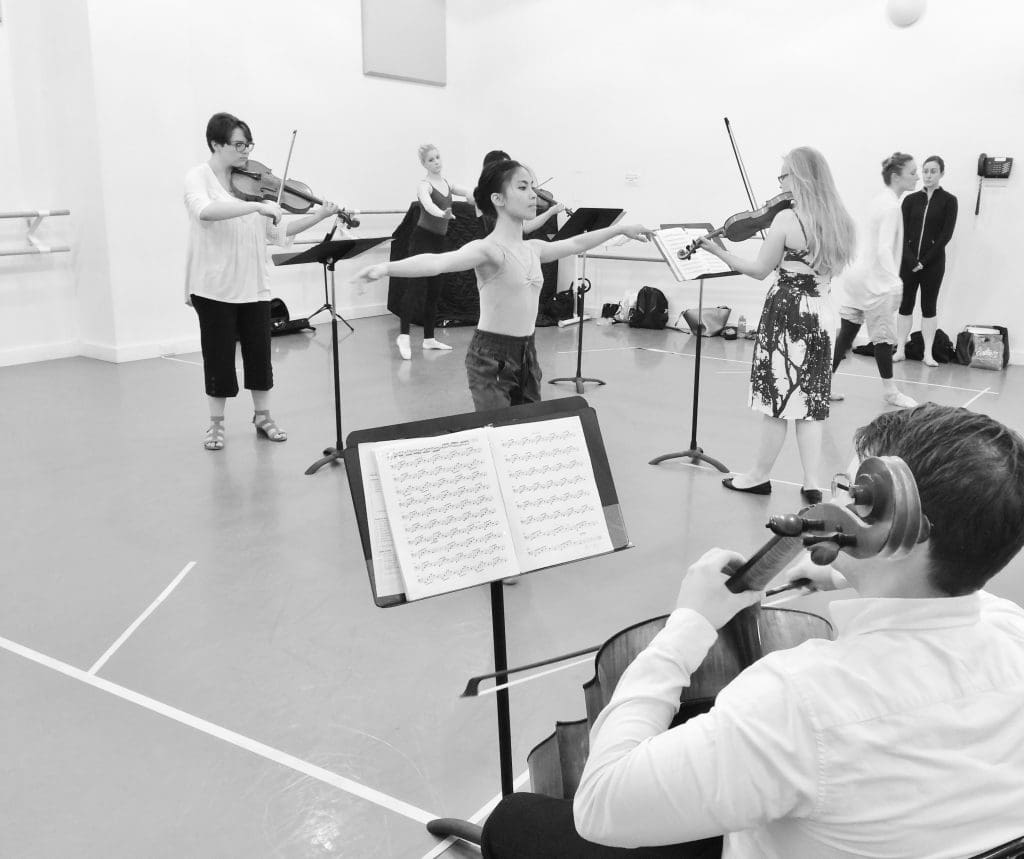
Photo courtesy of Arch Contemporary Ballet
Dance Mogul: Is there anyone you would like to thank for helping you with the production?
Arch: As the Artistic Director of Arch Contemporary, I can’t thank enough all of the members of the company. From each and every one of our dancers to our fantastic roster of musicians to our 21st-century composers who continue to create excellent work for the company, and to all of our supporters. As a young and thriving company, our generous supporters are what keep us creating new work. Our patrons, audience in attendance, and fans keep our art alive and we can’t thank them enough. —Sheena Annalise (Artistic Director)
Join Arch Contemporary Ballet Tuesday, June 14th — Thursday, June 16th presented by The Davenport Theatre Blackbox in NYC for one of ACB’s newest works “Château”. Tickets can be purchased at brownpapertickets.com.
Twelve dancers, four moving musicians, exciting partner work on pointe, 100+ yards of fabric, and a contemporary commissioned music score take the stage.
Advanced General admission tickets: $25
Advanced Visionaries of ACB Tickets: $35
Connect with us on Facebook, Instagram, and Twitter!
@ArchBallet
www.ArchBallet.com
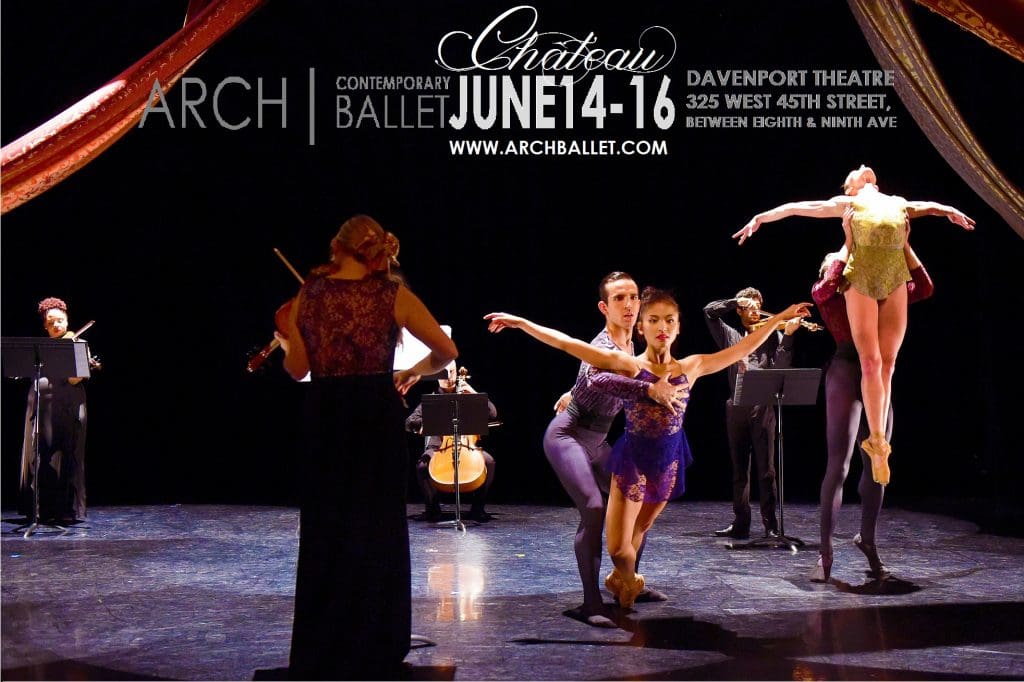
Arch Contemporary Ballet “Château” Poster
What Has Arch Contemporary Ballet Been Doing Since 2016?
The ten years following the “Château” premiere have been marked by consistent artistic production, institutional growth, and deepening roots in the New York dance ecology. While the company continued to develop new works—including world premieres that expanded on Sheena Annalise’s innovative approach to partnering, pointe work, and the integration of live music—the trajectory was never one of rapid expansion. Instead, Arch Contemporary Ballet has exemplified what sustainable contemporary practice looks like: intentional growth, quality over volume, and strategic investment in the infrastructure that allows art-making to survive beyond initial enthusiasm.
By the late 2010s and early 2020s, the company shifted its focus beyond mainstage performances to include robust community engagement. This evolution reflects a larger recognition in contemporary dance about the responsibility of artists and companies to expand access to their work. Arch Contemporary Ballet began developing residency programs in New York City schools, teaching movement, choreographic process, and contemporary ballet technique to students who might not otherwise encounter the art form. The company also established regular community performance opportunities, bringing work to neighborhoods beyond the traditional theater districts. These initiatives were not peripheral to Arch’s mission—they became central to how the company understood its role in the cultural landscape.
The COVID-19 pandemic, which disrupted nearly all live performance in 2020, created significant challenges for a company dependent on in-person rehearsals, live music, and audience attendance. Yet it also catalyzed innovation. Like many dance companies, Arch Contemporary Ballet adapted by developing digital content, virtual teaching modalities, and hybrid performance formats. The experience of 2020—2021 forced many companies to articulate more clearly why they existed and who they served. For Arch, it reinforced the importance of education work and community connections as anchors for sustainability.
As live performance resumed, Arch Contemporary Ballet emerged with a refined understanding of its artistic identity. The company continued commissioning original scores from contemporary composers, maintaining the core commitment to the choreography-first creative process that defines its approach. Recent productions have explored new themes while maintaining the signature aesthetic: innovative partnering, pointe work that challenges classical technique, live music integration, and investment in both artistic excellence and audience access.
The company has also become more visible in national dance conversations. Sheena Annalise has been invited to teach, choreograph, and lead workshops at major dance institutions and conferences. The company has toured beyond New York, building relationships with presenting organizations, universities, and communities interested in the kind of contemporary ballet work Arch makes. The dancers have gone on to perform with other companies, teach, and establish their own creative practices, extending the influence of the company beyond those currently in the ensemble.
Why This Matters to Dance Mogul Magazine
Dance Mogul Magazine has always understood dance as more than entertainment. Dance is history. Dance is education. Dance is discipline. Dance is business. Dance is leadership. Dance is cultural work. When DMM documents a choreographer, company, artist, teacher, or cultural institution, that coverage becomes part of the record that future readers can return to. That is the mission of the archive.
This archival approach is especially important in the case of independent contemporary ballet companies. The ballet world is often dominated by major institutional companies with significant financial resources, established donor bases, and clear pathways to visibility. Independent companies like Arch Contemporary Ballet operate with fewer resources, smaller audiences, and less media coverage. Yet these companies often do the most innovative artistic work, precisely because they have the freedom to take risks that institutions constrained by tradition and donor expectations cannot take. Female dancers partnering with one another on pointe. Choreography written before music. Musicians on stage as collaborators. These were not ideas that would have emerged easily from a traditional ballet institution.
When Dance Mogul Magazine covered Arch Contemporary Ballet in 2016, we were documenting a company making bold artistic choices at a vulnerable moment. We were preserving the thinking of artists who were trying to expand what ballet could be. For Dance Mogul, this kind of coverage is essential. It creates a record of innovation, risk, and artistic commitment at the level where so much of dance culture actually lives—in independent companies, community spaces, schools, and venues outside the Broadway-size theaters.
Ten years later, the fact that Arch Contemporary Ballet continues to exist, continues to create, continues to develop artists, and continues to reach new audiences, proves that this work mattered. The 2016 interview is not simply documentation of a past performance. It is a preserved moment in the ongoing story of a company that is still creating, still innovating, and still serving the dance ecosystem. That is why this archive feature still matters.
Educational Impact: Bringing Contemporary Ballet Into Schools and Communities
One of the most significant developments in Arch Contemporary Ballet’s trajectory has been its commitment to education and community access. While the company still produces theatrical performances, the work in schools and community spaces has become equally central to its identity and impact.
Contemporary ballet taught in schools looks different than classroom ballet traditionally has. Rather than focusing solely on technique and certification, Arch’s education programs emphasize creative process, collaborative problem-solving, and the discovery of personal movement language. Students are taught that bodies can express ideas, that music and movement can have complex relationships, and that dance is not about achieving a single correct form but about investigating what movement can communicate.
This matters because not every student will become a professional dancer. But every student benefits from understanding their body as a tool for expression. Every student benefits from collaborating with peers to solve creative problems. Every student benefits from experiencing what it feels like to move through space with intention and awareness. Dance education, at its best, teaches discipline, focus, body awareness, confidence, cooperation, and creativity in ways that traditional classroom instruction sometimes cannot.
Arch Contemporary Ballet’s work in New York City schools has reached students in neighborhoods where access to quality arts education is limited. The company has developed partnerships with schools that might not have robust arts budgets, offering residencies, one-time workshops, and demonstration performances. In some cases, students who encountered Arch’s work in school have gone on to pursue further training in dance or to bring what they learned into other areas of their lives. In all cases, students have had the opportunity to experience contemporary art-making in their school building.
The company has also used its performance work as an educational tool. When Arch produces a new work, the process itself becomes a teaching moment. Audience members can attend talk-backs, lecture-demonstrations, or preview events where the artistic process is explained. Composers discuss their creative choices. Dancers explain how the choreography is built and how it evolves through rehearsal. Musicians talk about collaborating with movement. This transparency about process demystifies contemporary art and invites audiences to think more deeply about what they see on stage.
For Dance Mogul readers, this educational emphasis is important to recognize. It shows that contemporary ballet companies are not museums preserving a fixed art form. They are living organisms, constantly teaching, adapting, and expanding the reach of dance. Arch Contemporary Ballet’s commitment to education ensures that the innovations developed on stage have the potential to influence how the next generation of dancers and dance-makers think about their work.
Legacy and Continuity: How 2016 Connects to Today
Looking back at the 2016 “Château” interview, certain themes emerge as constants in Arch Contemporary Ballet’s artistic DNA. The commitment to innovative partnering, particularly female dancers supporting one another in technically demanding work, has remained at the center of the company’s aesthetic. The insistence on setting choreography before music, creating an unusual creative workflow that challenges conventional hierarchies, continues to define how the company works. The belief that live music should be visible and active on stage, not hidden in a pit, has remained a signature choice.
What has evolved is the context and scope. The company that premiered “Château” at The Davenport Theatre Blackbox in 2016 was a young ensemble with limited resources navigating the precarious economics of independent dance making. The company of 2026 is older, more established, with deeper institutional roots. It has survived a pandemic, navigated the aftermath, and emerged with a clearer sense of its mission and impact. It has trained dancers who have gone on to other companies. It has influenced how students in New York City schools think about contemporary movement. It has contributed to the larger conversation about what ballet can be in the 21st century.
Yet the core commitment remains: to make art that challenges classical conventions, to collaborate thoughtfully with musicians and dancers, to be transparent about process, and to serve communities beyond the traditional theater audience. The 2016 interview is valuable today not because it tells a completed story, but because it reveals the moment when these principles were first tested at scale.
For contemporary dance artists, companies, and readers interested in how independent artistic practice sustains itself, Arch Contemporary Ballet offers an important case study. It demonstrates that innovation does not require massive budgets or institutional prestige. It requires clarity of vision, commitment to artistic integrity, willingness to take risks, and investment in community. These elements have allowed Arch Contemporary Ballet to not merely survive, but to grow and deepen its impact over a decade.
Share This Archive Feature
This updated Dance Mogul Magazine archive feature is part of our ongoing commitment to preserving and contextualizing dance history. Share this article to help other readers, researchers, educators, students, and artists discover this important cultural documentation of contemporary ballet innovation and artistic commitment.
Cite This Article:
Dance Mogul Magazine. “Arch Contemporary Ballet | Château: A 2016 Premiere and the Decade of Creation That Followed — Updated Archive Edition.” Updated June 2026. Originally published June 12, 2016. Accessed [DATE].
Original Citation:
Dance Mogul Magazine. “Arch Contemporary Ballet | Château.” Published June 12, 2016.


