
Industry Guide · Dance & Technology
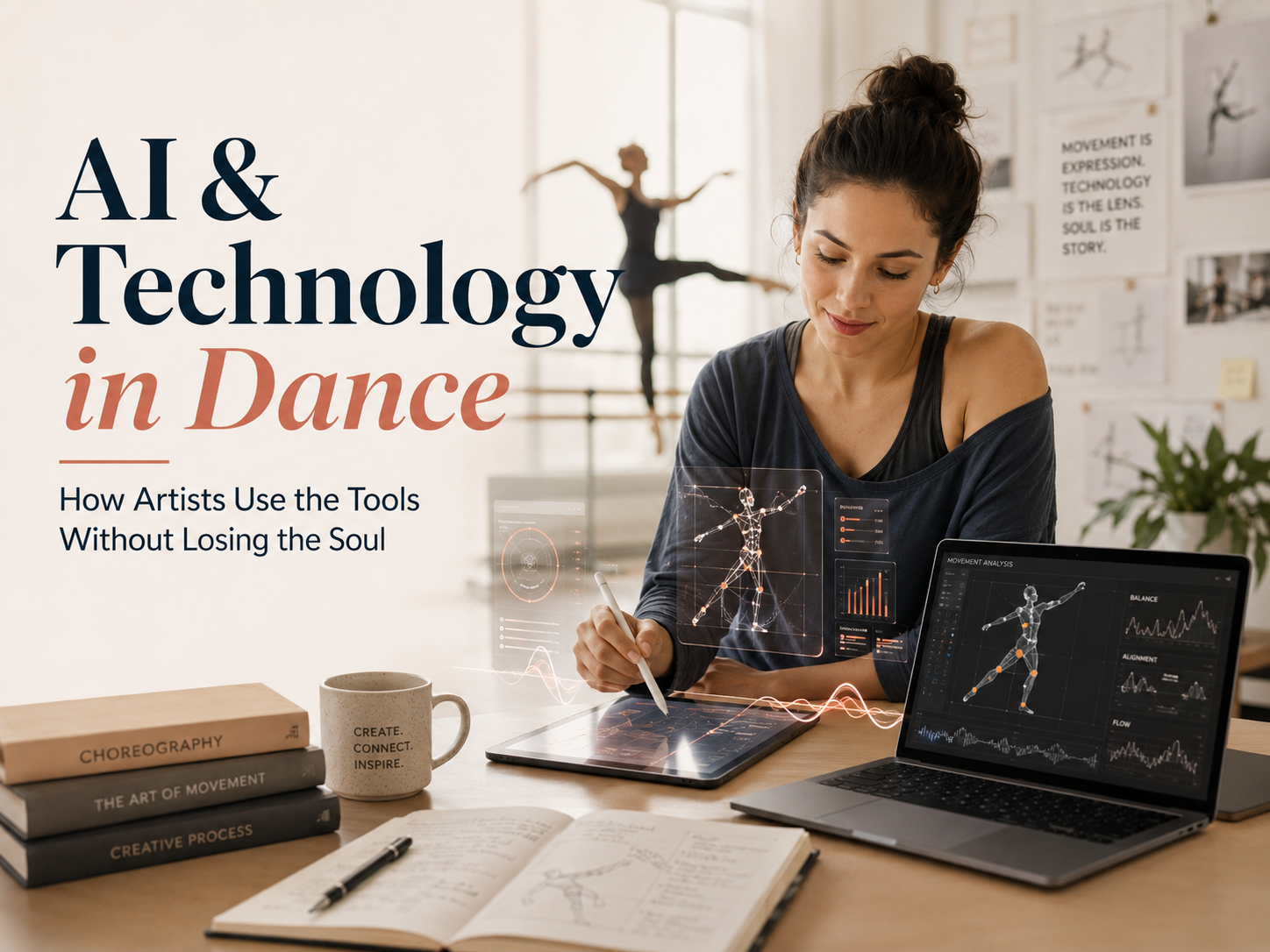
AI & Technology in Dance: How Artists Use the Tools Without Losing the Soul
AI can generate movement, capture it, and score it. What it still can't do is be a dancer. A Dance Mogul Magazine guide to using technology as a collaborator, not a replacement.
By Dance Mogul Magazine | Industry Guide
Technology Arrives on the Dance Floor
For most of history, dance was the one art form that lived only in the body and the moment. That is changing. AI in dance is now real and growing — generating movement ideas, capturing choreography in three dimensions, scoring original music, and even putting digital dance partners on stage. For some artists this is thrilling; for others it is unsettling. Both reactions make sense. The honest question is no longer whether technology belongs in dance, but how to use it without surrendering the very thing that makes dance human.
At Dance Mogul Magazine, we believe technology should amplify culture, not erase it. This guide breaks down what AI can actually do for dancers today, what it still cannot do, the hard questions it raises about ownership and identity, and how to bring these tools into your practice on your own terms.
What AI Can Actually Do for Dancers Now
The most useful way to think about today's tools is as creative collaborators — assistants that expand possibility rather than make decisions for you. Several capabilities are already in working use:
- Idea generation and co-creation. Generative tools can propose movement sequences and variations a choreographer can select, modify, and develop — a sketchpad for the body. Research projects have let artists build phrases from databases of captured movement and refine sequences pose by pose.
- Motion capture and archiving. Three-dimensional motion capture can preserve a choreographer's movement vocabulary in detail, creating living archives of work that once vanished the moment a performance ended.
- AI-generated music. Text-to-music tools let dancers generate original scores from a written prompt, opening fast, royalty-aware ways to explore how sound and movement interact.
- Interactive, responsive stages. Real-time systems can read a dancer's movement and adjust lighting and visuals on the fly, turning the stage itself into a responsive partner.
- Digital avatars and partners. Some choreographers have improvised live with AI-driven avatars trained on motion-capture data — partners that can move in ways no human body can, expanding the very idea of what dance can be.
- Training and feedback. Movement-analysis tools can give dancers objective feedback on technique, helping refine alignment, timing, and progress over time.
What AI Still Cannot Do
For all the hype, the limits are real — and in 2026 they remain significant. When journalists tested leading generative video models on a range of cultural, modern, and popular dance styles, the results confirmed what dancers already knew: AI still struggles to produce convincing footage of complex human movement. Most choreographers concluded their craft could not be replaced. At least, not yet.
The deeper reason is not technical but human. A spin on one leg is different every single time. Improvised choreography emerges from instinct, history, and feeling in a way no model can predict. Dancers describe movement that originates from the fascia — the connective tissue throughout the body — and from lived experience that cannot be mapped externally. AI can imitate the shape of a movement; it cannot carry the meaning, the memory, or the relationship the movement was made to express.
The Hard Questions: Ownership, Identity, and Privacy
As AI becomes embedded in the creative process, dancers face new questions of authorship and ownership. Where does human creativity end and machine contribution begin? If a choreographer builds a phrase with an AI tool, who owns it? These are not abstract concerns — they shape credit, compensation, and control over a career's worth of work.
There is also a privacy dimension that the dance world is only beginning to reckon with. Movement is deeply personal — close to biometric data. When systems capture, analyze, and reproduce a dancer's unique way of moving, real questions arise about consent, data ownership, and the risk of having your signature style mapped, copied, or deepfaked without permission. Protecting your movement is becoming as important as protecting your name. We explore the legal side of this in our companion guide, Dance Copyright & Legal Issues: How Choreographers Protect Their Work.
Using AI Wisely: A Dancer's Ground Rules
1. Treat AI as a collaborator and sketchpad — keep the human artist at the center.
2. Read the terms before you upload your movement; know who keeps your data.
3. Document and credit your original work, especially when tools are involved.
4. Use AI to expand your range, not to replace your training or your voice.
5. Stay informed — the tools and the rules are changing fast.
Bringing Technology Into Your Practice
The artists thriving in this moment are not the ones resisting technology or the ones surrendering to it — they are the ones using it on purpose. Let AI handle what it does well: generating raw material, capturing and archiving work, scoring drafts, surfacing patterns in your technique. Reserve for yourself what only you can do: choosing what matters, shaping meaning, and bringing the lived experience that turns movement into art.
There is an access story here too. Thoughtfully used, these tools can lower barriers — helping dancers in under-resourced communities study, create, and share work that once required expensive studios and gatekeepers. Used carelessly, they can flatten culture and erase the people who built it. The difference is intention. For the broader picture, see our feature on The Future of Dance Technology & Innovation.
Dance Mogul Magazine's position is simple: technology is a tool in service of human artistry and cultural legacy — never a substitute for it. Embrace what empowers you, protect what is yours, and keep the soul of the art exactly where it has always lived: in the dancer.
Resources & Further Reading
From Dance Mogul Magazine:
- Dance Copyright & Legal Issues: How Choreographers Protect Their Work
- The Future of Dance Technology & Innovation
- Dance Business & Entrepreneurship: Build a Career That Lasts
- Explore the Dance Mogul Magazine Dance Styles Hub
Trusted external resources:
- Stanford Institute for Human-Centered AI (HAI)
- Dance/USA — National Service Organization for Dance
- U.S. Copyright Office — Artificial Intelligence Initiative
The Dance Mogul Mission
Dance Mogul Magazine exists to inspire self-empowerment, celebrate cultural excellence, and equip the global dance community with the tools to build lasting legacies. We champion technology in service of human artistry — never as a substitute for it. Explore our coverage and keep building.