
Industry Guide · Copyright & Legal
Dance Copyright & Legal Issues: How Choreographers Protect Their Work
Dance is fleeting, but the law can protect it. Here's how copyright works for choreography in 2026 — and what one choreographer's breakthrough changed for everyone.
By Dance Mogul Magazine | Industry Guide
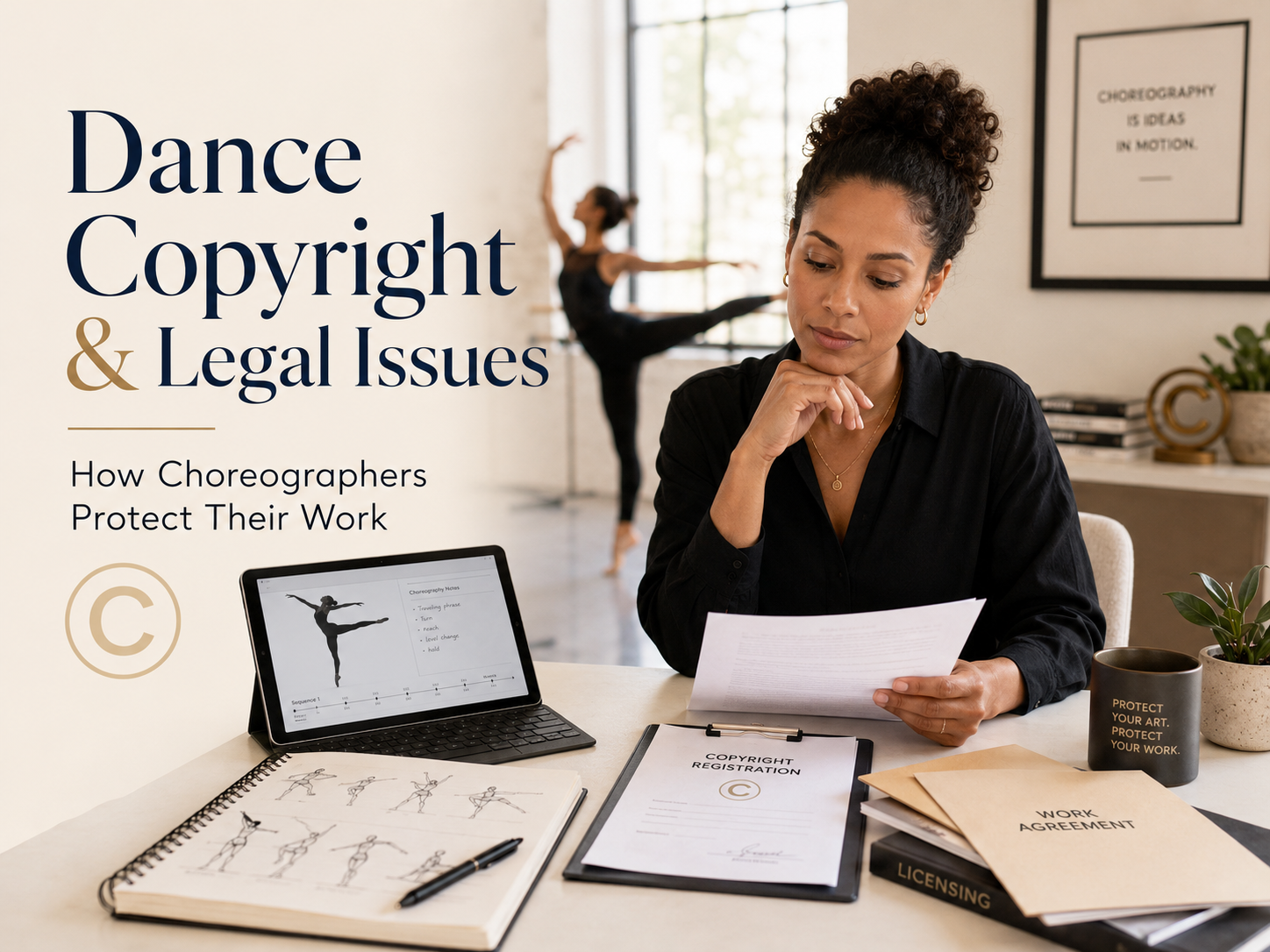
Protecting an Art Form That Lives in the Body
Choreography occupies a strange place in the law. Unlike a song or a painting, dance is ephemeral and human — it happens, and then it is gone. Yet U.S. law does recognize choreographic works as original authorship worthy of protection. Understanding dance copyright is one of the most important and least taught skills in the field, especially now that a single viral clip can travel the world overnight while its creator goes uncredited and uncompensated. (This article is general educational information, not legal advice. For your specific situation, consult a qualified attorney licensed in your jurisdiction.)
The stakes became impossible to ignore when choreographer JaQuel Knight — the mind behind Beyoncé's "Single Ladies" — became the first commercial pop choreographer to successfully register a copyright for his work. His breakthrough opened a conversation the industry had avoided for decades: dancers can, and should, own what they create.
Can You Copyright Choreography? Yes — With Conditions
Choreographic works have been explicitly protectable under U.S. law since the Copyright Act of 1976, which lists "pantomimes and choreographic works" among the categories of authorship. The Copyright Office defines choreography as the composition and arrangement of dance movements organized into a coherent whole. To qualify for protection, a work must meet two core requirements: originality and fixation.
Originality: The Creative Spark
Originality means the choreographer independently created the work and brought genuine creative choice to it. This matters in styles like hip-hop and jazz, which naturally sample and rearrange common steps. Individual moves and basic social steps are not protectable on their own — but the way a choreographer combines them, adds a new perspective, and shapes them into a distinctive whole can be. When Parris Goebel fused street styles with dancehall in her viral work, the originality lived in that revolutionary combination, not in any single step.
Fixation: You Have to Capture It
Because dance is fleeting, the law requires the work to be "fixed" in a tangible medium — recorded in enough detail that it can be performed in a consistent and uniform manner. Acceptable forms of fixation include dance notation systems such as Labanotation and Benesh, video recordings, photographs, and detailed written descriptions. In practice, most choreographers fix their work through video, though formal notation creates the most precise and defensible record.
What the Law Will Not Protect
It is just as important to know the limits. Short, simple routines and individual dance steps generally cannot be copyrighted — which is why many of the brief moves that go viral on social platforms fall outside protection. Common steps in the public vocabulary of a style remain free for everyone to use. Copyright protects the original, fixed, coherent composition — not the raw building blocks every dancer shares.
Registration: Why It Still Matters
Technically, copyright exists from the moment a qualifying work is created and fixed — you do not have to file anything for the right to come into being. But there is a crucial catch: you generally cannot sue for infringement in federal court until the work is registered with the U.S. Copyright Office. Registration is what turns a right on paper into a right you can actually enforce, and it strengthens your position in any dispute. The Copyright Office's Circular 52 specifically addresses how to register choreography and pantomime. For smaller disputes, the Copyright Claims Board offers a more accessible venue than a full federal lawsuit.
Protect Your Choreography: A Checklist
1. Fix it — record a clear, detailed video (or commission notation) of the full work.
2. Document the timeline: when it was created, fixed, taught, and first performed.
3. Register meaningful works with the U.S. Copyright Office (see Circular 52).
4. Put credit and ownership in writing before any paid or work-for-hire project.
5. When in doubt, consult an attorney who knows entertainment and IP law.
The JaQuel Knight Precedent
JaQuel Knight's path shows both the difficulty and the possibility. Working with the Dance Notation Bureau, he had his "Single Ladies" choreography fixed in Labanotation and secured a registered copyright — a first for a commercial pop choreographer. He then launched Knight Choreography and Music Publishing Inc. to manage choreographic rights the way music publishers protect songwriters, and pursued registrations for other major works.
Crucially, he did not stop at his own catalog. In a widely noted partnership, the technology company Logitech joined Knight to help ten Black creators copyright their viral dances — including social-media routines whose Black originators had gone uncredited, a flashpoint of the #BlackTikTokStrike. His legal team has included attorneys experienced in high-profile dance disputes. The message was clear: ownership is not just for superstars, and the creators who built the culture deserve to share in its value. We profile Knight's full journey in "Megan Thee Stallion's Dance Director: How JaQuel Knight Became the Most Important Choreographer of His Generation."
The Social Media Era and Work-for-Hire
Short-form video has supercharged both dance's reach and its credit problem. Routines spread instantly, often stripped of the creator's name. While many brief steps fall below the threshold of protection, the culture is shifting toward attribution — tagging originators, licensing where appropriate, and refusing to let viral success erase the artist behind it. Building a habit of crediting creators is both ethical and, increasingly, an industry expectation.
There is also the question of who owns work made for someone else. When you choreograph as an employee or under a "work-for-hire" arrangement, the client or company may own the resulting copyright — not you. This is exactly why contracts matter. Negotiate ownership, credit, and usage terms in writing before the work begins, and treat those terms as part of your professional foundation, the same way we discuss in Dance Business & Entrepreneurship: How to Build a Career That Outlasts the Spotlight.
The New Frontier: AI and Your Movement
The next wave of legal questions is already arriving. When choreography is created with the help of AI, authorship and ownership grow murkier — copyright law has long centered on human authorship. And as motion-capture and generative tools make it possible to record and reproduce a dancer's signature style, protecting your movement becomes a frontier of its own. We unpack the creative side of this shift in AI & Technology in Dance: How Artists Use the Tools Without Losing the Soul.
At Dance Mogul Magazine, we see protecting your work as an act of self-empowerment. Knowing your rights, fixing your work, and putting agreements in writing is how dancers move from being used by the industry to building lasting, ownable legacies within it. The art may be fleeting. Your rights do not have to be.
Resources & Further Reading
From Dance Mogul Magazine:
- AI & Technology in Dance: Use the Tools Without Losing the Soul
- Dance Business & Entrepreneurship: Build a Career That Lasts
- JaQuel Knight: The Choreographer Who Copyrighted Culture
- Parris Goebel: The Self-Made Queen of Global Choreography
Trusted external resources:
- U.S. Copyright Office
- Copyright Office Circular 52 — Choreography & Pantomime
- Copyright Claims Board (CCB)
- Dance/USA — National Service Organization for Dance
The Dance Mogul Mission
Dance Mogul Magazine exists to inspire self-empowerment, celebrate cultural excellence, and equip the global dance community with the tools to build lasting legacies. Knowing your rights is how dancers move from being used by the industry to owning their place within it. Explore our resources and keep building.