
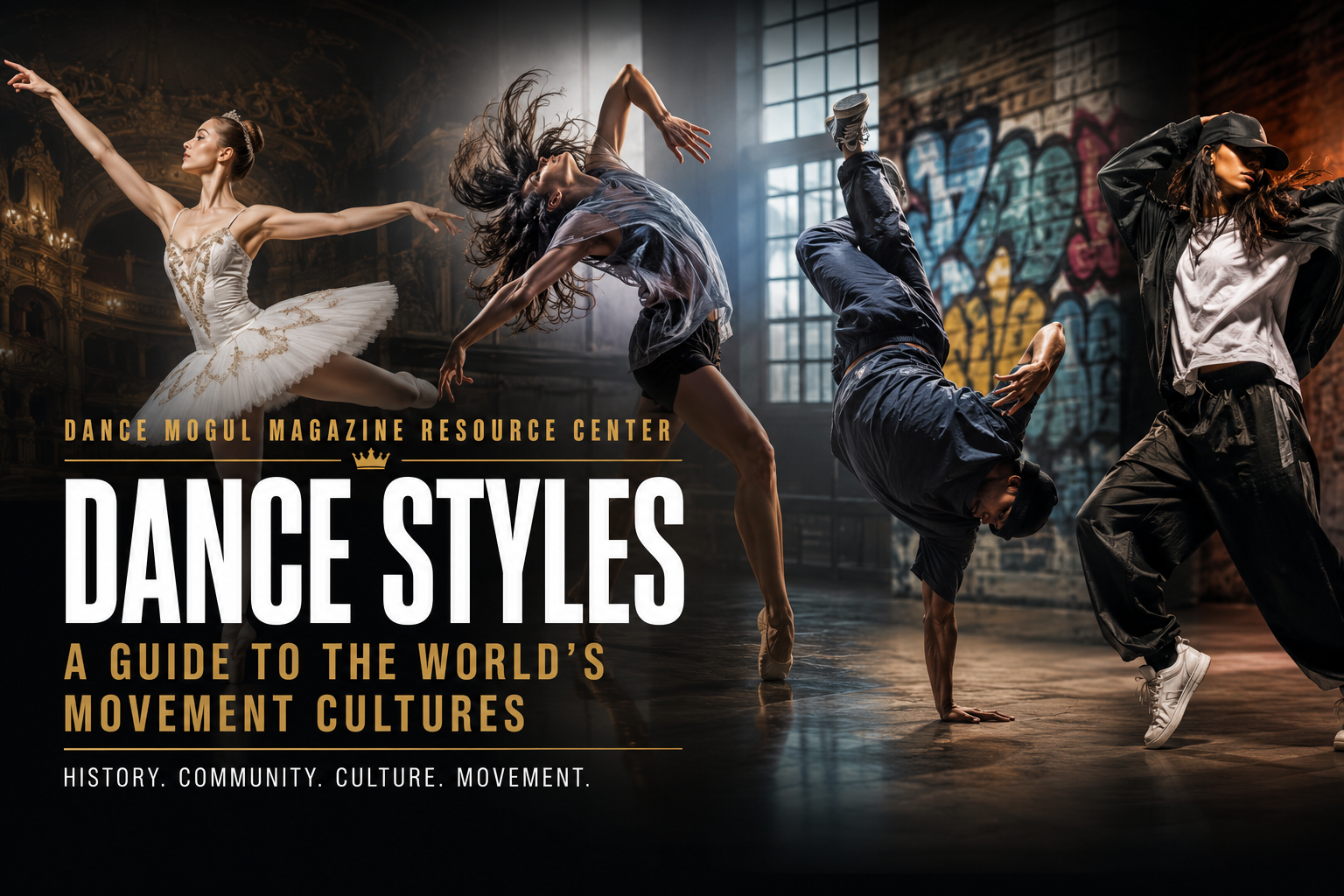
Dance Mogul Magazine Resource Center
Dance Styles: A Guide to the World’s Movement Cultures
From the courts of Renaissance Europe to the block parties of the Bronx and the clubs of Newark, every dance style carries a history, a community, and a culture. Below is a guide to the styles Dance Mogul Magazine has documented for over a decade — each with a brief history and a direct link to our full archive of interviews, features, and stories on that style.
Ballet — 83 articles
Born in the Italian Renaissance courts of the 15th century and formalized in France under Louis XIV, who founded the Académie Royale de Danse in 1661, ballet is the foundation of Western concert dance. Its codified vocabulary — turnout, the five positions, pointe work — evolved through the Romantic, classical Russian, and neoclassical eras into the technical language that underpins nearly every stage style today.
Explore all 83 Ballet articles →
BBoying (Breaking) — 40 articles
Breaking was born in the early 1970s in the Bronx as one of the four founding elements of hip-hop culture, danced to the looped breakbeats pioneered by DJ Kool Herc. Built from toprock, downrock, power moves, and freezes, it turned the dance floor into a battleground of individual expression — and in 2024 it entered the Olympic Games in Paris.
Explore all 40 BBoying articles →
Contemporary — 115 articles
Contemporary dance emerged in the mid-20th century as a deliberate break from ballet's rigidity, drawing on the modern-dance innovations of Martha Graham, Merce Cunningham, and José Limón. It prizes floorwork, contraction and release, improvisation, and raw emotional storytelling, blending multiple techniques into a fluid, ever-evolving art form.
Explore all 115 Contemporary articles →
Hip-Hop — 82 articles
Rooted in the block parties of 1970s New York and expanded by the funk styles of the West Coast, hip-hop dance is the movement language of a global culture. It spans social party dances, freestyle battling, and choreographed ‘new style,’ carried worldwide through music videos, cyphers, and the studio scene.
Explore all 82 Hip-Hop articles →
Locking — 16 articles
Created by Don Campbell in early-1970s Los Angeles, locking is a funk style defined by the ‘lock’ — freezing suddenly mid-movement, then snapping back to speed. Playful, comedic, and crowd-facing, it was carried into living rooms across America by The Lockers on Soul Train.
Explore all 16 Locking articles →
Street Dance — 78 articles
Street dance is the umbrella for vernacular styles that grew up outside the studio — in parks, clubs, house parties, and on the corner. Improvisation, battling, and social connection are its heartbeat, encompassing breaking, popping, locking, house, and the many regional forms that keep emerging from the culture.
Explore all 78 Street Dance articles →
Tap — 10 articles
Tap is an American original, forged in the 19th century from the collision of African rhythmic traditions with Irish and English step dancing. Metal plates turn the dancer into a percussionist, a lineage advanced by legends from Bill ‘Bojangles’ Robinson and the Nicholas Brothers to Savion Glover.
Voguing — 13 articles
Voguing rose from Harlem's Black and Latino LGBTQ+ ballroom scene between the 1960s and 1980s, translating the sharp poses of fashion magazines into movement. Through its Old Way, New Way, and Vogue Fem forms, it became a language of identity and defiance long before Madonna's 1990 hit carried it to the mainstream.
Explore all 13 Voguing articles →
Urban Dance — 53 articles
Urban dance is the choreography-driven movement that grew out of hip-hop but matured inside studios, dance teams, and on social media. Defined by intricate choreography, deep musicality, and crew performance, it spread globally through YouTube, conventions, and competitions like World of Dance.
Explore all 53 Urban Dance articles →
Waacking — 22 articles
Waacking was born in the disco-era LGBTQ+ clubs of 1970s Los Angeles, marked by fast, whipping arm movements, dramatic posing, and razor-sharp musicality. Closely tied to the punking and vogue lineages, it has been revived and carried forward by the global street-dance community.
Explore all 22 Waacking articles →
Jersey Club
Jersey Club is the style Dance Mogul Magazine was built around. It traces to Newark, NJ, where a movement that began in 1979 grew through the Brick City dancers and the legendary EnVy Dance Group into a genre now sampled by global artists. This is DMM's home culture — documented here as a first-person origin story straight from the source.
Read the definitive Jersey Club origin story →
Want the bigger picture? Visit the Dance Knowledge Hub for career, culture, and industry guides.