
FILM & MOVEMENT • THE CREATIVE TEAM
Children of Blood and Bone: The Artists Bringing Orïsha to Life
Inside the cast, choreography, movement, costumes, production design, and the collaborative craftsmanship shaping one of 2027’s most anticipated fantasy films — and why the people behind the camera matter as much as the stars in front of it.
By Dance Mogul Magazine | Film & Culture | Published July 27, 2026
Estimated reading time: 14 minutes

An original Dance Mogul rendering inspired by the South African landscapes — lush forest and a striking pink lake — where Children of Blood and Bone was filmed. Not an official film image.
Before audiences can believe in the magic of Orïsha, they have to believe in the people who live there — how they walk, fight, celebrate, worship, gather, grieve, and resist. A fantasy world is only as convincing as its body language. That is the part of filmmaking most previews skip past, and it is exactly the part Dance Mogul Magazine exists to honor.
When Paramount Pictures released its first behind-the-scenes look at Children of Blood and Bone on July 27, 2026 — taking viewers onto the South African set of director Gina Prince-Bythewood’s long-awaited fantasy epic — the footage did something most first looks do not. It put the craft first. Practical villages built by hand. Garments stitched from scratch. Combat and movement designed as a single physical language. This is not simply another cast announcement. It is a rare public window into the collaboration that turns an imagined kingdom into something you can feel.
So this feature widens the lens. Yes, we cover the release date, the star-studded cast, and the story. But our real subject is the creative team — the choreographer, the movement and action leads, the production and costume designers, the hair and makeup artists, the cinematographer, the editor, and the composer whose combined labor makes Orïsha breathe. At the center sits a name the dance world already knows: Fatima Robinson, one of the most influential choreographers of the last three decades, credited among the film’s movement leads.
Children of Blood and Bone at a glance
| Detail | Information |
| Release date | January 15, 2027 (theaters and IMAX) |
| Studio | Paramount Pictures |
| Director | Gina Prince-Bythewood |
| Screenplay | Gina Prince-Bythewood & Tomi Adeyemi |
| Source material | Children of Blood and Bone by Tomi Adeyemi (2018) |
| Genre | Action, adventure, fantasy |
| Movement leads | Fatima Robinson & Daniel Hernandez |
| Production designer | Hannah Beachler |
| Costume designer | Charlese Antoinette Jones |
| Hair department head | Andrea Mona Bowman |
| Makeup department head | Matiki Anoff |
| Cinematographer | Polly Morgan |
| Editor | Terilyn A. Shropshire |
| Composer | Terence Blanchard |
| Formats | Theaters, IMAX, Dolby Cinema |
Runtime, official rating, streaming date, and ticket on-sale date have not yet been announced. Below-the-line credits reflect Paramount’s official first-look featurette and will be confirmed against final screen credits after release.
What is Children of Blood and Bone?
Children of Blood and Bone is Paramount’s live-action adaptation of Tomi Adeyemi’s 2018 debut novel — the first book in her best-selling Legacy of Orïsha trilogy, which debuted at No. 1 on the New York Times list and became one of the defining young-adult fantasy phenomena of its generation. The film is set in the fictional West African–inspired kingdom of Orïsha, a world where magic once flowed through the hands of the maji before a ruthless monarchy stamped it out.
At the center is Zélie Adebola, a young woman who sets out on a dangerous quest to restore the magic violently taken from her people. She is joined by her older brother, Tzain, and by two unlikely allies from the royal family — Princess Amari and Prince Inan, the daughter and son of the king — as they fight back against his brutal rule. In the world Prince-Bythewood has built, Orïsha is divided into clans with different gifts: some command water, fire, wind, or earth, others heal or see into the past and future. The result is action, political intrigue, spiritual awakening, and a coming-of-age story braided into one epic.
“I wanted the audience to feel grounded, like they were in the real world — and that starts with production design. It goes to costume, it goes to casting, it goes to action.” — Gina Prince-Bythewood, on adapting the novel into a grounded fantasy epic
A note for readers: we separate three things throughout this feature — the film’s confirmed material, background drawn from the novel, and Dance Mogul’s own analysis. Not every event or relationship from the book will arrive on screen unchanged, so we hold the source material and the adaptation as related but distinct creative works.
When does Children of Blood and Bone come out?
Children of Blood and Bone opens in theaters and IMAX on January 15, 2027, distributed by Paramount Pictures, with premium large-format engagements including Dolby Cinema. As of this writing, the studio has not announced a runtime, an official MPA rating, a streaming release date, or a ticket on-sale date. Where those details are still open, we say so rather than guessing — and we will update this page as Paramount confirms them.
Who is in the cast?
Prince-Bythewood has described the ensemble as reflecting “the whole of the diaspora,” and the roster reads like a summit of Black screen talent across continents.
| Actor | Character |
| Thuso Mbedu | Zélie Adebola |
| Tosin Cole | Tzain |
| Amandla Stenberg | Princess Amari |
| Damson Idris | Prince Inan |
| Chiwetel Ejiofor | King Saran |
| Viola Davis | Mama Agba |
| Cynthia Erivo | Admiral Kaea |
| Idris Elba | Lekan |
| Lashana Lynch | Jumoke |
| Regina King | Queen Nehanda |
| Diaana Babnicova | Folake |
| Zackary Momoh | Role to be confirmed |
| Richard Mofe-Damijo | Role to be confirmed |
| Bukky Bakray | Binta |
| Saniyya Sidney | Role to be confirmed |
| Ayra Starr | Role to be confirmed |
Thuso Mbedu carries the film as Zélie. The South African actress broke through to global audiences in Barry Jenkins’s The Underground Railroad and made her feature debut opposite Prince-Bythewood’s camera in The Woman King — a prior collaboration that makes her casting here feel less like a discovery and more like a reunion. Damson Idris (Snowfall, F1) plays the conflicted Prince Inan; Amandla Stenberg (The Hate U Give, The Hunger Games) plays Princess Amari; and Tosin Cole (Doctor Who, 61st Street) plays Zélie’s brother Tzain.
Around them stands an extraordinary supporting ensemble: Chiwetel Ejiofor as the tyrannical King Saran, Viola Davis as the elder Mama Agba, Cynthia Erivo as Admiral Kaea, Idris Elba as Lekan, Lashana Lynch as Jumoke, and Regina King as Queen Nehanda, with Nigerian screen legend Richard Mofe-Damijo, Zackary Momoh, Bukky Bakray, Saniyya Sidney, and Afrobeats star Ayra Starr also aboard. It is a cast assembled with intention — and, just as importantly, a cast being taught to move as citizens of a world that does not exist yet.
Gina Prince-Bythewood: directing the world of Orïsha
If you want to understand why the movement in Children of Blood and Bone matters, start with the filmmaker. Gina Prince-Bythewood has spent her whole career using the body as a storytelling instrument. In Love & Basketball, the court was an emotional language — every crossover and every missed shot said something a line of dialogue could not. In The Old Guard, she built immortality and combat into character. And in The Woman King, she turned the training, unity, and warfare of the Agojie into some of the most physically articulate action of the decade.

An original Dance Mogul rendering inspired by the misty Drakensberg foothills of KwaZulu-Natal, part of the South African terrain where the film was shot. Not an official film image.
That history is the reason this adaptation lands in capable hands. Prince-Bythewood has repeatedly framed the film as a “grounded fantasy epic” — magic and gods, yes, but rooted in the real, tactile world. Her stated priority order is telling: production design, then costume, then casting, then action. Movement is not decoration bolted on at the end; it is load-bearing. That philosophy is what connects her directly to her movement leads, Fatima Robinson and Daniel Hernandez, and to a cinematographer, Polly Morgan, who already shot The Woman King for her.
That commitment to a grounded world extended well beyond the soundstage. Prince-Bythewood has said the production filmed across South Africa and the Canary Islands, traveling to remote natural environments — some requiring hours of driving followed by a walk into places that had rarely, if ever, appeared in a major film — rather than surrounding the performers with green screens. The goal was to give the actors a complete physical world to move, fight, and build relationships inside, with the cast training for months for the film’s demanding fight sequences. It helps explain why the trailer’s choreography feels connected to the terrain: bodies are responding to real water, stone, forest, heat, and distance rather than to an empty digital backdrop.
“I wanted to create a world that we can be inspired by. We do this together.” — Gina Prince-Bythewood, from the film’s first-look featurette
Fatima Robinson and the movement of Orïsha
You may not know Fatima Robinson by name, but if you love music and film, you have spent years watching her work. Raised in Los Angeles, she famously calls the clubs her classroom — a self-taught dancer who broke through at 21 by choreographing Michael Jackson’s epic Remember the Time, the nine-minute short film set in ancient Egypt. From there she became one of the defining movement architects of a generation: Aaliyah’s catalog, Mary J. Blige’s VMA-winning Family Affair, the Black Eyed Peas, the Backstreet Boys, Whitney Houston, and more.
Her reach kept expanding — two Super Bowl halftime shows, The Wiz Live!, the Academy Awards stage, and head-choreographer duties on Beyoncé’s history-making Renaissance World Tour. On film she has shaped Dreamgirls, Save the Last Dance, and Blitz Bazawule’s 2023 musical The Color Purple, where she was the director’s very first hire. A three-time Emmy nominee and one of the few choreographers ever invited into the film academy, she has been called by The New York Times the most elevated hip-hop and R&B choreographer working today. Her own creative motto is a mantra any young artist should tape to the wall: “Who said we can’t do that?”
What makes her the right choreographer for Orïsha is not just the résumé — it is her worldview. Robinson has long said that studying African dance taught her that hip-hop is a form of it, one branch of the same tree. That understanding of movement as lineage, as something inherited and carried forward, is precisely what a film about reclaiming stolen heritage needs.
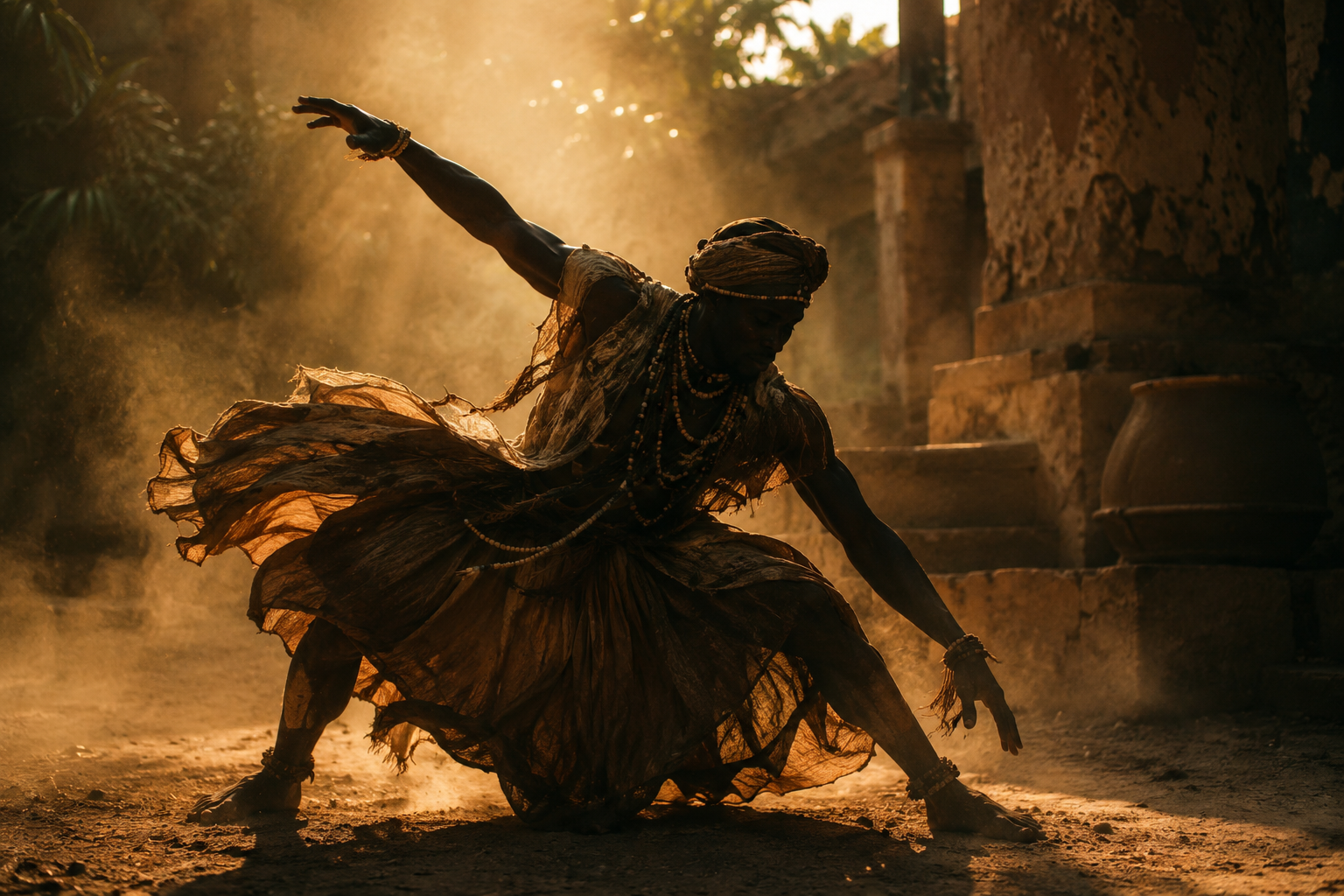
An original Dance Mogul rendering evoking the film’s movement and choreography. Illustrative — not from the film.
Choreography is bigger than dance numbers
Here is the distinction Dance Mogul cares about most: film choreography is rarely a “dance scene.” In a world like Orïsha, movement direction can shape ceremonial gatherings and processions, celebration and mourning, spiritual ritual, royal bearing, warrior preparation, crowd behavior, and the split-second transitions where a gathering tips into combat. It governs how a whole community moves when it is united — and how the body changes under fear, grief, or resistance. Prince-Bythewood’s featurette makes the film’s approach explicit: Robinson and Daniel Hernandez are credited as movement leads, bringing the action to life through high-energy stick fighting, martial arts, and sword combat. Movement and action here are not separate departments. They are one continuous physical vocabulary.
Building a physical language for an invented world
Every choice a movement team makes answers an invisible question. Do different clans carry themselves differently? How does royalty move compared to the people it rules? What does spiritual power look like in the spine and the hands before a single visual effect is added? What separates a ceremony from a fight, and how do you keep a truthful performance alive inside movement that has to repeat identically for take after take, angle after angle? These are the questions a choreographer of Robinson’s stature is built to answer — and, working with actors rather than a company of trained dancers, she has to teach that vocabulary safely, character by character, so the movement fits the person, not just the frame.
Why this matters to DMM
A choreographer on a film of this scale is a cinematic storyteller working in a language most audiences never consciously notice. When Orïsha feels alive, part of the reason will be a woman who learned her craft on a club floor and never stopped asking why the rules had to stand. That is empowerment through the arts, made visible on the biggest screen there is.
Daniel Hernandez: where choreography and combat meet
Credited alongside Robinson as a movement lead, Daniel Hernandez anchors the film’s action — the stick fighting, martial arts, and sword work the featurette puts front and center. It is worth pausing on how close his craft sits to a choreographer’s. Dance and combat are different disciplines with different stakes, but they run on the same engine: rhythm, timing, weight, spacing, repetition, partner awareness, and above all trust. A fight that reads clearly on camera is choreography by another name — every strike counted, every reaction rehearsed, every fall designed to look dangerous and land safe.
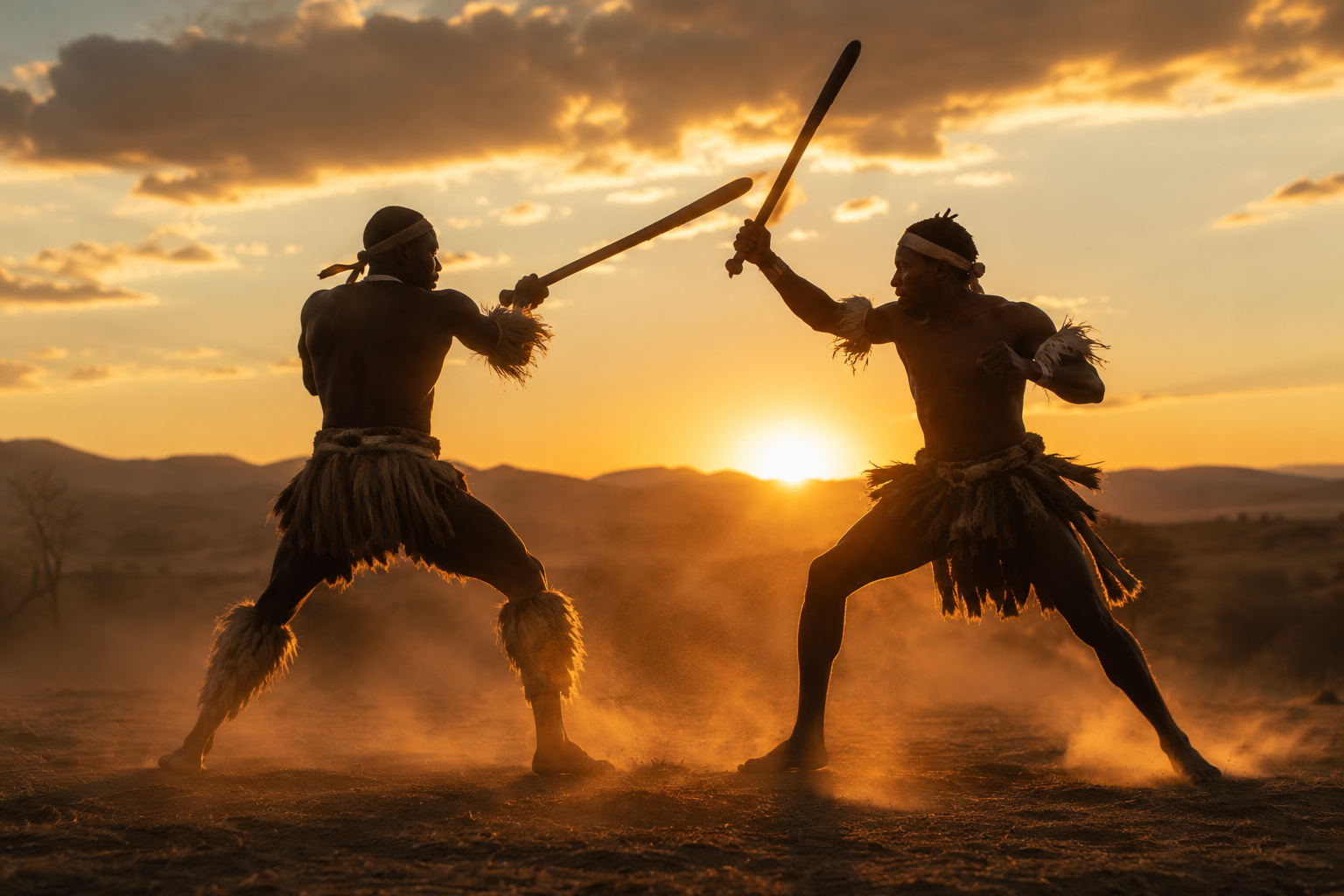
An original Dance Mogul rendering evoking the stick fighting and combat central to the film’s action. Illustrative — not from the film.
The real artistry is knowing when a fight should become choreography and when choreography has to serve the fight. Get the balance right and an audience forgets it is watching designed movement at all; they simply believe two people are trying to survive each other. On a grounded fantasy built around practical action rather than pure CGI spectacle, that believability is everything.
Building the visual world: design, costume, hair, and makeup
Movement never happens in a vacuum. It happens on a set, in a costume, framed by an identity that hair and makeup establish before the actor says a word. Four departments give Orïsha its surface — and each one changes what the body can do.

An original Dance Mogul rendering evoking the built, practical world of Orïsha — thatched dwellings and firelight at dusk. Not an official film image.
Hannah Beachler — designing the spaces of Orïsha
Oscar-winning production designer Hannah Beachler — who made history as the first Black winner in her category for Black Panther — built the physical kingdom, including sprawling multi-tiered thatch villages meant to make the world feel visceral and lived-in. Her work is the ground truth every other department stands on. A choreographer cannot design a procession without knowing the width of the path; a movement lead cannot stage combat without understanding the terrain; a camera cannot frame power without an architecture that expresses it. The featurette showcases those environments shot across natural South African landscapes, including lush forests and a striking pink lake.
Charlese Antoinette Jones — costumes that move and tell stories
Costume designer Charlese Antoinette Jones crafted hand-sewn garments and ornate armor to distinguish royalty from resistance, status from geography, ceremony from war. Clothing is never neutral on a moving body: fabric weight changes a silhouette, armor can free or restrict a shoulder, footwear decides whether a performer can run safely. The best costume design for an action film is a quiet collaboration with the movement team — can the actor turn, fall, and fight in this, and will it read as character while they do?
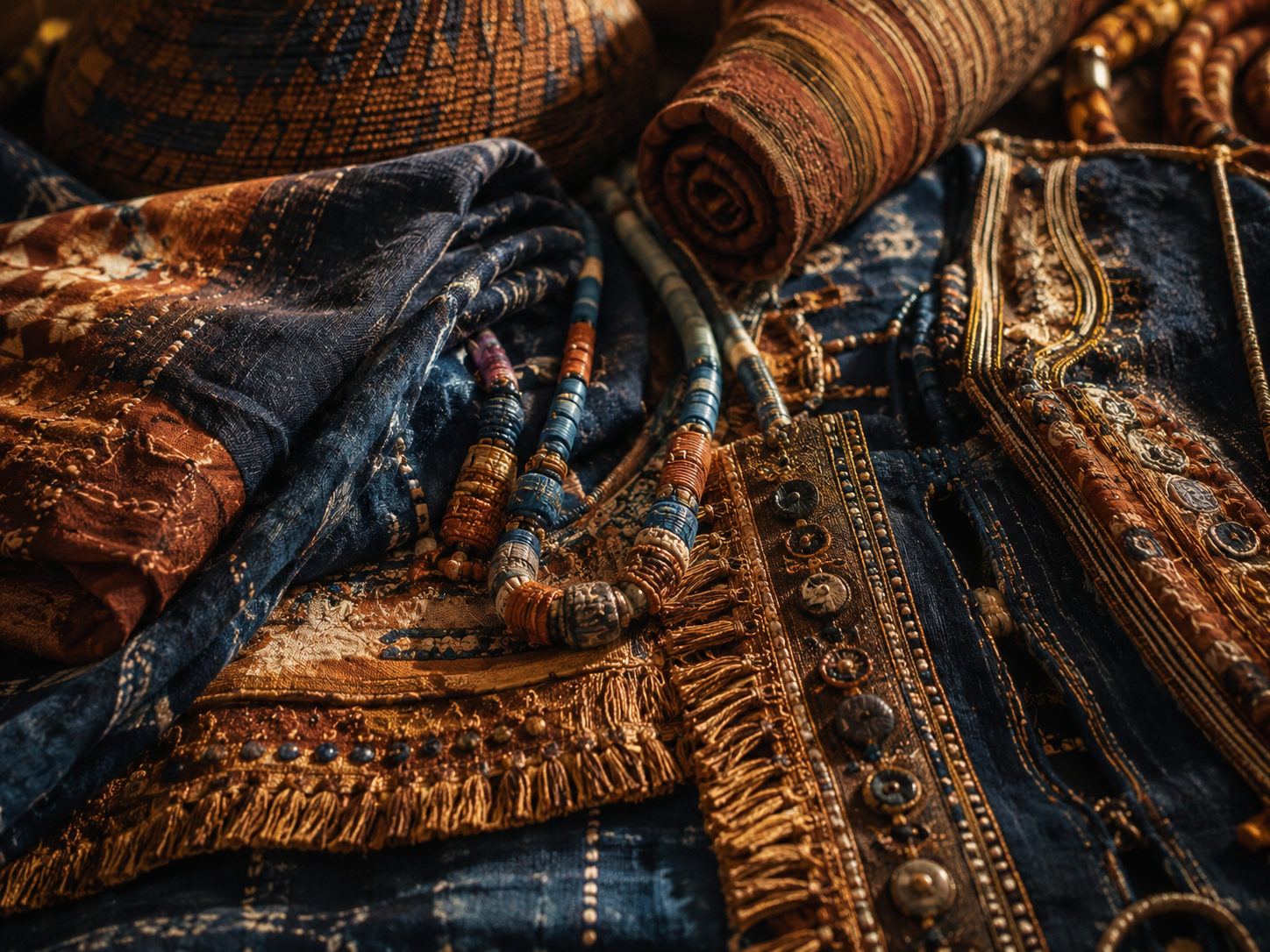
An original Dance Mogul rendering evoking the hand-crafted textiles and costume detail of Orïsha. Illustrative — not from the film.
Andrea Mona Bowman — hair as lineage and identity
Hair department head Andrea Mona Bowman drew on the diverse hair textures of the diaspora to distinguish Orïsha’s different clans — braids, coils, locs, and adornment doing the work of a visual family tree. On an action production, hair is also an engineering problem: complex styles have to survive movement, heat, and repeated takes while still reading as identity rather than costume.
Matiki Anoff — makeup, body art, and character
Makeup department head Matiki Anoff shaped the film’s body art and character work. According to the production’s own featurette, that work drew directly on traditional Yoruba body-paint techniques — a description we attribute to the filmmakers rather than presenting as our own cultural conclusion, and one we would want Anoff and the production’s consultants to detail in their own words. Beyond design, makeup on an action film is continuity under pressure: aging, injury, spiritual marking, and body paint all have to hold through sweat, water, and dozens of takes.
How the movement reaches you: camera and cut
You can build the most articulate movement in the world and lose it in the edit. Three artists decide whether audiences actually see the craft.
Polly Morgan, the cinematographer, already shot The Woman King for Prince-Bythewood, and the central question her work answers is simple: will the camera let us see the choreography, or will rapid cutting break it into fragments? Wide frames that preserve a full-body performance, movement through ensemble scenes, and lighting that honors a range of skin tones, textures, and costumes — those are the choices that either clarify movement or bury it.
Terilyn A. Shropshire, the editor, controls rhythm and comprehension — when to hold a wide shot and let a ceremony breathe, when to cut to an emotional reaction, how to build suspense without chopping every sequence into a music video. Get the cut right and the choreography reads; get it wrong and it dissolves into a blur. And then there is the sound.
The sound of Orïsha: Terence Blanchard’s score
If movement is the body of Orïsha, music is its pulse. The film’s score comes from Terence Blanchard — one of the most decorated composers in American film, a celebrated jazz trumpeter, two-time Academy Award nominee for BlacKkKlansman and Da 5 Bloods, longtime musical collaborator of Spike Lee, and the first Black composer to have an opera staged at the Metropolitan Opera. That pedigree matters here: a grounded fantasy epic needs a score that can hold both intimate character moments and large-scale spectacle, and Blanchard has spent a career doing exactly that.
On the film’s creative direction, the team has described a score that marries traditional orchestral writing with African instrumentation — with the songs woven through it leaning toward Afrobeats — aiming for something audiences haven’t quite heard before. It’s a fitting approach for a world built from the diaspora: a Western symphonic tradition and African sound sharing the same score, the way the film itself blends epic-fantasy scale with specifically Black creative authorship. Paramount has not yet released the full soundtrack credits, so we’ll hold specific track and collaborator details until they’re officially confirmed.
Here is why the score belongs in a story about movement: music is the instruction your body follows without being told. It decides whether a procession feels sacred or ominous, whether a fight reads as chaos or as choreography, whether a moment of grief lands. Score, movement, editing, and sound design are one nervous system — and when Orïsha moves, Blanchard’s music is a large part of what tells you how to feel it.
One sequence, many hands
Picture a single ceremonial gathering in Orïsha — the kind of scene a film like this lives or dies on. Production design creates the space and sets its scale. Costume decides how bodies can move within it. Hair and makeup establish who each person is and hold that identity through the day. Choreography gives the crowd its physical language; the action leads shape the moment it turns dangerous. Cinematography decides what we see; editing decides its rhythm; music and sound shape how we feel it. Eight departments, one seamless illusion. When it works, you never notice the seams — and that invisibility is the whole point of the craft.
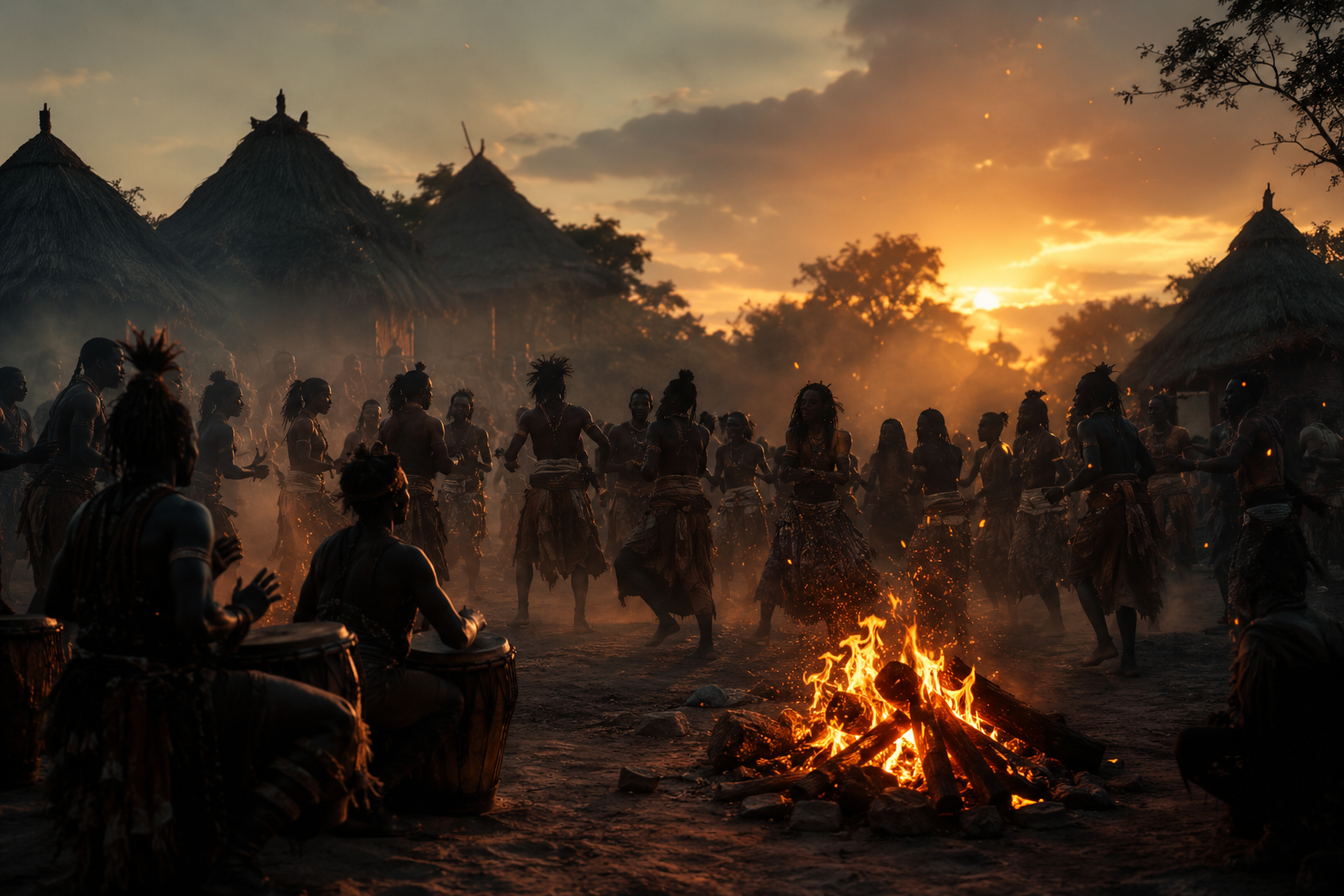
An original Dance Mogul rendering evoking a ceremonial gathering in Orïsha. Illustrative — not from the film.
The sequence above is an editorial illustration of how film departments collaborate, not a description of a specific confirmed scene.
From the novel to the screen
Tomi Adeyemi wrote Children of Blood and Bone in her early twenties, and it landed like a thunderclap — a major young-adult fantasy phenomenon that put a dark-skinned Black heroine with kinky hair at the center of epic fantasy at a moment when those covers were, as Adeyemi has said, few and far between. The Legacy of Orïsha trilogy — Children of Blood and Bone, Children of Virtue and Vengeance, and 2024’s Children of Anguish and Anarchy — sold millions and helped open the door for a wave of Afro-fantasy that followed.

An original Dance Mogul rendering inspired by Cape Town’s Atlantic coastline, one of the film’s South African filming regions. Not an official film image.
Adapting a world that expansive is its own kind of magic trick. A novel can conjure a kingdom in a reader’s imagination for free; a film has to build it, dress it, and move it in front of a lens. Some of it can be judged now, from footage and design; much of it has to wait for the finished film. What can be said today is that the adaptation has been mounted at a scale and with a craft roster that signals genuine ambition.
Cultural inspiration and responsible interpretation
Orïsha is a fictional kingdom inspired by West African — and specifically Yoruba — cultural traditions, but it is not a documentary about any single people. That distinction deserves care. Africa is a continent of thousands of cultures, not one visual identity, and the honest way to cover a film like this is to identify sources precisely rather than reaching for “African-inspired” as a catch-all. Where the production names a specific influence — as it has with Yoruba body-paint techniques in Anoff’s makeup work — we attribute it to the filmmakers and look forward to the department heads and any cultural consultants describing their research in their own words. Dance Mogul’s standard is simple: celebrate the craft, credit the source, and never flatten a living culture into set dressing.
Why Children of Blood and Bone matters
A Black heroine at the center of a global fantasy epic. A predominantly Black ensemble drawn from across the diaspora. Black creative leadership behind the camera — in the director’s chair, in production and costume design, in hair and makeup, in choreography and movement. And a production scaled to franchise ambition. That combination creates opportunity that ripples far beyond one film: for dancers, movement performers, designers, craftspeople, stunt professionals, and young artists who will see, in the closing credits, that these careers are real and reachable.
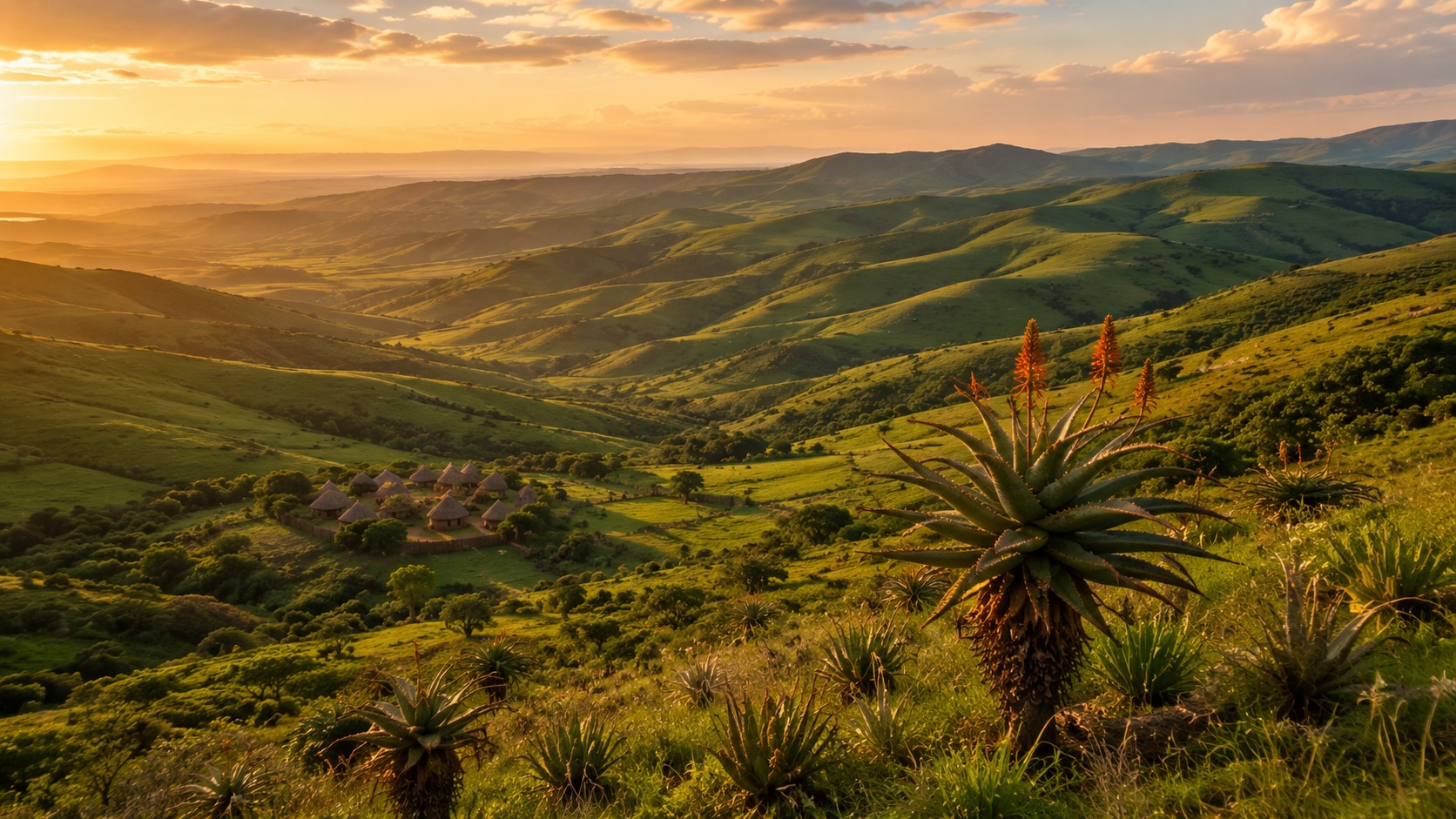
An original Dance Mogul rendering inspired by the rolling hills of KwaZulu-Natal. Not an official film image.
Fantasy has always been a language for talking about identity, courage, oppression, purpose, and resistance. When it centers people who are rarely allowed to be magical on screen — to be royal, vulnerable, heroic, and powerful all at once — it does something beyond entertainment. No single film represents all Black cultures or experiences, and we would never claim it does. But representation of this scale, built with this much care, expands what the next generation believes is possible for them.
THE DANCE MOGUL PERSPECTIVE
Dance is not separate from storytelling. It is present whenever the body communicates what dialogue cannot — belief, fear, discipline, history, belonging, grief, resistance, and hope. That is why we cover the people most previews overlook.
When you walk into Orïsha next January, you will see actors and spectacle. We will also be watching the hands that built the sets, the artists who shaped the garments, the departments that established identity, the choreographer and movement leads who created a physical language, and the camera, cut, and score that made it legible. Behind every believable world is a community of artists practicing empowerment through their craft. Those are the people we came to celebrate.
Watch the official trailer and behind-the-scenes featurette
Paramount Pictures released the first official Children of Blood and Bone trailer on July 28, 2026, a day after debuting its “Inside the World of Orïsha” behind-the-scenes featurette. Together they give audiences their clearest look yet at the movement, action, and physical world the creative team built.
Official trailer — Paramount Pictures.
Official first-look featurette, “Inside the World of Orïsha” — Paramount Pictures.
What the official trailer reveals
The trailer sharpens the distinction at the heart of this feature: choreography here is far more than a dance sequence. It moves through ceremonial gathering, combat training, stick and sword work, fire-lit magic, sweeping South African landscapes, and encounters with towering creatures — movement doing the work of spiritual practice, community, discipline, resistance, and warfare. Viola Davis’s Mama Agba is shown training Zélie and reminding her of the destiny she was born to carry, a teacher-and-student thread that grounds the spectacle in relationship. And it deepens Prince Inan’s conflict: groomed by King Saran and Queen Nehanda to inherit a throne built on the suppression of magic, he begins to question what kind of king he is willing to become — placing purpose, inherited responsibility, and moral choice at the center of the action.
The trailer is set to Beyoncé’s “Energy (feat. Beam),” a fitting pulse for footage this movement-driven — though its use in the marketing should not be read as confirmation that the track appears in the finished film or on Terence Blanchard’s official score.
The Orïsha creative team takes the stage
Ahead of the trailer’s debut, Paramount marked the moment with a trailer launch event at the Brooklyn Academy of Music on July 27, 2026. What made it notable for us was who stood in the spotlight. Alongside director Gina Prince-Bythewood and cast members including Thuso Mbedu, Tosin Cole, Regina King, Lashana Lynch, and Zackary Momoh, the film’s creative leads joined the onstage conversation — production designer Hannah Beachler, costume designer Charlese Antoinette Jones, hair department head Andrea Mona Bowman, and makeup department head Matiki Anoff.
It is rare for the artists who build a film’s physical world to share a marquee with its stars. That they did here — invited to speak about their craft at a major launch event — is exactly the recognition this feature argues they deserve. The people who designed Orïsha’s spaces, garments, hair, and faces are not background labor; they are co-authors of the world, and for one night in Brooklyn, the billing reflected it.
A note on the author and the adaptation
In July 2026, author Tomi Adeyemi publicly stated that she has distanced herself from the film adaptation and does not plan to watch it, sharing her explanation with fans via TikTok on July 6, 2026. Adeyemi is credited as a co-screenwriter alongside Prince-Bythewood and holds an executive-producer credit on the film. Paramount has continued to promote the movie toward its January 15, 2027 release.
We report this as documented industry context, not as the story of the film. Whatever unfolds between an author and a studio, it does not diminish the labor of the hundreds of artists — choreographers, designers, craftspeople, performers, and crew — whose work is the subject of this feature.
Frequently asked questions
When does Children of Blood and Bone come out?
It opens in theaters and IMAX on January 15, 2027.
Is it being released in IMAX?
Yes — Paramount has confirmed a theatrical release in IMAX, along with premium formats including Dolby Cinema.
Who directed Children of Blood and Bone?
Gina Prince-Bythewood (The Woman King, The Old Guard, Love & Basketball) directed and co-wrote the film.
Who plays Zélie?
South African actress Thuso Mbedu (The Woman King, The Underground Railroad) plays Zélie Adebola.
Who choreographed Children of Blood and Bone?
Fatima Robinson is credited among the film’s movement leads, alongside Daniel Hernandez, who anchors the action and combat.
Will there be dancing in Children of Blood and Bone?
The film features movement and choreographed sequences, and Fatima Robinson is credited as a movement lead. That said, it is a fantasy action epic, not a conventional dance movie — the choreography serves ceremony, ritual, crowd work, and combat.
Who are the dancers in Children of Blood and Bone?
A complete official list of dancers, movement performers, and choreography staff has not yet been released. We will update this section from official production notes and final screen credits as they become available.
Where was the film made?
The production’s featurette highlights natural South African landscapes, including lush forests and a striking pink lake.
Is the film based on a book?
Yes — it adapts Tomi Adeyemi’s 2018 novel, the first in the Legacy of Orïsha trilogy.
Is Tomi Adeyemi involved with the film?
She is credited as a co-screenwriter and executive producer, but in July 2026 she publicly stated she has distanced herself from the adaptation and does not plan to watch it.
When do tickets go on sale?
Paramount has not yet announced a ticket on-sale date.
Will there be a sequel?
Adeyemi’s trilogy leaves room for more films, but no sequel should be treated as confirmed until Paramount announces one.
The last word
Great fantasy convinces you that an impossible world has weight, history, and a heartbeat. That conviction is built by people — a choreographer who learned her craft on a club floor, movement and action leads who blur the line between dance and combat, designers who make a kingdom you could walk through, and the camera, cut, and score that carry it all to you. When Orïsha arrives, the spectacle will belong to everyone. But the craft belongs to the artists who built it, one gesture at a time.
Children of Blood and Bone opens in theaters and IMAX on January 15, 2027.
For more on the movement traditions, styles, and artists that shape screen and stage, explore our Dance Styles hub. Publications, brands, and creative teams interested in partnering with Dance Mogul can visit our media kit, or browse our store for books and features that celebrate empowerment through the arts.
Sources & transparency
Reporting drawn from Paramount Pictures’ official first-look featurette and materials, Variety, Deadline, People, and additional trade coverage of the film’s cast, crew, and creative team. Below-the-line credits will be re-verified against final screen credits after release. Cast roles listed as “to be confirmed” await official character confirmation. Cultural descriptions are attributed to the production rather than presented as independent conclusions. The editorial images in this article are original Dance Mogul renderings, clearly identified as such; official Paramount press stills may be added later once usage rights, photographer credits, and approved captions are confirmed. Video embeds are official uploads only.
Key sources: Paramount official trailer · Paramount “Inside the World of Orïsha” featurette · BellaNaija featurette creative-team breakdown · Variety (CinemaCon first look & “grounded fantasy epic”) · Deadline (cast & credits) · The Hollywood Reporter · UPI (South African set) · Complex (author’s statement) · Getty (trailer-launch event). Paramount’s official movie page link to be added.
Originally published: July 27, 2026 • Last updated: July 28, 2026
This is a living authority page. Update 07/28: Paramount’s first official trailer confirmed and embedded (set to Beyoncé’s “Energy”); trailer movement/action analysis added; South Africa and Canary Islands filming details expanded; official featurette retained; Brooklyn trailer-launch coverage and score section added; cast expanded. No confirmed announcements yet on runtime, MPA rating, ticket on-sale or streaming dates, full dancer roster, final choreography credits, full soundtrack, or a sequel.