
Featured Artist | Popping & Waacking | Red Bull Dance Your Style
Lily Frias: The Popper Who Refused to Dance Like a Man to Be Taken Seriously
She was the first Mexican dancer to reach the Top 20 on So You Think You Can Dance, a founding member of Femme Fatale, and a Tampa final-four finisher. The through-line across all of it is a refusal to treat femininity as something to apologize for.
By Dance Mogul Magazine | Featured Artist | September 2026

The room that decides it — voting wands up at the USA National Final, Tampa, September 19, 2026 | Photo: Jon Shih/Red Bull Content Pool
Artist Spotlight
Liliana “Lily” Frias is a Mexican dancer and choreographer based in Los Angeles, specializing in popping and waacking. She told Dance Mogul Magazine in 2020 that her first dance inspirations were music videos and movies, and that she spent five childhood years in New Mexico while her father completed his Ph.D. She appeared on MTV’s America’s Best Dance Crew as part of the first Mexican group on the show, then became the first Mexican dancer to reach the Top 20 of So You Think You Can Dance. In 2016 she co-founded Femme Fatale with Marie Poppins and Dassy Lee — a trio from France, Korea and Mexico whose Carnival Choreographer’s Ball performance drew some 40 million views and brought bookings with Red Bull, Marc Jacobs and Cirque du Soleil. She teaches on STEEZY, co-founded the Femme Fatale Training Program for women in street dance, and reached the final four at the 2026 Red Bull Dance Your Style USA National Final in Tampa.
File // At a Glance
NAME — Liliana “Lily” Frias
STYLES — Popping | waacking | hip-hop | house | locking
ORIGIN — Mexican | five childhood years in New Mexico
BASED — Los Angeles, California
COLLECTIVE — Femme Fatale, co-founded 2016
CREWMATES — Marie Poppins (France) | Dassy Lee (Korea)
TELEVISION — So You Think You Can Dance | America’s Best Dance Crew
STAGE — Cirque du Soleil | Red Bull BC One | The Hip Hop Nutcracker
TEACHING — STEEZY | Femme Fatale Training Program
TAMPA 2026 — Final four
|
2016 Femme Fatale Founded |
40M+ Views on One Performance |
3 Countries in the Trio |
4 Tampa Final Four |
Popping is a man’s room. Not by rule — nothing in the form requires it — but by decades of habit, and every woman who has walked into a popping session knows the arithmetic she is expected to do. Dress down. Move harder. Take the softness out of the arms. Earn the respect first and be yourself later, if there is a later. Lily Frias named the whole mechanism in a single sentence: “You’re expected to look a certain way or dress a certain way or try to be more masculine to get more validation.”
And then she said the part that reorganizes a career: “But I don’t think there’s a definition of what a female should look like.” That is not a slogan. It is a technical position with consequences, and she has spent roughly a decade proving it out in the hardest available venues — national television, a Cirque du Soleil stage, a Los Angeles choreography ball, and finally a Tampa arena where the audience, not a panel of specialists, decided whether it worked. The dance world tends to file this under representation. It is better understood as craft.
This piece argues that Frias’s career is a working answer to a question far bigger than dance: what happens when you stop editing yourself to be legible to a room, and instead get so good that the room has to widen? The answer, in her case, involved a group of three women from three countries, one performance that traveled forty million times, and a training program built so that the next woman would not have to do the arithmetic at all. That progression is the real subject here — because it is repeatable, and because most young dancers are never shown that it exists.
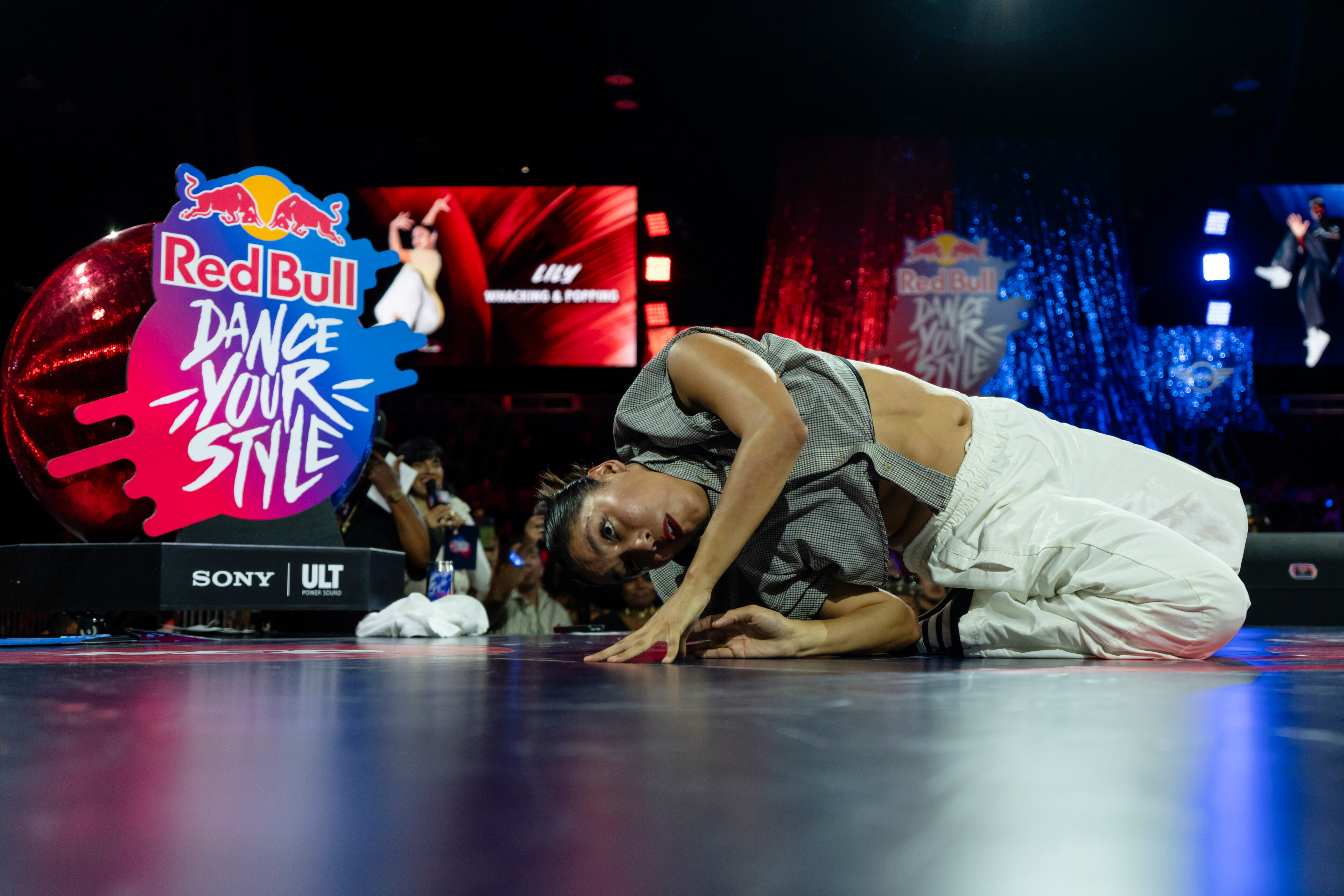
Frias on the floor in Tampa — the screen behind her billed the styles simply as whacking and popping | Photo: Jon Shih/Red Bull Content Pool
A Room, a Television, and Two Older Sisters
Frias grew up in a house full of music, with two older sisters and a father whose career took the family to New Mexico for five years while he completed a Ph.D. Her dance education did not begin in a studio. It began in front of a screen.
“My first dance inspirations were music videos, music, and movies,” she told this publication in 2020. The soundtrack was 1990s: TLC, Brandy, Usher, P. Diddy, Aaliyah, Missy Elliott. She learned the way an enormous number of working dancers actually learn, which is by watching something repeatedly and then trying it alone in a bedroom until the body catches up.
Understand what that means, because it cuts against the story the dance industry prefers to tell about itself. There was no conservatory in this origin. There was a television, a family that filled the house with music, and an unreasonable amount of repetition. Some of the most technically formidable dancers in the world came up exactly this way, and it is worth saying plainly to any young reader who does not live near a good studio: the door is not only the one with tuition attached.
What the family did provide was a position. Her father’s advice has stayed with her, and she repeats it as a sentence rather than a sentiment: “your dream is plan A, there is no plan B.”
“Your dream is plan A, there is no plan B.” — Lily Frias, quoting her father (Dance Mogul Magazine, 2020)
Parents of young dancers should sit with that. It is not reckless advice and it is not a promise of success. It is a refusal to build the safety net that quietly becomes the plan. Plenty of families say the opposite with love, and it lands as permission to stop.
The Word “First,” Twice
Frias has been the first at something twice, and both times the category was national television.
She appeared on MTV’s America’s Best Dance Crew during the Randy Jackson era as part of the first Mexican dance group to compete on the show. She has described that experience, and the exposure to Los Angeles dance culture that came with it, as the thing that settled the question of whether this would be a career.
Then came So You Think You Can Dance, where she became the first Mexican dancer to reach the Top 20.
Here is the part young dancers should read twice, and it is not the part about television. Both of those firsts were achieved inside formats built around a specific kind of dancer — contemporary-trained, competition-schooled, conventionally castable. A street dancer entering those rooms is entering someone else’s evaluation criteria. That she got through them is a fact about adaptability, not just talent.
And note what she did next, because the sequencing is everything. She did not convert that television visibility into a commercial career built on being available to other people’s projects. She went and built her own.
Femme Fatale: What Happened in Sweden
The origin of Femme Fatale is a good story precisely because nobody planned it.
In 2016, Marie Poppins was invited to perform a choreography piece in Sweden and recruited two dancers to do it with her: Lily Frias and Dassy Lee. The same Swedish event was hosting a choreography competition called Dance Delight. The three of them entered it. They won first place. That result, as Femme Fatale told this publication in 2020, is what turned a one-off booking into a group.
Look at the composition of that trio, because it is not incidental to anything that followed. Marie Poppins is French. Dassy Lee is Korean. Lily Frias is Mexican. Three women, three countries, three different relationships to a dance form born in California. The name they chose is a French expression, and the line they built the group on is worth quoting exactly:
“We use our technique as a weapon, our femininity a strength, and our passion as a power.” — Femme Fatale (Dance Mogul Magazine, 2020)
Read that as a technical statement rather than a motto and it tells you what the group actually does. Technique first — the popping, the animation, the robot work, the waacking. Femininity as an instrument in the choreography rather than a costume laid over it. And passion as the engine that makes the other two legible to a room. The sequence matters. Reverse it and you get a group selling an image with nothing underneath.
Dance Mogul Magazine published its full conversations with both Frias and the collective in 2020, and readers who want the unabridged versions can find them in our exclusive interview with Lily Frias and the companion Femme Fatale interview.
Know the Styles: Popping and Waacking
Popping originated in Fresno, California in the 1970s and is built on the pop — a sharp, deliberate contraction and release of the muscle, timed to the beat. Around that core sit related techniques: waving, tutting, animation, robot, gliding. It is a precision discipline, closer to percussion than to flow. Waacking (also written whacking) came out of Los Angeles club culture in the 1970s, danced to disco, and is built on fast rotational arm work, posing, and a performance relationship with an imagined or actual camera. Its history is rooted in LGBTQ+ club spaces, and its vocabulary is unapologetically theatrical.
Why this pairing matters: popping rewards control and waacking rewards projection, and most dancers are strong at one or the other. Holding both means you can build tension with precision and then release it outward to an audience — which is exactly the combination a crowd-voted battle asks for. It is also why Red Bull’s screen in Tampa billed her with both words rather than one.
Forty Million Views, and What They Actually Bought
Femme Fatale performed their Sweden-winning choreography at the Carnival Choreographer’s Ball in Los Angeles. The video of that performance went on to draw some 40 million views. What followed was work: bookings with Red Bull, Marc Jacobs and Cirque du Soleil, plus appearances at the VIBE Dance Competition. Frias’s own credits extend to performing with Femme Fatale at Red Bull BC One in Zürich, and to the 2020 touring production of The Hip Hop Nutcracker alongside Kurtis Blow.
A view count is not an impact statement, so let us be precise about what a performance like that actually does for the dancers in it.
It converts a reputation into leverage. Before the ball, three women had a strong piece and a regional win. After it, they had evidence that a mass audience would watch this specific thing — which is the only argument a brand or a producer genuinely responds to. Forty million views is not fame. It is a negotiating position.
It moved the work from being hired to being booked. There is a meaningful difference between a dancer hired to execute someone else’s choreography and a group booked because of what they already are. The second kind of work pays better, lasts longer, and does not disappear when a trend does.
It proved the thesis in public. The group’s entire premise is that femininity is a technical asset rather than a liability. A room of forty million people agreeing is a harder argument to dismiss than any amount of advocacy.
The Argument About What a Woman in Popping Looks Like
Frias has been unusually direct about the pressure she describes, and unusually specific about why she rejects it. Her position is not that appearance does not matter. It is that appearance has no bearing on whether the technique is there.
A woman who shows up to a popping session in something soft is read, by some rooms, as less serious before she has moved. Frias’s counter-argument is that the reading is simply wrong, and that the remedy is not to change clothes but to have paid your dues and to keep visibly growing. Do that, she argues, and you do not need external validation at all.
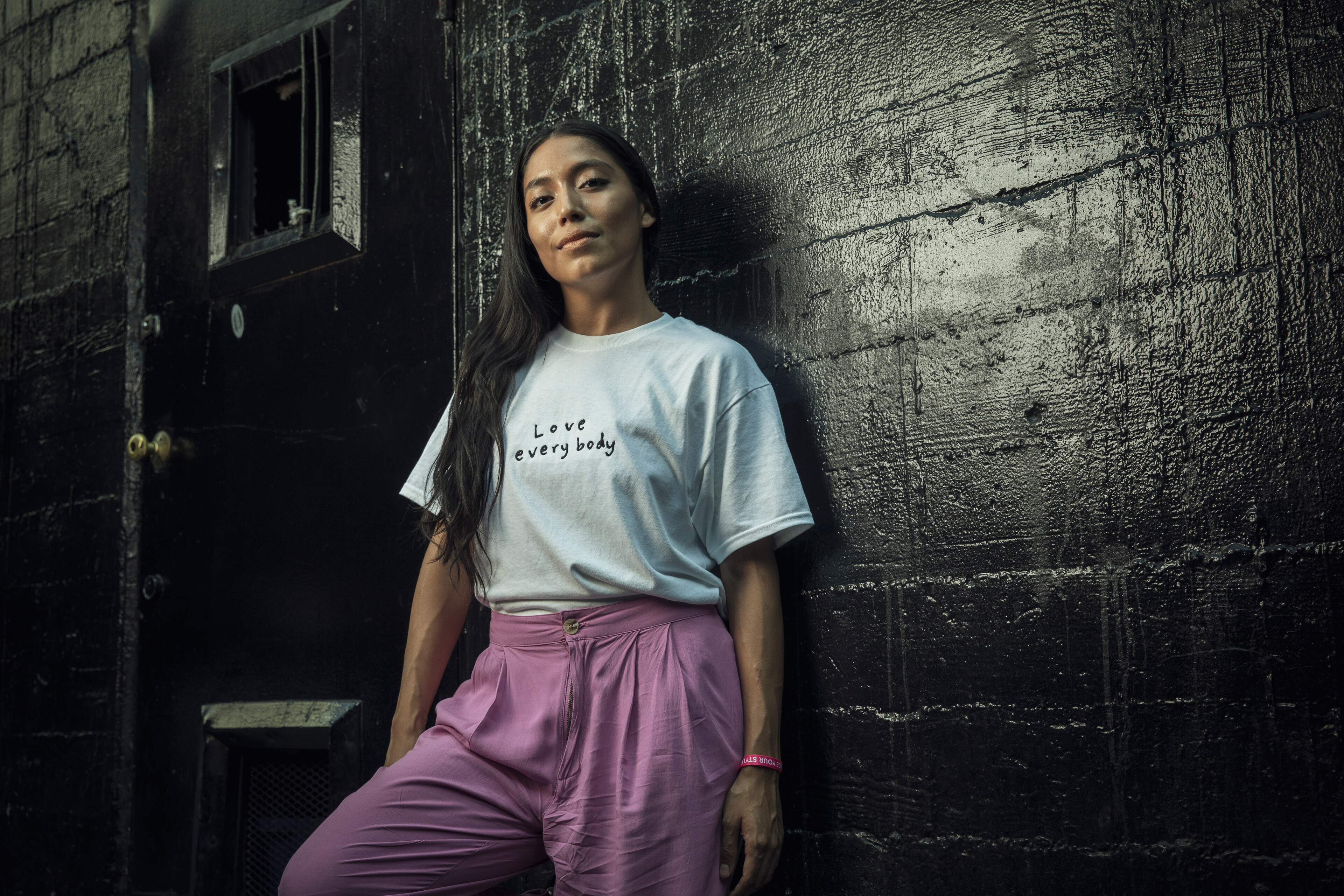
Tampa, September 2026 — pink trousers, a shirt reading “Love every body,” and a black wall | Photo: Jon Shih/Red Bull Content Pool
The photograph above was taken at the same event where she reached the final four. She is wearing pink, against a black industrial wall, in a shirt that reads “Love every body.” Nothing about it is hedged, and nothing about it softened what she did on the floor a few hours later.
There is a second half to her position that gets quoted less and matters more. Femme Fatale’s inclusivity is not only about gender presentation. “We really try to make it for everybody,” she has said — and a trio from Mexico, Korea and France deliberately showing three different versions of womanhood is a structural answer, not a stated one. They did not write a diversity statement. They built a group whose composition is the statement.
Tampa: Precision in a Room That Votes
The 2026 Red Bull Dance Your Style USA National Final took place at the Tampa Convention Center on September 19, 2026. Frias reached the final four, alongside eventual champion JREAMZ, runner-up Kidd The Monster and waving specialist Jesse Sykes. The full field and bracket are documented in our Red Bull Dance Your Style Newsroom.
Consider what the format asks of a popper specifically. Popping is a precision form whose pleasures are small and exact: the hit that lands a fraction after the snare, the arm that travels through a wave without leaking energy. Those details are legible instantly to anyone who knows the form, and nearly invisible to a general audience twenty rows back holding a voting wand.
This is the translation problem the whole event is built around, and it is the reason her second style matters so much. Waacking projects. It throws the movement outward, at speed, with the arms and the face and a performer’s relationship to being watched. A dancer holding both languages can build with popping’s precision and deliver with waacking’s reach.
Reaching the final four in a field containing artistic directors, touring professionals and regional champions is not a footnote. It is evidence that the combination works under the hardest possible conditions: unfamiliar music, no preparation, and a jury of strangers.
The Room She Built for Everybody Else
In 2020, Femme Fatale launched the Femme Fatale Training Program, described by the group as “a safe space for all girls and women who want to elevate in street dance.” They run online classes through STEEZY, where Frias teaches, along with their own weekly training sessions.
Note the sequencing one more time, because it is the single most transferable thing in this profile. She did not build the program first and hope the credibility followed. She earned the credibility — television, the ball, the bookings, the stages — and then spent it on infrastructure for the people coming behind her.
Read the phrase “safe space” in its technical sense here rather than its political one. In street dance, a training room where women are not the minority changes what can be worked on. You can try something and fail at it badly without it being read as proof of anything about women in the form. That is not comfort. That is the condition under which people actually improve.
The group has also spoken about developing a theatre show intended to tour worldwide, and about expanding the Femme Fatale brand to include more women performers. Those are stated intentions rather than announced dates, and we are treating them as such.
The Awards — and the Ones That Don’t Exist Yet
2016 — Dance Delight, Sweden, first place. Won with Marie Poppins and Dassy Lee; the result that turned a one-off booking into Femme Fatale.
— First Mexican dancer to reach the Top 20, So You Think You Can Dance.
— Member of the first Mexican dance group to compete on America’s Best Dance Crew.
2026 — Final four, Red Bull Dance Your Style USA National Final. Tampa Convention Center, September 19.
Here is the honest part, and Dance Mogul Magazine would rather print it than pad a page: there is no comprehensive, publicly maintained record of Lily Frias’s full competitive and performance history. Not because the work was not honored, but because the industry has never built the infrastructure to track street dance credit properly. Battles, sessions, showcase sets, choreography credits inside other people’s productions — the actual substance of a decade of work — leave almost no durable public trace.
That absence is not a footnote to her story. It is the argument. When a discipline is undercredited, its practitioners’ achievements have to be documented deliberately, by publications willing to do it. Otherwise a body of work that changed what a generation of women thought was available to them simply evaporates from the record. It is why The Legacy exists on this site, and why we published her interview in the first place six years ago.
Where Lily Frias Is Now
As of September 2026, the most recent verified activity is Tampa: a final-four finish at the USA National Final, competing in popping and waacking against the deepest all-styles field the event has assembled in the United States. She continues to teach on STEEZY and to work with Femme Fatale, which maintains its training program, its classes and its booking operation out of Los Angeles.
Beyond that, we are not going to invent a schedule for her. Public reporting on the remainder of her 2026 slate is thin, which is entirely normal for working dancers whose projects sit under non-disclosure until a release date. When there is verified news, this publication will report it.
What we will say is that Dance Mogul Magazine intends to keep following her, as we have since 2020, and the rest of the Tampa field through the next twelve months. The interesting question about a competition is never who won on the night. It is who is still building three years later.
Career Timeline
CHILDHOODGrows up in a music-filled household with two older sisters, including five years in New Mexico while her father completes a Ph.D. Learns from music videos, movies and 1990s R&B and hip-hop.
AMERICA’S BEST DANCE CREWCompetes on MTV as part of the first Mexican group to appear on the show. Decides on dance as a career.
SO YOU THINK YOU CAN DANCEBecomes the first Mexican dancer to reach the Top 20.
2016Travels to Sweden with Marie Poppins and Dassy Lee, wins Dance Delight, and Femme Fatale is founded.
CARNIVAL CHOREOGRAPHER’S BALLFemme Fatale performs the Sweden set in Los Angeles. The video reaches some 40 million views, bringing work with Red Bull, Marc Jacobs and Cirque du Soleil.
2020Tours in The Hip Hop Nutcracker with Kurtis Blow. Femme Fatale launches its Training Program for women in street dance. Dance Mogul Magazine publishes its interviews with Frias and the collective.
SEPTEMBER 19, 2026Reaches the final four at the Red Bull Dance Your Style USA National Final in Tampa.
What She Represents to Young, Up-and-Coming Dancers
The pattern Lily Frias broke is the one that tells a woman in a male-coded form to edit herself down until she is acceptable, and to consider that the price of entry. She declined to pay it and got better instead.
Read as a career path rather than a résumé, her trajectory shows five distinct stages, and any serious dancer can locate herself on this ladder — which is the whole reason we are laying it out.
1. Learn from whatever is actually in front of you
Music videos, movies, a bedroom and repetition. Not every dancer has a studio nearby or tuition available, and treating that as disqualifying removes most of the people who built these forms. Start with the material you have. The body does not know where the education came from.
2. Take the room that judges you by someone else’s criteria
Television competitions evaluate street dancers against standards the form was never built for. Frias went through two of them anyway and came out with credentials that opened doors her home discipline could not open by itself. Enter the unfamiliar room. Learn what it measures. Do not let it tell you what you are.
3. Build the thing you would rather be hired as
The move after television was not more auditions. It was a group with a point of view, a name, a philosophy and a set. Femme Fatale is bookable as itself. A dancer who exists only as a freelancer is always inside someone else’s idea; a dancer inside a collective with an identity gets hired for hers.
4. Hold two languages, not one
Popping for precision, waacking for projection. The combination is why a specialist form survived contact with a general audience in Tampa. Depth in one discipline is non-negotiable; a second that covers the first one’s blind spot is what makes a career portable.
5. Turn access into a door for other people
The final stage is the one most careers never reach: using your position to teach, hire, platform and mentor. Frias and Femme Fatale spent their leverage building a training program for women in street dance and teaching at scale online, so that the next woman walking into a popping session inherits a wider room than the one they found. That is what a career looks like when it stops being about you. If you are building the discipline behind a plan like the one mapped above, our workbooks were built for exactly that.
Why Lily Frias Matters to Dance Mogul Magazine
Dance Mogul Magazine has published for over fifteen years on a single conviction: dance is the foundation, not the ceiling. Frias answers that as directly as any artist we have covered. Her actual subject is not popping. It is the cost of editing yourself to be acceptable to a room, and the alternative — getting good enough, and staying yourself long enough, that the room changes shape instead. Move that out of the studio and it is a workplace, a classroom, a family, a life. Very few people are ever shown that the second option exists.
The movement vocabulary that drives mainstream entertainment is overwhelmingly born in Black communities, in club culture, in street dance and hip-hop, and is then absorbed upward into pop, film and television — frequently without credit traveling with it. Popping came out of Fresno. Waacking came out of Los Angeles club culture with deep LGBTQ+ roots. Both are borrowed from constantly and named rarely. As a father and son Black owned dance publication, documenting that chain of authorship is not a side project for us. It is the work.
There is also a continuity here we take seriously. Dance Mogul Magazine interviewed Frias and Femme Fatale in 2020, years before a Tampa arena was involved. Covering an artist once she is convenient to cover is publicity. Covering her for six years is a record.
If her story lands with you, keep going: explore the full range of forms in our Dance Styles Hub, read more conversations with working professionals in our Exclusive Interviews, study the artists shaping the commercial industry in Black Creative Directors & Choreographers, and build your foundation in the Dance Knowledge Hub.
Frequently Asked Questions About Lily Frias
Who is Lily Frias?
Liliana “Lily” Frias is a Mexican dancer and choreographer based in Los Angeles who specializes in popping and waacking. She is a founding member of the international trio Femme Fatale, a STEEZY instructor, and reached the final four at the 2026 Red Bull Dance Your Style USA National Final in Tampa.
What dance styles does Lily Frias specialize in?
Popping and waacking are her core disciplines — Red Bull’s screen at the Tampa final billed her as “whacking and popping.” She has said she draws on much more than that: “I take everything: locking, house, hip hop, lightfeet, vogue, like, I just love everything.”
What is Femme Fatale?
Femme Fatale is an international dance trio founded in 2016 by Marie Poppins, Lily Frias and Dassy Lee — from France, Mexico and Korea respectively. The group formed after winning the Dance Delight choreography competition in Sweden. Their stated philosophy: “We use our technique as a weapon, our femininity a strength, and our passion as a power.”
What television shows has Lily Frias been on?
She competed on MTV’s America’s Best Dance Crew as part of the first Mexican group to appear on the show, and she was the first Mexican dancer to reach the Top 20 on So You Think You Can Dance.
How did Lily Frias do at Red Bull Dance Your Style 2026?
She reached the final four at the USA National Final in Tampa on September 19, 2026, alongside champion JREAMZ, runner-up Kidd The Monster and Jesse Sykes.
Where can you take a class with Lily Frias?
She teaches on the online platform STEEZY, and Femme Fatale runs its own Training Program along with weekly online training sessions. The group describes the program as “a safe space for all girls and women who want to elevate in street dance.”
What advice does Lily Frias give young dancers?
“Never doubt your talent, be fearless, kind, disciplined and always true to yourself.” She also credits her father’s position on committing to the work: “your dream is plan A, there is no plan B.”
Keep Exploring
Dance Mogul Magazine documents the artists who build the culture and the careers that grow out of it. Start with the Featured Artist series, dig into the Archive, follow the season in the Red Bull Dance Your Style Newsroom, and browse everything we have published in the Article Library.
Reporting sources: Dance Mogul Magazine’s own 2020 interviews with Lily Frias and Femme Fatale, thINKingDANCE, STEEZY, femmefataledance.com, and Red Bull. Career details reflect verified public reporting as of September 2026. Where the public record is incomplete, this article says so rather than filling the gap.
Lily Frias Femme Fatale Popping Waacking Red Bull Dance Your Style Street Dance Women in Dance Marie Poppins Dassy Lee Los Angeles Dance Featured Artist Tampa 2026
© 2026 Dance Mogul Magazine LLC | dancemogul.com | Inspiring Self-Empowerment Through Dance Culture
Red Bull and Red Bull Dance Your Style are trademarks of their respective owners. Dance Mogul Magazine is an independent publication and is not affiliated with, endorsed by, or sponsored by Red Bull.
Featured Artist | Popping & Waacking | Red Bull Dance Your Style
Lily Frias: The Popper Who Refused to Dance Like a Man to Be Taken Seriously
She was the first Mexican dancer to reach the Top 20 on So You Think You Can Dance, a founding member of Femme Fatale, and a Tampa final-four finisher. The through-line across all of it is a refusal to treat femininity as something to apologize for.
By Dance Mogul Magazine | Featured Artist | September 2026
The room that decides it — voting wands up at the USA National Final, Tampa, September 19, 2026 | Photo: Jon Shih/Red Bull Content Pool
Artist Spotlight
Liliana “Lily” Frias is a Mexican dancer and choreographer based in Los Angeles, specializing in popping and waacking. She told Dance Mogul Magazine in 2020 that her first dance inspirations were music videos and movies, and that she spent five childhood years in New Mexico while her father completed his Ph.D. She appeared on MTV’s America’s Best Dance Crew as part of the first Mexican group on the show, then became the first Mexican dancer to reach the Top 20 of So You Think You Can Dance. In 2016 she co-founded Femme Fatale with Marie Poppins and Dassy Lee — a trio from France, Korea and Mexico whose Carnival Choreographer’s Ball performance drew some 40 million views and brought bookings with Red Bull, Marc Jacobs and Cirque du Soleil. She teaches on STEEZY, co-founded the Femme Fatale Training Program for women in street dance, and reached the final four at the 2026 Red Bull Dance Your Style USA National Final in Tampa.
File // At a Glance
NAME — Liliana “Lily” Frias
STYLES — Popping | waacking | hip-hop | house | locking
ORIGIN — Mexican | five childhood years in New Mexico
BASED — Los Angeles, California
COLLECTIVE — Femme Fatale, co-founded 2016
CREWMATES — Marie Poppins (France) | Dassy Lee (Korea)
TELEVISION — So You Think You Can Dance | America’s Best Dance Crew
STAGE — Cirque du Soleil | Red Bull BC One | The Hip Hop Nutcracker
TEACHING — STEEZY | Femme Fatale Training Program
TAMPA 2026 — Final four
|
2016 Femme Fatale Founded |
40M+ Views on One Performance |
3 Countries in the Trio |
4 Tampa Final Four |
Popping is a man’s room. Not by rule — nothing in the form requires it — but by decades of habit, and every woman who has walked into a popping session knows the arithmetic she is expected to do. Dress down. Move harder. Take the softness out of the arms. Earn the respect first and be yourself later, if there is a later. Lily Frias named the whole mechanism in a single sentence: “You’re expected to look a certain way or dress a certain way or try to be more masculine to get more validation.”
And then she said the part that reorganizes a career: “But I don’t think there’s a definition of what a female should look like.” That is not a slogan. It is a technical position with consequences, and she has spent roughly a decade proving it out in the hardest available venues — national television, a Cirque du Soleil stage, a Los Angeles choreography ball, and finally a Tampa arena where the audience, not a panel of specialists, decided whether it worked. The dance world tends to file this under representation. It is better understood as craft.
This piece argues that Frias’s career is a working answer to a question far bigger than dance: what happens when you stop editing yourself to be legible to a room, and instead get so good that the room has to widen? The answer, in her case, involved a group of three women from three countries, one performance that traveled forty million times, and a training program built so that the next woman would not have to do the arithmetic at all. That progression is the real subject here — because it is repeatable, and because most young dancers are never shown that it exists.

Frias on the floor in Tampa — the screen behind her billed the styles simply as whacking and popping | Photo: Jon Shih/Red Bull Content Pool
A Room, a Television, and Two Older Sisters
Frias grew up in a house full of music, with two older sisters and a father whose career took the family to New Mexico for five years while he completed a Ph.D. Her dance education did not begin in a studio. It began in front of a screen.
“My first dance inspirations were music videos, music, and movies,” she told this publication in 2020. The soundtrack was 1990s: TLC, Brandy, Usher, P. Diddy, Aaliyah, Missy Elliott. She learned the way an enormous number of working dancers actually learn, which is by watching something repeatedly and then trying it alone in a bedroom until the body catches up.
Understand what that means, because it cuts against the story the dance industry prefers to tell about itself. There was no conservatory in this origin. There was a television, a family that filled the house with music, and an unreasonable amount of repetition. Some of the most technically formidable dancers in the world came up exactly this way, and it is worth saying plainly to any young reader who does not live near a good studio: the door is not only the one with tuition attached.
What the family did provide was a position. Her father’s advice has stayed with her, and she repeats it as a sentence rather than a sentiment: “your dream is plan A, there is no plan B.”
“Your dream is plan A, there is no plan B.” — Lily Frias, quoting her father (Dance Mogul Magazine, 2020)
Parents of young dancers should sit with that. It is not reckless advice and it is not a promise of success. It is a refusal to build the safety net that quietly becomes the plan. Plenty of families say the opposite with love, and it lands as permission to stop.
The Word “First,” Twice
Frias has been the first at something twice, and both times the category was national television.
She appeared on MTV’s America’s Best Dance Crew during the Randy Jackson era as part of the first Mexican dance group to compete on the show. She has described that experience, and the exposure to Los Angeles dance culture that came with it, as the thing that settled the question of whether this would be a career.
Then came So You Think You Can Dance, where she became the first Mexican dancer to reach the Top 20.
Here is the part young dancers should read twice, and it is not the part about television. Both of those firsts were achieved inside formats built around a specific kind of dancer — contemporary-trained, competition-schooled, conventionally castable. A street dancer entering those rooms is entering someone else’s evaluation criteria. That she got through them is a fact about adaptability, not just talent.
And note what she did next, because the sequencing is everything. She did not convert that television visibility into a commercial career built on being available to other people’s projects. She went and built her own.
Femme Fatale: What Happened in Sweden
The origin of Femme Fatale is a good story precisely because nobody planned it.
In 2016, Marie Poppins was invited to perform a choreography piece in Sweden and recruited two dancers to do it with her: Lily Frias and Dassy Lee. The same Swedish event was hosting a choreography competition called Dance Delight. The three of them entered it. They won first place. That result, as Femme Fatale told this publication in 2020, is what turned a one-off booking into a group.
Look at the composition of that trio, because it is not incidental to anything that followed. Marie Poppins is French. Dassy Lee is Korean. Lily Frias is Mexican. Three women, three countries, three different relationships to a dance form born in California. The name they chose is a French expression, and the line they built the group on is worth quoting exactly:
“We use our technique as a weapon, our femininity a strength, and our passion as a power.” — Femme Fatale (Dance Mogul Magazine, 2020)
Read that as a technical statement rather than a motto and it tells you what the group actually does. Technique first — the popping, the animation, the robot work, the waacking. Femininity as an instrument in the choreography rather than a costume laid over it. And passion as the engine that makes the other two legible to a room. The sequence matters. Reverse it and you get a group selling an image with nothing underneath.
Dance Mogul Magazine published its full conversations with both Frias and the collective in 2020, and readers who want the unabridged versions can find them in our exclusive interview with Lily Frias and the companion Femme Fatale interview.
Know the Styles: Popping and Waacking
Popping originated in Fresno, California in the 1970s and is built on the pop — a sharp, deliberate contraction and release of the muscle, timed to the beat. Around that core sit related techniques: waving, tutting, animation, robot, gliding. It is a precision discipline, closer to percussion than to flow. Waacking (also written whacking) came out of Los Angeles club culture in the 1970s, danced to disco, and is built on fast rotational arm work, posing, and a performance relationship with an imagined or actual camera. Its history is rooted in LGBTQ+ club spaces, and its vocabulary is unapologetically theatrical.
Why this pairing matters: popping rewards control and waacking rewards projection, and most dancers are strong at one or the other. Holding both means you can build tension with precision and then release it outward to an audience — which is exactly the combination a crowd-voted battle asks for. It is also why Red Bull’s screen in Tampa billed her with both words rather than one.
Forty Million Views, and What They Actually Bought
Femme Fatale performed their Sweden-winning choreography at the Carnival Choreographer’s Ball in Los Angeles. The video of that performance went on to draw some 40 million views. What followed was work: bookings with Red Bull, Marc Jacobs and Cirque du Soleil, plus appearances at the VIBE Dance Competition. Frias’s own credits extend to performing with Femme Fatale at Red Bull BC One in Zürich, and to the 2020 touring production of The Hip Hop Nutcracker alongside Kurtis Blow.
A view count is not an impact statement, so let us be precise about what a performance like that actually does for the dancers in it.
It converts a reputation into leverage. Before the ball, three women had a strong piece and a regional win. After it, they had evidence that a mass audience would watch this specific thing — which is the only argument a brand or a producer genuinely responds to. Forty million views is not fame. It is a negotiating position.
It moved the work from being hired to being booked. There is a meaningful difference between a dancer hired to execute someone else’s choreography and a group booked because of what they already are. The second kind of work pays better, lasts longer, and does not disappear when a trend does.
It proved the thesis in public. The group’s entire premise is that femininity is a technical asset rather than a liability. A room of forty million people agreeing is a harder argument to dismiss than any amount of advocacy.
The Argument About What a Woman in Popping Looks Like
Frias has been unusually direct about the pressure she describes, and unusually specific about why she rejects it. Her position is not that appearance does not matter. It is that appearance has no bearing on whether the technique is there.
A woman who shows up to a popping session in something soft is read, by some rooms, as less serious before she has moved. Frias’s counter-argument is that the reading is simply wrong, and that the remedy is not to change clothes but to have paid your dues and to keep visibly growing. Do that, she argues, and you do not need external validation at all.

Tampa, September 2026 — pink trousers, a shirt reading “Love every body,” and a black wall | Photo: Jon Shih/Red Bull Content Pool
The photograph above was taken at the same event where she reached the final four. She is wearing pink, against a black industrial wall, in a shirt that reads “Love every body.” Nothing about it is hedged, and nothing about it softened what she did on the floor a few hours later.
There is a second half to her position that gets quoted less and matters more. Femme Fatale’s inclusivity is not only about gender presentation. “We really try to make it for everybody,” she has said — and a trio from Mexico, Korea and France deliberately showing three different versions of womanhood is a structural answer, not a stated one. They did not write a diversity statement. They built a group whose composition is the statement.
Tampa: Precision in a Room That Votes
The 2026 Red Bull Dance Your Style USA National Final took place at the Tampa Convention Center on September 19, 2026. Frias reached the final four, alongside eventual champion JREAMZ, runner-up Kidd The Monster and waving specialist Jesse Sykes. The full field and bracket are documented in our Red Bull Dance Your Style Newsroom.
Consider what the format asks of a popper specifically. Popping is a precision form whose pleasures are small and exact: the hit that lands a fraction after the snare, the arm that travels through a wave without leaking energy. Those details are legible instantly to anyone who knows the form, and nearly invisible to a general audience twenty rows back holding a voting wand.
This is the translation problem the whole event is built around, and it is the reason her second style matters so much. Waacking projects. It throws the movement outward, at speed, with the arms and the face and a performer’s relationship to being watched. A dancer holding both languages can build with popping’s precision and deliver with waacking’s reach.
Reaching the final four in a field containing artistic directors, touring professionals and regional champions is not a footnote. It is evidence that the combination works under the hardest possible conditions: unfamiliar music, no preparation, and a jury of strangers.
The Room She Built for Everybody Else
In 2020, Femme Fatale launched the Femme Fatale Training Program, described by the group as “a safe space for all girls and women who want to elevate in street dance.” They run online classes through STEEZY, where Frias teaches, along with their own weekly training sessions.
Note the sequencing one more time, because it is the single most transferable thing in this profile. She did not build the program first and hope the credibility followed. She earned the credibility — television, the ball, the bookings, the stages — and then spent it on infrastructure for the people coming behind her.
Read the phrase “safe space” in its technical sense here rather than its political one. In street dance, a training room where women are not the minority changes what can be worked on. You can try something and fail at it badly without it being read as proof of anything about women in the form. That is not comfort. That is the condition under which people actually improve.
The group has also spoken about developing a theatre show intended to tour worldwide, and about expanding the Femme Fatale brand to include more women performers. Those are stated intentions rather than announced dates, and we are treating them as such.
The Awards — and the Ones That Don’t Exist Yet
2016 — Dance Delight, Sweden, first place. Won with Marie Poppins and Dassy Lee; the result that turned a one-off booking into Femme Fatale.
— First Mexican dancer to reach the Top 20, So You Think You Can Dance.
— Member of the first Mexican dance group to compete on America’s Best Dance Crew.
2026 — Final four, Red Bull Dance Your Style USA National Final. Tampa Convention Center, September 19.
Here is the honest part, and Dance Mogul Magazine would rather print it than pad a page: there is no comprehensive, publicly maintained record of Lily Frias’s full competitive and performance history. Not because the work was not honored, but because the industry has never built the infrastructure to track street dance credit properly. Battles, sessions, showcase sets, choreography credits inside other people’s productions — the actual substance of a decade of work — leave almost no durable public trace.
That absence is not a footnote to her story. It is the argument. When a discipline is undercredited, its practitioners’ achievements have to be documented deliberately, by publications willing to do it. Otherwise a body of work that changed what a generation of women thought was available to them simply evaporates from the record. It is why The Legacy exists on this site, and why we published her interview in the first place six years ago.
Where Lily Frias Is Now
As of September 2026, the most recent verified activity is Tampa: a final-four finish at the USA National Final, competing in popping and waacking against the deepest all-styles field the event has assembled in the United States. She continues to teach on STEEZY and to work with Femme Fatale, which maintains its training program, its classes and its booking operation out of Los Angeles.
Beyond that, we are not going to invent a schedule for her. Public reporting on the remainder of her 2026 slate is thin, which is entirely normal for working dancers whose projects sit under non-disclosure until a release date. When there is verified news, this publication will report it.
What we will say is that Dance Mogul Magazine intends to keep following her, as we have since 2020, and the rest of the Tampa field through the next twelve months. The interesting question about a competition is never who won on the night. It is who is still building three years later.
Career Timeline
CHILDHOODGrows up in a music-filled household with two older sisters, including five years in New Mexico while her father completes a Ph.D. Learns from music videos, movies and 1990s R&B and hip-hop.
AMERICA’S BEST DANCE CREWCompetes on MTV as part of the first Mexican group to appear on the show. Decides on dance as a career.
SO YOU THINK YOU CAN DANCEBecomes the first Mexican dancer to reach the Top 20.
2016Travels to Sweden with Marie Poppins and Dassy Lee, wins Dance Delight, and Femme Fatale is founded.
CARNIVAL CHOREOGRAPHER’S BALLFemme Fatale performs the Sweden set in Los Angeles. The video reaches some 40 million views, bringing work with Red Bull, Marc Jacobs and Cirque du Soleil.
2020Tours in The Hip Hop Nutcracker with Kurtis Blow. Femme Fatale launches its Training Program for women in street dance. Dance Mogul Magazine publishes its interviews with Frias and the collective.
SEPTEMBER 19, 2026Reaches the final four at the Red Bull Dance Your Style USA National Final in Tampa.
What She Represents to Young, Up-and-Coming Dancers
The pattern Lily Frias broke is the one that tells a woman in a male-coded form to edit herself down until she is acceptable, and to consider that the price of entry. She declined to pay it and got better instead.
Read as a career path rather than a résumé, her trajectory shows five distinct stages, and any serious dancer can locate herself on this ladder — which is the whole reason we are laying it out.
1. Learn from whatever is actually in front of you
Music videos, movies, a bedroom and repetition. Not every dancer has a studio nearby or tuition available, and treating that as disqualifying removes most of the people who built these forms. Start with the material you have. The body does not know where the education came from.
2. Take the room that judges you by someone else’s criteria
Television competitions evaluate street dancers against standards the form was never built for. Frias went through two of them anyway and came out with credentials that opened doors her home discipline could not open by itself. Enter the unfamiliar room. Learn what it measures. Do not let it tell you what you are.
3. Build the thing you would rather be hired as
The move after television was not more auditions. It was a group with a point of view, a name, a philosophy and a set. Femme Fatale is bookable as itself. A dancer who exists only as a freelancer is always inside someone else’s idea; a dancer inside a collective with an identity gets hired for hers.
4. Hold two languages, not one
Popping for precision, waacking for projection. The combination is why a specialist form survived contact with a general audience in Tampa. Depth in one discipline is non-negotiable; a second that covers the first one’s blind spot is what makes a career portable.
5. Turn access into a door for other people
The final stage is the one most careers never reach: using your position to teach, hire, platform and mentor. Frias and Femme Fatale spent their leverage building a training program for women in street dance and teaching at scale online, so that the next woman walking into a popping session inherits a wider room than the one they found. That is what a career looks like when it stops being about you. If you are building the discipline behind a plan like the one mapped above, our workbooks were built for exactly that.
Why Lily Frias Matters to Dance Mogul Magazine
Dance Mogul Magazine has published for over fifteen years on a single conviction: dance is the foundation, not the ceiling. Frias answers that as directly as any artist we have covered. Her actual subject is not popping. It is the cost of editing yourself to be acceptable to a room, and the alternative — getting good enough, and staying yourself long enough, that the room changes shape instead. Move that out of the studio and it is a workplace, a classroom, a family, a life. Very few people are ever shown that the second option exists.
The movement vocabulary that drives mainstream entertainment is overwhelmingly born in Black communities, in club culture, in street dance and hip-hop, and is then absorbed upward into pop, film and television — frequently without credit traveling with it. Popping came out of Fresno. Waacking came out of Los Angeles club culture with deep LGBTQ+ roots. Both are borrowed from constantly and named rarely. As a father and son Black owned dance publication, documenting that chain of authorship is not a side project for us. It is the work.
There is also a continuity here we take seriously. Dance Mogul Magazine interviewed Frias and Femme Fatale in 2020, years before a Tampa arena was involved. Covering an artist once she is convenient to cover is publicity. Covering her for six years is a record.
If her story lands with you, keep going: explore the full range of forms in our Dance Styles Hub, read more conversations with working professionals in our Exclusive Interviews, study the artists shaping the commercial industry in Black Creative Directors & Choreographers, and build your foundation in the Dance Knowledge Hub.
Frequently Asked Questions About Lily Frias
Who is Lily Frias?
Liliana “Lily” Frias is a Mexican dancer and choreographer based in Los Angeles who specializes in popping and waacking. She is a founding member of the international trio Femme Fatale, a STEEZY instructor, and reached the final four at the 2026 Red Bull Dance Your Style USA National Final in Tampa.
What dance styles does Lily Frias specialize in?
Popping and waacking are her core disciplines — Red Bull’s screen at the Tampa final billed her as “whacking and popping.” She has said she draws on much more than that: “I take everything: locking, house, hip hop, lightfeet, vogue, like, I just love everything.”
What is Femme Fatale?
Femme Fatale is an international dance trio founded in 2016 by Marie Poppins, Lily Frias and Dassy Lee — from France, Mexico and Korea respectively. The group formed after winning the Dance Delight choreography competition in Sweden. Their stated philosophy: “We use our technique as a weapon, our femininity a strength, and our passion as a power.”
What television shows has Lily Frias been on?
She competed on MTV’s America’s Best Dance Crew as part of the first Mexican group to appear on the show, and she was the first Mexican dancer to reach the Top 20 on So You Think You Can Dance.
How did Lily Frias do at Red Bull Dance Your Style 2026?
She reached the final four at the USA National Final in Tampa on September 19, 2026, alongside champion JREAMZ, runner-up Kidd The Monster and Jesse Sykes.
Where can you take a class with Lily Frias?
She teaches on the online platform STEEZY, and Femme Fatale runs its own Training Program along with weekly online training sessions. The group describes the program as “a safe space for all girls and women who want to elevate in street dance.”
What advice does Lily Frias give young dancers?
“Never doubt your talent, be fearless, kind, disciplined and always true to yourself.” She also credits her father’s position on committing to the work: “your dream is plan A, there is no plan B.”
Keep Exploring
Dance Mogul Magazine documents the artists who build the culture and the careers that grow out of it. Start with the Featured Artist series, dig into the Archive, follow the season in the Red Bull Dance Your Style Newsroom, and browse everything we have published in the Article Library.
Reporting sources: Dance Mogul Magazine’s own 2020 interviews with Lily Frias and Femme Fatale, thINKingDANCE, STEEZY, femmefataledance.com, and Red Bull. Career details reflect verified public reporting as of September 2026. Where the public record is incomplete, this article says so rather than filling the gap.
Lily Frias Femme Fatale Popping Waacking Red Bull Dance Your Style Street Dance Women in Dance Marie Poppins Dassy Lee Los Angeles Dance Featured Artist Tampa 2026
© 2026 Dance Mogul Magazine LLC | dancemogul.com | Inspiring Self-Empowerment Through Dance Culture
Red Bull and Red Bull Dance Your Style are trademarks of their respective owners. Dance Mogul Magazine is an independent publication and is not affiliated with, endorsed by, or sponsored by Red Bull.