
Dance Mogul Magazine · The Legacy · Hip-Hop & Street Dance
Jabbawockeez History: Behind the Masks, Beyond the Fame
From a 2003 San Diego crew and the mentor they lost before the cameras found them, to Las Vegas headlining, creative ownership, and a red sneaker in 2026 that carries the name of the do-or-die routine that carried them into the final they won.
November 18, 2026 · Dance Mogul Magazine · Legacy Feature
On a phone this opens your share sheet, where you can choose Add Bookmark. On a desktop it copies the link and shows the shortcut.
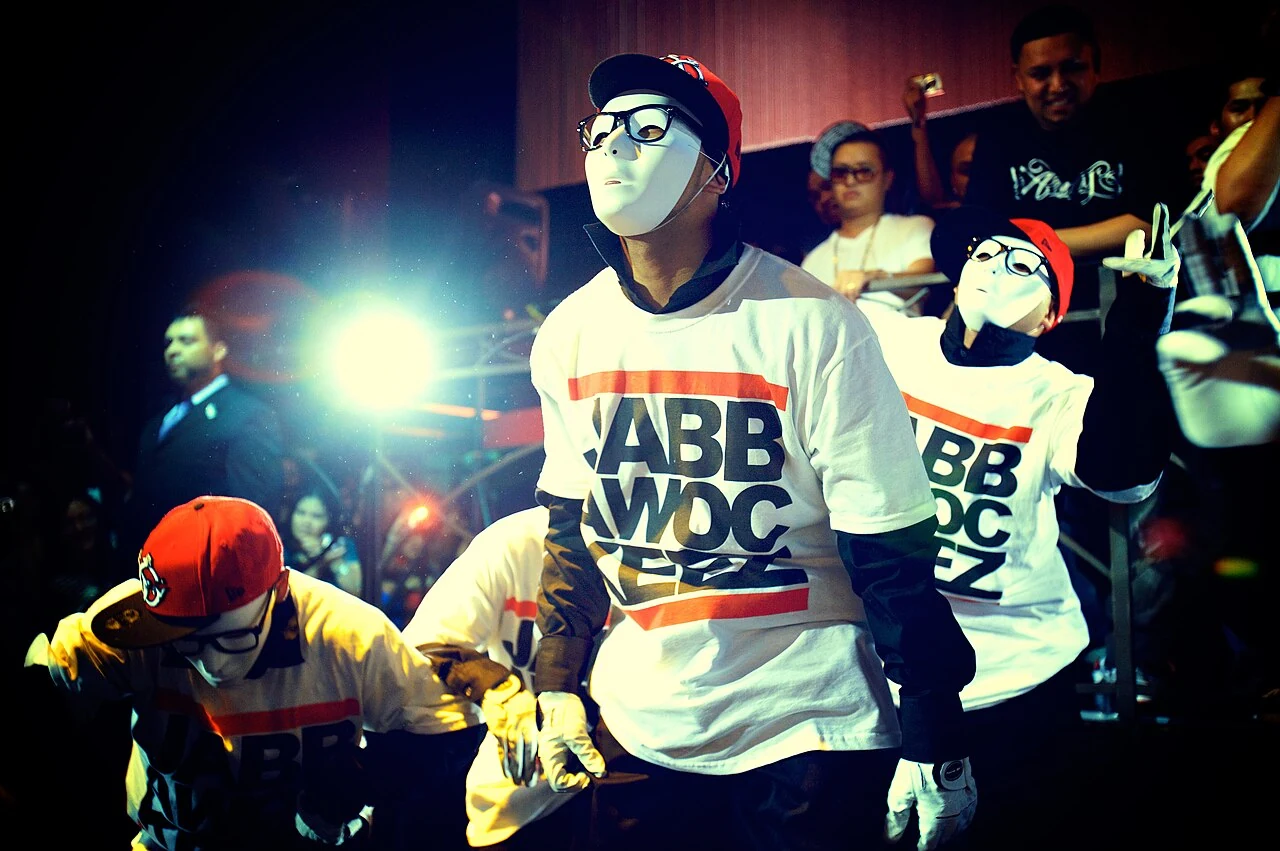
The mask is the first thing anyone tells you about the Jabbawockeez, and it is the least interesting thing about them.
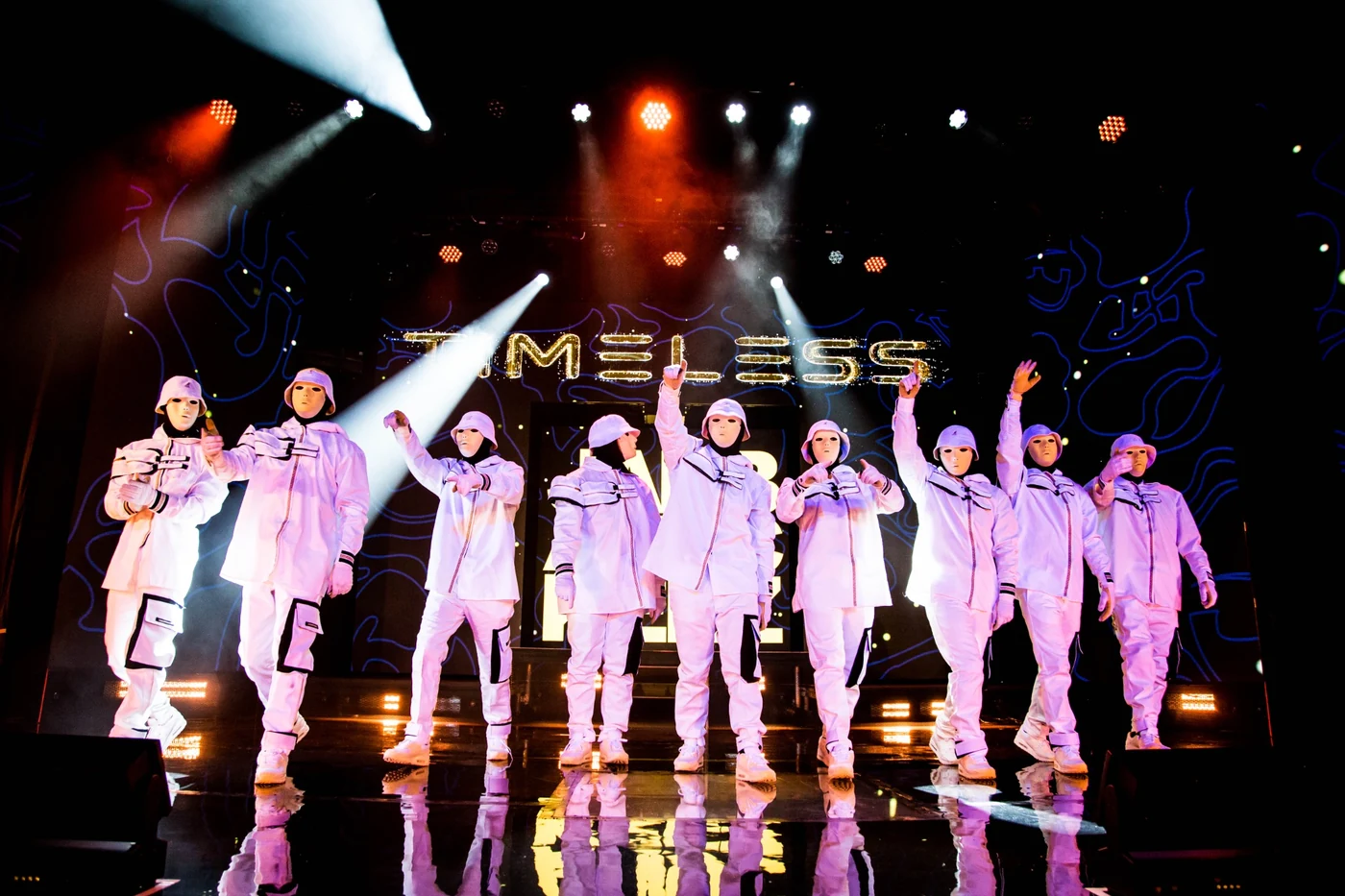
A plain white face, no expression to read, a pair of white gloves. Multiply that by six or eight bodies hitting the same count and the effect is not anonymity but amplification: you stop looking for a star and start watching the music get built in front of you. It is a deliberate design, and the people who made it were specific about why. In the summer of 2008, weeks after the crew had become the most famous dancers in America, member Eddie Gutierrez told AsianWeek that the mask was there to take ethnic and social barriers out of the performance, and Randy Bernal said audiences should judge them on their moves and their style. The crew that wore those masks was, in that same reporting, seven Asian American dancers of Filipino, Korean and Vietnamese background, one African American dancer and two Mexican American dancers. The blank white face was not a way of hiding who they were. It was a way of making sure nobody decided who they were before the first eight-count.
Eighteen years later, the paradox has gone industrial. Every individual face still disappears, and the collective identity is recognizable in airports. There is a theater on the Las Vegas Strip with their name on it. There is a federal trademark register entry, a record label, a headquarters full of memorabilia, a merchandise catalog, and as of November 14, 2026, a red suede PUMA sneaker in stores that carries the title of the do-or-die routine that put them in the 2008 final.
That last detail is where this story starts turning, because it points back to something in Dance Mogul Magazine's own archive.
The Jabbawockeez history that follows is not a finished chapter, and it is not a biography of six young men who won a television show. It is the record of a street-dance crew that turned a collective idea into an institution, kept the idea mostly intact while doing it, and lost the man who held them together before the world ever saw them. What follows separates what the documents establish from what remains an open question, names the people and communities the name was built on, and says plainly where DMM is still waiting on an answer.
“There’s not one guy who makes all the calls.”
Jeff “Phi” Nguyen, on how the Jabbawockeez decide, to Backstage
Jabbawockeez history at a glance
File // At a Glance
What they are — A masked hip-hop and street-dance collective, and also an entertainment business that produces ticketed Las Vegas shows, sells merchandise, makes music and video, and partners with brands.
Formed — 2003, San Diego, California.
Founding pair — Kevin “KB” Brewer and Joe “Punkee” Larot. Several accounts, including the group’s own bio as reported by NBC, also name Phil “Swagger Boy” Tayag.
The name — From “Jabberwocky,” the Lewis Carroll nonsense poem in Through the Looking-Glass. Credited to Joe Larot. Not an acronym.
The mentor — Gary “Gee One” Kendell, 1970–2007. Bay Area b-boy, teacher and the crew’s elder. Died December 14, 2007, before the breakthrough.
Television — America’s Got Talent season two, 2007, eliminated in the Las Vegas round. Won season one of MTV’s Randy Jackson Presents America’s Best Dance Crew, finale March 27, 2008.
Las Vegas — First dance crew to headline its own Las Vegas show, May 2010. Five productions since: MÜS.I.C., PRiSM, JREAMZ, TIMELESS, FREQNCY.
Playing now — FREQNCY at the Jabbawockeez Theater, MGM Grand, with ticketed dates listed into 2027.
Next confirmed date away from Vegas — TIMELESS, one night, Friday, April 2, 2027, Seneca Niagara Resort & Casino Event Center, Niagara Falls, New York.
The name on the paperwork — The JABBAWOCKEEZ word mark is held by WKZ, LLC of Las Vegas; other filings in the same portfolio are recorded under the name Jabbawockeez, LLC.
DMM connection — DMM’s 2013 Zulu Gremlin interview published video of the crew receiving the shoes worn in “The Red Pill,” their do-or-die piece of March 20, 2008.
2003
Founded in San Diego
2008
First ABDC champions
5
Las Vegas productions
16+
Years headlining the Strip
The short answers
What does the name mean? It comes from a poem, not an acronym. “Jabberwocky” is Lewis Carroll’s nonsense verse in Through the Looking-Glass, and the spelling the crew uses is their own. Nothing is hidden in the letters.
Dance crew or company? Both, and that is the whole point. The crew formed in 2003. The business that now carries the crew produces ticketed shows, merchandise, music and brand work.
Is it a corporation? The public records that exist point to limited liability companies, not a public corporation, and a trademark record names who holds a mark, not who owns a company. DMM has not been given an ownership chart and does not publish one.
What is next? FREQNCY continues at MGM Grand with dates listed into 2027, and one TIMELESS night is confirmed for April 2, 2027 in Niagara Falls. Everything beyond that is a question, not a plan, and this article marks it as such.
A nonsense poem, a deliberate misspelling, and what the name does not mean
In 1871 Lewis Carroll put a poem in the hands of Alice, in the book we now call Through the Looking-Glass, and the poem was built out of words that do not exist. “Jabberwocky” works anyway. You can feel the shape of a monster in it without being able to define a single invented term. That is a useful thing to know about this crew, because the name they chose does the same job: it sounds like something before it means anything.
The attribution is consistent across published accounts: the name is credited to Joe “Punkee” Larot, drawn from Carroll’s creature, respelled into something that belonged to dancers rather than to English literature. NBC, reporting on the group’s own website, places the origin in the 1870s poem and in Through the Looking-Glass. Backstage, writing about how the troupe operates, traces the name to the poem’s dragon-like title character. The crew leaned into the dreamlike register early: they told America’s Got Talent that they were a figment of the audience’s imagination, and in 2008 the phrase JABBAWOCKEEZ A FIGMENT OF YOUR IMAGINATION was filed as a federal trademark. That particular registration was later cancelled, but it tells you something about how young this crew was when it started treating language as an asset.
So let us settle the thing people most often get wrong, because it circulates constantly and DMM gets asked it directly. Jabbawockeez is not an acronym. The letters do not stand for anything. There is no registered mission statement encoded in the spelling, no secret sentence, no hidden creed. Anyone who tells you otherwise is inventing.
What the crew does have is a documented set of working values, which is a different and more interesting thing. They operate without an artistic director. Decisions are made by the group. Choreography, by their own description to Backstage, is built in relay: one member sets a run of bars, another picks up the next section, and the piece accumulates until it is finished, with solos usually freestyled rather than set. In 2008 they told AsianWeek that there was no team leader, that every member carried a vision of the group and argued it out in rehearsal, and that because each of them had taught before joining, each brought a different style into the room. Several of them lived in different states and would meet only days before a performance.
Read that list again and notice that it describes a governance model, not a vibe. Unity, individuality and creative autonomy are the words people use about the Jabbawockeez, and those words are DMM’s interpretation of what the members have described rather than slogans the crew has registered somewhere. But the interpretation is anchored: a group with no single boss, a decision rule based on the majority, a choreographic method that requires every member to contribute material, and a costume that refuses to let any one of them be the face of it. The mask is the visible part of an idea about power.
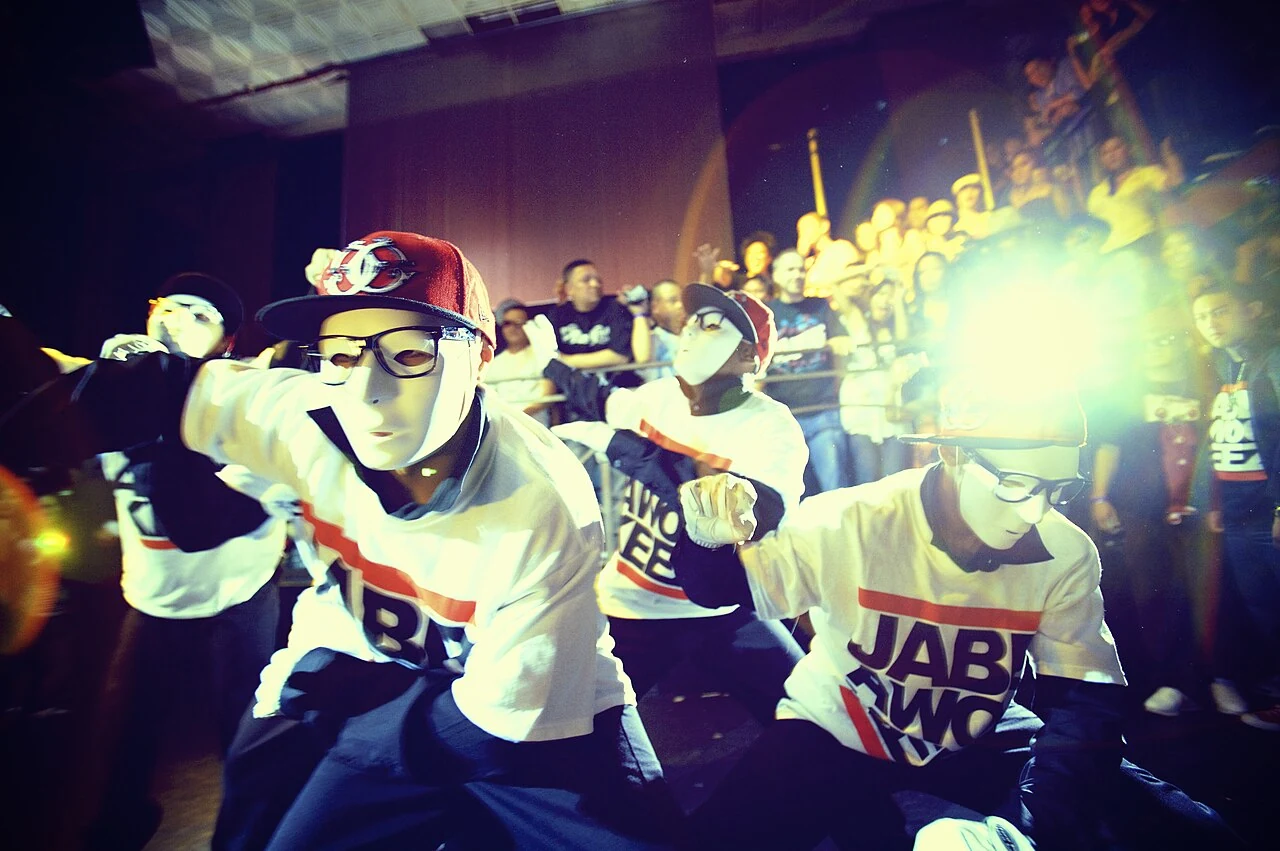
Before “Jabbawockeez”: three dancers in white masks and a crew that kept growing
The founding story has a smaller story inside it. Before the name existed, Phil “Swagger Boy” Tayag, Kevin “KB” Brewer and Joe “Punkee” Larot were performing as a trio out of Sacramento, in white masks and white gloves, under a name usually written Three Muskee. The masks came first. The crew came after.
In 2003, in San Diego, the thing that would become the Jabbawockeez was formed. The clearest contemporaneous account DMM located is the AsianWeek piece from July 2008, reprinted by Dancers’ Group: Brewer and Larot built the crew by recruiting friends in the dance community who shared their outlook on dance and on life. That is a short sentence carrying a lot of weight. They were not auditioning for skill alone. They were assembling people who agreed about something.
Then the roster grew, and this is where published histories start to disagree with each other, so here is what DMM can and cannot stand behind. By 2004 the names in circulation include Gary “Gee One” Kendell, Randy “DJ Wish One” Bernal, Phil Tayag, Ben “B-Tek” Chung, Kevin Brewer, Chris “Cristyle” Gatdula, Rynan “Kid Rainen” Paguio and Jeff “Phi” Nguyen, with Joe Larot present throughout. Nguyen’s entry is specific and well told: a Phoenix dancer who had moved to Los Angeles at 19, he earned his place in 2004 by winning a freestyle battle against Kevin Brewer. Eddie “Eddie Styles” Gutierrez and Saso “King Saso” Jimenez are named among the members by 2008, and the crew at that point is described as roughly eleven dancers.
Roughly. The same 2008 article gives both eleven and ten in different passages, and the two member lists on the most-cited reference page contradict each other over whether Ben Chung or Joe Larot belongs in a particular eight-name lineup. DMM is not going to resolve a roster by picking the version that reads best. The founding group, the televised 2008 lineup and the performing company today are three different things, and this article keeps them separate.
One lineage detail matters more than the headcount. Gary Kendell and Randy Bernal came out of MindTricks, a crew active in the San Francisco Bay Area, and it was through Kendell’s San Diego connections that the b-boys Rynan Paguio and Chris Gatdula came in. That is attributed rather than documented from a primary source, and DMM flags it as such. But if it holds, then the crew that America met in 2008 was already a merger: Sacramento by way of a masked trio, San Diego b-boying, and a Bay Area teaching lineage walking in through one man’s address book.
There is one more record DMM wants and does not yet have. A September 2004 interview with the crew, published by One Cypher, would be the earliest first-person account of what they thought they were doing before any of it worked. DMM could not retrieve the full text for this piece. It stays on the list.
Gary “Gee One” Kendell, 1970–2007: the mentor before the spotlight
In 1990, a young dancer in Santa Cruz took what he had learned in the street and walked it into a studio. The studio was All The Right Moves. The dancer was Gary Ray Kendell, and for most of the next two decades he taught hip-hop in that county: at Motion Pacific, at All The Right Moves, in parks and recreation after-school programs, at First Night Santa Cruz, at benefits for breast cancer research, at Kwanzaa celebrations, at an AIDS Walk kick-off. His obituary in the Santa Cruz Sentinel lists them one after another, and the cumulative effect is of a man who said yes to his community for twenty years.
In November 2007 he was in the Republic of Estonia, teaching hip-hop to hundreds of students.
On December 14, 2007, in Denver, Colorado, he died. He was 37. Contemporaneous reporting attributes his death to meningitis. He left his mother, Kisun Kendell, two brothers, Ronnie and David, and, in the obituary’s own framing, hundreds of friends and students.
DMM is correcting a circulating error here. One of the most-read reference pages about the Jabbawockeez states, in its passage about the television audition, that Kendell died in 2008. He did not. The obituary is dated December 18, 2007, and the contemporaneous AsianWeek reporting from July 2008 also places his death in 2007. The year matters, because the sequence of 2007 and 2008 is the emotional architecture of everything that followed.
The mentor before the spotlight
The San Francisco International Hip Hop DanceFest honors Gary Kendell with its Bay Area Legend Award, posthumously, accepted on his behalf by Jamie Fraser. The festival’s citation calls him an original founding member, mentor and dancer of the Jabbawockeez, a pioneering force in Northern California’s hip-hop dance community, and describes him as the crew’s “Yoda” and big brother: an accomplished b-boy and instructor known for musicality, fluidity and powerful movement, who taught and performed around the world and carried the culture’s values of connection, self-expression, respect and community with him.
Source: San Francisco International Hip Hop DanceFest, SFIHHDF Award Honorees. The festival does not state the award year; DMM is seeking it.
He was the eldest of them. Rynan Paguio described him as a spiritual presence who held the group together in its early days. The crew credited him as the force behind each individual member. He was also, per those published accounts, the connector: the man whose relationships brought Bay Area and San Diego dancers into the same room.
And he was slated to be on television with them. The lineup assembled for the first season of America’s Best Dance Crew was supposed to include him. He died before it aired.
It is tempting, and it would be wrong, to compress a twenty-year teaching life into an inspirational caption about a crew that won a trophy for him. Gary Kendell was not a prologue. He was a working teacher whose students in Santa Cruz, San Jose, Oakland, Redwood City, San Francisco and Estonia were not waiting on a television show to find out whether he mattered. One person who posted to his obituary described the local hip-hop dance scene deflating after he was gone. That is the measure of a teacher: not what happened next for the famous people, but what stopped happening in the room he used to walk into.
“We were just representing Gary.”
Jeff “Phi” Nguyen on the crew’s America’s Best Dance Crew performances, AsianWeek, July 2008
A note on his picture. DMM has no rights-cleared photograph of Gary Kendell, and will not manufacture one. A portrait of a man who died in 2007 is his family’s to give. If you hold a photograph of Gee One and the right to share it, DMM wants to hear from you.
The mask: a tribute first, a trademark later
The white mask did not arrive finished. By the crew’s own account to Backstage, the look travelled: ski and ninja masks at the start, then silver robotic masks, and finally the plain white faces, which were chosen in part for the simple reason that they fit better. The purpose stayed constant even as the object changed. They covered their faces so that an audience would see a group instead of a collection of individuals.
And the idea was not theirs alone. Published accounts credit the mask-and-glove motif as a tribute to Medea Sirkas, the Bay Area strutting crew whose own masked, gloved performances precede the Jabbawockeez by decades. DMM is going to be precise about the limits of that record: sources variously date Medea Sirkas to the 1960s, the 1970s and the 1990s, and none of the accounts DMM located settles it. So the tribute is credited and the era is left open until someone who was there says so on the record. Nobody owns the idea of a masked dancer. Strutting, robotting and the Bay Area funk-style lineage carried masks, gloves and faceless illusion long before a television show existed to reward it, and the honest version of this history has the Jabbawockeez standing on that, not inventing it.
There is a detail in DMM’s own archive that belongs here: the 2013 Zulu Gremlin interview on this site carries Medea Sirkas footage alongside the Jabbawockeez material. The lineage this chapter is describing is already documented in our own pages, which is a useful reminder of what an archive is for.
What the crew did build, and what is genuinely theirs, is the discipline of it. A mask is only an erasure if the dancing underneath is anonymous too. Theirs was the opposite: synchronization tight enough that the group read as one organism, popping and b-boying blended with a self-made musical arrangement, and a refusal to let one dancer carry the brand. The design directs attention to movement. Then the movement has to be worth the attention.
Later, the mask became an asset in the legal sense too, which is its own kind of story about street dance growing up. The word mark, the show titles and the visual identity all ended up in a federal register, and the crew sells an eight-inch plush toy of what its own store calls the “iconic Red Pill costume.” A costume became a character became a product. Hold on to that, because it is about to matter.
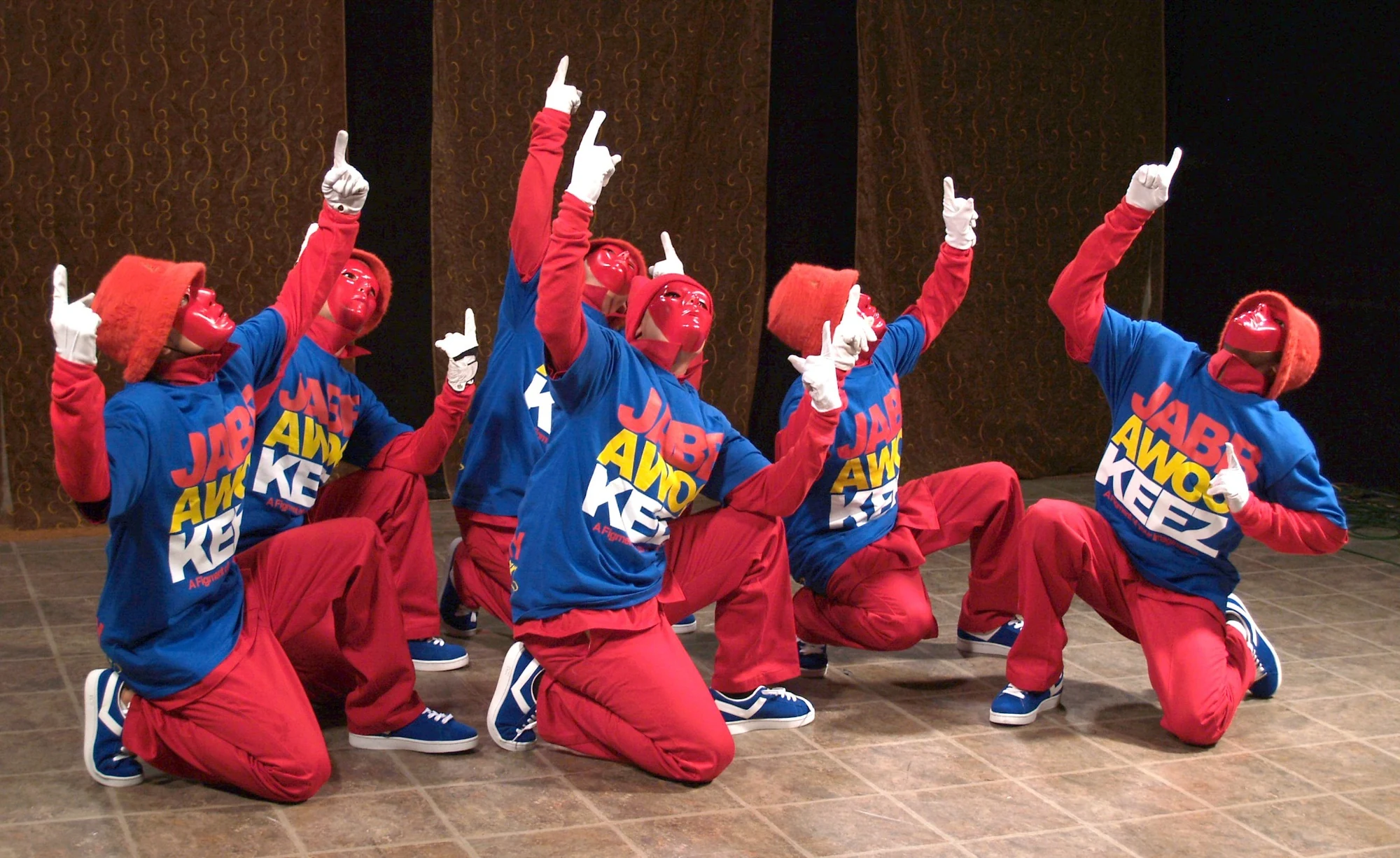
A victory in the middle of grief: 2007, 2008, and six dancers instead of a crew
Start with the television record, because it is the thing most often reported wrong. DMM has its own account of the season that changed crew culture, America’s Best Dance Crew, season one; this chapter is about what it meant for one crew.
In 2007 the Jabbawockeez appeared on the second season of America’s Got Talent. They performed with nine members, got three yes votes, advanced to the Las Vegas round, and went no further. One judge told them the audience loved them, which turned out to be the most accurate talent assessment in the building.
You will frequently read that this happened in 2006, including in the group’s own biography and in venue press releases issued as recently as October 2026. It did not. Season one of America’s Got Talent aired in 2006; season two aired in 2007, and NBC — the network that broadcast the show — places the Jabbawockeez in season two, in 2007. DMM is publishing 2007 and flagging the 2006 version as an error that has been copied forward for eighteen years. It is a small thing that illustrates a large one: when a crew becomes famous faster than anyone documents it, the first draft of the record calcifies.
Then December 2007 took Gary Kendell.
Then, in 2008, MTV launched Randy Jackson Presents America’s Best Dance Crew, and the Jabbawockeez were cast. The crew that walked onto that stage was smaller than the crew that existed. The show imposed a roster limit, so they had to cut down from roughly eleven to a televised contingent; the lineup first assembled included Kendell, and after his death and a knee injury to Joe Larot during the audition rounds, the group that competed was six dancers — Phil Tayag, Kevin Brewer, Rynan Paguio, Chris Gatdula, Jeff Nguyen and Ben Chung, a Kaba Modern alumnus. That is the reported sequence; DMM attributes it rather than asserting a primary MTV document.
So picture the actual conditions. Six men, a national broadcast, a format built to eliminate someone every week, a dead mentor two months in the ground, and a vacancy in their own lineup where he should have been standing. They did not perform grief. They performed precision. They were safe week after week until March 20, 2008, when the Evolution of Street Dance round put them in the bottom two for the first time, against Kaba Modern; they survived it, and the two surviving crews each danced once more that night in a do-or-die plea set to their own remixes. The Jabbawockeez remix was called “The Red Pill.” A week later, in the live finale of March 27, 2008, they were declared the winners, with a prize widely reported as $100,000. MTV’s own announcement afterwards put the night at 38.3 million votes cast and 7.9 million viewers, a season high for the series.
What the win changed is easy to overstate and easy to underrate. Here is the honest accounting. It changed access: within two years the crew was headlining a Las Vegas theater, which no dance crew had done. It changed the economics of being a street dancer on television, because it proved that a crew could be the attraction rather than the background of someone else’s attraction. It did not change the fundamentals of the art form, which existed in parks, clubs and studios for decades before MTV arrived and continued after the show was cancelled. And it did not change the thing they kept saying in every interview from that year: that they were dancing as a unit, that no one was the leader, and that the man who taught them that was gone.
From dance crew to production business: how five shows got built
Two years after the win, the Jabbawockeez did the thing that actually separates them from every crew that ever won a season of anything: they stopped being guests.
The 2010 sequence is usually compressed into a single sentence, so here it is properly. On May 7, 2010, MÜS.I.C. — pronounced “muse-I-see” — opened in the Hollywood Theater at the MGM Grand for a twenty-day run, a ninety-minute show with tickets at $49 to $59. Las Vegas native and crew member Chris Gatdula explained the concept at the time: it was about inspiration, about the muses. Then, that September, the Monte Carlo announced that it was replacing magician Lance Burton, who had just ended a fourteen-year run, with a hip-hop dance crew. MÜS.I.C. began at the Monte Carlo on October 7, five nights a week. Terms were not made public.
Read that again as a business event rather than a dance event. A Strip casino took a headliner slot that had belonged to a magician for fourteen years and gave it to six masked dancers from San Diego who had been on television for nine weeks. MGM Resorts’ own later statements describe the crew as the first dance crew to headline a Las Vegas theater show, dating that to the MGM Grand run in May 2010.
The productions kept coming, each with its own identity:
- MÜS.I.C. (2010) — MGM Grand’s Hollywood Theater, then the Monte Carlo. The first proof that the mask worked in a theater.
- PRiSM (2013) — the Luxor, in an 850-seat theater.
- JREAMZ — MGM Grand, with its grand opening held on February 19, 2016. Phil Tayag served as creative director. Some accounts date the show’s arrival to late 2015, which is likely a previews-versus-opening distinction; DMM notes both rather than picking one.
- TIMELESS (announced February 2020) — the Jabbawockeez Theater at MGM Grand, with a period in the MGM Grand Garden Arena during the arena era. It ran about five years. MGM Resorts extended the crew’s contract at MGM Grand through 2025.
- FREQNCY (announced September 2, 2025; debuted October 25, 2025) — the current production, which replaced TIMELESS. Tickets started at $49, and it plays every day except Tuesday. The crew described it as remixing genres and generations of music into one high-voltage journey, and said the theater would become a shared vibration the audience could feel.
Five productions, three venues, sixteen years. That is not a residency, it is a catalogue, and building a catalogue requires a company.
Here is the hardest evidence DMM found about that company, and note the date attached to it. In 2016, NBC News reported that the crew had become a full-fledged business with a staff of 65 people — cast members, production personnel and management — which the crew called its “tribe.” Kevin Brewer, in that reporting, framed the company culture as family, and talked about watching a next generation of Jabbawockeez being raised up. Rynan Paguio described the group as having evolved into the first dance company to hit the mainstream. Jeff Nguyen said their focus had never been winning, but sharing their artistry.
That 65-person figure is a 2016 snapshot and DMM has not been given a current number. We are not going to invent one, or a revenue figure, or a valuation, or a net worth, or an executive title. What can be said without a document is structural: a nightly ticketed show on the Las Vegas Strip requires choreography and rehearsal direction, lighting and sound design, stage and wardrobe crew, music production and licensing, box office and marketing, merchandise design and fulfilment, tour logistics for dates away from the residency, and management to hold the contracts together. Someone does every one of those jobs. The crew that won a television show in 2008 now signs the paychecks for a theatrical production, and in October 2026 a Las Vegas news crew toured a headquarters that holds their memorabilia and a recording studio, led by founding member Kevin Brewer.
The organization also includes JBWKZ Records, an in-house label founded to create and distribute their own music, built with dancers in mind, which signed The Bangerz in 2010 and TJ Lewis in 2019. A dance company that controls its own soundtrack is a dance company that does not have to ask permission to perform its own show. That is not a trivia item. That is leverage.
And the manager question deserves an answer, because the handoff that commissioned this article pointed DMM toward one name and the record pointed somewhere else. In the 2008 AsianWeek reporting the crew’s manager is named as Audie Vergara, who is quoted on the members still speaking their heritage languages. Later reference listings name a different manager and a management entity. DMM found nothing to support a historic management role for the individual named in our commissioning research, so that name does not appear in this article. If someone has the documentation, DMM will publish a correction with it.
Is Jabbawockeez a corporation? What the records actually show
This is the question DMM gets asked most often about them, and it is usually asked as though there were one answer. There are three, and keeping them apart is the whole skill.
The crew is a group of dancers that formed in 2003. The brand is the public-facing identity — the name, the mask, the show titles — that an audience recognizes. The business is one or more legal entities that hold the contracts, own the marks, pay the staff and carry the liability. People collapse the three and end up saying things like “the original six own it,” which no public record establishes.
Here is what the trademark records show, which is the clearest public paper trail that exists.
| Mark | Record | Holder as listed | Status |
|---|---|---|---|
| JABBAWOCKEEZ | Serial 77981842, reg. 3971657, filed May 27, 2008 | WKZ, LLC — Las Vegas, Nevada | Registered and renewed; status date September 29, 2021 |
| JABBAWOCKEEZ A FIGMENT OF YOUR IMAGINATION | Serial 77981802, filed June 2008 | Listed in the same portfolio | Cancelled under Section 8 |
| JABBAWOCKEEZ TIMELESS | Multiple filings | WKZ, LLC | Registered, March 14, 2023 |
| JABBAWOCKEEZ PRISM | Single filing | WKZ, LLC | Registered, November 21, 2023 |
| JBWKZ | Serial 77543498, filed August 11, 2008, Los Angeles address | Jabbawockeez, LLC | Abandoned, 2012 |
Source: public trademark database records for the JABBAWOCKEEZ portfolio, checked November 18, 2026. Filings in this portfolio appear under both the name WKZ, LLC and the name Jabbawockeez, LLC. Class coverage is reported slightly differently across database aggregators. DMM has not opened the underlying USPTO file or any assignment history.
Now the plain-English reading, with the limits attached.
An LLC is a limited liability company. It is not automatically a corporation, it does not issue stock to the public, and nothing in these records suggests a publicly traded company. No public-market listing for this business was located. So if you have read that Jabbawockeez is a corporation in the sense of a company you could buy shares in, that is wrong.
Equally: a trademark record is not an ownership chart. It tells you which entity is listed as the holder of a particular mark on a particular date. It does not tell you who the members of that LLC are, how the equity is split, who controls the operating agreement, who else holds contracts or what other entities exist. DMM has not been given that information, and will not model it from guesswork. “Owned by the original six” and “wholly owned by one person” are equally unsupported by the documents available here.
What the records do show is something more useful for any dancer reading this: the show titles themselves are registered property. TIMELESS and PRiSM are not just marketing words, they are marks with registration dates. That is what it looks like when a street-dance collective treats its own creative output as an asset rather than as a service it rents out. The crew that chose a nonsense word in 2003 filed that word federally in 2008, and by 2023 was registering the names of its individual productions. Somewhere in that eighteen-year span, a group of dancers learned intellectual property law, or paid someone who had.
How a creative collective survives its own success
A crew that refuses to have a leader has an advantage and a problem. The advantage is that it cannot be decapitated. The problem is that it has to find a way for individual ambition to exist without breaking the collective, because dancers grow up, get offers, start their own things and want their names on something.
The Jabbawockeez answer appears to have been: let them go and let them come back, and keep the mask bigger than any face under it. Here is the credit record, kept honest, with each person’s role stated as the sources state it and nothing implied about who is dancing tonight.
| Dancer | In the crew | Documented work beyond it |
|---|---|---|
| Kevin “KB” Brewer | Founding member; listed among current members; led a news tour of the crew’s headquarters in October 2026 | Spoke for the company on its culture and its next generation in 2016 national reporting |
| Joe “Punkee” Larot | Founding member; credited with the name; listed among current members; on the red carpet for the FREQNCY return in October 2025 | Quoted as co-founder on the creative intent of FREQNCY |
| Jeff “Phi” Nguyen | Joined 2004 by battling Kevin Brewer; listed among current members; the crew’s most consistent explainer across two decades of interviews | Described the collective decision model to Backstage; spoke for the company to NBC News in 2016 |
| Rynan “Kid Rainen” Paguio | Original member; listed among current members | Official assistant coach for the U.S. Olympic breaking team, travelling with it to the 2024 Paris Olympics, as reported in August 2024 |
| Phil “Swagger Boy” Tayag | Founding member of the masked trio and of the crew; creative director of JREAMZ; listed among past members on current rosters | Choreographer working with Bruno Mars, including the “Uptown Funk” video, the Super Bowl 50 halftime performance and the “Finesse” remix video with Cardi B |
| Ben “B-Tek” Chung | Kaba Modern alumnus who danced in the 2008 televised lineup; listed among past members | Described as a co-owner of Kinjaz |
| Chris “Cristyle” Gatdula | Early member, Las Vegas native, in the 2008 televised lineup; listed among past members | Explained the concept of MÜS.I.C. in 2010; spoke in 2008 about Asian American families and artistic careers |
| Gary “Gee One” Kendell | Original member and mentor; died December 14, 2007 | Nearly two decades teaching hip-hop in Santa Cruz County and internationally; posthumous Bay Area Legend Award honoree |
| Randy “DJ Wish One” Bernal, Eddie “Eddie Styles” Gutierrez, Saso “King Saso” Jimenez | Named among the crew in 2008 reporting; listed among past members | Gutierrez and Bernal gave the crew’s own 2008 account of what the masks were for |
Compiled from published reporting and current public rosters, checked November 18, 2026. Roster listings vary across sources and no official current roster page was located. DMM is not publishing a current performing company, and nothing here should be read as saying who appears in any given performance. Credits that belong to the collective are not assigned to any individual dancer.
Look at what those outside careers have in common. A crew member becomes the choreographer for one of the biggest pop acts in the world. Another becomes an assistant coach for the United States Olympic breaking team, which means the knowledge that moved from a Bay Area teacher to a San Diego garage to an MTV stage ended up in an Olympic coaching box. Another co-owns a different major dance collective. A fourth leads television crews through a headquarters and talks about raising the next generation.
That is not a crew breaking up. That is a crew functioning as a career launchpad, which is exactly what a healthy institution does, and it is only possible because the identity was never attached to one person’s face. The mask that erased individual celebrity in 2008 is the same mask that made it survivable for members to build individual careers later. You cannot leave a group whose brand depends on your face without damaging it. You can leave one whose brand is a blank white mask.
The open question, and DMM is asking it rather than answering it, is the mechanism of transfer: how a crew formally hands its repertoire, standards and name to dancers who were children in 2008. The 2016 reporting referenced a next generation being raised up. A 2025 trade account noted new members and the same energy. There is a system in there somewhere, and it is the single most valuable thing the Jabbawockeez could teach the rest of the dance world. DMM invites the crew to tell that part on the record.
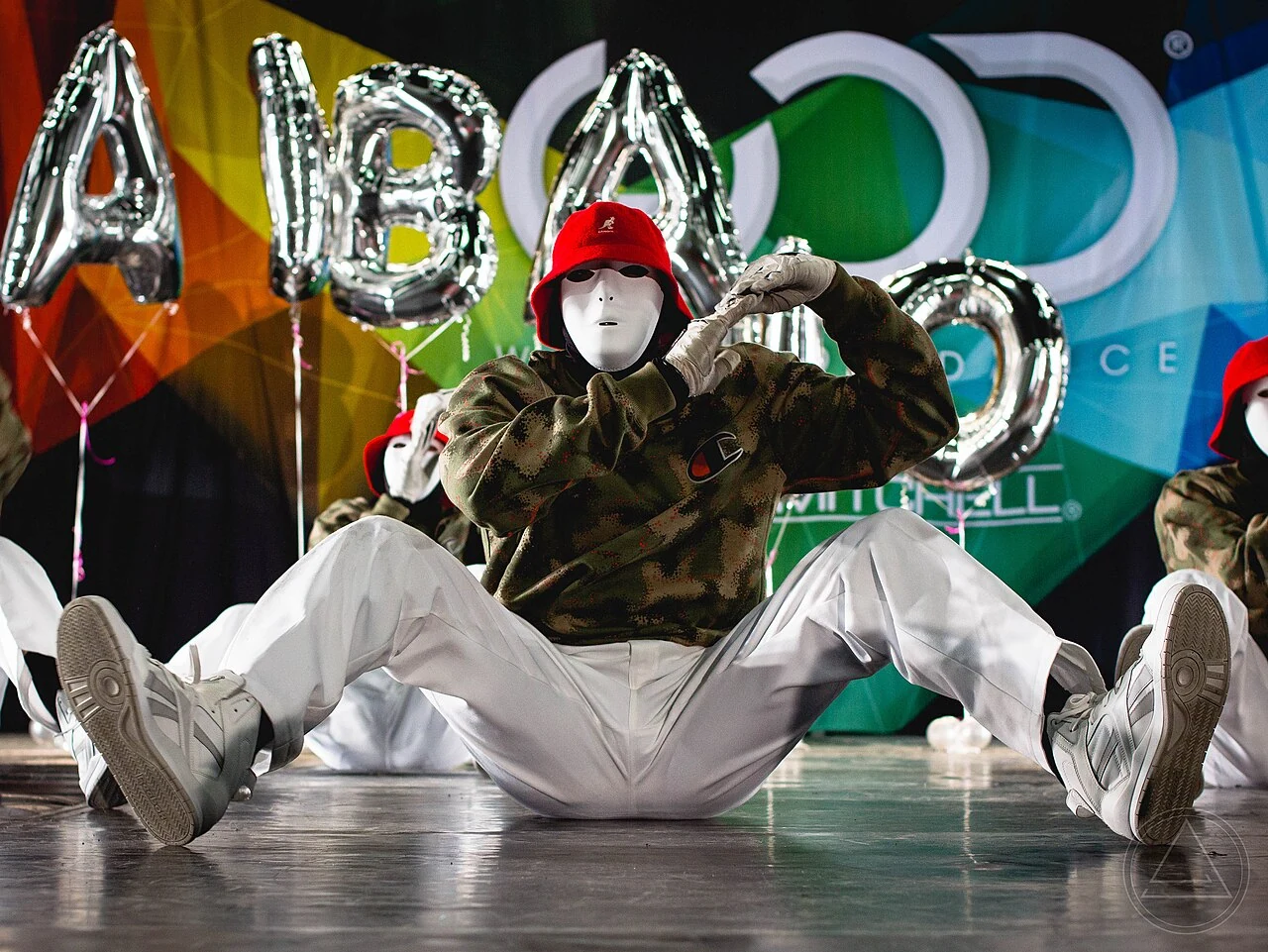
“Red Pill,” 2008 and 2026: what DMM’s own archive holds
In March 2026, PUMA and the Jabbawockeez released a collection together. The anchor was a Suede, the silhouette PUMA has sold since 1968, rebuilt with Jabbawockeez details: black, flat medium gray and silver, reflective, a second set of laces in the box, $120. It launched at PUMA’s Las Vegas Strip flagship on March 27, 2026, with a shoe drop, a dance competition and a meet-and-greet — and that weekend happened to mark eighteen years since the championship. The campaign film credits the crew as executive producers. The colorway has since sold out.
On November 14, 2026, the second chapter arrived. Same silhouette, new colorway: For All Time Red, with PUMA Silver and PUMA White, style 410051-01, $120. The campaign film went up on the crew’s official channel that morning, and its description opens with four words — “THE PAST INSPIRED US” — before introducing the chapter by name.
The chapter is called RED PILL.
Here is why that stopped us, and the chronology matters, so take it slowly. On March 20, 2008, in the Evolution of Street Dance round of the first season of America’s Best Dance Crew, the Jabbawockeez landed in the bottom two for the first time all season, against Kaba Modern. They survived. Before the final votes opened, the two surviving crews each performed one more time, a do-or-die plea set to their own remix. The Jabbawockeez remix on the record is titled “The Red Pill.” A week later, on March 27, they were crowned. The crew still sells an eight-inch plush of what their own store describes as the “iconic Red Pill costume.” Eighteen years on, the red shoe carries the name of the piece they danced when they were closest to going home.
And there is a piece of that story that exists, as far as DMM can tell, only in our own archive.
From the DMM archive, 2013
In Dance Mogul Magazine’s interview with Zulu Gremlin, the creator of the B-Boy Masters Pro-Am, DMM published video documenting the Jabbawockeez receiving Zulu Gremlin shoes — the shoes worn in their winning piece, “The Red Pill.”
“Winning piece” is DMM’s own 2013 caption, quoted here as written. To be precise about the chronology: “The Red Pill” was the do-or-die performance of March 20, 2008, which carried the crew into the March 27 finale they won. The shoes in that footage came to them from a pillar of the b-boy community.
The video is published in DMM’s 2013 interview; DMM has not established who filmed it, and does not claim to. The same archive page also carries Medea Sirkas footage, the masked Bay Area lineage the crew’s own mask motif is credited to.
So: a routine named “The Red Pill,” danced on the night they nearly went out. Shoes gifted by a b-boy elder, worn in that routine, published by this magazine in 2013. A costume that became a character that became a plush toy. And in November 2026, a red sneaker with a global brand’s name next to theirs, released under that same title, with a campaign that opens by saying the past inspired them.
DMM is not going to tell you that PUMA and the Jabbawockeez named this chapter after that piece, because neither has said so. DMM invites comment from both. Until one of them answers, the honest statement is the one we can prove: the title has eighteen years of history inside the crew’s own catalogue, the campaign itself invokes the past, and DMM published documentation of a shoe story attached to the original piece that nobody else appears to have published. If the echo is deliberate, it is one of the more elegant pieces of brand storytelling in dance. If it is not, it is a coincidence with remarkable aim.
Either way, there is a lesson in it that has nothing to do with sneakers. The crew kept its own history usable. The title, the costume, the merchandise, the trademarks: they kept the pieces in their own hands and in their own catalogue, so that eighteen years later one of them could be picked back up and put on a shelf at retail. Most dancers never get the chance to reuse their own best night. These dancers built a business that could.
Watch
DMM archive, 2013: the Red Pill shoes. Published in DMM’s Zulu Gremlin interview: the crew receiving the shoes worn in “The Red Pill,” their do-or-die piece of March 20, 2008, a week before the finale they won. Titles are as labeled in DMM’s original 2013 coverage.
Video as published in Dance Mogul Magazine’s 2013 Zulu Gremlin interview.
Chapter one, March 2026: the Jabba-Suede campaign. The first PUMA collaboration film, from the crew’s official channel, with the crew credited as executive producers. The cutting is built on the same principle as the stage work: bodies in unison, faces withheld, the rhythm carried by the group rather than by a soloist.
JABBAWOCKEEZ OFFICIAL, March 2026.
Chapter two, November 14, 2026: “Red Pill.” The second campaign film, published the morning the red Suede released. The red is the only loud element in a palette the crew has kept deliberately plain for twenty-three years, and the description frames the release as a continuation rather than a debut.
JABBAWOCKEEZ OFFICIAL, uploaded November 14, 2026.
A note on what is not here: the 2008 broadcast performances circulate widely in fan uploads. DMM does not embed re-uploaded broadcast footage, because an embed is not a license. If MTV or Paramount publishes the season-one performances officially, DMM will add them.
What comes next, separated into confirmed and unconfirmed
Dance journalism has a bad habit of turning a schedule into a prophecy. Here is the line, drawn clearly.
Confirmed
FREQNCY continues at the Jabbawockeez Theater, MGM Grand. The residency plays nightly except Tuesday, and ticketed dates at the theater are on sale into 2027, including dated performances as far out as August 2027. The crew’s own events page lists the Las Vegas residency as running nightly.
One night in Niagara Falls. TIMELESS plays the Seneca Niagara Resort & Casino Event Center in Niagara Falls, New York, on Friday, April 2, 2027, at 8 p.m., with tickets starting at $35 from the venue. Note the small but telling detail: the title retired from Las Vegas is the title that tours.
The PUMA partnership is live, in its second chapter. The red Suede released November 14, 2026.
Not confirmed — the open questions
Whether a third PUMA chapter or further footwear is planned. Whether the “Red Pill” title deliberately invokes the 2008 piece. What follows FREQNCY, and how long the MGM Grand agreement runs, since the last publicly reported contract term ran through 2025 and no newer term was located. Whether any touring beyond publicly ticketed dates is planned. Whether there is a film, television or documentary project. Whether the breaking-coach role continued past the 2024 Olympics. What the current staff count is, ten years after the 65-person figure. And the one DMM most wants answered: how the crew formally transfers repertoire and standards from one generation of Jabbawockeez to the next.
None of those are predictions. They are open questions, and DMM invites PUMA, the crew, MGM Resorts and the San Francisco International Hip Hop DanceFest to answer any of them on the record. This article will be updated when they are, rather than filled in with plausible guesses.
Career and cultural timeline
■ Culture ■ Career ■ Teaching & transfer
1990 · Teaching
Gary Kendell begins teaching hip-hop at All The Right Moves in Santa Cruz, moving his dancing from the street into the studio.
Before 2003 · Culture
Phil Tayag, Kevin Brewer and Joe Larot perform as a masked, gloved trio out of Sacramento, usually recorded as Three Muskee. Kendell and Randy Bernal are active in the Bay Area with MindTricks.
2003 · Career
The crew is formed in San Diego by Kevin Brewer and Joe Larot, who recruit dancers who share their outlook. The name, credited to Larot, comes from Lewis Carroll’s “Jabberwocky.”
2004 · Career
Jeff “Phi” Nguyen joins by winning a freestyle battle against Kevin Brewer. The roster expands toward its full size, with Kendell’s San Diego connections bringing in b-boys Rynan Paguio and Chris Gatdula.
2007 · Career
The crew appears on season two of America’s Got Talent with nine members and is eliminated in the Las Vegas round. (Often misdated to 2006.)
November–December 2007 · Teaching
Kendell teaches hip-hop to hundreds of students in Estonia in November. He dies on December 14, 2007, in Denver, Colorado, at 37.
March 20, 2008 · Career
In the Evolution of Street Dance round, the crew is in the bottom two for the first time, against Kaba Modern. They advance, and that night the two surviving crews each dance a do-or-die piece to their own remix. The Jabbawockeez remix on the record is titled “The Red Pill.”
March 27, 2008 · Career
Competing as six dancers, the Jabbawockeez win the live finale of Randy Jackson Presents America’s Best Dance Crew, with a prize widely reported as $100,000. MTV reports 38.3 million votes cast and 7.9 million viewers.
Mid 2008 · Career
The JABBAWOCKEEZ word mark is filed federally on May 27. Touring, commercial and television work follows, including dates with New Kids on the Block and Jesse McCartney, a Super Bowl Gatorade commercial and an NBA All-Star Game opening.
May–October 2010 · Career
MÜS.I.C. opens May 7 in MGM Grand’s Hollywood Theater for a 20-day run. In September the Monte Carlo replaces Lance Burton with the crew; the show begins there October 7. They become the first dance crew to headline a Las Vegas show.
2013 · Career
PRiSM opens at the Luxor in an 850-seat theater. Dance Mogul Magazine publishes its Zulu Gremlin interview, documenting the crew receiving the shoes worn in “The Red Pill.”
2016 · Career
JREAMZ holds its grand opening at MGM Grand on February 19, with Phil Tayag as creative director. NBC News reports the organization as a business with a 65-person staff.
2020–2023 · Career
TIMELESS is announced for the Jabbawockeez Theater in February 2020 and plays the MGM Grand Garden Arena during the arena period; MGM Resorts extends the agreement at MGM Grand. The crew returns to America’s Got Talent for season 15 in 2020 and guests on Rauw Alejandro’s Saturno tour in 2023. Show titles TIMELESS and PRiSM are registered as trademarks in 2023.
August 2024 · Teaching
Rynan Paguio travels to the Paris Olympics as official assistant coach of the U.S. Olympic breaking team.
September–October 2025 · Career
FREQNCY is announced on September 2 and debuts October 25 at MGM Grand, replacing TIMELESS after about five years. Tickets start at $49.
2026 · Culture
The first PUMA x JBWKZ collection launches at PUMA’s Las Vegas flagship on March 27. A Las Vegas news crew tours the group’s headquarters, memorabilia and recording studio in October. On November 14 the second chapter, “Red Pill,” releases in For All Time Red.
Why this legacy matters to Dance Mogul Magazine
DMM has spent sixteen years documenting dancers who built something and were not credited for it. The Jabbawockeez are the rarer case: dancers who built something and kept it.
That is why this story sits in The Legacy rather than in an entertainment column. Strip away the masks and the Strip marquee and what remains is a case study in the thing most dancers are never taught. The crew owned its name. It registered its show titles. It built a label so it would not have to license somebody else’s music to perform its own choreography. It kept its own titles, costumes and designs in active use for eighteen years, long enough for a 2008 routine to lend its name to a 2026 product. It held a headliner slot a magician had held for fourteen years. And it did all of that while refusing, publicly and structurally, to let any single member become the brand.
DMM’s values read character before celebrity, contribution before attention, people before popularity. A group with no leader, whose costume exists specifically to prevent individual celebrity, whose most-quoted member keeps saying the focus was never winning, is close to a literal illustration of all three.
And there is the part that matters most to this publication, which is the part that happened before any of it worked. A teacher in Santa Cruz spent nearly twenty years in studios, parks and after-school programs. He connected a Bay Area teaching lineage to a San Diego b-boy scene to a masked trio out of Sacramento. He was the eldest, the one the others describe as having held them together, and he died before the cameras arrived. Jabbawockeez is a case study in creative ownership. It is also a case study in what one teacher’s twenty years can build after he is gone. DMM has never been interested in the first lesson without the second.
What dance would be missing without them
Proof a crew could be the headliner. Before May 2010, no dance crew had headlined its own Las Vegas show. Every dance production on the Strip since is standing in a door they opened.
A model for collective authorship. A touring theatrical company with no artistic director, making choreography in relay and decisions by majority, is a genuinely unusual organizational design that worked for more than two decades.
Ownership as a dancer’s skill. Word marks, show-title registrations, an in-house label: the paper trail of a street-dance collective treating its creativity as property rather than piecework.
A mask that made room for everyone. Seven Asian American, one African American and two Mexican American dancers in 2008 told reporters the blank white face removed ethnic and social barriers from the performance. That argument still lands.
Careers built on the platform and carried outward. A Bruno Mars choreographer, an Olympic breaking assistant coach, a Kinjaz co-owner: the knowledge did not stay in one theater.
A line of credit back to the Bay Area. By crediting the mask-and-glove motif as a tribute, they kept an older masked strutting lineage inside the story of their own fame.
What the next generation can take from this
1. Name it, then file it. They chose a nonsense word in 2003 and filed it federally in 2008, before most of their peers understood that a crew name could be property.
2. Build the thing you would otherwise have to rent. A label of their own meant never asking permission to perform their own show.
3. Design the credit structure before you need it. No leader, majority decisions, choreography built in relay: the rules were in place long before there was money to argue over.
4. Make the brand survivable without you. Because no face carried the identity, members could leave, build outside careers and come back without breaking what they left.
5. Credit the people you borrowed from. They have consistently framed the mask as a tribute rather than an invention. That costs nothing and it is why the older generation still speaks well of them.
6. Keep your own archive. Titles, costumes, footage, trademarks: held long enough, a championship routine becomes a product eighteen years later.
7. Teach anyway. Gary Kendell taught in Santa Cruz community centers for almost twenty years with no expectation of a theater on the Strip. The careers that followed were built out of that unglamorous, repeated, local work.
The mask is still the first thing anyone tells you about the Jabbawockeez. It is still the least interesting thing about them. The interesting thing is that a group of young dancers decided in 2003 that nobody would be the star, and then spent twenty-three years proving that a collective can own a theater, a catalogue, a name and its own history — and that the man who made the whole thing possible never saw a single night of it. Every performance under that blank white face is also, still, a performance of his teaching.
Jabbawockeez: frequently asked questions
What does Jabbawockeez mean?
It comes from “Jabberwocky,” the nonsense poem Lewis Carroll published in Through the Looking-Glass in 1871, whose title character is a dragon-like creature. The crew’s spelling is their own invention, and the name is credited to founding member Joe “Punkee” Larot.
What does Jabbawockeez stand for?
Nothing. It is not an acronym and the letters do not stand for words. What the crew does have is a documented way of working: no artistic director, decisions made by the group, choreography built in sections by different members, and masks worn so an audience watches the collective instead of individuals. Descriptions of the group as standing for unity or creative autonomy are interpretations of those practices, not a registered motto.
Who founded the Jabbawockeez?
The crew was formed in San Diego in 2003 by Kevin “KB” Brewer and Joe “Punkee” Larot, who recruited dancers who shared their outlook. Several accounts, including the group’s own biography as reported by NBC, also name Phil “Swagger Boy” Tayag as a founder; Tayag, Brewer and Larot had already been performing as a masked trio. Gary “Gee One” Kendell is described by the San Francisco International Hip Hop DanceFest as an original founding member and mentor.
Is Jabbawockeez a dance crew or an entertainment company?
Both. The crew formed in 2003 and still performs. Alongside it there is a business that produces ticketed Las Vegas shows, sells merchandise, runs an in-house record label, makes video and music content, and partners with brands. In 2016 NBC News reported a 65-person staff of cast, production personnel and management. DMM has not been given a current figure and does not publish one.
Does WKZ, LLC own the Jabbawockeez name?
Public trademark records list WKZ, LLC of Las Vegas as the holder of the JABBAWOCKEEZ word mark, registered and renewed, with other filings in the same portfolio recorded under the name Jabbawockeez, LLC. That establishes who is listed as holding the mark. It does not establish who owns the company, how equity is divided, or what other entities exist — a trademark record is not an ownership chart. An LLC is a limited liability company, not a public corporation, and no public-market listing was located.
Why do the Jabbawockeez wear masks?
So the audience watches the group rather than individual faces. In 2008, member Eddie Gutierrez told AsianWeek the mask was meant to remove ethnic and social barriers during performance, and Randy Bernal said audiences should judge them on their moves and style. The look evolved from ski and ninja masks through silver robotic masks to the plain white faces. The mask-and-glove motif is credited as a tribute to the Bay Area strutting crew Medea Sirkas; published accounts disagree on which decade that crew belongs to, so DMM credits the tribute without dating the era.
Who was Gary “Gee One” Kendell?
An original member and the crew’s mentor, born in 1970. A Bay Area b-boy who began teaching hip-hop at All The Right Moves in Santa Cruz in 1990 and taught for nearly two decades across Santa Cruz County and internationally, including in Estonia in November 2007. He died on December 14, 2007, in Denver, Colorado, at 37; contemporaneous reporting attributes his death to meningitis. He was slated to be in the crew’s America’s Best Dance Crew lineup. The San Francisco International Hip Hop DanceFest honors him posthumously with its Bay Area Legend Award. Note for the record: some widely read reference pages say he died in 2008. The obituary and contemporaneous reporting both establish 2007.
Did the Jabbawockeez appear on America’s Got Talent in 2006 or 2007?
2007, on season two, performing with nine members and eliminated in the Las Vegas round. The 2006 date appears in the group’s own biography and in venue press releases as recently as October 2026, but season one of America’s Got Talent aired in 2006 and season two aired in 2007, and NBC — the network that broadcast it — places them in season two in 2007. They returned to the show for season 15 in 2020.
Are the original Jabbawockeez still in the group?
Some are. Public rosters list Kevin Brewer, Joe Larot, Jeff Nguyen and Rynan Paguio among current members, and Brewer and Larot have appeared in 2025 and 2026 coverage as founding members. Others are listed among past members, including Phil Tayag, Ben Chung and Chris Gatdula, and several have built significant careers elsewhere. Roster listings vary across sources, no official current roster page was located, and the performing company is larger than the six who competed in 2008. DMM does not publish who performs on a given night.
Where are the Jabbawockeez performing in 2026 and 2027?
FREQNCY plays at the Jabbawockeez Theater at MGM Grand in Las Vegas, nightly except Tuesday, with ticketed dates listed into 2027. Away from the residency, one TIMELESS performance is confirmed for Friday, April 2, 2027 at 8 p.m. at the Seneca Niagara Resort & Casino Event Center in Niagara Falls, New York, with tickets starting at $35 from the venue. Check the group’s own events page and the venues before booking, because schedules change.
What is the connection between the Jabbawockeez and PUMA?
A footwear and apparel collaboration in two chapters. The first, PUMA x JBWKZ, launched in March 2026 with a Suede in black, gray and silver at $120, released with an event at PUMA’s Las Vegas Strip flagship on March 27, 2026. The second, titled “Red Pill,” released on November 14, 2026 as a red Suede at $120. “The Red Pill” is also the title recorded for the crew’s do-or-die performance of March 20, 2008, the night they first landed in the bottom two and survived it, a week before the March 27 finale they won. DMM’s 2013 archive published video of the crew receiving the shoes worn in that piece. Whether the 2026 title deliberately invokes 2008 has not been confirmed by PUMA or the crew, and the question remains open.
The Legacy // Masks, Crews & Collectives
Jabbawockeez: Behind the Masks, Beyond the Fame — You are here
Zulu Gremlin: B-Boy Masters Pro-Am creator interview — DMM’s 2013 archive, including the Red Pill shoe footage and Medea Sirkas video.
America’s Best Dance Crew, season one — DMM on the show that gave crew culture a national stage.
Michael “Boogaloo Shrimp” Chambers — the California funk-style lineage behind the illusion work.
Steffan “Mr. Wiggles” Clemente — popping, b-boying and the keeping of foundation.
Brian “Footwork” Green — on teaching, touring and the economics of a dance career.
Sources and further reading
The crew’s own records and official pages: the group’s events page and online store; the “Red Pill” campaign film and the Jabba-Suede campaign film on the official channel; PUMA’s product listings; and public trademark database records for the JABBAWOCKEEZ mark.
Contemporaneous reporting: “Behind the Mask,” AsianWeek, July 11–17, 2008, reprinted by Dancers’ Group; “Dancing With the Jabbawockeez,” Backstage; the Las Vegas Sun on the 2010 MGM Grand run; the Hollywood Reporter on the Monte Carlo booking; NBC News on the company in 2016.
Gary Kendell: his obituary in the Santa Cruz Sentinel; the San Francisco International Hip Hop DanceFest award honorees.
Television, current shows and recent coverage: NBC on the crew’s America’s Got Talent season and history; the Las Vegas Review-Journal on the FREQNCY announcement; KLAS inside the crew’s headquarters, October 2026; Las Vegas Magazine on Rynan Paguio’s Olympic coaching role; Las Vegas Magazine on the March 2026 PUMA launch; the Niagara Falls announcement and the venue’s own listing.
How this article was verified: every material claim in this piece is recorded in a claim-level source register held by DMM’s editorial department, with the source, its publication date, the date it was checked, conflicts between sources, and a status of verified, attributed or unresolved. Where sources disagree — the America’s Got Talent year, Gary Kendell’s death year, the size of the early roster, the era of Medea Sirkas — this article says so in print rather than choosing the tidier version. Claims DMM could not establish, including questions of company ownership and any matter still before or formerly before a court, are not published here at all. Where DMM is waiting on an answer from the crew, PUMA, MGM or a festival, the article says that too.
Dance Mogul Magazine · The Legacy. Published November 18, 2026. Reporting and verification by the Dance Mogul Magazine editorial department.
Dance Mogul Magazine documents dance culture and the people behind it. We interpret the documented record; we do not speak for the Jabbawockeez. Corrections, documents and first-hand accounts are welcome through our contact page, and corrections are published with their sources.
If you hold a rights-cleared photograph of Gary “Gee One” Kendell, or you taught alongside him in Santa Cruz, San Jose, Oakland, Redwood City, San Francisco or Estonia, DMM would like to add your account to this record.