
JREAMZ: From Phoenix Krump to the 2026 Dance Your Style USA Title
At eighteen, Jossette “JREAMZ” Sanaphay won the 2026 Red Bull Dance Your Style USA National Final in Tampa, earning the U.S. spot at the World Final in Zürich. Her path runs through years of Arizona training, krump battles, a 2025 National Final setback and a 2026 return that ended with the title.
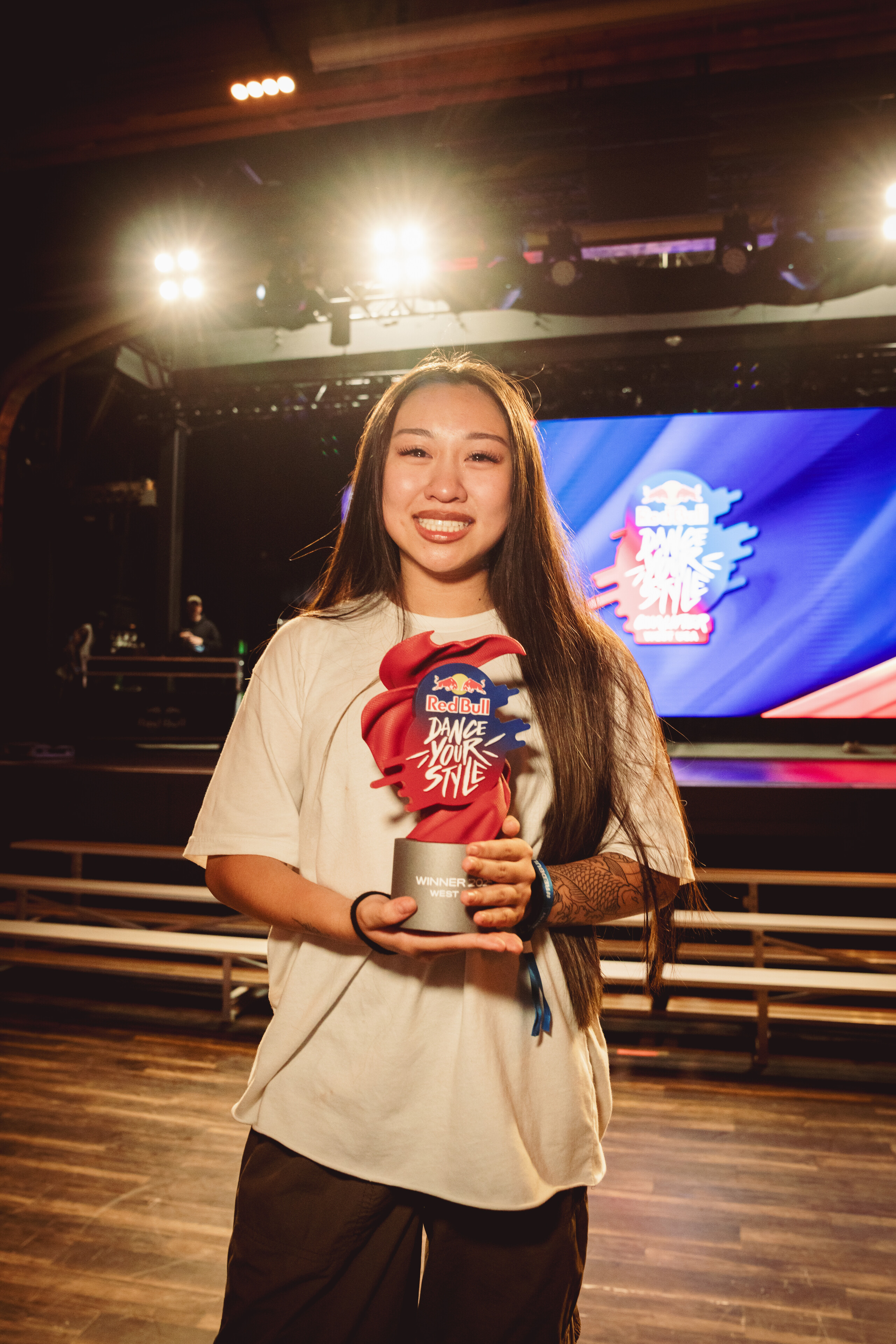
JREAMZ with the national trophy after winning the USA National Final in Tampa, September 19, 2026 | Photo: Jon Shih / Red Bull Content Pool
Jossette Sanaphay — known as JREAMZ, listed professionally as Jossette (JJ) Sanaphay, and identified by the Krump Championship Series as Jreamz aka Girl Deadend — is a dancer from North Phoenix, Arizona. Mentor Andrea “RaeRae” Pentecostes told KJZZ that she and Leah Roman had been training JREAMZ at The Jukebox Dance Studio since she was about nine or ten. In August 2025, at seventeen, JREAMZ won the Red Bull Dance Your Style West Qualifier in Phoenix and advanced to the National Final in San Francisco, where KJZZ now reports she was eliminated. On September 19, 2026, at eighteen, she won the USA National Final in Tampa, defeating Tyler D. Creator on the way to the final four and Kidd The Monster in the championship battle. She will represent the United States at the World Final in Zürich on October 24, 2026.
Correction — September 23, 2026: An earlier version misattributed a KJZZ quote from mentor RaeRae to JREAMZ and used it to state that JREAMZ had studied krump for seven years. DMM removed that unsupported timeline, corrected her 2025 National Final result, and standardized her name to Jossette Sanaphay while noting that some published sources use a variant spelling.
FILE / AT A GLANCE
Krump sits at the center of how JREAMZ presents herself in battle. In KJZZ’s 2025 reporting, she described what she loves about the form: its rawness, its expressiveness, and the ability to put everything into it. That matters in Dance Your Style because dancers bring specialized movement languages into a room where the audience — not a judging panel — decides who advances.
Red Bull Dance Your Style removes prepared music and formal judging from the equation. Dancers improvise to unexpected songs and the audience votes after each matchup. Red Bull’s official Tampa recap described JREAMZ as bringing krump and hip-hop-influenced movement, high energy, facial expression, glides and spins into that format. Her challenge was not to make krump “less krump”; it was to respond to the music clearly enough for a mixed audience to follow her choices in real time.
Her 2026 title is more meaningful when placed beside the year before it. In 2025, JREAMZ won the West Qualifier in Phoenix and reached the National Final in San Francisco, but KJZZ’s September 2026 follow-up confirms that she was knocked out there. One year later she returned to the national stage and won the championship. That progression — regional win, national setback, national title — is the record DMM can document.
Mesa, Arizona, and the Training Behind the Title
JREAMZ did not appear from nowhere in September 2026. RaeRae told KJZZ that she and Leah Roman had been training her at The Jukebox Dance Studio in Mesa since she was about nine or ten years old.
That establishes years of dance training with the same mentors. It does not establish seven years of krump. The “seven years” statement in KJZZ’s 2025 report was spoken by RaeRae, not JREAMZ. A separate 2025 feature described JREAMZ as having discovered krumping about a year earlier. Because those sources describe her overall training and her krump timeline differently, DMM is not assigning an exact start year for her krump training until JREAMZ confirms it directly.
The distinction matters. Her mentors can still document a long developmental relationship with her, and her battle record shows serious krump work by 2025 and 2026. What DMM should not do is turn years of general dance training into years of krump training without evidence.
By the time the public record begins following JREAMZ closely, krump is central to how she battles and talks about movement. KJZZ recorded her describing the form as raw and expressive, while later coverage documented her taking that movement language into Red Bull Dance Your Style and the Krump Championship Series. That documented progression is strong enough without stretching the timeline.
“Krump, I love how raw it is. It’s such an expressive dance where you can put everything into it.” — JREAMZ (KJZZ, The Show, August 2025)
The Phoenix Qualifier That Made a Hometown Pay Attention
The break came in August 2025, in her own city, at seventeen. JREAMZ won the Red Bull Dance Your Style West Qualifier in Phoenix and advanced to that season’s National Final in San Francisco.
Local coverage treated it as a hometown story, which it was. But something more interesting happened in her own description of the night, and it had nothing to do with the result. What she kept returning to was the disorientation of it — of having watched these battles as a small girl on YouTube and then finding herself in one.
There is another detail in that interview worth keeping: JREAMZ spoke about seeing her parents in the crowd and knowing that their support had been worth it. The qualifier made years of family support visible on a national pathway, and her first instinct was to acknowledge the people who helped her reach it.
Hold onto the 2025 season for a moment. JREAMZ advanced from the Phoenix qualifier to the USA National Final in San Francisco. KJZZ’s September 22, 2026 follow-up now confirms that she was eliminated at that National Final. Public video also documents her battling Sean Lew, who ultimately finished as runner-up. DMM will not assign an elimination round unless a reliable source establishes it. A year later, JREAMZ returned to the National Final and won.
The Two Women Who Built Her
RaeRae told KJZZ that she and Leah Roman had trained JREAMZ since she was about nine or ten. That establishes a multi-year teaching relationship with the same mentors and studio — an important part of the development behind a national title.
Andrea “RaeRae” Pentecostes and Leah Roman are not a footnote in this story. They are the infrastructure. In an era where dancers assemble their training from workshops, conventions, Instagram tutorials and whoever is in town that weekend, JREAMZ was raised inside one studio’s culture by two people who watched her grow up.
For young dancers and parents, the useful lesson is continuity. Years with mentors who know a dancer’s habits, strengths and gaps can create a level of feedback that one-off classes cannot replace. JREAMZ’s public record shows that kind of long-term studio relationship, even though the exact timeline of her krump specialization still needs direct confirmation.
When the DJ drops a record nobody prepared for, a dancer has to rely on whatever has become instinctive through training and battle experience. For JREAMZ, the documented foundation includes years at The Jukebox and, by 2025, a clear commitment to krump in competitive settings. Tampa tested whether she could make those instincts work against unfamiliar music and a crowd vote.
Krump emerged in South Central Los Angeles in the early 2000s, growing out of clowning into its own discipline. Its core movements are stomps, chest pops, arm swings, jabs and buck-ups, driven by breath and sudden bursts of force rather than smooth continuous motion. Facial expression is not decoration in krump — it is content. The form is built for catharsis and confrontation, traditionally practiced in sessions and battles where dancers “get buck” against each other inside a circle that understands what it is watching.
Why this matters for a young dancer: krump trains a capacity most styles never touch, which is the ability to generate real emotional intensity on command and shape it into movement. That skill transfers everywhere — to a music video, a stage, a camera, an audition room. The catch is that krump’s intensity can read as hostility to audiences who have no context for it. Learning to keep the force while opening the door for the viewer is the advanced work, and it is exactly what JREAMZ did in Tampa.
What the Krump Circuit Says About Her — and What It Misses
This is where the story gets genuinely interesting, and where most coverage of a national champion would simply stop.
Krump has its own competitive infrastructure, and JREAMZ competes inside it. On the Krump Championship Series she is ranked #5 among women in 1v1 and #17 in tournament play, with a career tournament record of 1–2 and an official 1v1 record of 1–0. Her logged results include a win over Rogue at KCS One in July 2026, a win over Rucgirl in the Top 24 of KCS x Kill Krump followed by an elimination loss to Dread in the Top 16, and a Top 16 loss to No Joke at KCS x Mecca 3 in June 2025.
The KCS record and the Red Bull result measure different competitive environments. KCS documents her inside krump-specific competition; Dance Your Style tests dancers across styles, unknown music and audience voting. The numbers should not be treated as interchangeable rankings of the same skill set.
A record is not an impact statement, so let us be precise about what those two sets of numbers actually measure — because they are not measuring the same thing, and the gap between them is the most instructive fact in this profile.
A krump tournament evaluates dancers inside the form and its battle culture. Dance Your Style is broader: dancers from different foundations meet under the same unknown music, and the audience decides who advances. Those formats ask different questions of a competitor.
In a crowd-voted all-styles battle, communication becomes part of the task. Technique still matters, but the dancer also has to make musical choices, character and timing legible to people who may not know the details of the form. That is one reason a result in Dance Your Style cannot simply be read as a krump ranking.
JREAMZ is currently listed at #5 in the KCS Women’s 1v1 ranking, while Red Bull records her as the 2026 USA Dance Your Style champion. Together, those records show a young competitor operating in both a style-specific krump circuit and a national all-styles format.
Tampa: One Night, One Crowd, One Vote
The 2026 Red Bull Dance Your Style USA National Final was held at the Tampa Convention Center on September 19, 2026, and the field was a genuine cross-section of American street dance. Flexn out of Brooklyn. Vogue and Ballroom out of Philadelphia. Waving out of Utah. Jooking and gliding out of South Florida. Bharatanatyam-derived movement out of Chicago by way of Chennai. Commercial hip-hop out of Los Angeles and Japan. Full profiles of every competitor are collected in our Red Bull Dance Your Style Newsroom.
Her path through it, per Red Bull’s official recap: she came through the field of sixteen finalists, defeated Tyler D. Creator to reach the final four, and then beat Kidd The Monster — the Florida gliding and jooking specialist — in the championship battle. Lily Frias, Jesse Sykes, Marlee Hightower, Surge and Harini rounded out the late stages.
Ask what her preparation was and the answer is almost comically simple. “I was preparing by being myself and having fun,” she said. “Dance is supposed to be fun.”
Her own explanation of preparation was straightforward: she wanted to be herself, have fun and avoid overthinking. Red Bull’s recap shows why that mattered in a format built around unknown songs. The documented foundation underneath that freedom is years of dance training and active battle experience — not an unsupported claim of eight years of krump.
And then, by her own account, she could not process what had happened: “I really can’t believe it. I think I’m in shock of this moment.”
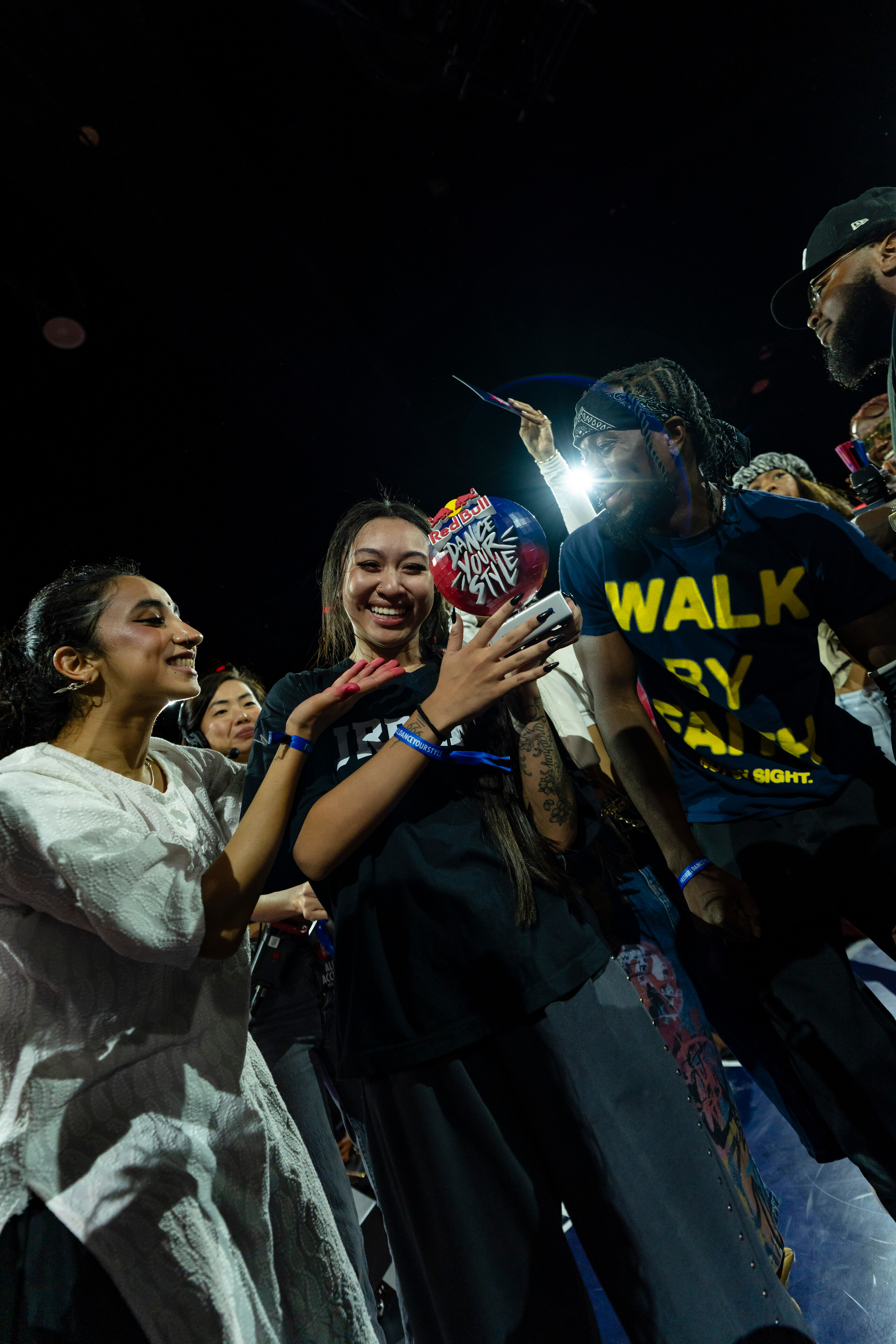
The post-battle images also show competitors gathering around the champion after the final. That is one of the useful details of battle culture: intensity during the round and respect after it can exist in the same space.
“So if I’m battling, sometimes I look mean, I’m not mean, but sometimes I look mean or sometimes I look smiley. It just depends on the moment in the song.” — JREAMZ (KJZZ, The Show, August 2025)
That 2025 quote helps explain what viewers saw in Tampa: JREAMZ treats facial expression as a response to the music rather than a fixed character. Red Bull’s Tampa recap likewise emphasized her winks, hair flips, smirks, backbends, glides and spins as part of how she connected movement to the song and the crowd.
JREAMZ, JJ and Girl Deadend: What the Public Record Actually Shows
The public record uses several names for her. Red Bull and most competition coverage use JREAMZ. Copper Hills Center for the Arts currently lists her professionally as Jossette (JJ) Sanaphay. The Krump Championship Series has published battle footage identifying her as “Jreamz aka Girl Deadend.”
Those records establish that the names are used. They do not, by themselves, establish who gave her the name Girl Deadend, what lineage it represents, or what the name means to her personally. An earlier version of this article filled in that meaning from general krump naming conventions; DMM has removed that assumption.
That is exactly the kind of detail better answered by JREAMZ herself. DMM has included it in our follow-up interview questions so the explanation can enter the record in her own words rather than through inference.
The larger editorial principle remains the same: names, mentors, crews and lineages should be credited accurately. When the specific relationship is not confirmed, DMM should leave the space open until the artist or a reliable source confirms it. DMM applies the same credit standard across our American Social Dance Movement coverage and our reporting on Black creative directors and choreographers.
What a National Stage Can Do for Krump
A krump-based dancer winning a national all-styles, crowd-voted event gives the form visibility in a context where many viewers may be encountering it outside a krump-specific battle for the first time.
Krump emerged in Los Angeles and has developed through battles, sessions, crews, films and international communities. Mainstream audiences often encounter only fragments of that culture. A national event can introduce viewers to the form, but it cannot replace the deeper history and community context behind it.
Tampa adds one clear data point: in a field of sixteen dancers representing different movement backgrounds, the audience ultimately selected JREAMZ. That result does not prove that one style is “better” than another. It shows that her performance communicated strongly enough in this format to win the title.
What happens next is worth documenting rather than predicting. DMM can follow whether the title leads to new battles, teaching opportunities, collaborations, media attention or other career steps — and let the record show what the exposure actually changed. Follow the continuing record through DMM’s street dance coverage and hip-hop coverage.
The Awards — and the Ones That Don’t Exist Yet
2026 — Red Bull Dance Your Style USA National Champion. Won September 19, 2026 at the Tampa Convention Center, defeating Kidd The Monster in the final. Carries the United States slot at the World Final.
2025 — Red Bull Dance Your Style West Qualifier Champion. Won in Phoenix in August 2025 at seventeen, advancing to that season’s National Final in San Francisco.
2026 — KCS ranking, #5 Women’s 1v1. Her standing on the Krump Championship Series circuit, with a win over Rogue at KCS One in July 2026.
There is no single comprehensive public record of JREAMZ’s full competitive history. KCS documents specific krump results, Red Bull documents Dance Your Style, and local reporting fills in parts of the story. Studio showcases, local sessions and smaller battles can still fall outside searchable archives. DMM will distinguish what is documented from what remains unconfirmed.
That absence is not a footnote to her story. It is the argument. When a discipline is undercredited, its practitioners’ achievements have to be documented deliberately, by publications willing to do it. Otherwise a body of work that shaped how thousands of young people understood what was possible for them simply evaporates from the record. It is the reason The Legacy exists on this site at all.
Where JREAMZ Is Now
As of late September 2026, she is the reigning USA champion and preparing for the Red Bull Dance Your Style World Final at the Hallenstadion in Zürich, Switzerland, on October 24, 2026. She will represent the United States against national champions from around the world. The 2025 World Final, held in Los Angeles, was won by Jaïra Joy.
Asked how she intends to prepare for it, she gave an answer entirely consistent with everything else in this profile: “I’m going to prepare with my training, my mindset and my movement.” Training, mindset, movement. No mention of strategy, scouting or tricks. The same three things that got her from a Mesa studio to a national title.
Beyond Zürich, DMM will not invent a schedule for her. She is eighteen, has just won the largest title currently documented in her career, and public reporting on what comes after is still developing. Copper Hills Center for the Arts also currently lists Jossette (JJ) Sanaphay on its dance staff, giving us one verified piece of her work beyond competition.
What we will say is that Dance Mogul Magazine intends to keep following her, and the rest of the Tampa field, through the next twelve months. A championship is a night. A career is a decade. The interesting question is never who won — it is who is still building three years later.
In Her Own Words: JREAMZ on Tampa, Krump and the Dream Behind the Name
Dance Mogul Magazine sent Jossette Sanaphay ten questions after her national title: about the night in Tampa, what her first Dance Your Style run taught her, what krump lets her say, the people who shaped her, and what she wants JREAMZ to become. These are her answers, in her own words.
Winning the 2026 Red Bull Dance Your Style USA National Final in Tampa was a major moment in your journey. When you think back to that night, what moment stands out most clearly to you?
Honestly, I think what stands out to me most is everything I felt in that moment. I remember looking around and realizing how many people were there, hearing the crowd, seeing my parents, and just thinking about how far I had come. There was a little girl inside of me who dreamed about moments like that without knowing what the journey would look like. Being able to experience it with my parents there made it even more meaningful.
But beyond the result, I remember feeling overwhelmed with joy and gratitude. Grateful to be standing in that lineup, grateful for the dancers around me, and grateful that I got to express myself through something I love so deeply. That night felt like a reflection of so many years of training, losses, lessons, and faith.
You had already experienced Dance Your Style competition before returning in 2026. What did you learn from your earlier experience that helped prepare you differently for Tampa?
My earlier experience taught me that I couldn’t focus too much on the outcome. The first time around, I was learning what it meant to be in that environment and how much pressure can come with competing on a stage like that. I realized that I had to not overthink about what song I was gonna get or who I was battling, but really enjoy each and every moment.
Coming back in 2026, I felt more comfortable being uncomfortable. I understood that I didn’t need to prove that I belonged there, I just needed to dance. I focused more on my expression, having fun, and staying present instead of thinking about what might happen next. I think the biggest difference was learning to trust myself and live in the moment.
Dance Your Style asks dancers to respond to music they do not know in advance while the audience decides the winner. How do you stay connected to your own identity as a krump dancer while also communicating with a crowd that may come from many different dance backgrounds?
For me, it comes back to being honest. Krump is such a big part of who I am, so I don’t try to separate myself from that when I dance. I also had to understand that I’m a dancer that krumps and not a krumper that can dance. I think about the foundation, the emotion, the character and the freedom that krump has given me, while also having the dance aspect be the base of my movement.
At the same time, I know that the audience may not know every movement or understand every part of the culture behind it. So I try to communicate through something more universal like emotion. I want people to feel something, even if they don’t know exactly what they’re looking at. I don’t want to dance like I’m trying to convince someone to understand me. I want to dance in a way where they can feel me. So even if that feeling is joy, sadness, or any other feeling a song gives me, I want to use that feeling to connect to others.
“I don’t want to dance like I’m trying to convince someone to understand me. I want to dance in a way where they can feel me.”
Krump can communicate intensity, emotion, character and personal experience in ways that go far beyond steps. What does krump allow you to express that you feel you might not be able to communicate any other way?
Krump gives me a place to be completely honest. There are emotions that are difficult to put into words, and sometimes I don’t even know how to explain what I’m feeling until I’m dancing. It gives me permission to be powerful, vulnerable, angry, joyful, uncomfortable, free all in the same space. I can take something I’m experiencing internally and turn it into movement. For me, krump isn’t just about looking intense. It’s about having something to say. It has taught me that my emotions don’t have to be something I hide, but something I express.
Your development has included years of training, mentorship and being part of a dance community in Arizona. Who are some of the people who have helped shape the dancer and person you are becoming, and what have they taught you?
There are so many people who have poured into me that it’s hard to name everyone without leaving someone out. My family has been one of the biggest parts of my journey. My parents have supported me through the highs and lows, traveled with me, believed in me, and allowed me to keep chasing something that started as a dream.
My dance community in Arizona has also shaped me tremendously. My mentors Leah, RaeRae, Ronnie and Armani have taught and guided me through dance and life, and I couldn’t be more grateful for them. I wouldn’t be where I am without them; they have helped me grow and shape me in many ways in and out of dance. I’ve learned that you don’t become a dancer alone. There are pieces of so many people in the way I move and the person I’m becoming.
When younger dancers see a national championship, they often see the final moment but not everything that came before it. What parts of your journey — training, setbacks, losses, repetition or personal growth — do you think people need to understand in order to appreciate what happened in Tampa?
I think people need to understand that the moment in Tampa didn’t start in Tampa.
It started years ago when I was just a kid who fell in love with dance. It was in the days where I didn’t feel good enough, the battles I lost, the times I questioned myself, and the moments I had to choose to show up for myself even when it was hard. There were so many moments that nobody saw. Training when I was tired. Learning how to lose without letting a loss define me. Learning how to believe in myself while still knowing I had more to work on.
I think that’s what makes moments like Tampa meaningful. The achievement is visible, but the becoming isn’t.
“The achievement is visible, but the becoming isn’t.”
You competed against dancers with very different styles and life experiences. Was there anyone you faced or watched in Tampa who taught you something, challenged you differently, or made you think about your own dancing in a new way?
Honestly, I felt inspired by so many of the dancers there. Being surrounded by dancers with completely different ways of moving reminded me that there isn’t only one way to be an artist. Everyone brought their own story, musicality, personality and experience into the room. Watching that made me think about how important it is to protect what makes me different instead of trying to become what I think people want to see. Competition can make you focus on winning, but being around great dancers reminds me why I started dancing in the first place. I want to keep learning from people while still becoming more of myself.
You are now representing the United States on an international stage. What does that responsibility mean to you personally, and what do you hope people around the world understand about the dance community you come from?
It’s an honor and something I don’t take lightly. Representing the United States means I’m carrying more than just my own name onto that stage. I’m carrying the people, communities and experiences that helped me get here. I’m especially proud to come from Arizona and from a dance community that has given me so much. I hope people see how connected dance really is. We may come from different cities, countries and backgrounds, but we’re able to meet through movement and understand each other without always needing words.
Beyond competition, what kind of artist do you want JREAMZ to become? Are there areas such as performance, choreography, teaching, community work, creative projects or other opportunities that you hope to explore?
I want JREAMZ to become bigger than competition.
I want to perform, teach, choreograph, create, collaborate and continue building spaces where other people feel like they can dream too. I want to be able to give younger dancers some of the encouragement and opportunities that people gave me.
JREAMZ has always represented dreams to me, the idea of continuing to believe in something even before you can see where it’s going. So I don’t want the name to only represent me as a dancer. I want it to represent a movement and a mindset for creatives.
There are so many things I haven’t explored yet, and honestly, that’s one of the most exciting parts.
“I want it to represent a movement and a mindset for creatives.”
Years from now, when people look back at this chapter of your life, what do you hope they remember — not only about JREAMZ the champion, but about Jossette Sanaphay the person?
I hope they remember that I stayed true to myself, who I was as an artist, and my passion. I hope they remember that I cared about the people around me, that I stayed grateful, that I kept learning, and that I never let one moment convince me that I had already reached my destination.
If someone sees my journey years from now and feels like they can chase their own dream because of it, then that means more to me than any title. I don’t want to only be remembered for what I won. I want to be remembered for what I gave, what I created, and how I made people feel along the way.
Interview conducted in writing in September 2026. Answers are published as submitted, with minor spelling and punctuation edits only.
JREAMZ: The Documented Path
Grows up in North Phoenix, Arizona. Begins dancing very young — by her account, “since I was really little.”
Starts training at The Jukebox Dance Studio in Mesa under Andrea “RaeRae” Pentecostes and Leah Roman. Public sources do not cleanly establish the exact year she began specializing in krump.
Competes at KCS x Mecca 3, falling to No Joke in the Top 16.
Wins the Red Bull Dance Your Style West Qualifier in Phoenix at seventeen, advances to the National Final in San Francisco, and is eliminated there, according to KJZZ’s September 2026 follow-up.
Defeats Rogue at KCS One. Holds a #5 ranking among women in 1v1 on the Krump Championship Series.
Wins the Red Bull Dance Your Style USA National Final at the Tampa Convention Center, beating Tyler D. Creator en route and Kidd The Monster in the final.
Represents the United States at the World Final, Hallenstadion Zürich, Switzerland.
What She Represents to Young, Up-and-Coming Dancers
JREAMZ’s documented path is useful because it includes both development and setback: years of studio training, a 2025 regional win followed by a National Final elimination, continued krump competition, and a 2026 national title. That is a stronger lesson than a simplified overnight-success story.
Read as a career path rather than a résumé, her trajectory shows five distinct stages, and any serious dancer can locate herself on this ladder — which is the whole reason we are laying it out.
The verified long-term piece of JREAMZ’s story is her studio training: RaeRae told KJZZ that she and Leah Roman had worked with her since she was about nine or ten. The exact krump timeline is less clear, so the practical lesson is broader — consistent training creates something to draw from when opportunity arrives.
She competes on the krump circuit, where the judges know the form and her record is a real record — wins and losses both, Top 16 exits included. Losing in front of experts is how you find out what is actually missing. A dancer who only enters rooms she can win learns nothing and improves on schedule with nobody.
Tampa required JREAMZ to use her own movement identity inside unfamiliar music and a crowd-voted format. Red Bull’s recap describes her leaning into krump and hip-hop-influenced movement while reacting visibly to the songs. The useful lesson is adaptation without pretending every audience understands your foundation in advance.
She won a regional qualifier at seventeen, was eliminated at the 2025 National Final, returned the following year, and won the USA title at eighteen. That sequence is a reminder that an early national-stage loss can be part of development rather than the end of the story.
A title is only one part of a career. As of September 2026, Copper Hills Center for the Arts lists Jossette (JJ) Sanaphay on its dance staff, while Red Bull has her preparing to represent the United States in Zürich. Teaching, training, competing and whatever comes next are all parts of the record DMM intends to follow. DMM’s workbooks are also available for dancers building their own training and career plans.
Why JREAMZ Matters to Dance Mogul Magazine
Dance Mogul Magazine has published for over fifteen years on a single conviction: dance is the foundation, not the ceiling. JREAMZ answers that directly. What she demonstrated in Tampa was not a dance skill — it was the ability to make yourself understood by people who do not share your language, while refusing to become someone else in order to do it. Change the setting and that is a job interview, a classroom, a negotiation, a life. Krump taught her to take the rawest thing she had and make it legible. There is no arena in which that is not useful.
Krump itself emerged from Black communities in Los Angeles and has grown into an international street-dance culture. DMM’s responsibility is to document artists, mentors, battles and lineages carefully enough that credit travels with the movement — especially when a form reaches a broader mainstream audience.
And there are the years of training behind the title. The public record clearly supports a long relationship with The Jukebox and her mentors, even though it does not support turning all of those years into a krump-specific timeline. That distinction is exactly why careful documentation matters.
If her story lands with you, keep going: explore the full range of forms in our Dance Styles Hub, read more conversations with working professionals in our Exclusive Interviews, and build your foundation in the Dance Knowledge Hub.
Frequently Asked Questions About JREAMZ
Who is JREAMZ?
JREAMZ is Jossette Sanaphay, a dancer from North Phoenix, Arizona, and the 2026 Red Bull Dance Your Style USA national champion. Copper Hills Center for the Arts lists her as Jossette (JJ) Sanaphay, and KCS has published battle footage identifying her as Jreamz aka Girl Deadend. RaeRae told KJZZ that she and Leah Roman had trained JREAMZ at The Jukebox Dance Studio since she was about nine or ten.
How old is JREAMZ?
She was eighteen when she won the national title in September 2026. She had won the West Qualifier in Phoenix a year earlier, in August 2025, at seventeen.
What dance style does JREAMZ do?
Krump is central to JREAMZ’s current battle identity. KJZZ recorded her describing the form as raw and expressive, and Red Bull describes her Tampa movement as krump and hip-hop influenced. The exact year she began specializing in krump is not cleanly established by the public sources DMM reviewed.
Who did JREAMZ beat to win the 2026 national final?
According to Red Bull’s official post-event recap, she defeated Tyler D. Creator on the way to the final four and then beat Kidd The Monster in the championship battle. Lily Frias, Jesse Sykes, Marlee Hightower, Surge and Harini also reached the late stages of the Tampa bracket.
What is JREAMZ’s krump battle record?
On the Krump Championship Series circuit she is ranked #5 among women in 1v1 and #17 in tournament play, with a career tournament record of 1–2 and a 1v1 record of 1–0. Logged results include a win over Rogue at KCS One in July 2026, a win over Rucgirl and a loss to Dread at KCS x Kill Krump, and a Top 16 loss to No Joke at KCS x Mecca 3 in June 2025.
What is Red Bull Dance Your Style and how is it judged?
It is a one-on-one all-styles freestyle battle in which dancers do not know the songs in advance and the crowd — not a judging panel — votes after each battle. The format rewards musical adaptability, individuality, performance presence and the ability to make a specialized dance language readable to a general audience.
What is next for JREAMZ?
She represents the United States at the Red Bull Dance Your Style World Final at the Hallenstadion in Zürich, Switzerland, on October 24, 2026. Asked how she would prepare, she said: “I’m going to prepare with my training, my mindset and my movement.”
KEEP EXPLORING
Dance Mogul Magazine documents the artists who build the culture and the careers that grow out of it. Start with the Featured Artist series, dig into the Archive, follow the season in the Red Bull Dance Your Style Newsroom, and browse everything we have published in the Article Library.
Reporting sources: Red Bull, KJZZ (The Show), Copper Hills Center for the Arts, Yahoo/Refinery29 syndication, and the Krump Championship Series. DMM corrected this article on September 23, 2026 after verifying that a KJZZ quote about “seven years” of krump belonged to RaeRae, not JREAMZ, and after KJZZ’s new follow-up confirmed JREAMZ was eliminated at the 2025 National Final. Public sources use variant spellings of her surname; DMM now uses Jossette Sanaphay, matching her current professional staff listing and other published coverage.
© 2026 Dance Mogul Magazine LLC | dancemogul.com | Inspiring Self-Empowerment Through Dance Culture
Red Bull and Red Bull Dance Your Style are trademarks of their respective owners. Dance Mogul Magazine is an independent publication and is not affiliated with, endorsed by, or sponsored by Red Bull.