
Lil Buck: The Memphis Jookin' Pioneer Who Danced From the Street Corner to Oxford
In 2021 he judged an emerging-dancer competition and told us why movement artists deserve respect as artists in their own right. Nearly five years on, Charles "Lil Buck" Riley is an Oxford Cultural Fellow, a foundation founder, and still the world's most recognizable ambassador of Memphis Jookin'.
By Dance Mogul Magazine | Originally featured July 2021 | Updated & expanded 2026
Movement artists Lil Buck (left) and Jon Boogz — co-founders of Movement Art Is (M.A.I.).
Charles "Lil Buck" Riley is thriving. In 2025–26 he was named a Schwarzman Centre Cultural Fellow at the University of Oxford, where he created 1776, a hip-hop-and-Jookin' work marking the 250th anniversary of American independence. He also leads The Lil Buck Foundation, his nonprofit expanding arts education and career pathways for Memphis youth — a mission that recently carried an all-Memphis Jookin' cast to a sold-out Lincoln Center stage.
When we first sat down with Lil Buck and his creative partner Jon Boogz in the summer of 2021, the dance world was climbing out of a pandemic that had shuttered studios and scattered careers. The two were serving as lead judges for an emerging-talent dance competition, and the conversation quickly became something bigger than one event: a clear-eyed argument for why dancers deserve to be treated as artists on equal footing with the musicians they so often elevate.
That argument has aged remarkably well. Lil Buck — the Memphis-raised movement artist who turned a freestyle street dance into a language spoken on the world's most prestigious stages — has spent the years since proving his own thesis, taking Memphis street dance from parking-lot cyphers to a fellowship at one of the oldest universities on earth. Before we get to where he is now, revisit the conversation exactly as it happened.
The 2021 Interview
Alongside host and lead judge Samantha Long, Lil Buck and Jon Boogz joined an emerging-dancer competition tied to the UPROAR Hip Hop Festival. Dance Mogul spoke with both movement artists about respect, the post-pandemic comeback, and how music and dance can lift each other.

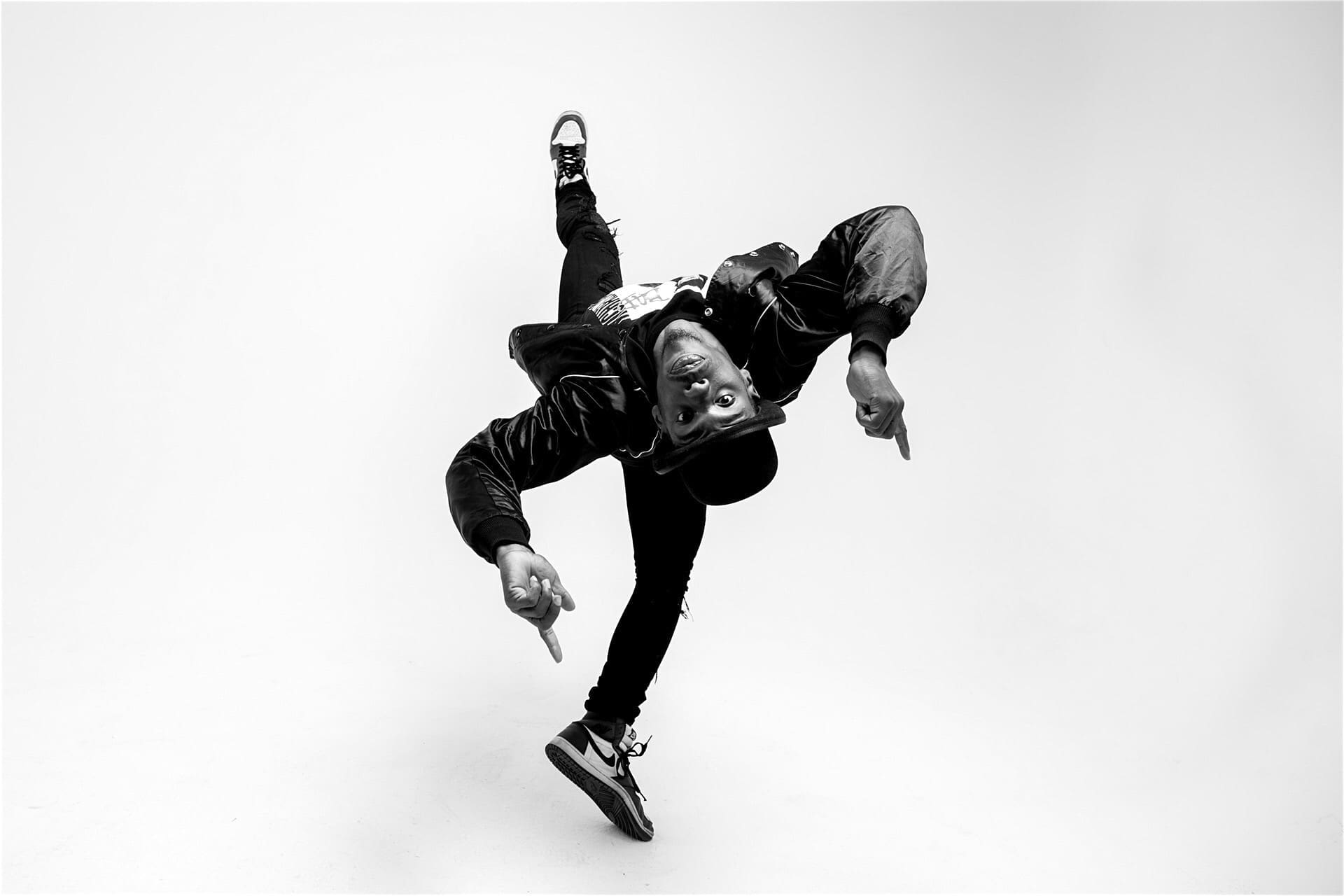
Lil Buck, the Memphis-turned-global sensation showing the world that Jookin' is fine art.
Dance Mogul: How important is it that major artists help create platforms for dancers?
Lil Buck: I think it's extremely important for major artists to help create platforms for dancers — dancers are artists too, and that seems to go past a lot of music artists' heads. Dancers have always been there to support major music artists. We give free promotion to the major artist by creating dances that catch trends and cause the world to dance to their music or become fans of it if they weren't already. That is a big deal. We create art that stands the test of time and helps people understand their music in different ways. Dancers do so much for major artists, and with the amount of success major artists get from sharing their art with the world, it's extremely hard for dancers and performing artists to get to that level of success. If we had more support from the major artists and the music industry in general, I feel dancers would truly be able to reach that level of success and respect.
Jon Boogz: It's very important. Dance is a universal language like music is. Those who speak the language of dance deserve to be honored on the same level as any other artist. So much blood, sweat, and tears go into the life of a movement artist. It's awesome to see artists in other genres giving dance its proper respect.
"Dance is a universal language like music is. Those who speak the language of dance deserve to be honored on the same level as any other artist." — Jon Boogz
Dance Mogul: How does it feel to get back to work as a dancer after the pandemic?
Lil Buck: It feels great to get back to work after the pandemic. Unfortunately, for many dancers that wasn't the case. A lot of dance studios had to close their doors. Many dancers who were grinding to make a living and achieve their dream had to move back home with their parents. It was a real eye-opener for a lot of dancers in the industry. On the other hand, many dancers adapted to what was happening and found ways to keep sharing their art and movement in innovative ways virtually. I think this pandemic put into perspective how dancers use the money they make and their role in life as an entrepreneur.
Jon Boogz: It feels amazing — even though I never stopped working during the pandemic, writing shows and filming a TV show. I was blessed to be busy and working, but being around humans again is awesome. Not doing everything on Zoom and actually building in person is such a relief. All-Zoom work was just a weird space to be in when you're trying to make something powerful or groundbreaking. Very happy to be back out in the world and really connecting with others.
Dance Mogul: When judging, how do you give constructive criticism without shooting down a person's efforts in the moment?
Lil Buck: When judging a dance competition, as an experienced dancer, I make sure the competitor knows that first off this is just a competition. No matter the outcome, it shouldn't make them feel like it's a make-or-break situation or make them second-guess their talent. I'll always give honest feedback, but I encourage them not to let one experience make them give up if it doesn't go their way.
Jon Boogz: It's all about communication. I can be honest in my critiques but deliver it in a way that doesn't belittle the artist. We've all been in phases of our artistry where we're growing and finding ourselves. That's a lifelong process. When you understand that, it's easy to be respectful with your critiques. Just because I'm a judge doesn't mean I don't know that feeling of putting your all on the line and hoping for the best. You have to respect the fact that dance artists have the guts to be judged in the first place.
Dance Mogul: How can music artists and dancers better collaborate to help each other grow on a grassroots level and an industry level?
Lil Buck: One thing music artists and dancers can do to better collaborate and help each other grow is to not put each other's art in a lower or higher class — and to see each other as artists, period. An artist of music and an artist of movement. That's how we should see each other, because we both bring something to the table that's respected when people see it and can't be duplicated by the other. If music artists could see dancers as artists in their own right and respect what they bring to the table, and vice versa — and if dancers saw themselves as artists and respected themselves as such — it would make it so much easier for both to collaborate.
Jon Boogz: Music artists and dance artists can better collaborate once people truly respect each other's craft. I think dance is still so disrespected and downplayed. Some music artists do show their dancers, and dance in general, a lot of love. But as an industry as a whole, dance is still at the bottom tier — as far as pay, publicity, and overall treatment. Once all the different industries truly respect dance, and it reflects on all levels, the relationships will grow and the standards will change. Amazing art is still yet to be made because of these barriers.
The Competition Behind the Conversation
The 2021 interview grew out of a dance competition attached to the UPROAR Hip Hop Festival, a live music, arts, and nightlife experience produced in partnership with Lil Wayne's lifestyle brand GKUA. Choreographer and creative partner Samantha Long hosted and served as lead judge, co-producing the event through her company A THREAT Media, with Lil Buck and Jon Boogz judging alongside her.
The format invited two-person dance teams from California — novice to experienced — to submit video entries on social media for a chance to compete live in front of thousands, with a cash prize on the line and a finalist showcase streamed worldwide. It was exactly the kind of platform Lil Buck argued for in his interview: a partnership that used a major brand's reach to spotlight up-and-coming movement artists who might otherwise never get a stage that size. That through-line — using visibility and resources to open doors for the next generation — would become the defining thread of the next chapter of his career.
Who Is Lil Buck? The Backstory
Charles "Lil Buck" Riley was born in Chicago on May 25, 1988, and raised in Memphis, Tennessee, where he was introduced to Jookin' — a freestyle street dance of intricate footwork, gliding, and gravity-defying illusion born from Memphis "Gangsta Walking" — as a young teenager. After rising through the local Jookin' ranks, he earned a scholarship to study ballet for two years, and it was that rare fusion of street-dance instinct and classical discipline that produced his signature vocabulary of toe stalls, ankle breaks, and impossibly smooth glides.
His breakthrough came in 2011, when director Damian Woetzel paired him with cellist Yo-Yo Ma for a performance of Camille Saint-Saëns' "The Swan." Filmed by Spike Jonze and posted online, the clip went viral and introduced Jookin' to millions. In the years that followed, Lil Buck performed and choreographed alongside a staggering range of collaborators — Madonna, Janelle Monáe, Cirque du Soleil's Michael Jackson: One, Benjamin Millepied, and the New York City Ballet — and appeared in global campaigns for brands including Apple, Versace, Chanel, and the Jordan Brand.
Just as importantly, in 2016 he and Jon Boogz co-founded Movement Art Is (M.A.I.), an organization built to elevate the artistic, educational, and social impact of dance. Their short film Color of Reality, made with painter Alexa Meade, turned movement into a protest against gun violence and racial injustice, earning festival honors and cementing the pair's belief that street dance is fine art with something urgent to say.
"All jookin' is balance; it's a groove... It came out of the Gangsta Walk." — Lil Buck
Where Is Lil Buck Now? (2026)

Lil Buck — from Memphis street corners to the world's leading stages.
The dancer who told Dance Mogul that movement artists deserve real institutional respect has since walked straight into one of the world's most storied institutions. For the 2025–26 academic year, Lil Buck was named a Cultural Fellow at the University of Oxford's Stephen A. Schwarzman Centre for the Humanities, in partnership with St Hilda's College and DANSOX. As a Fellow, he immersed himself in Oxford's academic community — even consulting anatomy and history experts — to research how bodies and cultures moved in the eighteenth century.
The centerpiece of that fellowship is 1776, a new stage work marking the 250th anniversary of the American Declaration of Independence. A collision of hip-hop and Memphis Jookin', it premiered in Oxford in June 2026 as part of the Schwarzman Centre's inaugural "Unfinished Revolutions" season, then traveled to the Royal Ballet's Next Generation Festival at the Linbury Theatre. Crucially, the piece is a co-production of the Schwarzman Centre, ZooNation: The Kate Prince Company (led by choreographer Dannielle 'Rhimes' Lecointe), Oxford's Body Politic, and The Lil Buck Foundation — uniting young dancers from Memphis, London, and Oxford on one stage.
"All your passion, your anger, your frustration, your love, everything — Memphis Jookin' is that." — Lil Buck, Schwarzman Centre, 2026
That foundation is the clearest fulfillment of everything Lil Buck argued for back in 2021. The Lil Buck Foundation is his nonprofit dedicated to expanding arts education, mentorship, and career pathways for underserved youth — particularly in his hometown of Memphis. Through it, he produced the first-ever touring Memphis Jookin' stage show with an all-Memphis cast, giving young dancers national touring exposure and sold-out performances at Lincoln Center, and integrated foundation youth into a Nike Air Force 1 campaign that put Memphis Jookin' in an international spotlight. In 2026 he also appeared as a guest of the SCAD Fashion Show, continuing a two-decade run at the intersection of dance, fashion, and film.
Partner Jon Boogz, meanwhile, continues to build through Movement Art Is, with the duo's collaborations extending into projects that fuse percussion, opera, and movement. Together they remain living proof of the idea they pressed in this very interview: that when the wider culture finally treats dance as fine art, the standards — and the opportunities — change for everyone who moves.
Why It Matters to Dance Mogul Magazine
Lil Buck's journey is the Dance Mogul Magazine mission in motion. He took a dance born on Memphis street corners, refused to let it be boxed in as "background," and carried it — and the young dancers who share its roots — onto ballet stages, into fashion houses, and all the way to an Oxford fellowship. That is exactly the arc DMM exists to document and amplify: talent from underserved communities, elevated to the level of fine art, and turned into opportunity for the next generation.
His words to us in 2021 — that dancers must see themselves as artists and demand the respect that follows — sit at the heart of our empowerment coverage. And his path is a template worth studying for any young mover: master your craft, build a platform, then reach back and pull others up. Explore more journeys like his across our Dance Styles Hub and our library of Exclusive Interviews.
• Dive into more styles at the Dance Styles Hub
• Read our full library of Exclusive Interviews
• Browse Street Dance and Hip-Hop features
• Get inspired in the Empowerment archive
The Story Continues
When we spoke with Lil Buck in 2021, he was helping judge a competition designed to give unknown dancers a stage. Five years later, he is building those stages himself — in Memphis, in London, and in Oxford — and handing them to the young Jookers coming up behind him. The competitor's mindset he described (honest feedback, but never a reason to quit) has become the ethos of an entire foundation.
From the parking lots of Memphis to a viral moment with Yo-Yo Ma to a fellowship at Oxford, Lil Buck has spent his career proving that Memphis Jookin' — and the artists who carry it — belong anywhere in the world. Dance Mogul Magazine will keep following that story, because it is the story we were built to tell.
© 2026 Dance Mogul Magazine. All rights reserved.