
Exclusive Interview · Legacy Feature · Where Are They Now
Michael Joy: The Late Starter Who Danced for Alvin Ailey, Opened The Lion King and Gave It All Back to Kansas City’s Kids
He took his first beginner dance class at 21, was told by a ballet teacher to quit, and was personally invited into the Ailey company eight years later. Then he spent his second act teaching children that power lives in the choices they make.
By Dance Mogul Magazine | Originally published July 2013 | Updated and expanded October 2026

Michael Joy in “I Want to Be Ready” from Alvin Ailey’s Revelations, Alvin Ailey American Dance Theater. (Dance Mogul Magazine archive, 2013)
At a Glance
Name
Michael Joy
Roots
New Jersey; biology student at William Paterson College, Wayne, NJ
Training
The Ailey School certificate program and full scholarship, New York City
Companies
Ailey II (1984–1986); Alvin Ailey American Dance Theater (joined 1989 at Alvin Ailey’s personal invitation)
Broadway
Original cast, Disney’s The Lion King (opened November 13, 1997), ensemble dancer
Also danced with
Radio City Rockettes Christmas Show, Gallman’s Newark Dance Theater, Elisa Monte Dance Company, Dennis Wayne’s Dancers, Nanette Bearden Contemporary Dance Theater; assistant to Talley Beatty
Education leadership
AileyCamp Director (from 2002) and Director of Artistic and Educational Programs (from 2006), Kansas City Friends of Alvin Ailey
Known for
Proving a late start is not a closed door; dance as a vehicle for life skills
21
His age at his first beginner dance class
8
Years from first class to the Ailey company
30,000+
Kansas City students reached each year (2013)
10
Year-round KCFAA youth programs he helped oversee (2013)
Who Is Michael Joy?
Most dancers who reach the Alvin Ailey American Dance Theater begin training as children. Michael Joy began as a 21-year-old biology student in New Jersey who had never taken a dance class. Eight years later, Alvin Ailey himself asked him to join the company. He went on to dance the works of Judith Jamison, Donald McKayle, Jerome Robbins, Garth Fagan and others on the world’s great stages, perform at President Bill Clinton’s first inauguration, and open on Broadway in the original cast of Disney’s The Lion King.
Then he did something many performers never get to: he turned a performing career into a teaching mission. As AileyCamp Director and Director of Artistic and Educational Programs for Kansas City Friends of Alvin Ailey (KCFAA), Joy helped run programs that, by his count in 2013, reached more than 30,000 school-aged children a year, many of them free of charge.
When Dance Mogul Magazine interviewed him in July 2013, we sought him out for one reason: to help inspire and empower the next generation of dancers. This updated feature preserves that conversation in full and adds the timeline, the context and the reasons his story still matters.
A Biology Major Who Found the Stage
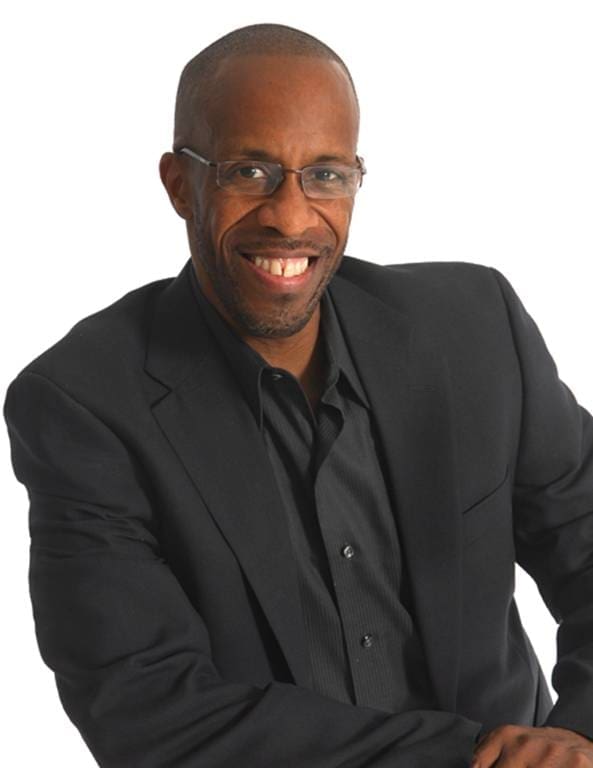
Michael Joy. (Dance Mogul Magazine archive, 2013)
Joy’s love of performing started early, long before he had a word for it. As a four- or five-year-old he made up dances in his living room to his parents’ records, imitating the singers and dancers on television variety shows. His older sister, Karen, became his first real inspiration when she took an African dance class at a neighborhood community center. Boys were not allowed in the class, so he watched and practiced the steps when no one was around.
His schools offered sports and band, and neither fit. It was not until college, at William Paterson College in Wayne, New Jersey, that he had room to explore. He enrolled as a biology major but drifted to the theater department, where directors kept casting him as a dancer even though he had no training. One of those productions earned him the Award of Excellence at the 1981 Kennedy Center American College Theater Festival.
The Night He Saw Himself on Stage
The turning point came on a college field trip to see Alvin Ailey American Dance Theater at New York City Center. It was only the second professional dance company he had ever seen. What struck him was that the dancers looked like “real people” — people from his own neighborhood and his own town. He saw himself on that stage, and decided to find out what it would take to get there.
A few months later he auditioned for The Ailey School and was accepted into its certificate program. He commuted an hour each way from New Jersey, worked weekends to pay for the trip and took out student loans for tuition. His parents let him live at home, a kind of support he credits with keeping him in training when many friends had to quit.
“Consider Pursuing Something Else”
After his first term, one ballet instructor wrote that he had shown no improvement at all and should think about another career. Denise Jefferson, the director of The Ailey School, moved him into a different teacher’s class instead. His ballet technique began to improve soon after. It is one of the clearest examples in the Dance Mogul archive of how one educator’s decision can change the course of a life — and it foreshadows the kind of educator Joy would become.
From Ailey II to Alvin Ailey’s Own Invitation
After earning his Certificate of Dance, Joy received a full scholarship to continue at The Ailey School, performing along the way with the Nanette Bearden Contemporary Dance Theater, Blue Mercury Dancing Company and Michiyo and Dancers. In 1984 he joined Ailey II under the direction of Sylvia Waters and danced with the company until 1986.
He then took his career abroad, traveling to Rome as a featured dancer on the weekly Italian variety series Premiatissima and other Italian television productions. Back home in 1987, he danced with the Radio City Rockettes in the Christmas Show, with Gallman’s Newark Dance Theater, Dennis Wayne’s Dancers and the Elisa Monte Dance Company, and worked as an assistant to the choreographer Talley Beatty — an apprenticeship he still counts among the most valuable of his life.
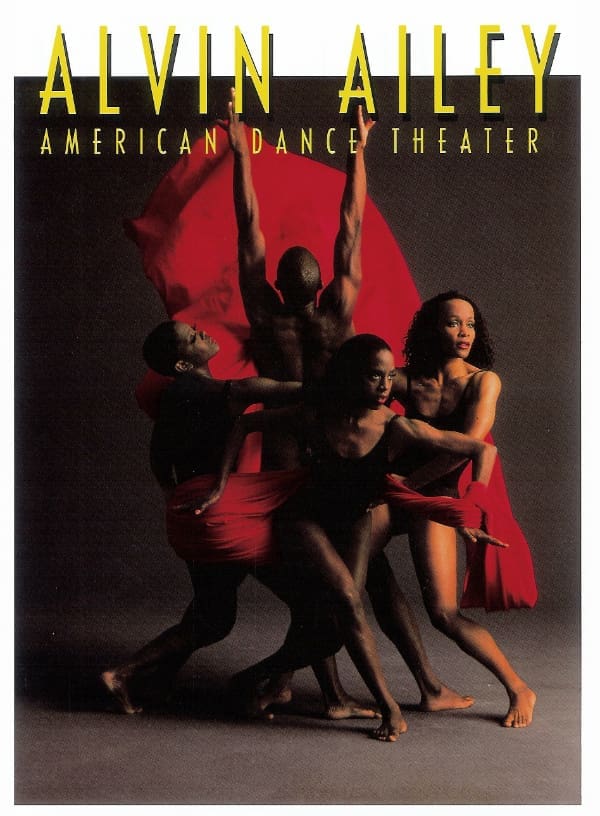
Michael Joy, Alvin Ailey American Dance Theater. (Dance Mogul Magazine archive, 2013)
In 1989, Alvin Ailey personally asked him to join Alvin Ailey American Dance Theater, the year of Ailey’s death. With the company, Joy performed works by Judith Jamison, Donald McKayle, John Butler, Jerome Robbins, Lar Lubovitch, Garth Fagan, Billy Wilson, Jawole Willa Jo Zollar, Shapiro & Smith, George Faison, Louis Johnson and Donald Byrd. He danced at the Palais Garnier of the Paris Opera, the Odeon of Herodes Atticus in Athens, the Cairo Opera House, Lincoln Center and the Kennedy Center, as well as at President Clinton’s inaugural celebration, the 1996 Olympic Arts Festival, the Lyon Dance Biennale and the Spoleto festivals in Italy and the United States.
Broadway: The Lion King
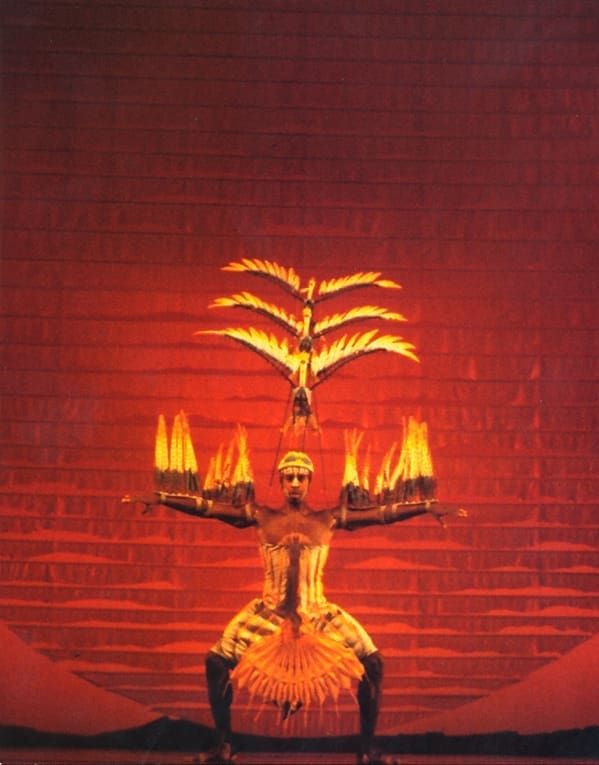
Michael Joy in The Lion King on Broadway. (Dance Mogul Magazine archive, 2013)
Joy then joined the original Broadway cast of Disney’s The Lion King, which opened at the New Amsterdam Theatre on November 13, 1997, and went on to win the Tony Award for Best Musical. Playbill’s Vault lists him as an ensemble dancer in that opening company. During this period he also returned to school: through SUNY Empire State College’s Richard Porter Leach Fellowship, a program that lets working performing artists complete a degree while continuing their careers, he resumed the college education he had set aside for dance.
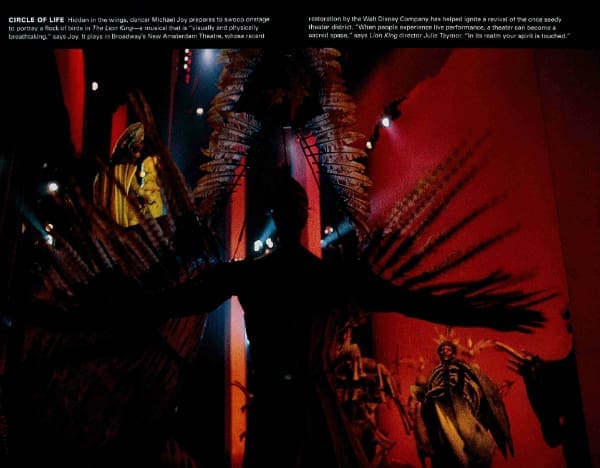
The Lion King, as featured in National Geographic. (Dance Mogul Magazine archive, 2013)
Career Timeline
Michael Joy — Career Timeline
1981 — Wins the Award of Excellence at the Kennedy Center American College Theater Festival as a William Paterson College student; begins formal training in The Ailey School certificate program at age 21
1980s — Earns his Certificate of Dance and a full scholarship to continue at The Ailey School; performs with Nanette Bearden Contemporary Dance Theater, Blue Mercury Dancing Company and Michiyo and Dancers
1984–1986 — Dances with Ailey II under director Sylvia Waters
1986–1987 — Featured dancer on Italian television, including the variety series Premiatissima, in Rome
1987–1989 — Radio City Christmas Show with the Rockettes; Gallman’s Newark Dance Theater, Dennis Wayne’s Dancers, Elisa Monte Dance Company; assistant to Talley Beatty
1989 — Joins Alvin Ailey American Dance Theater at Alvin Ailey’s personal invitation
1993 — Performs with the Ailey company at President Bill Clinton’s first inaugural celebration
1996 — Performs at the Olympic Arts Festival; awarded the Richard Porter Leach Fellowship by SUNY Empire State College
1997 — Original cast (ensemble dancer) of Disney’s The Lion King, opening November 13 at the New Amsterdam Theatre
2002 — Becomes AileyCamp Director for Kansas City Friends of Alvin Ailey
2006 — Named KCFAA Director of Artistic and Educational Programs
2008 — Welcomes more than 2,000 Kansas City students to an Ailey performance at the Midland Theatre, as reported by The Pitch
2013 — Dance Mogul Magazine exclusive interview (July); profiled by KC Studio as KCFAA’s education and artistic programs director (October)
2026 — No longer listed on KCFAA’s published staff page
The 1980s and 1986–1989 ranges follow the sequence and ages Joy gave in 2013; the 1993 date is the year of President Clinton’s first inauguration.
The Teacher: AileyCamp and Kansas City Friends of Alvin Ailey
Kansas City Friends of Alvin Ailey was founded in 1984 and serves as the Ailey company’s “second home,” presenting the company and running year-round education programs. Kansas City is also home to the oldest AileyCamp in the country, launched in 1989 by Alvin Ailey himself. Today the camp still serves middle-school students ages 11 to 14 free of charge, with transportation, dance attire, meals and field trips covered through donors and school-district partners.
Joy ran that camp from 2002 and, from 2006, oversaw KCFAA’s artistic and educational programming as a whole. His description of the work in 2013 reads like a mission statement: using dance to improve knowledge, build self-esteem, sharpen critical thinking and encourage positive role models and smart life choices. Two of the programs he highlighted, AileyCamp and the KCFAA Studio Programs for second through twelfth graders, were completely free for the families they served.
His teaching reached well beyond camp. He taught company class for Alvin Ailey American Dance Theater, worked with KCFAA’s Ailey Male Trio, taught ballet for AileyCamp Boston, served as a guest teaching artist at Paseo Academy of Fine and Performing Arts, and worked extensively in the Kansas City, Missouri and Kansas City, Kansas public schools. He also choreographed local productions of Rent, Dreamgirls, Chicago, Smokey Joe’s Café, Jesus Christ Superstar, High School Musical and Hairspray.
In a 2013 interview with KC Studio, he explained that the programs have to keep evolving because students learn in different ways, and that the adults in the room teach as much through their behavior as through their lessons. In 2008, The Pitch described him greeting a crowd of more than 2,000 students at a special Ailey performance at the Midland Theatre and recognizing children he had first met in kindergarten.
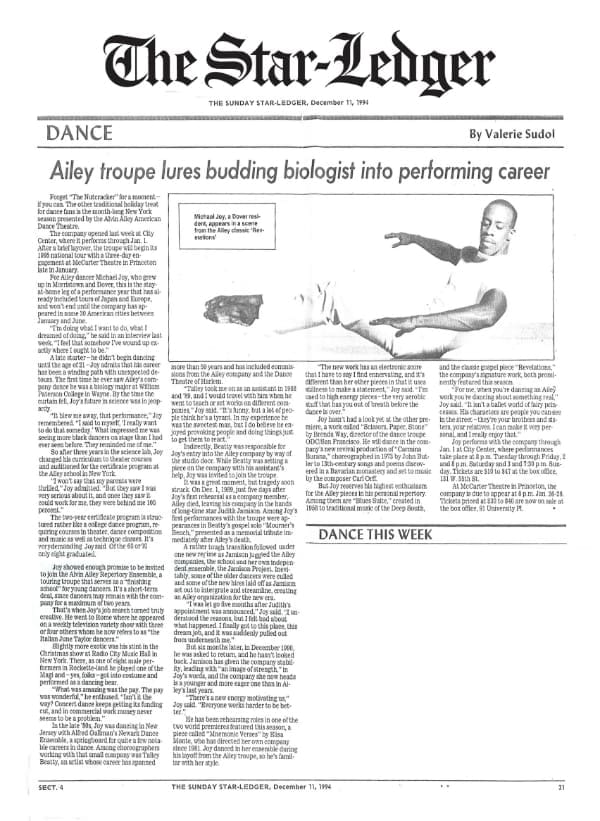
Michael Joy, as featured in the Newark Star-Ledger. (Dance Mogul Magazine archive, 2013)
The Dance Mogul Exclusive Interview (2013)
Michael finds his greatest fulfillment when a young person realizes that power resides in the choices they make. That is exactly why we sought him out. It takes a special kind of person to dedicate a life to helping others succeed, and we are honored to provide a platform for him to do so. The original interview appears below as published in July 2013.
DANCE MOGUL: At what age did you discover your passion for the arts?
MICHAEL JOY: I can’t quite put an age on it but I do remember when I was young, four or five years old, there were lots of various types of entertainment television programs featuring singers and dancers. I remember pretending to be a performer on those programs making up dances and dancing around the house to records my mother and father played in the home. At the time didn’t know it was a passion for the arts, I was just having fun. That passion stayed with me as I grew up, but the schools I attended only offered sports and band. Sports weren’t my thing so I experimented by trying to play several instruments but never excelled at any. It wasn’t until I attended college that I had the opportunity to really explore the arts and found that dance was my passion.
DANCE MOGUL: Who were some of your early inspirations?
MICHAEL JOY: My first inspiration was my older sister, Karen. When I was about nine or ten she took an African dance class at the neighborhood community center. I wanted so badly to do what she was doing but there were no boys allowed. I would watch and do the dances when no one was around.
DANCE MOGUL: Were your parents supportive of your passion for dance?
MICHAEL JOY: What I appreciate most about my parents is that they always allowed me to be myself. As long as I was serious and committed to an interest they stood behind me 100 percent. Of course, at times they said things most parents do, like “you need to think about a backup plan” and “you need to think about finding a job with benefits”, I understood they were only thinking as parents do, trying to protect me in the event things did not work out for me and wanting what they thought was best for me. I do know it’s because of their support I was able to complete the certificate training program at the Ailey School. Although I had to take out student loans to pay the program’s tuition and work weekends to earn money for my daily commute from a town an hour away in New Jersey, I was allowed to live at home and not have to worry about paying for housing and meals. I’ve seen hundreds of young dancers, many of them my friends that were forced to either put their dance training on hold or stop altogether because of the stress of having to fully support themselves while studying dance full-time and working in New York City.
DANCE MOGUL: When did you know that you could become a professional?
MICHAEL JOY: I was on a college field trip to see Alvin Ailey American Dance Theater at City Center Theater in New York City. It was actually my second time seeing a professional dance company; the first was Paul Taylor earlier that year. In that performance, I saw “real people” on stage, not dancers. They were people I could identify with, not because they were African-American but because they were like people I knew in my life, in my neighborhood, in my town. I saw myself. It was then I realized I could be on that stage too and was determined to find out what I had to do to get there. Of course, I knew it would be a huge challenge but the passion I felt put no doubts in my mind. A few months later I attended an audition for the Ailey School and was selected for the certificate training program. Of course, there were those that tried warning me by telling me how competitive it would be and that I was too old to be starting out.
I began training at age 21 in all beginner classes, joined Ailey II at age 24, and joined Alvin Ailey American Dance Theater at age 29. I remember receiving my ballet evaluation after my first term at the Ailey school. One instructor said I showed no improvement whatsoever and should consider pursuing something else. Fortunately, Denise Jefferson, the director of the school put me in a class with a different instructor. Very soon thereafter my ballet technique began to show improvement.
“I saw myself. It was then I realized I could be on that stage too and was determined to find out what I had to do to get there.”
— Michael Joy, Dance Mogul Magazine, 2013
DANCE MOGUL: How did you balance pursuing higher education and your dance training?
MICHAEL JOY: Pursuing higher education came prior to attending The Ailey School and then later in my dance career. Following high school, I attended college as a biology major but soon found my way to the theater department. Though I never trained in dance I was often cast as a dancer in college theater productions. After two years in college, I left college to attend the Ailey School in the Ailey Certificate Program. The Ailey Certificate Program is a three-year program for advanced beginner to intermediate-level students, ages 17-23, who have completed their secondary school requirements. This program takes a conservatory approach to dance training, combining technique, dance academics, creative studies, and repertory and performance. Several years later before leaving the Ailey Company and while performing on Broadway in The Lion King, I applied for and was awarded the Richard Porter Leach Fellowship through SUNY Empire State College. The Richard Porter Leach Fellowship allows active and established performing artists to pursue a college degree while continuing to practice their craft. I do admit balancing both work and school was difficult but it’s all worth it in the end.
DANCE MOGUL: You have had numerous opportunities and accomplishments, what have been some of your most memorable?
MICHAEL JOY: Some of my most memorable was working as an assistant to choreographer Talley Beatty. I learned so much more than dance steps from him. He shared information and stories with me about his life, travels, and experiences with the greats that he studied under and worked with including Katherine Dunham, Martha Graham, George Balanchine, and Syvilla Fort. What also stands out for me is having the opportunity to perform with and learn from many of the dancers I idolized such as Dudley Williams, Marilyn Banks, Sarita Allen, Gary DeLoatch, and Renee Robinson. Another memorable accomplishment was the opportunity to perform at President Clinton’s first inauguration.
DANCE MOGUL: What has dance taught you as far as discipline, determination, and dedication?
MICHAEL JOY: In my particular case I learned that patience and perseverance are indispensable when it comes to discipline, determination, and dedication. Along with being committed and willing to work hard, it is also important to give oneself the time and space necessary for the body to incorporate change and build technique.
“Patience and perseverance are indispensable when it comes to discipline, determination, and dedication.”
— Michael Joy, Dance Mogul Magazine, 2013
DANCE MOGUL: What advice would you have for the younger generation of dancers that want to become professionals?
MICHAEL JOY: Today when so much seems immediate, I’m always telling young people not to be discouraged when things don’t come as quickly as they want. I’m a prime example where hard work and patience paid off in the long run. Additionally, I tell the younger generation of dancers how important it is to work on their craft outside the studio, that it has to become a way of life, a lifestyle. For example, I often hear young dancers talk about how much they want to become professionals. Then I ask if they stretch at home, do they work on certain exercises at home, do they read, visit museums, or know of other cultures. To those that answer no, I tell them what separates a professional from an amateur is that professionals are working on their craft all the time, they practice even when they don’t feel like it. It takes more than just taking a dance class to be great. The more one knows about life, the world, other art forms, and cultures, the more it will make them not just a dancer but a dance artist.
“Professionals are working on their craft all the time, they practice even when they don’t feel like it.”
— Michael Joy, Dance Mogul Magazine, 2013
DANCE MOGUL: We have seen a trend when dancers get opportunities that because they don’t get many, those opportunities go to their heads and have negative effects on their career and their way of thinking. What do you think can be added by teachers/instructors to make dancers more well-rounded not only in the dance industry but as productive citizens in society?
MICHAEL JOY: Opening the door to help young dancers learn requires that teachers/instructors are mentors first. People learn so much more from what they see on a consistent basis than what they hear. Old sayings such as “talk is cheap”, “practice what you preach”, and “walk the walk”, are very relevant when it comes to teaching. Not just in areas of training and technique, but more importantly in teaching life skills. As mentors, teachers/instructors should model behavior in humility, teamwork, how to best handle conflict and difficult situations, respect, self-respect, appropriateness, and giving back. In addition, teachers/instructors should help young dancers understand the business aspect of dance, teaching them that their craft is their livelihood. Young dancers also need mentoring in areas of negotiating contracts, working with agents, promotion, investments, financial planning, and higher education.
DANCE MOGUL: How important is it that dancers try to leave legacies like Alvin Ailey instead of bits and pieces of momentary satisfaction?
MICHAEL JOY: I think of art as a great communicator because of its ability to transcend cultures, customs, age, race, religion, language, ethnicity, gender, and economic circumstance. It’s the most basic and fundamental form of communication between human beings. As human beings, we have the ability to make choices every day as to how we want to be viewed or remembered. That being so, it’s important that dance artists realize the importance of their craft because of its ability to teach and advance us as a society. Not all of us will necessarily achieve great fame as Alvin Ailey did, but we all do contribute at some level to the advancement of all.
“Not all of us will necessarily achieve great fame as Alvin Ailey did, but we all do contribute at some level to the advancement of all.”
— Michael Joy, Dance Mogul Magazine, 2013
DANCE MOGUL: What are you currently doing now to engage the youth?
MICHAEL JOY: I engage youth directly through my role as Director of Artistic and Educational Programs for Kansas City Friends of Alvin Ailey (KCFAA). I help develop, deliver, and oversee youth programming that uses the art of dance as a vehicle to improve knowledge, increase self-esteem, enhance critical thinking skills, and encourage positive role models and smart life choices. We reach more than 30,000 school-aged children annually through ten year-round programs. My work speaks directly to our vision, a diverse community united by dance to inspire and change lives, and to the part of our mission that addresses teaching young people critical life skills through dance.
Two programs, in particular, AileyCamp and KCFAA Studio Programs reach out to underserved populations and are offered absolutely free of charge. AileyCamp, designed to reach urban youth is an innovative summer program for middle school students using dance to develop their self-esteem, self-discipline, critical thinking skills, and creativity. KCFAA Studio Programs provide a program of dance instruction, cultural field trips, and smart life choices seminars and activities for second through twelfth-grade students during the school academic year.
DANCE MOGUL: Do you feel a publication like Dance Mogul is needed to connect Professionals with the next generation to help guide them to their goals and aspirations?
MICHAEL JOY: Most definitely! In my work with young people, I often see that they receive a lot of misinformation, mainly because they lack access to professionals in the field. Dance Mogul Magazine is an indispensable resource of accurate information for young dancers, providing the opportunity to learn from top industry professionals and benefit from a pool of extensive knowledge.
DANCE MOGUL: Is there anyone you would like to thank for helping you on your journey?
MICHAEL JOY: There are so many people that helped me and guided my journeys such as Denise Jefferson, Sylvia Waters, and Talley Beatty. But most of all I thank my Dad. He’s probably the hardest-working man I’ve ever known. He worked in a fish market for nearly 35 years and after work did odd jobs to supplement his income. From the age of thirteen until I joined Ailey II at age twenty-four I worked with my dad in the fish market either after school, on weekends, or during the summers. I also went to work with him on his many odd jobs where I learned how to do almost everything from gardening to carpentry. Although at the time I was never too thrilled about working, I did like having my own money. As I got older and began dance training, I realized what I learned working with my Dad was the very thing that helped me and continues to help me succeed on my journey. It wasn’t anything he said or taught me to do; it was the consistency of seeing him in everyday situations; his demeanor, humility, and respect for themselves and others; in other words the quality of his character. From him, I learned that character and integrity are doing the right thing when nobody’s looking, and in order to succeed one has to understand the value and importance of determination and hard work. I learned from him to be patient and always give my very best, that from challenges come opportunities, the importance of a positive attitude, and most importantly to believe in myself.
“Character and integrity are doing the right thing when nobody’s looking.”
— Michael Joy, Dance Mogul Magazine, 2013
Where Is Michael Joy Now?
Michael Joy’s documented public record runs from his Ailey and Broadway years through his long tenure at Kansas City Friends of Alvin Ailey, where reporting from The Pitch (2008), Dance Mogul Magazine (July 2013) and KC Studio (October 2013) places him at the center of the organization’s youth programming. As of October 2026, he no longer appears on KCFAA’s published staff list, which names Carla Williams-Evans as CEO, Tyrone Aiken as Chief Artistic Officer and Latra Wilson as Master Teaching Artist.
We were not able to confirm his current role or location from public sources, and we will not guess. What we can confirm is that the programs he helped build are still running. AileyCamp Kansas City, the oldest AileyCamp in the country, continues to welcome students ages 11 to 14 free of charge, with its 2027 session already on the calendar for June 7 through July 15. KCFAA’s school residencies and studio programs continue in the same Kansas City classrooms where Joy taught.
If you studied with Michael Joy, danced beside him, or know where his work has taken him since, we want to hear from you. Contact Dance Mogul Magazine and help us continue his story.
Why Michael Joy’s Career Matters to the Next Generation
1. Late is not too late. He took his first beginner class at 21, an age most people consider the end of the road for a concert dancer. He joined Ailey II at 24 and Alvin Ailey American Dance Theater at 29. In a culture that celebrates child prodigies and viral teenagers, his path is proof that serious, steady work can still open the biggest doors.
2. One adult’s verdict is not your destiny. A ballet teacher told him to quit. A school director moved him to a different class instead. Young dancers will hear doubters; the lesson is to keep showing up until you find the teacher who sees you.
3. Craft is a lifestyle, not a class. His test for aspiring professionals is simple: do you stretch at home, read, visit museums and learn about other cultures? A dance artist is built outside the studio as much as inside it.
4. Character is the real training. He credits his father’s 35 years in a fish market, not any single dance teacher, for the work ethic that carried him. Consistency, humility and respect are skills too.
5. Learn the business. Long before it was common, he argued that young dancers need mentoring in contracts, agents, promotion, investments, financial planning and higher education. He finished his own degree while dancing on Broadway.
6. A performing career can become a teaching legacy. His greatest audience turned out to be tens of thousands of Kansas City children, many reached through free programs. That is how a dancer’s impact outlives the final bow.
Why Michael Joy’s Story Matters to Dance Mogul Magazine
Dance Mogul Magazine exists to document lived stories that help people become better versions of themselves, and Michael Joy’s story speaks to almost every doorway we cover: discipline, mentorship, family, education, purpose and legacy. It is the story of a sister’s community-center dance class, a father’s example, a school director’s second chance, and a man who turned his own good fortune into free programs for children who might otherwise never see the inside of a dance studio.
In 2013 he told us young people receive a lot of misinformation because they lack access to professionals. That gap is the reason this publication was founded, and the reason we keep rebuilding our archive so readers do not have to search anywhere else. Explore more of that work in our Exclusive Interviews, our Alvin Ailey Hip Hop Program coverage, the Ballet archive, Celebrating Black Creative Directors & Choreographers, and the Mentorship chapter of Beyond Wealth, which picks up where his advice on teachers as mentors leaves off.
Frequently Asked Questions
Who is Michael Joy?
Michael Joy is a former Alvin Ailey American Dance Theater dancer and original Broadway cast member of Disney’s The Lion King who served as AileyCamp Director and Director of Artistic and Educational Programs for Kansas City Friends of Alvin Ailey.
When did Michael Joy start dancing?
He began formal dance training at age 21 in beginner classes at The Ailey School in New York City, after discovering dance through college theater productions at William Paterson College.
When did Michael Joy join Alvin Ailey American Dance Theater?
He joined in 1989 at Alvin Ailey’s personal invitation, after dancing with Ailey II from 1984 to 1986 under Sylvia Waters.
Was Michael Joy in the original cast of The Lion King?
Yes. Playbill lists him as an ensemble dancer in the original Broadway company of The Lion King, which opened November 13, 1997, at the New Amsterdam Theatre.
What did Michael Joy do at Kansas City Friends of Alvin Ailey?
He directed AileyCamp from 2002 and served as Director of Artistic and Educational Programs from 2006, overseeing youth programs that reached more than 30,000 Kansas City students a year as of 2013.
Where is Michael Joy now?
As of October 2026 he is no longer listed on KCFAA’s staff page, and his current role could not be confirmed from public sources. Dance Mogul Magazine invites anyone with information to contact us.
The Story Continues
Michael Joy started late, heard “no” early, and kept working anyway. He danced for Alvin Ailey, opened one of Broadway’s most successful musicals, finished his degree mid-career, and then spent his second act making sure thousands of children in Kansas City had what he did not have at their age: a dance class, a mentor, and an adult who believed in them.
The lesson he took from his father is the one he left with us in 2013, and it is the one worth passing on: character and integrity are doing the right thing when nobody’s looking. Power resides in the choices we make.
Continue Your Journey
Explore more from the Dance Styles Hub and discover how dancers across every genre are shaping the future of movement and performance.
• Exclusive Interviews — more first-person stories from the DMM archive
• Featured Artists — in-depth profiles of the dancers and choreographers shaping the culture
• The Legacy — the history DMM has documented since 2010
• Career and Craft — building a sustainable career in the dance industry
• Join the Dance Mogul Community — connect with the global dance community
© 2026 Dance Mogul Magazine LLC | dancemogul.com | Inspiring Self-Empowerment Through Dance Culture


