
Legacy Feature | Locking
Shock-a-Lock: New York's First Locker and the Brooklyn Teacher Whose Lineage Circled the World
Locking was born in Los Angeles. Kevin "Shock-a-Lock" Porter made it a New York language — then taught it to the dancers who carried it to Paris, Beijing, and Tokyo.
By Dance Mogul Magazine | Legacy Feature

Before New York Had Lockers
In the early 1970s, a new dance was arriving through television sets. On the West Coast, Don "Campbellock" Campbell had stumbled into a move that would change street dance forever — a sudden freeze in the middle of a groove, a point, a wrist roll, a laugh. On Soul Train, the whole country watched it happen. Locking was moving faster than anyone could teach it.
Three thousand miles away, in East New York, Brooklyn, a teenager from a family of twelve was watching. He already danced. His mother had raised him on the steps of the 1930s and 1940s, and James Brown had given him a rhythm and a reason to be proud. What he saw on that screen was not something to copy. It was something to build on.
His name was Kevin Porter. Brooklyn would come to know him as Shock-a-Lock — the man the Brooklyn Arts Council would describe as the first "locker" in New York in the early '70s.
This is not the story of the man who invented locking. That honor belongs to Don Campbell, and Shock-a-Lock has always said so. This is the story of something just as rare: the person who carried a dance across a continent, gave it a home in a new city, protected its spirit for fifty years, and then sent it back out into the world through his students. It is the story of how dance knowledge travels when there is no YouTube, no tutorial, no app — only a teacher, a block party, and a young person willing to listen.
Shock-a-Lock — At a Glance
Name: Kevin Porter
Known As: Shock-a-Lock (also written Shock-a-lock, Shockalock); stage persona "The Mekanical Locker"
Hometown: East New York, Brooklyn, New York
Style: Locking (Campbellocking), robotics, mimelocking, street-dance theater
Distinction: Recognized by the Brooklyn Arts Council as the first locker in New York (early 1970s)
Groups Founded: Realism (New York's original locking group); Lockism: The World's First Mimelockers; Circulock / Cirkulock
Events Created: Compete to the Beat street-dance showdown; East New York "Old School Meets New School" amphitheater showcases
Honors: Crowned among the "Dance Kings of Black Brooklyn" (Brooklyn Arts Council, 2010); documented in the Folk Feet traditional dance program
Notable Students: Omar "FireLock" Thomas (Juste Debout 2011 locking world champion); Alan "Killawatts" Watson (NYU Tisch Open Arts instructor)
DMM Connection: DMM interview subject (2012), contributing writer (2014), Compete to the Beat collaboration partner (2014)
East New York Was the Classroom
Shock-a-Lock grew up in Brooklyn in the 1960s and '70s, in a household he describes plainly: a Black family that was not rich, twelve children, and him "right in the middle." What he had going for him, he told Dance Mogul Magazine, were two gifts — he could dance, and he could draw.
His first teacher was at home. His mother loved the social dances of the 1930s and '40s, and she was, in his words, the person who got him to dance more. Long before Soul Train arrived, the soundtrack of the house and the block was James Brown — and the Godfather of Soul did more than supply the beat. When Brown released "Say It Loud – I'm Black and I'm Proud," Shock-a-Lock remembers, young Black dancers felt permission to be fully themselves: the Afro, the dashiki, the history, the pride.
There was racism, he says — not always direct, but woven into the fabric of the era. The soul-power movement answered it by teaching young people to stand tall in who they were and where they came from. That lesson never left him.
His training ground was not a conservatory. The Brooklyn Public Library's Folk Feet documentation places his development where New York street dance itself grew up — at block parties, house parties, community centers, and dance competitions. When the Brooklyn Historical Society and Brooklyn Arts Council recorded his oral history, he led researchers on a walking tour of East New York, pointing out the exact spots where unforgettable freestyle moments had happened. The neighborhood was the archive. He was its guide.
"My mother used to say, y'all don't need to be no followers. If you're going to do something, be a … leader. That's something that stuck with me for the longest. I always wanted to lead."
— Shock-a-Lock, Dance Mogul Magazine interview
The First Locker in New York
It is worth being precise about what the title means, because precision is how legacies are protected.
Don Campbell created locking in Los Angeles around 1970. His Campbellock Dancers, and later The Lockers — formed with Toni Basil and featuring legends like Fred "Mr. Penguin" Berry, Fluky Luke, and Shabba-Doo — took the style to Soul Train and national television. That is the origin.
What Shock-a-Lock did was different and essential. He was the first dancer in New York to take up the form, live it, and plant it in the city's soil. The Brooklyn Arts Council's Folk Feet program credits him as instrumental in establishing locking in New York during the 1970s. NYU's Tisch School of the Arts, in the faculty biography of one of his students, calls him simply "New York's first locker." And Don Campbell himself shared the frame with him — Dance Mogul Magazine's own tribute to Campbell features the father of locking side by side with "Shockalock, NYC's 1st Locker."
Shock-a-Lock has always pointed back to the source. Asked who he had to thank, he named James Brown, his mother — and the original Campbellock dancers. "Without the whole thing about the locking," he said, "obviously I wouldn't be Shock-a-Lock today."
Creator and carrier. Originator and transmitter. Both roles are necessary. Without the first, there is no dance. Without the second, the dance never leaves home.
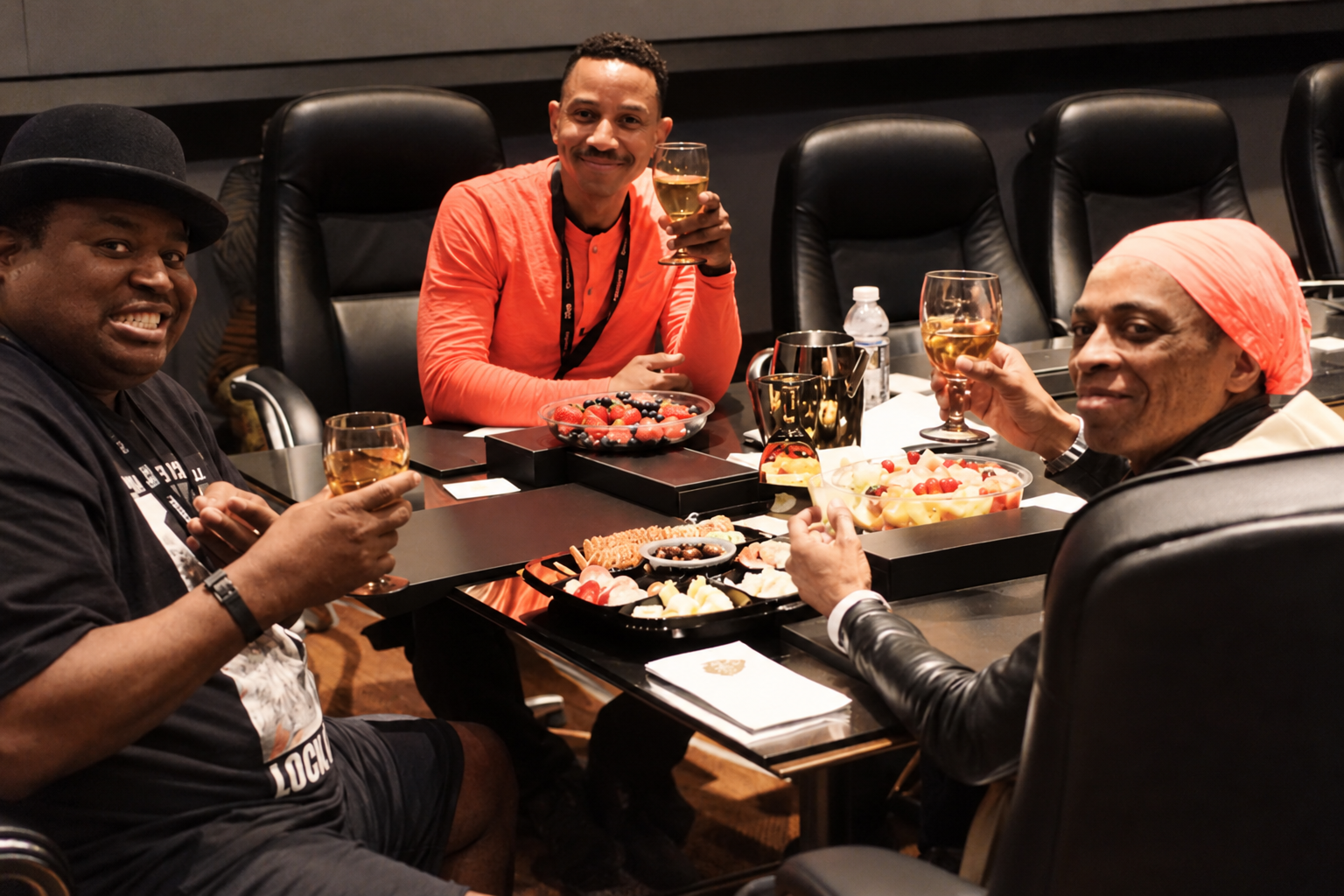
Don "Campbellock" Campbell, the creator of locking, with Shock-a-Lock, New York's first locker. Dance Mogul Magazine archive.
Realism: New York's Original Locking Group
For a while, dance was something Kevin Porter did because he loved it. Then came the moment that made it serious.
In the mid-1970s, a housing authority sponsored a citywide talent competition. Singers, bands, and dancers from across New York entered. Shock-a-Lock gathered a friend and a cousin — three young men from Brooklyn — and went after it. They took first place.
"That kind of sent the message that I should be more serious," he recalled. "We can do this."
That victory gave birth to Realism, which the Brooklyn Arts Council identifies as the original locking group in New York. Its sound was the sound of the moment: a fusion of robotics and locking, the two styles that dominated the early '70s. He is careful about the chronology. Before 1975, he notes, nobody in New York was talking about the Electric Boogaloo styles that would later define West Coast popping. Realism was locking and robot, pure and early.
The full story of Realism — its members, its battles, its stages — remains one of the most important unwritten chapters in the history of locking's journey from Los Angeles to New York. Dance Mogul Magazine considers it unfinished history, and we invite anyone who danced with or witnessed Realism to help us document it.
From Imitation to Identity
If there is one idea that runs through every stage of Shock-a-Lock's career, it is this: never be a copycat.
He traces the lesson to the Lockers themselves. Don Campbell, he says, always taught that a dancer has to bring himself to the table — otherwise there is no originality. You cannot spend your life trying to be Don Campbell, Fluky Luke, or Shabba-Doo. You have to ask what you can do that they did not, or do it in a way they never did.
He points to the original Lockers as proof. Toni Basil brought ballet — pirouettes and spins. Fluky Luke brought cheerleading cartwheels and splits, plus a double-jointed flexibility no one else on the team had. Fred Berry, whom Shock-a-Lock partied with at New York's legendary Loft, brought pure entertainment and outsized character. The Lockers, he notes, were an entertainment act first, and they launched not only a dance trend but a fashion trend.
So when students ask him how to be creative, he gives them a definition simple enough to remember for life.
"Creativity is doing something old in a new or different way."
— Shock-a-Lock, Dance Mogul Magazine interview
He explains it the way a teacher would — through television and computers. Someone took black-and-white TV and imagined color. Someone took IBM's room-sized machines and imagined computers small enough to carry. Every step built on what came before. Locking is no different: if the pioneers did half splits, try mixing in full splits. Nobody wrote a rule that you can only do it one way.
And he names the two ingredients that make creativity real. Creativity without courage, he says, never leaves the room because you are afraid of what people will say. Courage without creativity means you are bold enough to act but have nothing to act on. "You need both creativity and the courage to do it."
He is blunt about coaches who demand sameness: if creativity offends your coach, perhaps you need a new coach. You raise children to become individuals with minds of their own, he reasons. You coach dancers the same way.
Lockism and the Mekanical Locker
After Realism, Shock-a-Lock turned toward private teaching — and then built something no one had seen before.
Lockism: The World's First Mimelockers fused the vocabulary of locking with mime and character performance. Shock-a-Lock took the stage as "The Mekanical Locker," a persona that combined the hard stops of locking and the precision of robotics with theatrical storytelling. The Brooklyn Arts Council has documented Lockism's performances in Canada, Las Vegas, and Hollywood.
Lockism was more than a show. It was his philosophy made visible: learn the foundation, honor the source, then build a character that belongs only to you. It also became the company where the next generation would train — the place where a young Brooklyn b-boy named Omar Thomas would one day become FireLock.
Circulock: A Circus Built on Street Dance
Shock-a-Lock never froze locking in 1973. He kept widening the circle.
When the Dance Mogul interviewer asked where he saw dance in ten years, he refused to wait on the commercial world. Start with purpose, he said; purpose gives you vision, and vision gives you missions. His own vision was specific: a circus built entirely on street dance. "That's my vision," he said. "That's what I would create. In fact, that is what I started on."
He did. As CEO of Circulock Inc. — described by the Brooklyn Public Library as "the world's first street-dance circus" — he brought older and newer Brooklyn styles onto the same stage. By 2015, the company (then spelled Cirkulock) was presenting Volkanos, the mechanical street dance soldiers, at the Umoja Events Juneteenth Festival in Brooklyn's Linden Park, and teaching the public a mix of new-time poppin', lite-feet, mimelocking, and stepping. A dancer who began in the early-'70s locking era was now building bridges to the newest movements born on Brooklyn's own streets.
Teacher, Organizer, Community Leader
Ask Shock-a-Lock about leadership and he does not start with a stage. He starts with a community center.
When neighborhood organizers needed someone to coordinate young people — for tutoring, for sports, for talent shows — he was the one they chose. Once they saw he was as strong in academics as in the arts, they asked him to run what he calls a "bicultural" program: improve your reading and writing, and earn your spot in the talent show. He told students about his trips to the Schomburg Center for Research in Black Culture in Harlem, where Black history in art, music, and theater filled the shelves. They went to the library, he says, because it led where they wanted to go.
He brought the same spirit outdoors. In East New York's amphitheater, he and fellow youth advocates staged summer talent competitions and showcases from 7 p.m. until 10 or 11 at night — spotlights, microphones, a fresh coat of paint so it looked professional. It was the first time in years the amphitheater had drawn crowds of young people. They called it "Old School Meets New School," inviting the community's DJs, rappers, MCs, and dancers. It ran for at least six years.
That commitment to education was personal. In his family, school was not optional — a headache got you an aspirin and a stomachache got you Pepto-Bismol, and either way you were out the door. He wanted young people to see that a performer could also be a reader and a writer.
"My real award in terms of accomplishment is when I find young people who are also now reaching out and doing what they had as their dreams."
— Shock-a-Lock, Dance Mogul Magazine interview
His teaching has reached every level. The Brooklyn Arts Council's Folk Feet workshop roster notes that he can train professional dancers, introduce first-timers to the foundations in a welcoming way, or lead seniors through moves set to early-'70s funk. He describes his whole philosophy in three words: think and do.
When the Student Becomes the Evidence
The truest measure of a teacher is not where he performed. It is where his students went.
Omar "FireLock" Thomas started b-boying in 2000 with the Vanderbilt Breakers. In 2003, he found his calling in locking under his mentor, Shock-a-Lock, and joined Lockism. What followed was one of the most decorated careers in modern locking, as documented by Broadway Dance Center:
• 2011 — Juste Debout 2 vs 2 Lockin' World Champion (Paris)
• 2009, 2010, 2013 — Hip Hop International Lockin' Champion
• 2009, 2010 — Don Campbellock Award
• 2012 — Keep On Dancin' World Crew Battle Champion (Beijing)
• 2011, 2013 — World Dance Colosseum 2 vs 2 Champion (Japan)
FireLock has since taught and judged in Japan, Taiwan, Russia, Sweden, Canada, China, the Czech Republic, Germany, Italy, France, Switzerland, and Singapore. Wherever he goes, the lineage goes with him.
Shock-a-Lock branded him early. Writing for Dance Mogul Magazine in 2014, he called FireLock "the Flying Prince of Lock," because ruling the air was his natural specialty. And when FireLock sat as a judge at Compete to the Beat, his advice to competitors sounded like his teacher's voice coming back through a new generation:
"What I'm looking for is originality... We already know the basics and foundations of lockin'. Now just be you, do you, do something different, do something we haven't seen before — but of course, be on beat."
— Omar "FireLock" Thomas, judging at Compete to the Beat
Alan "Killawatts" Watson represents another branch. Originally from St. Paul, Minnesota, he came to New York to study at NYU and trained in locking under Shock-a-Lock. In 2013, he won the one-on-one locking title at Compete to the Beat — judged by Don Campbell himself. He went on to teach at PMT Dance Studio, perform on NBC's TODAY show as part of a Guinness World Record for the largest street dance, and teach in NYU Tisch's Open Arts program, where his faculty biography still names his teacher as New York's first locker.
Shock-a-Lock speaks of this new school with pride — FireLock, Hurricane, Abdullah, Lucas Lock, and others who win abroad and come home to teach. What matters, he says, is not that they copy the past, but that each one shares "a new flavor of the spirit of the dance."
Compete to the Beat — and Don Campbell in New York
Shock-a-Lock is also the creator of Compete to the Beat, the "majestic street dance showdown" built to honor creativity, originality, and musicality. The event became a meeting place for generations — and, remarkably, for the man who started it all. When Killawatts won his 2013 title, the judge in the chair was Don Campbell, the creator of locking.
Think about the arc. Four decades earlier, a Brooklyn teenager watched Campbell on television and decided to become New York's first locker. Now the originator sat in judgment at an event that teenager had created, scoring a student that teenager had trained. The circle closed in New York.
In 2014, Dance Mogul Magazine partnered with Compete to the Beat — a collaboration DMM described at the time as the first between a magazine and a street dance event — producing a special issue devoted to the showdown. Shock-a-Lock's guiding principle for the partnership could serve as a motto for any creative life: "We are clear about our purpose in all that we do." Collaboration, he argued, works only when every partner contributes real value and stays focused on purpose. "The purpose is always the Boss."
Don Campbell passed away in 2020 at the age of 69. The dance he created lives in millions of bodies worldwide — and in New York, much of it moved first through Shock-a-Lock.
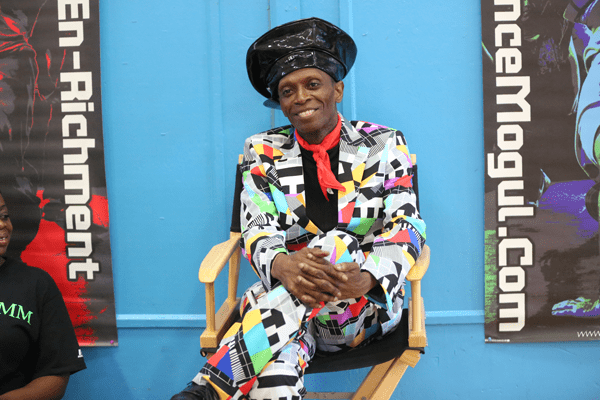
The Writer: "Brand New Lockers"
Shock-a-Lock did not only dance his philosophy — he wrote it down. In August 2014, Dance Mogul Magazine published his essay "Brand New Lockers: The Law of Expansion," which applied marketing principles from Al and Laura Ries and Jack Trout to street dance.
His argument was ahead of its time, years before "personal brand" became everyday language for dancers on social media: every dancer is a brand, and a brand has to stand for something specific. He pointed to Slim the Robot, an original Campbellock dancer whose name and specialty were one and the same. Trying to be the original Lockers, he warned, is the "me-too" syndrome — and it never works.
"When we try to stand for everything, we end up standing for nothing."
— Shock-a-Lock, "Brand New Lockers," Dance Mogul Magazine, 2014
A King of Black Brooklyn Dance
On October 9, 2010, at the Kumble Theater for the Performing Arts on Long Island University's Brooklyn campus, the Brooklyn Arts Council presented INTERGENERATIONS: Dance Kings of Black Brooklyn. The evening celebrated Black male dancers and choreographers who had shaped the borough's culture and served its communities.
Kevin "Shock-a-Lock" Porter was crowned alongside Baba Chuck Davis, Ronald K. Brown, Jamel Gaines, Reggie Wilson, Michael Manswell, and Obediah Wright. Each honoree performed with proteges of his choosing — a fitting format for a man whose legacy lives in the people he taught.
The honor matters because of the company it placed him in. It refused the narrow label of "street dancer" and recognized Shock-a-Lock as part of the larger heritage of Black dance in Brooklyn — a tradition that includes African dance, modern concert dance, and the social dances born on the borough's own blocks.
Shock-a-Lock — Legacy Timeline
1960s — Grows up in a family of twelve in East New York, Brooklyn; learns social dances of the '30s and '40s from his mother and moves to James Brown
Early 1970s — Inspired by Don Campbell's Campbellock Dancers on Soul Train; becomes the first locker in New York
Mid-1970s — Wins first place in a citywide housing-authority talent competition; forms Realism, New York's original locking group
Later years — Turns to private teaching; founds Lockism: The World's First Mimelockers and performs as The Mekanical Locker
Community work — Runs youth programs and the "Old School Meets New School" showcases in East New York's amphitheater for at least six years
2003 — Begins training Omar "FireLock" Thomas, who joins Lockism
2008–2009 — Records an oral history with the Brooklyn Historical Society and Brooklyn Arts Council; featured in Folk Feet; leads Circulock Inc., "the world's first street-dance circus"
2010 — Crowned among the Dance Kings of Black Brooklyn (October 9)
2011 — Student FireLock wins the Juste Debout locking world title in Paris
2012 — Featured by Dance Mogul Magazine in a two-part video interview
2013 — Compete to the Beat, judged by Don Campbell; student Killawatts wins 1-on-1 locking
2014 — Writes "Brand New Lockers" for DMM; Compete to the Beat and DMM publish a special collaboration issue
2015 — Cirkulock presents Volkanos at the Umoja Events Juneteenth Festival, Linden Park, Brooklyn
The Global Footprint: A Lineage, Not a Tour Schedule
Shock-a-Lock has performed beyond New York — Canada, Las Vegas, Hollywood — and he counts among his favorite achievements the chance to travel city to city and country to country inspiring new-school lockers. But his worldwide reach is best measured another way.
Trace the line: Don Campbell in Los Angeles → Shock-a-Lock in Brooklyn → FireLock, Killawatts, and the Lockism generation → classrooms and battle circles in Paris, Beijing, Tokyo, Moscow, Stockholm, Berlin, Singapore, and beyond. Every time FireLock teaches a workshop abroad, a piece of East New York goes with him. Every time a student in Prague or Taipei learns to "be you, do you," they are learning a philosophy that started in a Brooklyn amphitheater.
A teacher does not need to stand on every stage his influence reaches. That is the quiet power of transmission — and it is why Shock-a-Lock's name keeps appearing in the biographies of champions on three continents.
Why Shock-a-Lock's Legacy Matters to Dance Mogul Magazine
Dance Mogul Magazine exists to tell lived human stories that help someone become a better version of themselves. Few stories in our archive answer that question as completely as this one.
Shock-a-Lock's life is a working blueprint for self-empowerment. He found his purpose before he found a stage. He paired the arts with academics so no young person would believe a dancer could not also be a reader. He taught that creativity takes courage. He refused to be a follower — and then spent decades making leaders.
His relationship with DMM runs deep. He sat with us for one of our earliest video interviews. He wrote for our pages. He partnered with us on Compete to the Beat in 2014, built on a shared conviction he put into words: "Dance Mogul serves by inspiring self-empowerment, and Compete to the Beat serves by honoring creativity." He stood in the frame with Don Campbell, the man DMM chose for its first Lifetime Achievement Award given to a dancer.
And his story is exactly the kind DMM was built to preserve. The history of street dance in New York lives largely in memories, block-party recollections, and oral histories that never reached a textbook. Groups like Realism risk disappearing entirely. As the first Father-and-Son Black-owned dance magazine — with roots in the same grassroots street-dance culture across the river in Newark — DMM considers it a responsibility to document pioneers like Shock-a-Lock accurately, completely, and with the respect they earned.
"That's what happens when you work to inspire. Inspiration lasts forever."
— Shock-a-Lock, Dance Mogul Magazine interview
Legacy Is Transmission
There is no trophy that captures what Kevin "Shock-a-Lock" Porter did. There is no single television appearance, no one viral clip. His legacy is harder to see and far more durable: a dance that crossed a continent, took root in Brooklyn, and kept moving — from body to body, teacher to student, block party to world championship — for more than fifty years.
He gave the generation before him credit. He gave his own generation a home for locking in New York. And he gave the generations after him the one lesson that keeps any art alive: honor the foundation, then bring yourself to the table.
"Think big," he told Dance Mogul Magazine. "Have your vision." He had his. The world of locking is still living inside it.
Dance Mogul Magazine is proud to honor Shock-a-Lock — New York's first locker, Brooklyn Dance King, teacher of champions — as a legacy artist whose life proves that the greatest teachers remain students, and the greatest students pass the teaching on.
Watch: Shock-a-Lock in His Own Words
In this two-part Dance Mogul Magazine interview, Shock-a-Lock talks about growing up in Brooklyn, forming Realism, the meaning of creativity, and the generations of lockers who followed him.
Part 1
Part 2
Frequently Asked Questions About Shock-a-Lock
Who is Shock-a-Lock?
Shock-a-Lock is Kevin Porter, a dancer, teacher, and street-dance innovator from East New York, Brooklyn, recognized by the Brooklyn Arts Council as the first locker in New York in the early 1970s.
Did Shock-a-Lock invent locking?
No. Locking was created by Don "Campbellock" Campbell in Los Angeles. Shock-a-Lock was the first dancer to bring and establish locking in New York, and he has always credited Campbell and the original Campbellock dancers.
What was Realism?
Realism was the group Shock-a-Lock formed in the mid-1970s after winning a citywide talent competition. The Brooklyn Arts Council identifies it as the original locking group in New York, blending locking and robotics.
What is Lockism?
Lockism: The World's First Mimelockers is Shock-a-Lock's performance company, which fuses locking with mime and character work. He performs in it as "The Mekanical Locker." FireLock trained in and joined Lockism.
Who are Shock-a-Lock's most famous students?
Omar "FireLock" Thomas, the 2011 Juste Debout locking world champion and three-time Hip Hop International locking champion, and Alan "Killawatts" Watson, the 2013 Compete to the Beat 1-on-1 locking winner and NYU Tisch Open Arts instructor.
What is Compete to the Beat?
Compete to the Beat is a street-dance showdown created by Shock-a-Lock to honor creativity and originality. Don Campbell judged its 2013 edition, and Dance Mogul Magazine partnered with the event in 2014.
What honors has Shock-a-Lock received?
In 2010, the Brooklyn Arts Council crowned him one of the "Dance Kings of Black Brooklyn," alongside Baba Chuck Davis, Ronald K. Brown, and others. His work is also documented in the Brooklyn Arts Council's Folk Feet traditional dance program.
Continue Your Journey
Explore more from The Legacy and discover the pioneers who built the culture of dance.
• Don "Campbellock" Campbell — The father of street dance and creator of locking
• Toni Basil — The Lockers co-founder who took locking to the world
• Shabba-Doo — Street dance pioneer and Breakin' film star
• Brand New Lockers — Shock-a-Lock's 2014 essay on branding for dancers
• Compete to the Beat — Inside DMM's 2014 collaboration with the street dance showdown
• Locking — More locking stories from Dance Mogul Magazine
• Black Dance History — Black dance and its contribution to humanity
• Join the Dance Mogul Community — Connect with the global dance community
Did you dance with Realism, Lockism, or Circulock? Help Dance Mogul Magazine preserve this history — reach us through our community page.
© 2026 Dance Mogul Magazine LLC | dancemogul.com | Inspiring Self-Empowerment Through Dance & Culture