
EDITORIAL | THE DANCE WORKFORCE | ARCHIVE / RESEARCH
The People Who Make the Stadium Move
Inside the dancers, choreographers and hidden employment structure behind Usher and Chris Brown's 2026 R&B Tour.
By Dance Mogul Magazine | Editorial & Archive Research
Reporting current as of August 9, 2026. The R&B Tour is ongoing; details may change as additional first-party credits become available.
Independent Editorial Coverage
Dance Mogul Magazine is an independent publication and is not affiliated with, sponsored by or endorsed by Chris Brown, USHER, Live Nation or The R&B Tour. Artist names, tour names and related marks are used only to identify the subjects of this editorial reporting.
From the stands, the picture looks simple.
Usher. Chris Brown. Two generations of R&B performance sharing one enormous stage.
The music hits. Dancers enter. Bodies move across platforms and video screens. Artists disappear for wardrobe changes and return inside another scene. Choreography helps connect songs, eras and personalities while tens of thousands of people watch from every direction.
But underneath the spectacle is another story. A workforce.
Dance Mogul Magazine went looking for the people helping make Usher and Chris Brown's 2026 R&B Tour move. What we found was not one simple group of “backup dancers.” We found established touring professionals with years of experience behind major artists. We found choreographic relationships extending through previous Usher productions. We found local performers hired city by city under a separate employment structure. We found an industry-development program bringing aspiring professionals backstage to learn how major tours operate.
And we discovered something else: for a production in which movement is so visible, identifying the complete dance company and current choreography team is considerably harder than finding the artists, venues, promoters and tour dates.
That matters. Because years from now, people will still have the footage. The question is whether they will still have the names.
Two Superstars. One Stadium Machine.
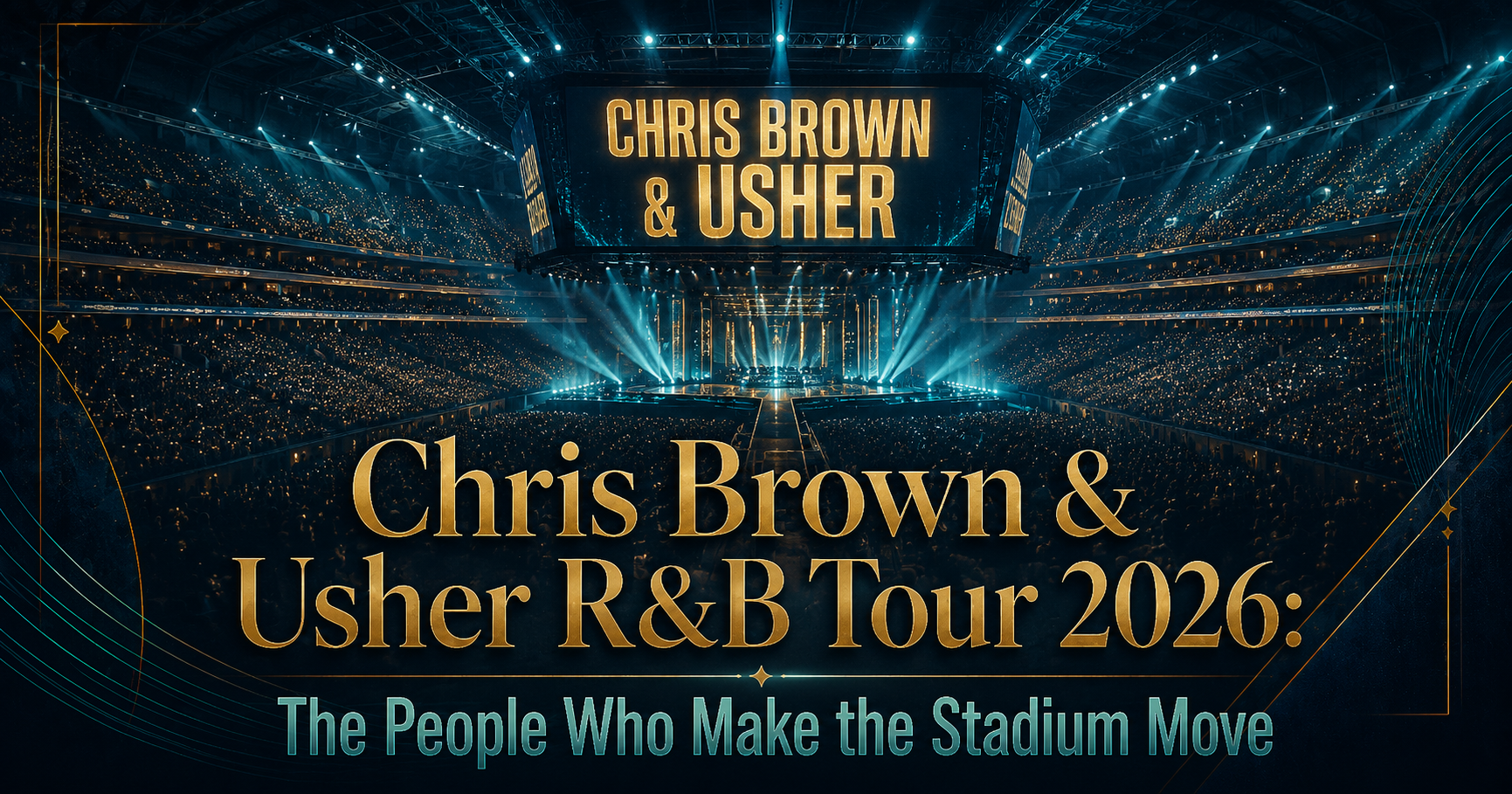
Live Nation originally announced The R&B Tour as a 33-date North American stadium run beginning June 26, 2026, at Empower Field at Mile High in Denver. Demand changed the size of the undertaking. By July, Pollstar reported that 51 North American shows were planned, extending the tour through December. Live Nation also announced that $1 from every ticket sold goes to the FIFA Global Citizen Education Fund.
The numbers communicate scale. But they do not explain what it takes to make a production of that scale move.
Usher and Chris Brown also bring distinctly different performance languages to the same stage. Usher's movement vocabulary has long balanced precision, musicality, control, skating, sensuality and classic R&B showmanship. Brown's stage identity frequently emphasizes athleticism, freestyle vocabulary, street-dance influence, speed and physical risk. Then there are the moments when those worlds have to meet.
That raises questions audiences rarely have reason to ask. Who organizes the movement? Who rehearses it? Who keeps it consistent from city to city? Who adapts choreography when staging changes? Who performs it? And when several kinds of dancers appear on the same stadium stage, are they actually doing the same job?
Concert Media & Rights Notice
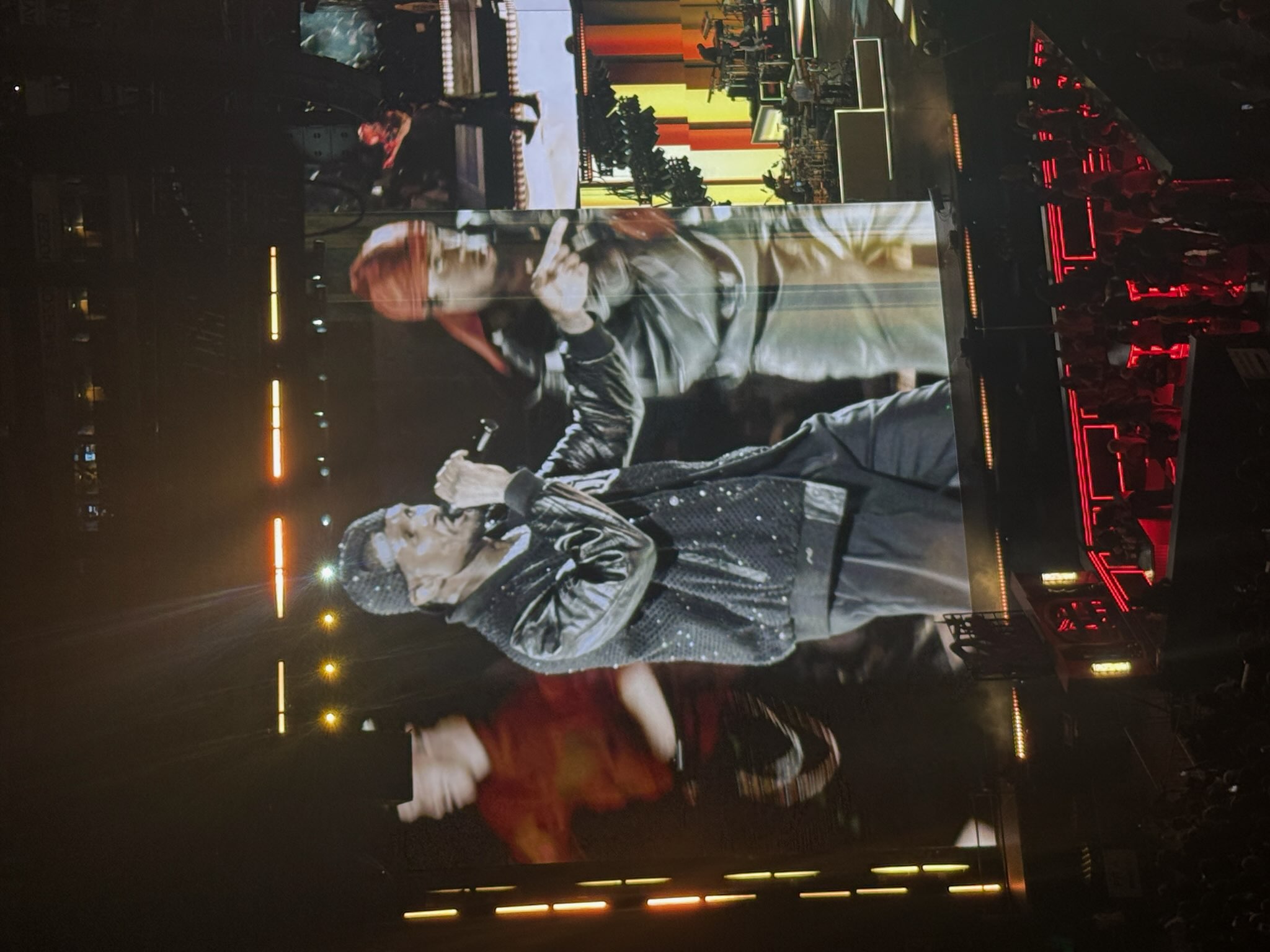
Concert photographs and video excerpts on this page were supplied to Dance Mogul Magazine for editorial documentation in connection with this report. DMM does not claim ownership of third-party music, performances, choreography, trademarks, stage production, designs or other underlying works captured in the media; any such rights remain with their respective rights holders. No person pictured or recorded is identified by DMM solely from appearance. Names are attached to roles only where DMM has separate reporting or source support. Inclusion of media does not imply endorsement, affiliation or a transfer of third-party rights, and the media should not be copied or redistributed from this page without any permissions that may be required from the applicable rights holders.
DMM CONCERT PHOTOGRAPHS // FIELD DOCUMENTATION
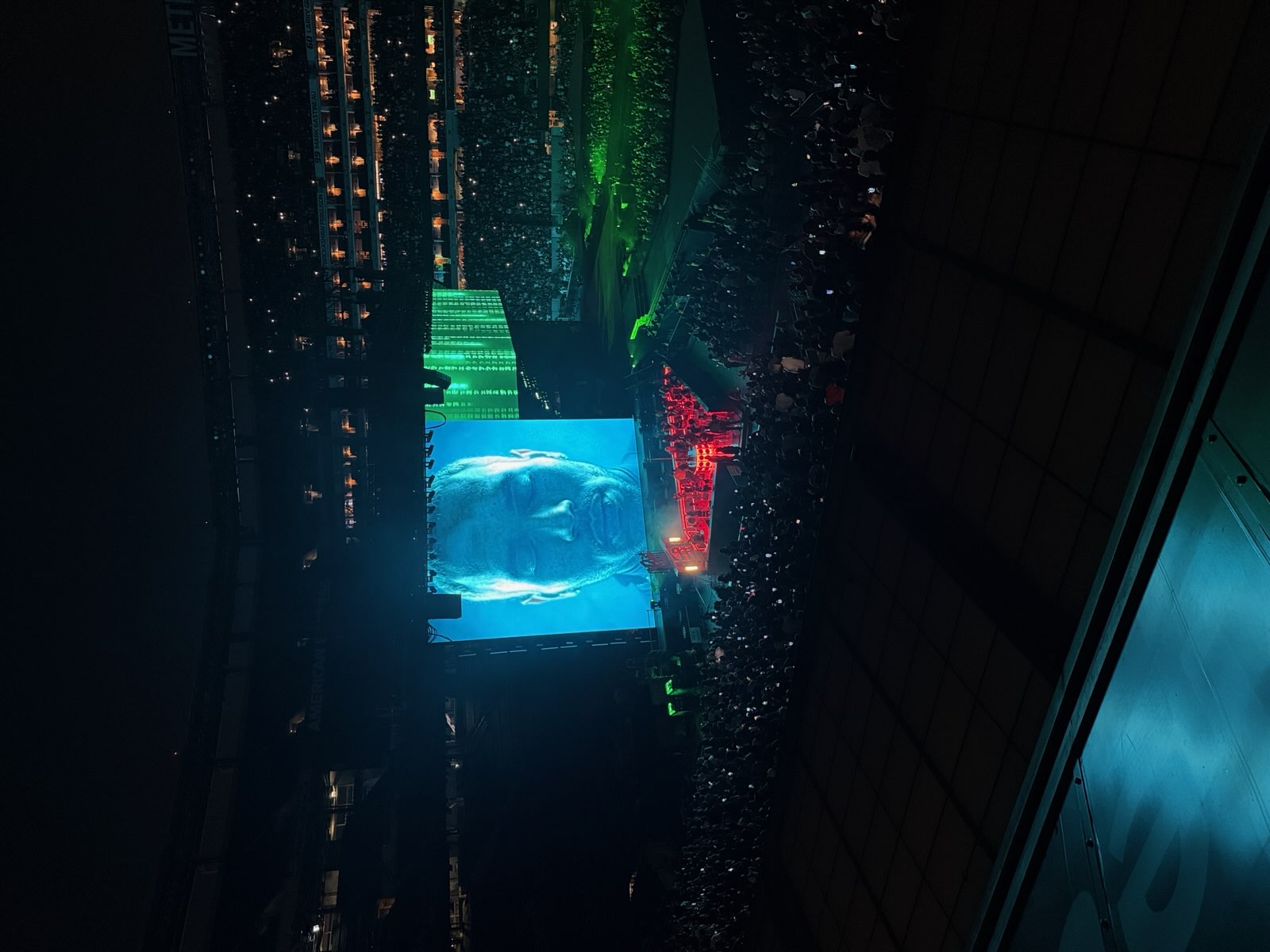
DMM CONCERT FOOTAGE // FIELD DOCUMENTATION
Dance Mogul Magazine found that the answer to that last question is no.
One Stadium. Different Dance Jobs.
One of the most revealing discoveries in DMM's research came not from a concert review or a celebrity interview. It came from a job posting.
Backlit Casting publicly recruited Atmosphere Cast performers for individual stops on The R&B Tour. These performers appear as part of the stadium production, but their employment model differs sharply from what audiences might imagine when they hear the phrase “touring dancer.”
What the Casting Notices Said
Per the published Backlit Casting listings for The R&B Tour Atmosphere Cast:
— Movement explicitly described as “un-choreographed”; performers freestyle to a “club energy” brief while following stage direction, positioning and entrances
— Non-union, classified as short-term W-2 employment
— Cleveland: $11/hour, four-hour guarantee; rehearsal and performance the same day
— Washington, D.C.: $15.30/hour across three shows, four-hour guarantee per night
— No travel or lodging provided; performers supply their own wardrobe to a styling brief
— Application by headshot, full-body photographs and a short freestyle video
That distinction is important. A person dancing inside a superstar stadium production may be a veteran touring professional traveling across the country after extensive rehearsals. Another person visible on that same stage may be a local performer hired specifically for that market, asked to bring freestyle energy and employed for only a small number of shows.
Both are performers. Both are workers. Both contribute to what the audience sees. But they are not doing the same job.
What Does “I Danced on the Tour” Actually Mean?
Commercial dance is often presented as though professional success follows one simple ladder. Train. Audition. Book the tour. Travel the world. Reality contains more layers.
File // Roles Under the Same Lights
General industry guide: individual contracts and duties vary. The Atmosphere Cast description below reflects terms documented in this tour's public casting notices.
CORE TOURING DANCER — typically travels with a production, rehearses set material and performs recurring choreography across multiple dates; representation and contract structure vary by performer.
CHOREOGRAPHER & ASSISTANTS — create, stage, adapt and help maintain movement; exact responsibilities differ by production.
DANCE CAPTAIN & REHEARSAL LEADERSHIP — may help maintain choreography, run cleanups and support consistency once a production is touring.
SPECIALTY PERFORMERS — may include skaters, freestyle specialists, acrobatic performers or featured soloists with distinct movement responsibilities.
LOCAL ATMOSPHERE PERFORMER — in the verified R&B Tour listings, hired city by city as short-term hourly W-2 employees; movement is un-choreographed/freestyle, and the listings provide no travel or lodging.
The audience may see all of them underneath the same lights. Their responsibilities, contracts, rehearsal schedules, travel arrangements and long-term relationships with the production may be completely different. That is not automatically an argument against the system. It is an argument for understanding it.
Because for a young dancer trying to build a career, knowing the difference between these opportunities matters. A stadium credit can be valuable. But not every stadium credit represents the same professional experience.
DMM Went Looking for the Names
If Dance Mogul Magazine is going to argue that dancers deserve credit, then DMM has an obligation to practice that principle. So we started looking. Not for dancers who worked with these artists sometime in the past. Not for names repeated on fan pages. Not for people assumed to be present because they performed on the previous tour. We looked for evidence connected specifically to 2026.
Maho Udo — current tour confirmed
Maho Udo provides one of the clearest records. Her own professional website states that she is currently performing on Chris Brown and Usher's R&B Tour and documents the tour beginning June 26 in Denver. Her career history also reveals something more interesting than a single booking. Udo's site documents work with Chris Brown across multiple consecutive touring cycles: the Under the Influence Tour in 2023, the 11:11 Tour in 2024, the Breezy Bowl XX Stadium World Tour in 2025, and The R&B Tour in 2026. That is not merely a roster entry. That is career continuity — repeated employment across major productions, which can tell us something about trust, adaptability and the value of maintaining professional relationships inside the touring industry.
Taylor Romero — current tour confirmed
Professional touring-development platform TOUR MODE identifies Taylor Romero among its working alumni on the 2026 Usher × Chris Brown R&B Tour. The available public source does not establish whether Romero performs exclusively with Usher, exclusively with Brown or across shared material. So DMM will not invent the answer. Her participation is documented. Her exact assignment remains to be confirmed.
Lance Savali — current Brown-side evidence
Contemporary reporting during the Nashville/Birmingham tour cycle identified Lance Savali as Chris Brown's backup dancer. That places Savali inside Brown's current touring world with stronger evidence than simply carrying his name forward from an older production. For a permanent historical roster, DMM would still prefer a direct professional or official production credit. There is an important distinction between evidence that someone is currently working and the highest level of documentation we want preserved in an archive.
DMM's Current 2026 Named Personnel & Verification Board
Co-Headlining Artists
USHER
2026 role: Co-headlining artist — official tour announcement
Chris Brown
2026 role: Co-headlining artist — official tour announcement
Dancers / Movement Personnel
Maho Udo
2026 participation: Confirmed — first-party professional website
Connection: Chris Brown / R&B Tour
Taylor Romero
2026 participation: Confirmed — professional touring platform
Artist-side assignment: Not yet established publicly
Lance Savali
2026 participation: Strong contemporary reporting
Connection: Chris Brown side
Rio Henderson
2026 connection: Rehearsal leadership for Usher
Exact R&B Tour title & scope: Still being verified
Atmosphere Cast
2026 participation: Directly documented — public casting records
Classification: Local, city-specific employment; not treated as proof of core touring-company status
That list will grow only when the evidence grows. DMM does not convert a visual resemblance in a concert photograph or clip into an identification.
Who Created the Movement?
This is where the investigation becomes more difficult.
DMM found strong evidence connecting choreographer Cornithea “Rio” Henderson directly to preparation for Usher's 2026 R&B Tour performances. In a dated public post, COCA President and CEO Indigo Sams wrote that Henderson returned to COCA to lead dance rehearsals for Usher's upcoming concert with Chris Brown on The R&B Tour. That matters. It establishes Henderson inside the 2026 rehearsal process rather than merely connecting him to Usher historically.
But it does not answer every question. DMM has not located a complete official 2026 creative-credit document defining Henderson's exact title, which portions of the production he choreographed, whether he restaged existing material, or how responsibilities are divided among the wider creative team.
Therefore DMM will not simply declare: “Rio Henderson choreographed The R&B Tour.” The evidence currently supports something more precise — that Henderson led dance rehearsals for Usher in preparation for the 2026 R&B Tour and enters the production with an established history helping shape Usher's movement. That distinction is what credible documentation requires.
On Chris Brown's side, DMM did not locate a publicly accessible 2026 credit sheet identifying the lead choreographer, dance captain or rehearsal leadership for The R&B Tour. Brown's previous choreographic collaborators provide valuable historical context, but DMM is not carrying those older credits forward as 2026 roles without current confirmation. That gap remains part of the reporting.
The Lineage Before 2026
Henderson's involvement did not begin this year. His professional portfolio identifies choreography for Usher's My Way Las Vegas residency and Past Present Future tour, along with dance creation for Usher's Super Bowl LVIII halftime performance. His biography also places him inside a professional lineage that includes work with Jamaica Craft, Aakomon “AJ” Jones and Fatima Robinson before his transition further into choreography.
Another valuable record comes from creative producer Dani Edgren's published credits for Usher's 2024 Past Present Future tour. Those credits identify Creative Direction by aakomon and Choreography and Creative by Rio Henderson and Amy Allen. They also preserve the names of the previous touring dance company: Caho Kitaori, Skyler Semien, Nerita McFarlane, Tacir Roberson, Edye Kelly, Imani Peterson, Marc Marvelous, Clifford McGhee, Christian Mooney, Lil Buck, Dior Rion, Noah Tyji, KaJanee’ and Keanua Washington. Six skaters are also credited.
That is an excellent historical reference. It is not a 2026 roster. DMM refuses to turn previous employment into present employment simply because doing so would make the list easier to complete. Instead, the previous company gives us better questions. Who returned? Who moved on? Who entered leadership? Who joined the company? Who changed artistic camps? Which dancers have built multi-tour careers? Those are career stories — and careers are what an archive should document.
A Stadium Is Not a Big Dance Studio
Choreographing for a stadium involves more than making steps larger. Movement has to communicate to somebody close enough to see an expression and somebody hundreds of feet away watching the same moment through a video screen. It has to work with cameras, platforms, scenery, lighting, wardrobe, special effects, artist entrances and exits, vocal demands, transitions, audience interaction — and months of physical repetition.
On a co-headlining production, another challenge appears. Two established performers need to remain themselves. Usher should not suddenly move like Chris Brown. Chris Brown should not suddenly move like Usher. Their individual physical languages are part of what audiences came to see. Yet the production still has to feel like one event.
That is architecture. Where should the dancers enter? When should the stage feel crowded? When should it suddenly become empty? When does precision matter? When does freestyle create more electricity? When should movement support the artist, and when should movement become the visual event itself? Audiences remember the answers even when they never learn who made the decisions. That is why choreographic credit matters.
DMM CONCERT FOOTAGE // FIELD DOCUMENTATION
Credit Is Not a Compliment
There is a difference between praise and documentation.
Praise says: “Those dancers were incredible.” Documentation asks: who were they? Praise says: “The choreography was amazing.” Documentation asks: who created it?
Praise disappears into a social feed. A credit can become searchable. It can enter a résumé. It connects one production to another. It helps establish professional lineage. It gives future journalists, dancers, historians and families a way to reconstruct careers.
And that is where DMM encountered the central problem in this story. Finding the artists was easy. Finding the venues was easy. Finding ticketing information was easy. Finding the promoter was easy. Finding the complete dance company was not. Neither was locating one centralized public document containing the complete 2026 choreography structure.
Instead, the record had to be reconstructed from individual dancer websites, professional development organizations, previous production portfolios, arts institutions, casting notices, contemporary press and public professional channels. Piece by piece.
DMM CONCERT FOOTAGE // FIELD DOCUMENTATION
That does not prove anybody intentionally withheld credit. It proves something simpler. Dance credits remain too easy to fragment. And fragmented credits eventually become fragmented history.
The Local Worker and the Touring Professional
The Atmosphere Cast documentation makes that issue even more interesting. Consider two people standing on the same stadium stage.
One may be a touring dancer who rehearsed extensively, travels with the production and performs choreographed material night after night. The other may have responded to a city-specific casting call, submitted a freestyle video, arrived for rehearsal that afternoon, and been hired under a short-term W-2 arrangement to perform spontaneous club-style movement.
A photograph might capture both. A fan video might show both. Twenty years from now, somebody examining that footage may simply label them “backup dancers.” But professionally, their experiences may have been completely different. This is why proper documentation requires more than identifying faces. It requires understanding roles.
The Next Generation Is Already Backstage
The workforce story does not stop with the people currently earning checks from the production. The Black Music Action Coalition and Live Nation's School of Live created a special touring edition of BMAC Live around selected R&B Tour stops.
According to Live Nation, approximately five to ten aspiring music-industry professionals per participating stop receive an immersive look at stadium touring — backstage venue access, exposure to live production and stadium operations, soundcheck and production activity, interaction with tour personnel, and education about how major live events are executed. The initiative was announced for selected markets including Atlanta, Baltimore, Birmingham, Charlotte, Chicago, Dallas, Detroit, Houston, Las Vegas, Los Angeles, Memphis, Miami, Nashville, New Orleans, New York City, Orlando, the Bay Area, St. Louis, Tampa and Washington, D.C.
That introduces another level to the ecosystem. Someone watches the production. Someone gets backstage. Someone books a local opportunity. Someone enters a touring company. Someone becomes dance captain. Someone choreographs. Someone eventually directs the creative world another generation of dancers hopes to enter. Careers do not begin at the top. Somebody has to open the first door.
In Memoriam — Leilani Robinson
Among the working dancers connected to this tour was one who never reached opening night. Connecticut reporting, citing dance teacher Monica Fish, documented that 18-year-old Leilani Robinson had been preparing to begin work as a background dancer connected to Chris Brown and Usher's R&B Tour before she died in an automobile crash on June 25, 2026 — days before the tour began, and three days before her nineteenth birthday.
DMM includes Robinson's name here carefully. Not to turn loss into entertainment, but because an opportunity earned should still be remembered. For a young performer, a major tour booking can represent years of classes, auditions, sacrifice and preparation becoming professional possibility. Her teacher described a young woman whose dance career was just beginning.
Leilani Robinson earned the opportunity to be part of this chapter. Her name belongs in the record. Dance Mogul Magazine extends its condolences to her family and her dance community.
Why DMM Is Documenting This Now
Dance history has a recurring problem. People begin looking for names after the names have become difficult to find. Twenty years pass. A photograph survives without identification. A performance circulates without credits. A movement becomes famous. An artist remains famous. Sometimes even the choreography remains recognizable. But the people surrounding that history become harder to recover. Then another generation has to reconstruct what should have been documented while it was happening.
Dance Mogul Magazine does not believe that should be necessary. The R&B Tour is happening now. The dancers are working now. The choreographers are creating and rehearsing now. Local performers are entering stadiums now. Young professionals are learning backstage now. So the record should be built now.
The People Who Make the Stadium Move
Chris Brown and Usher deserve attention because they are extraordinary performers whose careers have helped keep movement central to contemporary R&B presentation. But look beneath the marquee. There is another history unfolding.
Maho Udo, continuing a multi-year professional relationship with Chris Brown. Taylor Romero, working inside a major 2026 stadium production. Lance Savali, appearing inside Brown's current dance world. Rio Henderson, returning to the rehearsal room as part of Usher's continuing movement lineage. Local Atmosphere Cast performers, entering the same stadium under completely different employment conditions. Aspiring professionals, entering backstage through BMAC Live. And additional dancers, choreographers, captains and specialists whose exact 2026 credits DMM is still working to verify.
Different careers. Different responsibilities. Different pathways. One spectacle. That is the part of a stadium production most audiences never see. It is also the part the dance community cannot afford to forget.
DMM CONCERT FOOTAGE // FIELD DOCUMENTATION
DMM Decided Not to Wait Twenty Years
One day the tour will end. The stages will come down. The trucks will move on. The performances will become photographs, video, résumés and memory. And eventually somebody will watch that footage and ask: who were those dancers?
The answer should already exist. Because dance is not simply what happens behind the artist. Dance is part of the architecture.
Dancers need stages. Dancers need opportunities. Dancers need contracts. Dancers need careers. And dancers need their names attached to the history they helped create. Dance Mogul Magazine will keep documenting until the record is complete.
Frequently Asked Questions
Who are the confirmed dancers on Usher and Chris Brown's 2026 R&B Tour?
DMM currently treats Maho Udo and Taylor Romero as confirmed 2026 R&B Tour participants based on current professional sources, and contemporary reporting identifies Lance Savali as Chris Brown's backup dancer during the current tour cycle. DMM is continuing to verify the complete 2026 roster and does not treat previous-tour participation — or visual identification from concert footage alone — as automatic proof of a current booking.
Who choreographed The R&B Tour?
DMM has not located a complete official 2026 choreography credit sheet. A dated public post from COCA President and CEO Indigo Sams states that Rio Henderson returned to COCA to lead dance rehearsals for Usher's R&B Tour work with Chris Brown. DMM has not found a source establishing Henderson as the sole or tour-wide choreographer, and Brown-side choreography leadership remains under verification.
What is the R&B Tour Atmosphere Cast?
Backlit Casting recruited local performers in individual cities to provide freestyle R&B club energy onstage. The verified listings describe the movement as un-choreographed and the jobs as non-union, short-term W-2 employment.
How much were Atmosphere Cast performers paid?
The public Cleveland listing stated $11 per hour with a four-hour guarantee. The Washington, D.C., listing stated $15.30 per hour with a four-hour guarantee per night. The verified listings did not provide travel or lodging.
Why is Dance Mogul Magazine documenting the credits while the tour is still running?
Because performance footage often survives longer than complete credits. DMM's goal is to preserve dancers, choreographers and professional roles while the information is current enough to verify, then update the record as additional first-party credits become available.
KEEP EXPLORING
Dance Mogul Magazine documents the dancers, choreographers and creative directors behind the movement. Continue with Chris Brown Choreographers: The Dance Architects Behind Two Decades of Breezy, read our feature on Jamaica Craft, explore the Featured Artist series, dig into the Archive, and browse everything in the Article Library.
Sources & Documentation
Live Nation — official R&B Tour announcement
Pollstar — expanded 51-show routing
Backlit Casting — Cleveland Atmosphere Cast
Backlit Casting — Washington, D.C. Atmosphere Cast
Maho Udo — official professional site
TOUR MODE — Taylor Romero 2026 tour listing
Page Six — contemporary identification of Lance Savali as Chris Brown's backup dancer
Indigo Sams / COCA — Rio Henderson rehearsal statement
Rio Henderson — official professional site
Dani Edgren — Usher Past Present Future 2024 production credits
Live Nation / BMAC Live — workforce-development program
Reporting sources: Live Nation, Pollstar, Backlit Casting, Maho Udo (official site / Bloc Talent Agency LA), TOUR MODE, Page Six (contemporary Lance Savali identification), Rio Henderson (official site), Dani Edgren production portfolio, COCA (St. Louis), Variety, CBS Detroit, CT Insider and Connecticut Daily Voice, and the Black Music Action Coalition / Live Nation School of Live. Reconstructing even a partial 2026 dance roster required drawing on every one of these — the fact that no single centralized credit sheet exists is itself part of this report.
DMM Reporting Note
Dance Mogul Magazine distinguishes throughout this reporting between confirmed 2026 participation, contemporary reporting, documented previous-production credits and unverified continuity. Previous employment with Usher or Chris Brown is not automatically treated as proof of participation in The R&B Tour, and DMM does not identify dancers in photographs or video solely by facial or visual resemblance. At publication, DMM continues to seek a complete official 2026 creative and dance credit sheet identifying the production's choreographers, dance captains, rehearsal leadership, core touring dancers and specialty performers. This page is independent editorial coverage; no affiliation with or endorsement by the artists, promoter or tour is implied.
The R&B Tour Usher Chris Brown Rio Henderson Maho Udo Taylor Romero Lance Savali Dance Workforce Atmosphere Cast Touring Dancers Choreography BMAC Live Dance Credit R&B
© 2026 Dance Mogul Magazine LLC | Inspiring Self-Empowerment Through Dance Culture | dancemogul.com