
Featured Artist | Gliding & Jookin | Red Bull Dance Your Style
Kidd The Monster: The Glider Who Teaches Back the Style Everyone Borrows
Everybody on earth can picture a glide. Almost nobody can name a glider. Amaleke “Kidd The Monster” Bradley came one battle from the 2026 national title with it — and spends the rest of his time handing the technique back to the people it came from.
By Dance Mogul Magazine | Featured Artist | September 2026
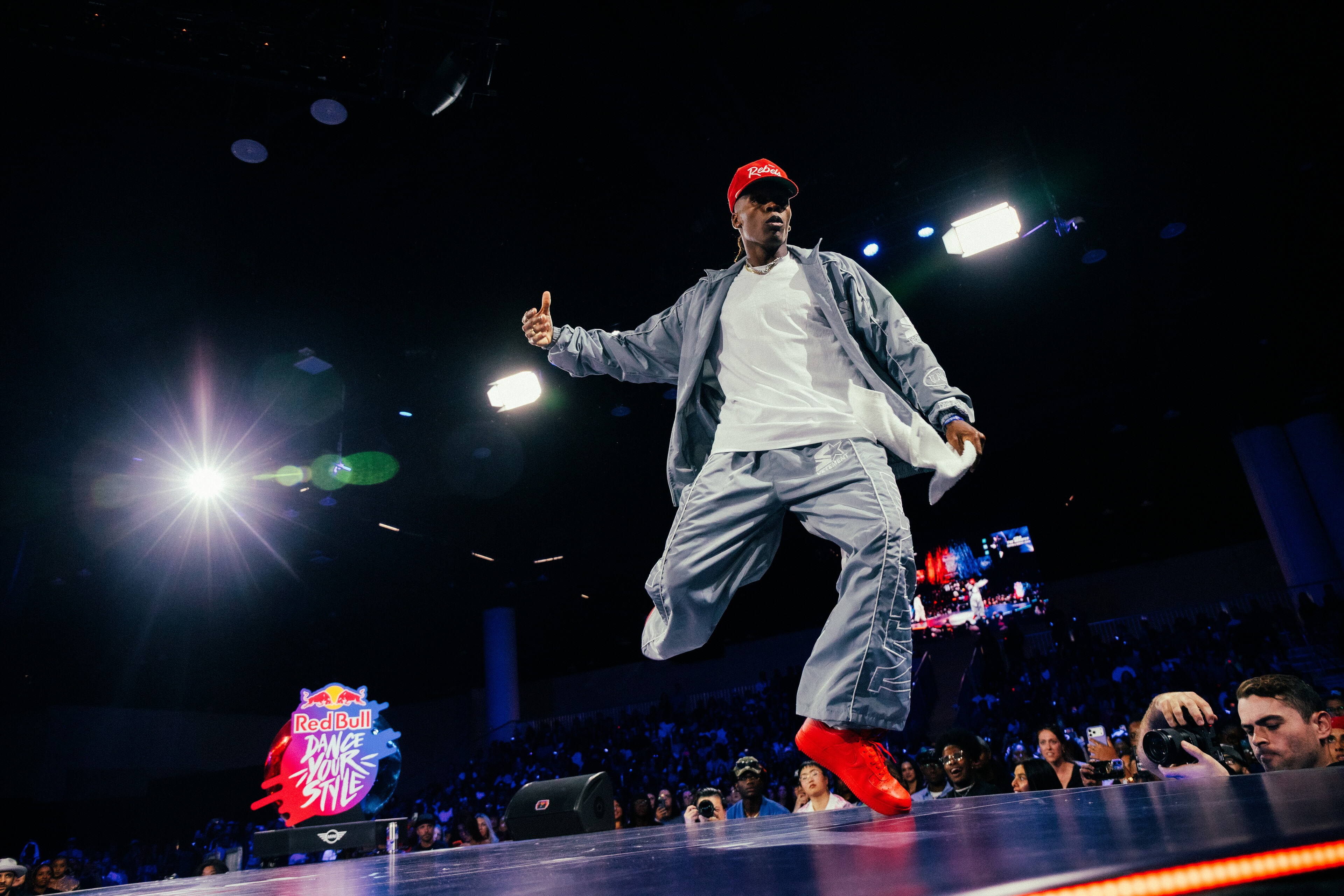
Kidd The Monster, off the ground entirely, at the USA National Final in Tampa | Photo: Marina Oya/Red Bull Content Pool
Artist Spotlight
Amaleke Bradley — credited in battle and on screen as Kidd The Monster, and sometimes as Amaleke Kidd Bradley — is a Florida-born dancer and screen performer whose movement crosses gliding, jookin and popping. Tampa-area coverage identifies him as Pompano Beach-born, and his own Instagram profile carries the flag of the U.S. Virgin Islands. He appears in the television series Blindspotting, and runs teaching work he presents on his own channels as Glide University. At the 2026 Red Bull Dance Your Style USA National Final in Tampa on September 19, he advanced through the final eight and the final four to reach the championship battle, where he finished runner-up to JREAMZ. Red Bull’s own account of that final described his movement through hypnotic gliding, jookin and popping.
File // At a Glance
NAME — Amaleke Bradley
KNOWN AS — Kidd The Monster | Amaleke Kidd Bradley
STYLES — Gliding | jookin | popping
ORIGIN — Florida | Pompano Beach roots
HERITAGE — Flies the U.S. Virgin Islands flag on his own profile
SCREEN — Blindspotting
TEACHING — Glide University
TAMPA 2026 — Runner-up, lost the final to JREAMZ
INSTAGRAM — @kidd_themonster
|
2nd Tampa 2026 Finish |
1 Battle From the Title |
3 Styles He Fuses |
16 Dancers in the Field |
Ask a hundred people at random to imitate a dance move and a large share of them will attempt the same one. They will plant one foot, drag the other, and try to travel backwards while appearing to walk forwards. Most will do it badly. All of them will know exactly what they are reaching for. The glide is probably the single most universally recognized piece of vocabulary street dance has ever produced.
Now ask those same hundred people to name a glider. The silence is the subject of this article. An entire technical language — gliding, floating, the whole family of illusion footwork that runs from Fresno through Memphis jookin to a thousand imitations on a thousand phones — travels the planet permanently detached from the people who built it and the people who can actually do it. The move is famous. The practitioners are not.
Amaleke Bradley, who battles as Kidd The Monster, is a useful place to examine that gap, because he sits on both sides of it. In September 2026 he took gliding, jookin and popping into a Tampa arena and finished one battle away from the national championship in a crowd-voted format — proof the form can carry a room that has never studied it. And away from the floor he runs teaching work he calls Glide University, which is the other half of the answer. This piece argues that those two things are the same project, and that the second one is the more important.
Look back at that photograph for a second longer than you normally would. Both feet are clear of the floor. That is worth noticing in a profile about gliding, because gliding is the art of appearing to leave the ground while never actually doing so. The glider’s entire craft is a negotiation with friction. Here, mid-battle, he has simply dispensed with the negotiation and gone up.
Florida, and a Style That Travels Without a Passport
Tampa-area coverage of the 2026 National Final identified Kidd The Monster as Pompano Beach-born, which gave Florida a direct representative in a field it was hosting. His own Instagram profile flies the flag of the U.S. Virgin Islands.
We are going to be careful here rather than expansive. The detailed biography — when he started, who taught him, which rooms he came up in — is not comprehensively documented in public sources, and Dance Mogul Magazine is not going to reconstruct a childhood from inference. What the record does establish is a Florida dancer who arrived at a national final holding a specific and demanding technical vocabulary, and who was good enough at it to beat everyone in the building except one person.
The absence itself is worth naming, because it is the pattern this publication keeps running into. A dancer can be excellent enough to reach a national final and still have almost no durable public record of how he got there. That is not a gap in the dancer. It is a gap in the infrastructure.
The Illusion, and How It Actually Works
Here is the part most coverage of gliding skips, and the part a young dancer can actually use.
A glide is not a trick. It is a controlled lie told with the feet, and it depends on the dancer managing three things at once. Weight has to sit almost entirely over one foot while the other travels, so that the travelling foot carries no load and leaves no drag. Edges do the steering — the glider works off the outside edge, the inside edge, the toe and the heel, converting a step into a continuous curve rather than a series of placements. And the upper body has to lie convincingly, staying level and unhurried, because the moment the torso bobs, the audience’s eye finds the mechanism and the illusion collapses.
That is why gliding is so widely attempted and so rarely done well. The move looks like a secret. It is actually an enormous amount of unglamorous conditioning in the ankles, the arches and the standing leg. People who try it for thirty seconds at a party and give up are not failing at a trick. They are declining an apprenticeship.
Understand what that means for the credit problem. The vocabulary is easy to recognize, trivial to imitate badly, and extremely hard to do properly. A form with that profile gets copied constantly and studied almost never — which is exactly the condition that separates a style from the people who own it.
Know the Styles: Gliding, Jookin and Popping
Gliding is the family of illusion footwork in which a dancer appears to travel across the floor without the steps that would normally produce the travel. Its most famous single expression reached a global audience through Michael Jackson, but the technique belongs to a much wider street lineage and has been developed continuously by dancers who are rarely named alongside it. Jookin — Memphis jookin — is a distinct discipline built on toe work, glides and an extraordinarily smooth, weightless quality, danced originally to Memphis rap. Popping, out of Fresno, supplies the opposite pole: the sharp muscular hit on the beat.
Why a young dancer should care about the combination: gliding and jookin are continuous and liquid, popping is percussive and abrupt. A dancer who owns both has access to the full dynamic range — they can float through eight bars and then stop the room on a single hit. In a battle judged by strangers, that contrast is what makes a performance readable. Sameness is what loses crowds, whatever the style.
Why Three Styles Beat One in a Crowd-Voted Room
Red Bull’s own account of the Tampa final described Kidd The Monster moving through hypnotic gliding, jookin and popping. That sentence is doing more work than it appears to.
A credit list is not an impact statement, and neither is a style list, so let us be precise about what those three disciplines give a dancer who does not know what song is coming.
Gliding buys him the entrance. It is the most immediately legible street vocabulary in existence. A crowd with no dance education still knows something impossible is happening. That is a very large advantage in the opening seconds of a battle, when a dancer has to win attention before he can win a vote.
Jookin buys him the groove. Where gliding can read as a demonstration, jookin is musical and continuous — it rides a track rather than interrupting it. It is what keeps an illusion style from looking like a magic act.
Popping buys him the punctuation. When the record gives him a hit, he has somewhere to put it. A dancer who can only float has no answer to a beat that demands a stop.
Put those together and you have a competitor equipped for an unknown playlist, which is the entire technical problem the format poses. He was not carried through Tampa by one spectacular skill. He was carried by range.
Blindspotting, and the Screen Question
Kidd The Monster appears in the television series Blindspotting. That credit matters for a reason that has little to do with celebrity.
Street dancers who cross into scripted television are doing something harder than it looks. A battle rewards a dancer for taking up maximum space and holding an audience’s eye by force. A scene rewards the opposite: serving a story, hitting a mark, repeating a movement identically across takes from four camera positions, and knowing when the movement should be smaller than the dancer’s instinct. Those are close to opposite disciplines.
Here is the part young dancers should read twice. Every year a large number of extremely good battle dancers audition for screen work and do not book it, not because they lack ability but because they arrive treating the camera like a crowd. The dancers who cross over successfully are the ones who understood early that these are two different jobs with two different definitions of “good.”
We have also been unable to verify, from sources we could retrieve, some of the further screen and competition credits that circulate around his name. Where the record is uncertain, this publication says so rather than listing it.
Glide University: Handing the Technique Back
On his own channels, Kidd The Monster presents teaching work under the name Glide University. Public documentation of its structure and scale is thin, and we are not going to inflate it into something it may not be. What we will say is that the existence of the thing, and the name he chose for it, is the most interesting fact in this profile.
Consider what a name like that claims. Not “glide tutorials.” Not “learn the glide in five minutes.” A university — a word that asserts the existence of a body of knowledge deep enough to require study, with a curriculum, levels, and something worth being formally taught.
That claim is the correct one, and it is the direct answer to the problem this article opened with. A form that everybody imitates and nobody studies will be permanently detached from its practitioners. The fix is not complaining about appropriation. The fix is building the pedagogy — putting the technique into a teachable structure, under the name of someone who actually has it, so that the next generation learns the form from the inside rather than from a phone screen.
Note the sequencing, because it is the same one this publication keeps finding in the artists worth writing about. He did not build the school and then go looking for credibility. He competed to a national final and then spent the standing on infrastructure.
A form that everybody imitates and nobody studies will always be separated from the people who built it. The remedy is not a complaint. It is a curriculum.
Tampa: One Battle From the Title
The 2026 Red Bull Dance Your Style USA National Final was held at the Tampa Convention Center on September 19, 2026, with an announced field of sixteen. Kidd The Monster advanced through the final eight and the final four and reached the championship battle, where he lost to JREAMZ, the eighteen-year-old krump dancer from Phoenix who now carries the United States to the World Final in Zurich. The full bracket and the rest of the field are documented in our Red Bull Dance Your Style Newsroom, and the champion’s own story is in our JREAMZ profile.
Florida’s presence in that bracket ran deeper than the host city. Lily Frias came out of Los Angeles by way of Mexico, but Marlee Hightower carried Orlando, Tyler D. Creator carried St. Petersburg, and Kidd The Monster carried Pompano Beach. Three of the final eight held Florida connections at an event Florida was hosting.
What a Runner-Up Position Actually Measures
Second place is the most misread result in competition, so let us be exact about what it means in this particular format.
He did not lose to a panel of specialists who preferred another technical tradition. He lost a popular vote, in a room, on a night, against a dancer working in a completely different vocabulary, on music neither of them chose. That is a margin of taste and moment, not of ability. Run the same two dancers on a different night with a different playlist and the result is genuinely open.
What his finish does establish, and establish firmly, is that an illusion-based Florida street vocabulary can beat almost anything in the country in front of a general audience. He went through the field. The only thing that stopped him was one other person having a better night.
Here is the part worth saying plainly to any young dancer reading: nobody remembers second place, and that is a failure of memory rather than a fact about worth. The margin between the champion and the runner-up in a crowd-voted battle is frequently nothing at all.
The Awards — and the Ones That Don’t Exist Yet
2026 — Runner-up, Red Bull Dance Your Style USA National Final. Tampa Convention Center, September 19, 2026. Advanced through the final eight and final four before losing the championship battle to JREAMZ.
Screen — Blindspotting. Credited appearance in the television series.
Here is the honest part, and Dance Mogul Magazine would rather print it than pad a page: there is no comprehensive, publicly maintained record of Kidd The Monster’s full competitive history. Not because the work was not honored, but because the industry has never built the infrastructure to track street dance achievement properly. Sessions, local battles, guest sets, teaching engagements and the ordinary accumulated labour of a dance career leave almost no durable public trace.
That absence is not a footnote to his story. It is the argument, and in his case it is the argument twice over — once for him as a dancer, and once for gliding as a form. A vocabulary recognized by billions of people has no canonical history, no widely agreed list of its innovators, and no institution charged with remembering them. Which is precisely why a dancer deciding to call his teaching operation a university is not a joke about naming. It is a repair.
When a discipline is undercredited, its practitioners’ achievements have to be documented deliberately, by publications willing to do it. It is why The Legacy exists on this site.
Where Kidd The Monster Is Now
As of late September 2026, the most recent verified activity is Tampa: a runner-up finish at the USA National Final, reached through the deepest all-styles field the event has assembled in the United States. He continues to post teaching work under the Glide University name and remains active on Instagram as @kidd_themonster.
Beyond that, we are not going to invent a schedule for him. Public reporting on the rest of his 2026 slate is thin, which is entirely normal for working dancers whose bookings sit under non-disclosure until announcement. When there is verified news, this publication will report it.
What we will say is that Dance Mogul Magazine intends to keep following him and the rest of the Tampa field through the next twelve months. A championship is a night. A career is a decade. The interesting question about any competition is never who won it — it is who is still building three years later.
Career Timeline
FLORIDA ORIGINSBorn in Florida with Pompano Beach roots, according to Tampa-area coverage of the National Final. Builds a movement vocabulary across gliding, jookin and popping.
SCREEN WORKAppears in the television series Blindspotting, crossing from battle floors into scripted performance.
GLIDE UNIVERSITYBegins presenting teaching work under the Glide University name, putting the technique into a structure other dancers can learn from.
SEPTEMBER 19, 2026Reaches the championship battle at the Red Bull Dance Your Style USA National Final in Tampa and finishes runner-up to JREAMZ.
What He Represents to Young, Up-and-Coming Dancers
The pattern Kidd The Monster broke is the one where a street dancer becomes very good at a widely-copied style and then watches the style get famous without him. He built a place to teach it instead.
Read as a career path rather than a résumé, his trajectory shows five distinct stages, and any serious dancer can locate himself on this ladder — which is the whole reason we are laying it out.
1. Take the apprenticeship the crowd skips
Everybody tries the glide. Almost nobody trains the ankles, arches and standing leg for the years it takes to do it properly. The styles that look like tricks are the ones where the gap between an amateur and a master is widest — which makes them, counterintuitively, some of the best places to build a career. Pick something easy to attempt and hard to own.
2. Collect a second and third language
Gliding, jookin, popping. Float, groove, hit. He did not win rounds in Tampa by being the best at one thing; he won them by having an answer for whatever the DJ played. Depth in one discipline is non-negotiable, but a career is made portable by the second one.
3. Learn the other job before you need it
Battle and camera are different disciplines with different definitions of good. A dancer who works out that difference before the audition books work that dancers of equal ability do not. Study the job you want next while you are still winning at the one you have.
4. Enter the room where strangers decide
Specialist rooms tell you whether your technique is correct. A crowd-voted arena tells you whether it communicates. Both are real information and most dancers only ever collect one of them. He went and got the second, and finished second in the country with it.
5. Turn access into a door for other people
The final stage is the one most careers never reach: using your position to teach, hire, platform and mentor. Glide University is exactly that move — taking a form the whole world imitates and building somewhere it can be properly learned, from someone who has it. That is what a career looks like when it stops being about you. If you are building the discipline behind a plan like the one mapped above, our workbooks were built for exactly that.
Why Kidd The Monster Matters to Dance Mogul Magazine
Dance Mogul Magazine has published for over fifteen years on a single conviction: dance is the foundation, not the ceiling. Kidd The Monster answers that in an unusually direct way, because his real subject is ownership. What do you do when the thing you are excellent at is famous and you are not? The available answers are bitterness, silence, or building the institution that should have existed. He picked the third, and that choice transfers to anyone whose work gets used without their name on it — which is most people, in most industries.
The movement vocabulary that drives mainstream entertainment is overwhelmingly born in Black communities, in club culture, in street dance and hip-hop, and is then absorbed upward into pop, film and television — frequently without credit traveling with it. Gliding is perhaps the purest case study available: a technique recognized on every continent, attached in the public mind to a single superstar, and sustained for decades by street dancers almost none of whom the public could name. As a father and son Black owned dance publication, documenting that chain of authorship is not a side project for us. It is the work.
If his story lands with you, keep going: explore the full range of forms in our Dance Styles Hub, read our street dance coverage, study the artists shaping the commercial industry in Black Creative Directors & Choreographers, and build your foundation in the Dance Knowledge Hub.
Frequently Asked Questions About Kidd The Monster
Who is Kidd The Monster?
Kidd The Monster is Amaleke Bradley, a Florida-born dancer and screen performer who works in gliding, jookin and popping. He appears in the television series Blindspotting, teaches under the name Glide University, and finished runner-up at the 2026 Red Bull Dance Your Style USA National Final in Tampa.
What is Kidd The Monster’s real name?
Amaleke Bradley. He is also credited as Amaleke Kidd Bradley, and competes and posts as Kidd The Monster.
What dance styles does Kidd The Monster do?
Gliding, jookin and popping. Red Bull’s account of the 2026 national final described his movement through hypnotic gliding, jookin and popping — a combination that gives him float, groove and percussive impact in the same round.
How did Kidd The Monster do at Red Bull Dance Your Style 2026?
He finished runner-up. He advanced through the final eight and the final four at the USA National Final in Tampa on September 19, 2026, and lost the championship battle to JREAMZ.
What is gliding in street dance?
Gliding is a family of illusion footwork in which a dancer appears to travel across the floor without taking the steps that would produce the travel. It depends on precise weight placement over the standing leg, steering from the edges of the feet, and an upper body that stays level enough not to reveal the mechanism.
What is Glide University?
Glide University is the name under which Kidd The Monster presents his teaching work on his own channels. Public documentation of its structure and scale is limited, but the premise — treating gliding as a body of knowledge worth formally teaching rather than a trick to copy — is the significant part.
Where is Kidd The Monster from?
Florida. Tampa-area coverage of the 2026 National Final identified him as Pompano Beach-born, and his own Instagram profile carries the flag of the U.S. Virgin Islands.
Keep Exploring
Dance Mogul Magazine documents the artists who build the culture and the careers that grow out of it. Start with the Featured Artist series, dig into the Archive, follow the season in the Red Bull Dance Your Style Newsroom, and browse everything we have published in the Article Library.
Reporting sources: Red Bull’s official 2026 National Final recap, Creative Loafing Tampa, IMDb, and Kidd The Monster’s own channels. Career details reflect verified public reporting as of September 2026. Where the public record is incomplete — including his early training and the full scale of Glide University — this article says so rather than filling the gap.
Kidd The Monster Amaleke Bradley Gliding Jookin Popping Red Bull Dance Your Style Street Dance Florida Dance Glide University Blindspotting Featured Artist Tampa 2026
© 2026 Dance Mogul Magazine LLC | dancemogul.com | Inspiring Self-Empowerment Through Dance Culture
Red Bull and Red Bull Dance Your Style are trademarks of their respective owners. Dance Mogul Magazine is an independent publication and is not affiliated with, endorsed by, or sponsored by Red Bull.