
Featured Artist | Bharatanatyam & Indian Fusion | Red Bull Dance Your Style
Harini Nilakantan: The Classical Dancer Who Refused to Be a Box
Twenty years of Bharatanatyam, four teachers she names, and a first battle in late 2024. Under two years later she was in the national final eight — and the most important thing she brought onto the floor was not a step. It was a tradition that remembers who taught whom.
By Dance Mogul Magazine | Featured Artist | September 2026
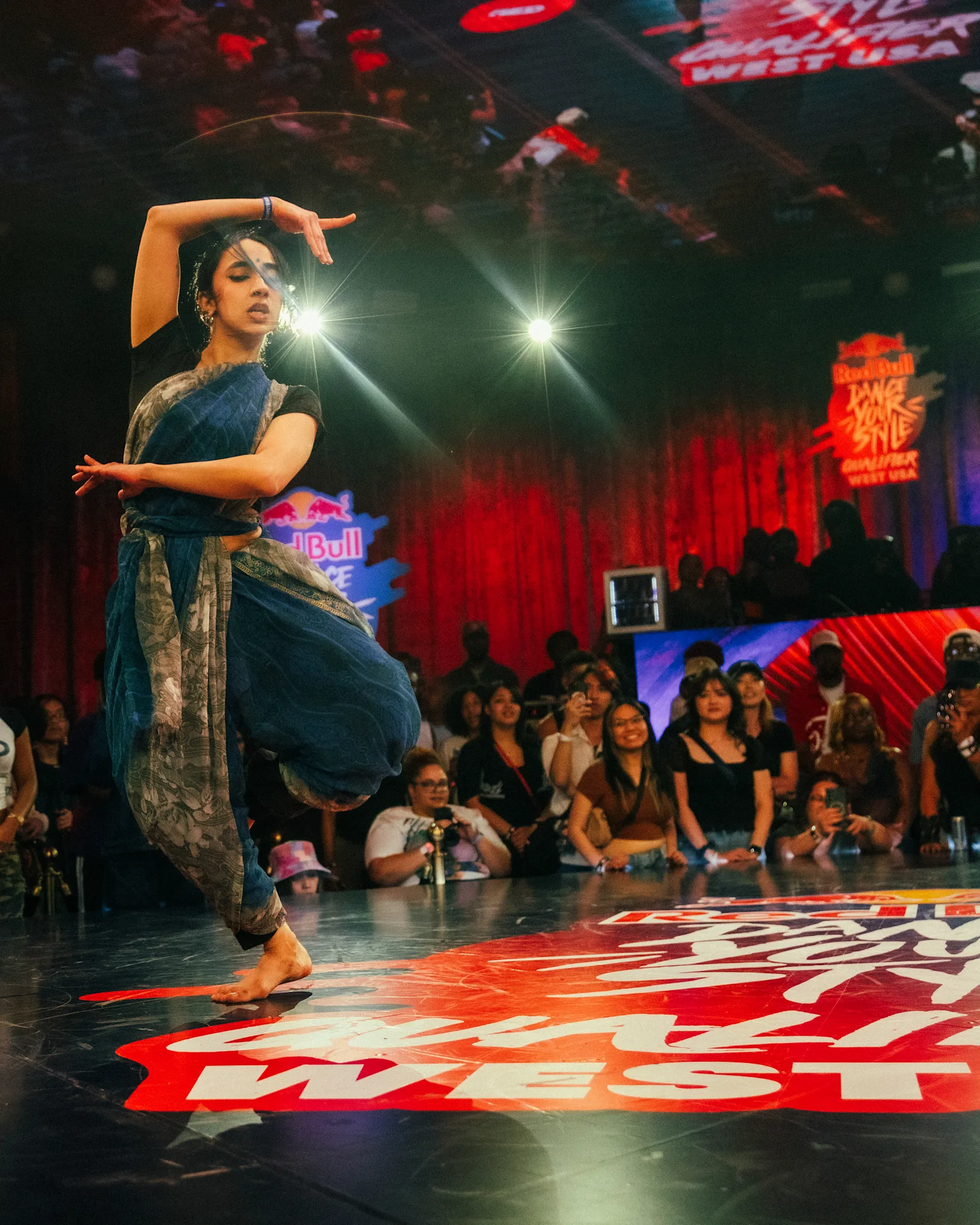
Both hands in classical mudras, eyes turned inward, the crowd close enough to touch — the West Qualifier, Las Vegas, March 21, 2026, where she reached the top four | Photo: Marina Oya/Red Bull Content Pool
Artist Spotlight
Harini Nilakantan is a Chicago-based dancer, choreographer and movement artist, originally from Chennai, with more than twenty years of Bharatanatyam training. She began at four in Bangalore, performed her arangetram in Pune, and trains today with Kalaimamani Guru Smt. Roja Kannan. In Chicago she became lead choreographer for Movement of Desis, program head of dance at the Kalapriya Center for Indian Performing Arts and founder of Patchwerk. She entered her first battle in late 2024, won the Red Bull Dance Your Style Chicago City Qualifier in June 2025, reached the top four at the Las Vegas West Qualifier in March 2026, and made the final eight in Tampa on September 19, 2026.
File // At a Glance
NAME — Harini Nilakantan
PRONOUNS — She / they
ROOTS — Chennai | raised in Bangalore | Indianapolis from 2013
BASED — Chicago
FORM — Bharatanatyam | battles as Indian fusion, with house, freestyle and footwork
LINEAGE — Smt. Sujatha Raghavendra | Smt. Usha Rahul | the late Shri Adyar K. Lakshman | Smt. Roja Kannan
ALSO TRAINED — Waacking | hip-hop | Chicago footwork
EDUCATION — School of the Art Institute of Chicago | MA, museum and exhibition studies, UIC, 2023
WORK — Program head of dance, Kalapriya | founder and director, Patchwerk
BATTLE RECORD — Chicago champion 2025 | West Qualifier top four 2026 | Tampa final eight 2026
|
20+ Years of Bharatanatyam |
2 Years, First Battle to Tampa |
30M+ Views on Her Battle Rounds |
8 Tampa Final Eight |
A classical Indian dancer who walks into a street battle arrives with two scripts already written for her. One says she is bringing culture to the cypher, as if the cypher had none. The other says she is cheapening a classical form by dragging it somewhere it does not belong. Harini Nilakantan has heard the second one — “she’s cheapening this dance form” is how she sums up the criticism — and a gentler version from her own mother, whose advice on a childhood competition routine was to “maybe keep the classical out of this.” Both scripts assume the same thing: that Bharatanatyam is a sealed box, to be either protected or damaged.
Her answer rejects the box. “I’m a permeable membrane,” she told Red Bull in May 2026. “I’m not a box.” Take that as the technical statement it is. A membrane is neither a wall nor an open door. It is selective — it decides what passes through. That is a precise description of fusion done with discipline, and it explains a result that looks impossible on paper. She entered her first battle in late 2024. By June 2025 she was a Red Bull city champion. On September 19, 2026, she was in the national final eight in Tampa.
This profile makes two arguments. The first is that the speed is no mystery: twenty years inside a form built on rhythmic structure is the most thorough preparation for battling there is. The second matters more to Dance Mogul Magazine. Bharatanatyam passes itself on through a system that names its teachers, and she carried that habit onto a battle floor, thanking “my Gurus in all forms of dance” after Las Vegas. Street dance has fought for decades for that kind of credit. Follow her lineage back far enough, though, and you find that even the classical tradition carries a debt it did not always acknowledge.
A Cousin Worth Copying: Bangalore, Age Four
Originally from Chennai and raised in Bangalore, she started the way many South Indian children do: by copying someone slightly older. In her case it was a cousin, and the adults noticed. “Oh, this kid really likes moving, so we’ll put her in there,” is how she described their reasoning to JoySauce. “There” was the class of Smt. Sujatha Raghavendra, her cousin’s guru. Harini was four.
The house was not classical-only. She describes a childhood soundtrack running from Indian classical music and Bollywood to new jack swing, Michael Jackson, Frank Sinatra and Carlos Santana. Before she had a word for fusion, she lived in a household that practiced it.
Here is what a young dancer should take from those years. A classical foundation is not glamorous: the same footwork drilled in sets, the same half-seated stance held until the thighs shake, the same hand shapes corrected hundreds of times. None of it looks like a battle. All of it becomes one, twenty years later, when an unfamiliar track starts and your body already knows how to turn sound into shape.
Four Gurus, and Why She Names Every One
Ask a Bharatanatyam dancer who they are and, sooner or later, they will tell you who taught them. The form passes through the guru–shishya relationship, teacher to student, and that relationship is public identity. A dancer’s teachers are part of her name.
Harini names four: Smt. Sujatha Raghavendra, her first teacher; Guru Smt. Usha Rahul, under whom she performed her arangetram, the solo debut recital that marks a student’s formal arrival in the form; the late Guru Shri Adyar K. Lakshman; and her current guru, Kalaimamani Guru Smt. Roja Kannan.
The honorifics carry weight. Kalaimamani is an honor the state of Tamil Nadu confers on artists. Adyar K. Lakshman received the Padma Shri, one of India’s national civilian honors, in 1989, and died in 2014, at eighty. His own training began at Kalakshetra in 1944 under its founder, Rukmini Devi Arundale — so Harini’s lineage reaches, in two steps, the woman most associated with remaking Bharatanatyam for the modern concert stage.
Now set that beside the culture she walked into. Street dance has its own lineage — crews, houses, the older dancer who took you to your first session — but it has had to fight for every public acknowledgment of it. After Las Vegas, Harini thanked “my Gurus in all forms of dance.” All forms. She extended the honorific to the people who taught her waacking, hip-hop and footwork. That phrase is the credit system street dance deserves, practiced by someone raised inside one.
Indianapolis, 2013, and a Talent-Show Duet
In 2013 her family moved to Indianapolis. For a young dancer whose teachers and sense of self were rooted in South India, that is a test of whether the form comes with you. “My relationship with Bharatanatyam went through its ups and downs,” she told DESIblitz, “particularly when it came to my identity and if I was still connected to my roots after I’d moved to the States, but I’d say my love, respect, and hunger to delve deeper has only grown as I’ve grown as a dancer.”
One of her earliest fusion pieces came at a high school talent show: a call-and-response with a ballet dancer named Sonia. Note the format. It is not a blend. A call-and-response keeps both vocabularies intact and lets the audience see where they rhyme — the instinct she described to JoySauce: “Wait, there’s so many connections. This reminds me of this in my dance style. What if I just do them back to back?”
The instinct was older than that. Years earlier, on a routine for a childhood competition, her mother’s advice was to “maybe keep the classical out of this.” It deserves a generous reading. It is protection, not hostility: a parent who does not want years of classical training treated as a gimmick. The fear and the ambition point at the same thing. The disagreement is only about what respect requires.
Inside the tradition, the opinion that carries most weight is the guru’s, and hers was supportive. Her guru, she told DESIblitz, “gave me her blessing and sound advice.” In a system where a teacher’s authority is real, that is the classical tradition itself signing off on the experiment.
Know the Form: What Bharatanatyam Trains, and Why It Transfers to a Battle
Bharatanatyam is the classical dance of Tamil Nadu, built on a few core systems. Adavus are the foundational units of footwork and movement, drilled in graded sets. Many are danced in araimandi, a deep half-seated position with the knees turned out — the source of the leg strength that lets her balance, in the photograph above, on one bare foot. Hastas, or mudras, are a codified vocabulary of hand gestures. Abhinaya is storytelling through the face, eyes and body. Beneath it all sit tala, the rhythmic cycle, and jathis, spoken rhythmic syllables the dancer answers in footwork, traditionally called live by a conductor, the nattuvanar — the role Adyar K. Lakshman was celebrated for.
Why it matters in a battle: a battle hands you an unfamiliar track and asks you to find its structure and answer it in real time. A dancer raised on jathis has spent years hearing rhythm as a language the body must answer precisely, on demand. “My goal is to always amplify what I’m hearing with my body,” she says. Our Dance Knowledge Hub breaks down other forms the same way.
“I’m a permeable membrane, I’m not a box.” — Harini Nilakantan (Red Bull, May 2026)
Chicago Adopted Her
She came to Chicago for art school at the School of the Art Institute, then earned a master’s degree in museum and exhibition studies from the University of Illinois Chicago in 2023. That is not incidental. Museum work is the discipline of provenance: who made something, and whose name belongs on the label. Red Bull’s feature ran under the headline “The Historian on the Dance Floor,” and the label fits.
Chicago also gave her a scene. She spent two years as lead choreographer for the competitive branch of Movement of Desis, a South Asian dance collective, trained at Puzzle Box, studied waacking, hip-hop and the city’s own fast, percussive footwork, and headlined World of Dance Chicago twice.
“Chicago has adopted me and I owe it so much for everything that’s happened here,” she told Red Bull. Note the verb. Not I moved to Chicago — Chicago adopted me. It is the language of someone who knows a scene is the people who chose to teach you.
From First Battle to City Champion Inside a Year
In late 2024, after two decades as a classical dancer who also studied street styles, she entered a battle. Her reason was a question nobody had answered: “Simply put, I’d never seen it happen, and I always wondered why. Bharatanatyam is such a versatile dance form.”
She describes the difference between a battle and a recital precisely: “Battling is taking this very raw creativity and then trying to package it in the fastest way possible [to make it] visible.” A recital is composed and rehearsed. A battle gives you seconds to hear, decide and commit.
In June 2025 she won the Red Bull Dance Your Style Chicago City Qualifier, then reached the top sixteen at Red Bull’s North USA qualifier in Kansas City that July. She had been battling for well under a year.
The 2025 Chicago qualifier final, which she won, filmed from the crowd | Video: Seyo/YouTube
Note what made that possible, because it is the part that transfers. She did not need to learn musicality, control, stamina or presence in the cypher; twenty years had built those. She needed to learn the social form of battle — the exchange, the timing of an entrance, reading an opponent. That takes real time. But it is a far smaller thing to learn than dance itself, and she had already learned dance.
Las Vegas: A Sari, a Missy Elliott Record, and the Top Four
The photograph in this article was taken on March 21, 2026, at the Red Bull Dance Your Style West Qualifier in Las Vegas. You can read the event off the room: the decal under her feet spells West, and the neon sign behind her reads Qualifier West USA. Look at what she is doing. Both hands are held in classical hastas. Her eyes are lowered and turned inward — abhinaya, not the outward stare battles usually reward. She is barefoot, balanced on one foot, the other knee drawn up inside the folds of a sari.
The costume was a considered decision. “I usually wear Patiala pants and a blouse — something Indo-western,” she told Cosmopolitan India. “I’d packed the sari thinking I’d drape it like pants with a T-shirt, but I didn’t want to risk tripping if the folds were loose.” The photograph shows where that thinking landed: the sari drawn into a close, trouser-like drape over a black T-shirt, secured for a slick floor. That is the method in miniature. Bring the tradition onto the floor, then adapt it to the floor’s demands so it survives them. Membrane, not box.
Red Bull’s channels posted one of her rounds under the caption “class is in session,” set to Missy Elliott’s “Pass That Dutch,” a 2003 record built on heavy drums and a chanted hook. She did not pick it. In this format the DJ does, and the dancers hear the track when the crowd does. But a hard, sharply accented beat is exactly what a dancer trained on jathis is built to hit.
Red Bull USA’s clip of the Las Vegas round | Video: Red Bull USA/YouTube
She made the top four. “I’d never seen any Desi dance styles in a battle before, so I wanted to try,” she wrote afterward, and then: “I was here to showcase, to dance – for my friends who couldn’t anymore, for the little ones who didn’t know we could do this, for my family who supported me through it all and still do.”
For the little ones who didn’t know we could do this. She is naming an audience that was not in the room: South Asian children who had never seen their form in a battle, and so did not know it was allowed there. That is what representation means with the slogan stripped away. Not being seen. Showing a child a door they did not know existed.
Thirty Million Views, and What They Cost
Red Bull reported in May that her following jumped from roughly 380,000 to 700,000 and put the views at 40 million; Cosmopolitan India counted more than 30 million across four or five competition clips, a figure DESIblitz repeated. We would rather print the range than pick the biggest number. Her own reaction was plain: “That is an eye-popping number, I won’t lie. I knew my rounds were solid during that battle; I just didn’t expect that specific round to go crazy.”
Virality has a price, and she is open about it. She was posting fusion work online long before Las Vegas. “In 2020, everybody was online, and the hate was much worse,” she told Cosmopolitan India. What changed was her relationship to it: “Social media is a journal of sorts, but I’ve learned to be a lot more discerning.”
“Good fusion honors both. You’re not just going to willy-nilly take something and put it there because you want it as a gimmick.” — Harini Nilakantan (Red Bull, May 2026)
Here is the part young dancers should read twice. Her standard is not “all fusion is good.” That sentence concedes the critics’ best point — bad fusion exists, and it is disrespectful — then answers with a criterion instead of a defense. The question is never whether you combined two forms. It is whether you understood both well enough to know what each would permit. That is a test you can fail, and naming it is the reason to trust her when she passes it.
Tampa: The Final Eight
On September 19, 2026, at the Tampa Convention Center, with the crowd voting every battle, Harini reached the final eight alongside Marlee Hightower, Surge and Tyler D. Creator. The final four was JREAMZ, Kidd The Monster, Lily Frias and Jesse Sykes, and JREAMZ took the title. The whole field is tracked in our Red Bull Dance Your Style Newsroom. Red Bull’s post-event recap places her in the final eight; the sources reviewed do not spell out her qualifying route from Las Vegas.
The field included dancers with major tour credits, studio owners and regional champions. The result is decided by crowd vote, not a panel — so a room of street dance fans watched a classical Indian dancer and voted her through. That is not polite tolerance of an unfamiliar form. It is a crowd recognizing musicality in whatever vocabulary it arrives. She had been battling for less than two years.
The Career Underneath the Clips
A viral round makes a dancer visible for a week. What makes her employable for a decade is everything underneath it.
She was assistant choreographer, with a cameo, on “Jacquemus,” a single by Tesher, the Canadian producer behind the crossover hit “Jalebi Baby.” She has danced for Diljit Dosanjh, the Punjabi singer and actor whose recent tours have filled stadiums, and told DESIblitz she “would love the opportunity to choreograph for him one day.” Her site also lists Shreea Kaul and Bhuvana Ananth. Those credits matter because both men built their reach by combining South Asian musical tradition with hip-hop and pop, and working in that world demands fluency in both vocabularies at once. The battles made her famous. The fluency makes her hireable.
She is also building institutions. She is program head of dance at the Kalapriya Center for Indian Performing Arts in Chicago and founded and directs Patchwerk; a 2025 episode of the Break the Barrier podcast called her “a teacher, a leader, and the founder of a collective” making space for South Asian artists. In August 2025 she led JHOOM, billed as a joyful movement mehfil — a mehfil being an intimate South Asian gathering for music, poetry and dance — at the Chicago Athletic Association Hotel. In 2026 Arts India USA named her a Lotus Fellow.
Note the sequencing. She was already a program head, a founder and a lead choreographer before Las Vegas. The virality landed on a structure that could hold it.
The Honors, and the Debt Behind the Lineage
2025 — Champion, Red Bull Dance Your Style Chicago City Qualifier. June.
2025 — Top sixteen, North USA qualifier. Kansas City, July.
2026 — Top four, West Qualifier. Las Vegas, March 21.
2026 — Lotus Fellow, Arts India USA.
2026 — Final eight, USA National Final. Tampa, September 19.
Two-time headliner, World of Dance Chicago.
Here is the honest part, and Dance Mogul Magazine would rather print it than pad a page: there is no comprehensive, publicly maintained record of Harini Nilakantan’s full performance history. Not because the work was not honored, but because the industry has never built the infrastructure to track dance credit properly. Recitals, showcases, choreography inside other artists’ productions and years of teaching leave almost no durable public trace.
Follow the lineage back far enough
Her own tradition shows what the alternative looks like, and where even it fell short.
Walk her teachers backward. Adyar K. Lakshman trained under several masters, among them Mylapore Gowri Ammal. Roja Kannan trained under Lakshman and under Kalanidhi Narayanan — also Gowri Ammal’s student. And Rukmini Devi, who taught Lakshman at Kalakshetra, studied abhinaya with Gowri Ammal in the mid-1930s. Three routes through Harini’s lineage, two of them through Lakshman, arrive at the same woman.
Mylapore Gowri Ammal was born in 1892 into a hereditary devadasi family in Madras and is often described as the last devadasi of the city’s Kapaleeshwarar temple. The devadasis were hereditary women artists attached to South Indian temples, and their dance, then called sadir, is the ancestor of Bharatanatyam. She danced at the temple until the practice was outlawed in 1947. The founder of Kalakshetra, the institution that remade the form, was her student.
The revival of the 1930s renamed the form and remade it for the concert stage. Standard accounts of Rukmini Devi’s life credit her and E. Krishna Iyer with the renaming from sadir to Bharatanatyam, and describe her modernization as removing elements that were “the legacy of its Devadasi association.” Scholars have spent decades since reconstructing what that cost the community whose art it was.
Here is why that belongs in a profile of a battle dancer. Bharatanatyam is among the best-credited traditions this magazine covers; its students can recite their teachers’ teachers across a century. Even so, it reinvented itself by distancing the art from the hereditary community that created it, above all its women. What that community gave survives in Harini’s lineage because individual teachers kept passing it on, and kept saying where it came from.
That is the lesson for street dance. Credit is not a natural property of a dance form. It is a practice, and it survives only as long as somebody keeps saying the names — in the studio, in the cypher, in print. A version of the pattern that carried sadir out of the hereditary community and into the concert hall has carried movement born in Black and Latino neighborhoods into videos, tours and advertising, often leaving its authors behind. “My Gurus in all forms of dance” is the habit that protects against it. It is why The Legacy exists on this site, and why we trace the American social dance movement back to the people who built it.
Where Harini Nilakantan Is Now
As of late September 2026 she is based in Chicago, leading dance programming at Kalapriya and directing Patchwerk: a 2026 Lotus Fellow coming off a final-eight finish in Tampa.
Beyond that, we are not going to invent a schedule for her. When there is verified news, this publication will report it.
A championship is a night. A career is a decade. Hers, as a battler, is less than two years old. Dance Mogul Magazine will keep following it.
Career Timeline
AGE FOURFollows a cousin into Bharatanatyam class in Bangalore, under Smt. Sujatha Raghavendra.
THE CLASSICAL YEARSArangetram under Guru Smt. Usha Rahul in Pune. Studies under Guru Shri Adyar K. Lakshman, who dies in 2014. Continues with Kalaimamani Guru Smt. Roja Kannan.
2013Her family relocates to Indianapolis.
HIGH SCHOOLAn early fusion piece: a talent-show call-and-response with a ballet dancer.
CHICAGOArt school at SAIC; MA from the University of Illinois Chicago, 2023. Lead choreographer for Movement of Desis’ competitive branch. Headlines World of Dance Chicago twice. Assistant choreographer for Tesher; dances for Diljit Dosanjh.
LATE 2024Enters her first battle.
JUNE 2025Wins the Red Bull Dance Your Style Chicago City Qualifier; top sixteen at the North USA qualifier in July.
AUGUST 2025Leads JHOOM, a movement mehfil, at the Chicago Athletic Association Hotel.
MARCH 21, 2026Top four at the West Qualifier in Las Vegas. Her rounds pass thirty million views.
2026Named a Lotus Fellow by Arts India USA.
SEPTEMBER 19, 2026Final eight at the Red Bull Dance Your Style USA National Final in Tampa.
What She Represents to Young, Up-and-Coming Dancers
The assumption she broke is that a dancer must choose: stay inside the form you were raised in, or leave it for something new. She stayed, and she went. Read as a method, her path shows five stages any serious dancer can locate herself on.
1. Go deep before you go wide
Twenty years in one form came before a single battle. Fusion is only as good as the depth of each thing being fused; you cannot honor a vocabulary you only half speak.
2. Name your teachers, in every form
Say who taught you your footwork, your waacking, your first eight-count — in every room you enter, including the ones where nobody asks.
3. Learn the rules of the room you are entering
She studied what a battle asks for — speed, clarity, exchange — and adapted, right down to how a sari is draped for a slick floor. Respecting a new culture means learning its rules, not expecting it to learn yours.
“If you’re nervous, it means you care. Put your work out there, but be honest with your movement.” — Harini Nilakantan (Cosmopolitan India, June 2026)
4. Put the work out before you feel ready
She entered a battle because she had never seen her form in one. That was reason enough. “You are already special if you take that first step and record yourself,” she told Cosmopolitan India.
5. Build the structure before the spotlight arrives
A program to run, a collective to lead, a room to host. When thirty million people showed up, there was already something for them to find. If you are building the discipline behind a plan of your own, our workbooks were made for it.
Why Harini Nilakantan Matters to Dance Mogul Magazine
Dance Mogul Magazine has published for over fifteen years on a single conviction: dance is the foundation, not the ceiling. Harini Nilakantan is a working demonstration of it.
The movement vocabulary that drives mainstream entertainment is overwhelmingly born in Black communities, in club culture, in street dance and hip-hop, and is then absorbed upward into pop, film and television — frequently without credit traveling with it. As a father and son Black owned dance publication, documenting that chain of authorship is not a side project for us. It is the work. Her story gives the argument two things it rarely gets at once: a working credit system, and a clear warning that even the best one can fail at its source.
If her story lands with you, keep going: explore the full range of forms in our Dance Styles Hub, read our street dance coverage, and study the artists shaping the industry in Black Creative Directors & Choreographers.
Frequently Asked Questions About Harini Nilakantan
Who is Harini Nilakantan?
Harini Nilakantan (she/they) is a Chicago-based dancer, choreographer and movement artist, originally from Chennai, with more than twenty years of Bharatanatyam training. She won the 2025 Red Bull Dance Your Style Chicago City Qualifier, reached the top four at the 2026 West Qualifier in Las Vegas, and made the final eight at the 2026 USA National Final in Tampa.
What dance style does Harini Nilakantan do?
Her foundation is Bharatanatyam, the classical dance of South India. In battles she competes in Indian fusion, combining Bharatanatyam with freestyle, house and footwork. She has also trained in waacking, hip-hop and Chicago footwork.
Where is Harini Nilakantan from, and how old is she?
She is originally from Chennai and grew up in Bangalore. Her family moved to Indianapolis in 2013, and she is based in Chicago. Cosmopolitan India gave her age as twenty-seven in June 2026; a JoySauce interview a month earlier said twenty-six.
Who are Harini Nilakantan’s gurus?
She began with Smt. Sujatha Raghavendra in Bangalore, performed her arangetram under Guru Smt. Usha Rahul in Pune, studied under the late Guru Shri Adyar K. Lakshman, and trains today with Kalaimamani Guru Smt. Roja Kannan.
Why did Harini Nilakantan go viral?
Her rounds at the Red Bull Dance Your Style West Qualifier in Las Vegas on March 21, 2026, where she reached the top four, spread widely online. Cosmopolitan India and DESIblitz reported more than 30 million views across her competition clips; Red Bull reported her following rising from about 380,000 to 700,000.
How did Harini Nilakantan do at Red Bull Dance Your Style 2026?
She reached the top four at the West Qualifier in Las Vegas in March and the final eight at the USA National Final in Tampa on September 19, 2026, in a bracket won by JREAMZ.
What does Harini Nilakantan do outside of battles?
She is program head of dance at the Kalapriya Center for Indian Performing Arts in Chicago, founder and director of Patchwerk, a two-time World of Dance Chicago headliner and a 2026 Lotus Fellow with Arts India USA. She has choreographed for Tesher and danced for Diljit Dosanjh.
Keep Exploring
Dance Mogul Magazine documents the artists who build the culture and the careers that grow out of it. Start with the Featured Artist series, dig into the Archive, follow the season in the Red Bull Dance Your Style Newsroom, and browse everything we have published in the Article Library.
Reporting sources: Red Bull’s May 2026 feature on Harini Nilakantan and its National Final recap; Cosmopolitan India; JoySauce; DESIblitz; Harini Nilakantan’s official website; the Break the Barrier podcast; and published biographies of Adyar K. Lakshman, Roja Kannan, Mylapore Gowri Ammal and Rukmini Devi Arundale. Career details reflect verified public reporting as of September 2026. Where the record is incomplete, this article says so.
Harini Nilakantan Bharatanatyam Indian Fusion Classical Indian Dance Desi Dance Chicago Dance Red Bull Dance Your Style Dance Lineage Movement of Desis Women in Dance Featured Artist Tampa 2026
© 2026 Dance Mogul Magazine LLC | dancemogul.com | Inspiring Self-Empowerment Through Dance Culture
Red Bull and Red Bull Dance Your Style are trademarks of their respective owners. Dance Mogul Magazine is an independent publication and is not affiliated with, endorsed by, or sponsored by Red Bull.