
Jersey Club · Street Dance History · Legacy
25 Years of Jersey Club: The Dancers Who Gave Newark’s Sound a Body
From Brick City house parties and skating rinks to stages, classrooms and screens around the world, Jersey Club’s history is incomplete without the dancers who turned Newark’s rhythm into movement.
By Dance Mogul Magazine | October 2026 | #25YearsOfJerseyClub
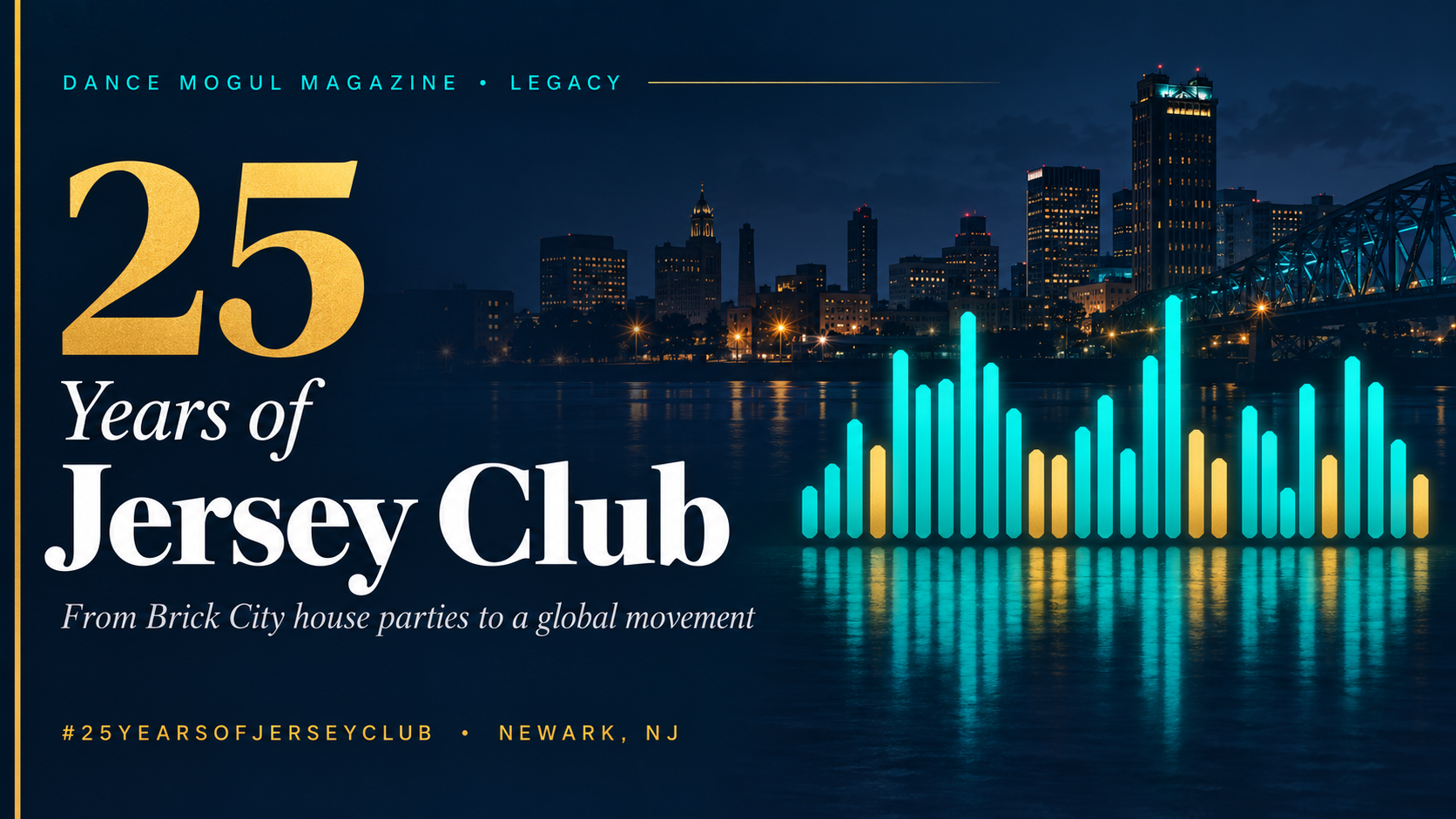
Celebrating 25 years of Jersey Club: Newark’s sound, and the dancers who gave it a body. (Dance Mogul Magazine)
Jersey Club at a Glance
Born in
Newark, New Jersey (“Brick City”)
Original name
Brick City Club
Sound developed
c. 1999–2000; DJ Tameil releasing his own club records by 2001
Musical roots
Baltimore Club, Newark house and club culture
Key builders
DJ Tameil, the late Tim Dolla, Mike V, DJ Black Mic and the Brick Bandits family
Signature sound
Rapid drums, triplet kicks, chopped vocals, sudden breaks, the bed-squeak sample
Dance lineage
Basil Harris and first-generation New Jersey street dancers (1979), Brick City Dancers (1990s), EnVy Dance Group (2003) and generations since
Landmark
Branch Brook Park Roller Skating Center, NJ Black Heritage Trail site (approved 2025)
25
Years of Jersey Club, counted from 2001
2001
DJ Tameil releasing his own club records
2003
EnVy Dance Group formed in Newark
2025
Birthplace site added to the NJ Black Heritage Trail
Twenty-five years after DJ Tameil began releasing his own club records in Newark, Jersey Club history has become world history, and Jersey Club is no longer something the rest of the world has to be introduced to. People recognize the bounce: the rapid kicks, chopped vocals, abrupt breaks, triplet patterns and the signature bed-squeak sample. They recognize the energy that can turn a few seconds of music into an invitation to move.
It has moved through speakers, clubs, house parties, skating rinks, school dances, battles and stages, and eventually onto phones around the world. But Jersey Club did not become a culture because people simply listened to it. They danced to it.
As Dance Mogul Magazine celebrates #25YearsOfJerseyClub, we are documenting the culture through the people whose bodies gave the music its visual identity. DJs created records; dancers interpreted them. Producers developed new rhythms; dancers figured out how those rhythms should move. The two histories are connected, but they are not identical. If Jersey Club is going to be preserved for another twenty-five years, the dancers cannot remain a footnote to the music. This is Jersey Club: The Dancer Perspective.
Jersey Club History Begins Before It Had a Name
Jersey Club’s story is rooted in Newark, but the street-dance lineage around it began earlier. Long before anyone was using the name Jersey Club, New Jersey already had a developing culture of Black street dance, nightlife, DJs, social dancing and club culture. Through the 1970s and 1980s, spaces such as Club Zanzibar and Sensations made New Jersey an important center for house and club music, with legendary DJ Tony Humphries among the figures associated with the Zanzibar era. These rooms established a culture where DJs, dancers, artists and nightlife met.
Dance Mogul Magazine’s firsthand New Jersey street-dance record reaches back to 1979, when Basil Harris and his dance team came on the scene as first-generation street dancers. DMM documents that generation as the beginning of the New Jersey street dance movement—an earlier foundation that predates the Jersey Club sound and the later crews that carried Newark movement culture into new eras.
By the 1990s, young people in Newark were hearing club records circulating from Baltimore, Chicago and Detroit. Mixtapes moved from person to person. Songs such as “Percolator” and “Hit It From the Back” became part of the soundtrack of parties and dance spaces. House parties created their own ecosystem, and music, fashion, neighborhood identity and dance developed together.
That matters, because some of the movement culture associated with Jersey existed before the Jersey Club label itself. DJ Tameil has recalled Newark dances such as Lock It Up, also called the Stolen Car Dance, being popular in the 1990s, before the city’s style of club music was formally branded. Dance Mogul Magazine’s own oral-history archive remembers the same period through house parties and social dances including the Wall and Lock It Up/Stolen Car. The dancers were already building a movement language while the musical identity was still coming together.
When Brick City Found Its Sound
Around the turn of the millennium, those currents locked into place. As Baltimore Club traveled north, Newark DJs began reshaping its blueprint for their own community. DJ Tameil, widely credited with pioneering the Jersey Club sound, developed a Newark interpretation alongside the late Tim Dolla, Mike V, DJ Black Mic and the wider Brick Bandits family. The sound grew into something distinctly local.
Before the world called it Jersey Club, it was Brick City Club, named for Newark’s famous nickname. Tameil has dated the development of the sound to approximately 1999–2000, and by 2001 he was producing and releasing his own club material. As the music traveled beyond Newark, the identity expanded. Brick City Club became Jersey Club.
The music was fast, playful and unpredictable, and that changed the relationship between music and movement:
A track could stop without warning.
A vocal phrase could repeat until it became percussion.
The drums could accelerate underneath the dancer.
A break could open just enough space for someone to do something nobody had seen before.
The Other Half of the Story
Music history leaves artifacts: records, production credits, mixtapes, track lists, equipment, release dates. Dance history is much harder to preserve. Someone creates a movement at a party. Someone across the room catches it. Another dancer changes it. By the following weekend, dozens of people are doing variations of it, and the movement belongs to the room. There is rarely paperwork, often no creator credit, and sometimes not even a camera. The culture simply moves.
During Jersey Club’s formative years, Newark’s house parties became laboratories for movement. Concepts such as the Wall and Lock It Up/Stolen Car circulated socially, and over time dances including the Percolator, One Leg Get Back and Rock Ya Hips became part of the larger vocabulary associated with the culture.
That is why Jersey Club history cannot be documented through the producers alone. The dance floor was part of the development process. A producer could make a beat in a bedroom or basement, but the party revealed whether it worked. The dancers became the test, an immediate focus group. When the floor exploded, the DJ knew. When dancers created something new to a record, the record gained another life.
The music inspired movement. The movement influenced the party. The party influenced the DJ. And the cycle started again.
— Dance Mogul Magazine, #25YearsOfJerseyClub
Brick City Dancers: Taking the Party to the Stage
By the 1990s, the next generation of New Jersey street dancers was carrying forward a movement that DMM traces back to Basil Harris and the first-generation street dancers of 1979. Among the most important crews in that later lineage were the Brick City Dancers, already active in the 1990s.
Their significance was not simply that they could dance. During the 1990s, they moved Newark’s social and street movement from parties into organized, choreographed performance. Performing at major Newark talent shows and on stages such as Newark Symphony Hall and NJPAC, they helped make Newark street and club dance visible as something larger than a party moment.
That transition changes culture. Once something reaches a stage, a larger community can see it. Parents see it. Children see it. Other dancers study it. Promoters recognize it. Institutions begin to acknowledge it. Crews gave the culture faces, and they gave younger dancers something to study. A young person could watch them and think: I want to do that. That is how generations begin.
The EnVy Generation
By the early 2000s, another generation was coming of age alongside the developing Jersey Club sound. Among them was Anthony “Solo” Harris, a member of EnVy Dance Group, formed in 2003. For these dancers, Jersey Club was not a genre discovered years later through a tutorial or playlist. It was their environment. The skating rinks were real. The parties were real. The crews and the battles were real. The music was changing while they were dancing to it.
EnVy also illustrates something essential about Jersey Club dance history: the dancers were never limited to one step. They brought together party dances, freestyle, choreography, popping, locking, house, footwork, character, musicality and competition, and carried that approach into performances, battles, showcases and competitions. Reducing Jersey Club dance to a single viral movement misunderstands the culture.
Jersey Club was an environment before it became an internet category.
— Dance Mogul Magazine, #25YearsOfJerseyClub
Before the Algorithm
Today a dancer posts a movement, a producer posts a track, and an algorithm connects the two. Millions of people can encounter the result before learning the name of the city that produced it. But Jersey Club had viral characteristics before viral platforms existed: short musical phrases, dramatic drops, recognizable movement, call and response, personality, competition, participation and repetition. Those elements worked in a Newark party long before they worked on a phone screen.
The internet did not invent Jersey Club’s ability to spread. It amplified something the culture already knew how to do.
Before YouTube became the default home for dance video, footage circulated through VHS tapes, DVDs, early websites and person-to-person sharing. DMM’s archive traces that bridge through projects including Urbanvision.net and Da Sample, and through surviving footage of EnVy, the Brick City Dancers and other New Jersey crews. Dance Mogul Magazine’s EnVy & Jersey Club archive footage now preserves performances, battles, tributes and showcases. Those recordings matter for a reason nobody may have understood when the cameras were rolling: they became evidence.
Watch · Jersey Club in Motion
A Visual Companion to the History
These Instagram posts were supplied to Dance Mogul Magazine as a visual companion to this feature. They remain embedded from their original Instagram pages so the source stays attached to the media.
Instagram Clip 01
Instagram Clip 02
Instagram Clip 03
Instagram Clip 04
Instagram Clip 05
Instagram Clip 06
Instagram Clip 07
Instagram Clip 08
Instagram Clip 09
Instagram Clip 10
Embedded media is hosted by Instagram and remains subject to the availability and settings of the original posts.
From Newark to the World
Over the next two decades, Jersey Club moved far beyond New Jersey, into mainstream hip-hop, R&B, pop, electronic music and global dance culture. New generations met it through DJs, producers, dancers, battles, social media and viral challenges. Cookiee Kawaii’s “Vibe” became a major TikTok dance phenomenon in 2020, and by the 2020s Jersey Club rhythms were appearing across mainstream rap and popular music. The sound that once had to be explained became recognizable even to listeners who did not yet know its history.
That growth deserves celebration. But global reach creates another responsibility: preserve the lineage. A teenager can now learn a Jersey Club movement without ever entering a Newark skating rink. A producer can download a Jersey-inspired drum kit without knowing the Baltimore Club connection or who built the sound. A dancer can learn a movement without knowing the generations of Newark dancers who practiced it before cameras were everywhere. Culture must evolve. Preserving those connections gives the evolution context.
Newark’s History Receives Official Recognition
One of the most significant moments in Jersey Club preservation came in 2025, when the New Jersey Historical Commission approved “BBPSR: Birthplace of the Jersey Club Movement” at Branch Brook Park Roller Skating Center in Newark as a site on the New Jersey Black Heritage Trail. The designation places Jersey Club within the state’s documented Black cultural history and formally recognizes a physical space where DJs, dancers and young people helped build the movement.
For a culture that once lived largely through parties, mixtapes, word of mouth and memory, that recognition carries weight. The places matter. The rooms matter. The floors matter. Culture does not happen in the abstract. It happens somewhere.
Jersey Club — 25-Year Timeline
1970s–1980s — Newark and New Jersey club culture grows through spaces such as Club Zanzibar and Sensations
1979 — Basil Harris and his dance team come on the scene as first-generation street dancers; DMM documents this generation as the beginning of the New Jersey street dance movement
1990s — Baltimore, Chicago and Detroit club records circulate in Newark; house-party dances such as the Wall and Lock It Up/Stolen Car take hold; Brick City Dancers emerge in the 1990s and carry Newark street and club dance into organized performance and major stages
c. 1999–2000 — DJ Tameil develops a Newark take on Baltimore Club with the Brick Bandits family
2001 — Tameil releasing his own club records; the sound is known as Brick City Club, the milestone behind #25YearsOfJerseyClub
2003 — EnVy Dance Group forms, part of the generation that grew up inside the sound
2000s — Footage spreads through VHS, DVDs, Urbanvision.net and Da Sample before the YouTube era
2020 — Cookiee Kawaii’s “Vibe” becomes a major TikTok dance phenomenon
2025 — Branch Brook Park Roller Skating Center approved for the NJ Black Heritage Trail as the Birthplace of the Jersey Club Movement
2026 — Dance Mogul Magazine celebrates 25 years of Jersey Club and the dancer perspective
Twenty-Five Years Later: The Dancer Becomes the Teacher
The next stage of preservation is not simply remembering what happened. It is transferring that knowledge. For Anthony “Solo” Harris, Jersey Club eventually became more than something to perform. It became something to teach. Through Solo Expression, he uses dance and the energy of Jersey Club with youth, adults, seniors and individuals with intellectual and developmental disabilities. Programs including Dance Warz, Jersey Club 101 and the BFAM School Assembly connect younger generations with dance, history, mentorship and community.
The teenager who once watched dancers becomes the dancer.
The dancer becomes the mentor.
The mentor becomes the educator.
The participant becomes the archivist.
And eventually, the person who once needed a stage begins building stages for other people. That cycle may be as important to Jersey Club’s future as any viral record.
What Future Generations Should Learn
Jersey Club offers a larger lesson about how culture is actually created. It is rarely the work of one person. It is an ecosystem. The DJ matters. The producer matters. The dancer matters. So do the promoter, the videographer, the party, the skating rink and the crew. The person who carried the speaker matters. The person who recorded the VHS tape matters. The person who saved the flyer matters. The person who remembers who was really there matters.
Technology can make culture travel faster. It cannot replace lineage.
— Dance Mogul Magazine, #25YearsOfJerseyClub
And popularity should never become a reason to erase the community that built the thing being celebrated.
Why Jersey Club Matters to Dance Mogul Magazine
Dance history is often documented only after something becomes commercially valuable. By then, some names are missing. Some footage is gone. Some movements have been renamed. Some originators are watching younger audiences discover something they helped create without knowing they existed. Dance Mogul Magazine was founded to help prevent that kind of disappearance.
This story is also our own. Dance Mogul Magazine was born from Newark street dance, the same streets, parties and crews this article celebrates. Jersey Club is proof of what DMM has believed since 2010: that dance is a foundation for discipline, community, creativity and purpose, and that the people who build a culture deserve to be named in its history. Our responsibility is not to freeze Jersey Club in the past. It is to preserve enough of the past that the future knows what it is building on.
That means documenting DJs and producers. It also means documenting dancers. Especially dancers. Because music tells us what people heard. Dance shows us what that music made people do. Explore more of that work in our Jersey Club coverage, Street Dance, The American Social Dance Movement, The Legacy and The Archive.
Give the Dancers Their Flowers
Twenty-five years in, the music deserves celebration. The DJs deserve their flowers. The producers deserve their flowers. The promoters, party organizers, photographers, videographers, families, venues and community spaces deserve recognition. And so do the dancers.
Because Jersey Club was never simply something Newark listened to. Newark moved to it. Dancers translated drums into footwork. They turned musical breaks into battles. They carried neighborhood movements onto stages and transformed social dances into choreography. And when the cameras finally arrived, dancers gave Jersey Club a visual identity the whole world could recognize.
The history of Jersey Club music and the history of Jersey Club dance are intertwined, but they are not identical. Both deserve names. Both deserve archives. Both deserve context. From the club culture that came before it, to Baltimore’s influence, to DJ Tameil and the Brick Bandits, to Newark’s house parties, from Basil Harris and the first-generation street dancers of 1979, to the Brick City Dancers of the 1990s, to EnVy and the early-2000s generation, to Dance Warz, classrooms, workshops and today’s digital generation, the technology changed, the stages grew and the audience became global. One relationship stayed at the center.
The DJ drops the beat.
The dancer gives it life.
Twenty-five years later, Jersey Club is still moving.
Jersey Club: Frequently Asked Questions
When did Jersey Club begin?
Jersey Club developed in Newark, New Jersey, in the late 1990s and early 2000s. DJ Tameil has placed its creation around 1999–2000, and 2001 marks a documented milestone when he began releasing his own club material. Dance Mogul Magazine’s 25-year celebration counts from that 2001 milestone rather than claiming the culture began in a single year.
Was Jersey Club originally called Brick City Club?
Yes. The early Newark-centered sound was called Brick City Club, after Newark’s “Brick City” nickname. As producers and participants beyond Newark became involved, Jersey Club became the broader name.
Who created Jersey Club music?
DJ Tameil is widely credited with pioneering the Jersey Club sound, building on Baltimore Club alongside the late Tim Dolla, Mike V, DJ Black Mic and the Brick Bandits family.
Did Jersey Club dancing exist before Jersey Club music?
Newark had social and street dances before the music received the Jersey Club name. DJ Tameil has recalled Lock It Up, also called the Stolen Car Dance, as a popular Newark dance in the 1990s, and DMM’s oral-history archive documents house-party dances such as the Wall from that period.
Who helped shape Jersey Club dance?
Dance Mogul Magazine’s firsthand archive identifies multiple generations in the New Jersey street-dance lineage: Basil Harris and his dance team as first-generation street dancers beginning in 1979; the Brick City Dancers, active in the 1990s; and EnVy Dance Group, formed in 2003, alongside countless neighborhood dancers whose movement circulated through parties, skating rinks, battles, schools and stages.
Why is Branch Brook Park Roller Skating Center important to Jersey Club?
The Newark rink was a key gathering and performance space for Jersey Club culture. In 2025 the New Jersey Historical Commission approved it for the New Jersey Black Heritage Trail as “BBPSR: Birthplace of the Jersey Club Movement.”
Why does preserving the dancer perspective matter?
Recordings and production credits preserve music more easily than spontaneous movement. Without interviews, video archives and firsthand testimony, the contributions of dancers can disappear even when the music they helped popularize survives.
Continue Your Journey
Explore more from the Dance Styles Hub and discover how dancers across every genre are shaping the future of movement and performance.
• Jersey Club — every DMM story on the culture
• Jersey Club 101 — learn the dance and its history
• Street Dance — the styles and crews that built the culture
• The Archive — Dance Mogul Magazine’s history collection since 2010
• Join the Dance Mogul Community — connect with the global dance community
Reporting foundation: Dance Mogul Magazine’s “What Is Jersey Club? The Dancer Perspective” Parts 1 and 2; the DMM New Jersey Street Dance and Jersey Club Origins archive; interviews and archival materials preserved by DMM; New Jersey Historical Commission, Black Heritage Trail approved sites (2025).
© 2026 Dance Mogul Magazine LLC | dancemogul.com | Inspiring Self-Empowerment Through Dance Culture