
The Elephant in the Room · Installment 2
Am I Too Old to Dance Professionally? The Honest Truth About Age, Gigs and Every Path a Dancer Has
Most dancers wonder about it. Few say it out loud. Here are the real numbers, the dancers still working past 40 and 55, and a map for every stage of a dance life, so the young can plan and the experienced can choose.
By Dance Mogul Magazine | The Elephant in the Room | Career & Longevity

Illustration: Dance Mogul Magazine. Characters are fictional.
File // At a Glance
The Question — Am I too old to dance professionally, and am I too old to get hired for gigs?
The Short Answer — Some doors close with age. Others stay open, and some only open later. Aging out of one kind of job is not aging out of dance.
Who This Is For — Young dancers mapping out a dream, and experienced dancers deciding what comes next
What Changes — Recovery time, injury risk, and how many youth-focused auditions will look at you
What Does Not — Musicality, timing, stage presence, teaching ability and the value of experience
The Real Risk — Having only one plan: performing in one style, for one kind of employer
The Move — Build more than one income stream and more than one way to be in the room, early
~34
Average age dancers stopped performing in a 2004 three-country study
$24.80
Median hourly pay, U.S. dancers, May 2025
2,200
Average yearly openings for dancers and choreographers, 2025–2035
87
Oldest age reported for the Liberty’s prior-season squad (Gothamist, 2025)
Say It Plainly: The Question Dancers Ask Alone
There is a conversation happening in dressing rooms, audition lines and group chats that almost nobody has in public. It sounds like this: The callbacks stopped. Is it me, or is it my age? Did I wait too long? Should I have had a backup plan?
Dancers keep that question quiet for a reason. Nobody wants to look like they failed, or like they didn’t plan. Dance is built on confidence, and saying “I’m worried I’m aging out” can feel like admitting defeat in a room where everyone is supposed to be fearless.
So the silence gets passed down. Young dancers chase the dream without seeing its full shape. Experienced dancers carry the question alone, often long after they could have used help. This installment of The Elephant in the Room puts the question on the table, looks at what the evidence actually says, and lays out paths for every stage of a dance life.
The central finding is simple: ageism in dance is real, but aging out of one kind of job is not the same as aging out of dance. A dancer can lose ground in youth-focused commercial auditions while still being fully able to perform, teach, choreograph, direct, judge, tour or build their own shows. Knowing the difference is where the power starts.
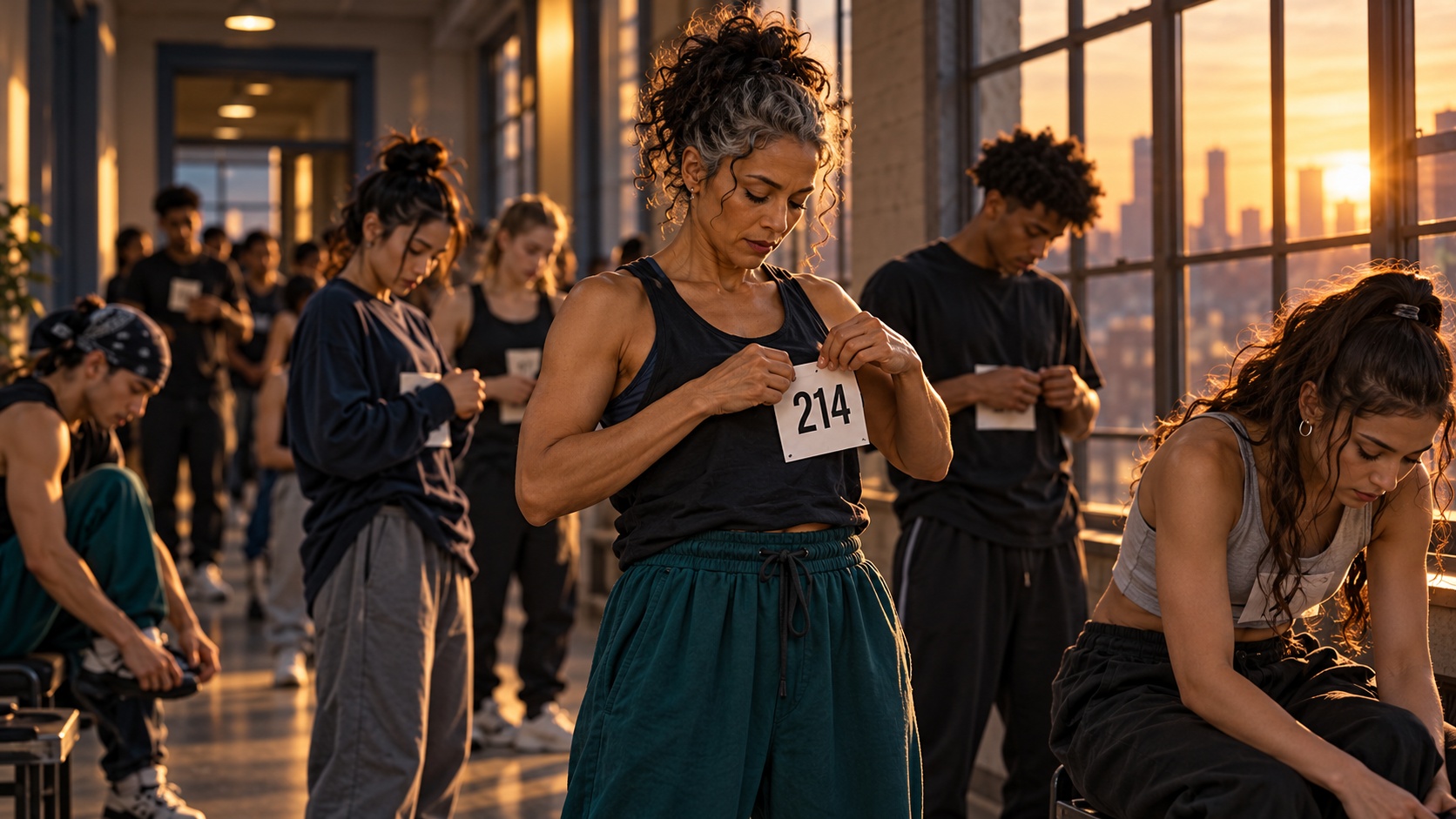
Illustration: Dance Mogul Magazine. Characters are fictional.
Three Truths That Get Mixed Up
When a dancer asks “Am I too old?” three different things are usually tangled together. Pull them apart and the answer gets much clearer.
1. The body changes. That part is real.
Recovery takes longer. Old injuries talk louder. The U.S. Bureau of Labor Statistics states plainly that dancers have one of the highest rates of injuries and illnesses of any occupation, and that part-time work is common in the field (BLS Occupational Outlook Handbook). Explosive power moves may require more deliberate conditioning and recovery as dancers age, but physical capacity varies widely from person to person. Training choices and injury prevention matter; they do not justify treating every older performer as less capable.
Crazy Smooth, the Canadian b-boy who founded the street-dance company Bboyizm in 2004, has spoken about this openly. In a 2022 interview with Canada’s National Arts Centre, he described the body’s timeline as fixed even when the spirit stays young, and referred to his own four knee operations.

Illustration: Dance Mogul Magazine. Characters are fictional.
2. Industry ageism is also real. And it isn’t about ability.
Many casting calls are built around a look, not a skill set. Commercial work, music videos and some company auditions often favor youth because a client wants a certain image, not because older dancers can’t execute the choreography. That is a business decision, and it can shut out qualified people.
There is some measurable movement. In April 2025, Actors’ Equity Association published its Hiring Bias and Wage Gap report on theatre contracts in 2022 and 2023, and said actors and stage managers over 45 saw 1.18% more contracts than during 2016–2019 (Actors’ Equity). That covers theatre broadly, not dance alone, and it is a small change. It does show the industry is tracking age, which means age is part of the hiring conversation whether anyone says it out loud or not.
Researchers have pushed further. A 2022 study in Frontiers in Sports and Active Living followed six Canadian contemporary dancers aged 42 to 65 who rehearsed for about nine months and performed together in Edmonton. The authors connect early retirement in dance to cultural ideals of young, thin bodies. The dancers’ own first fears were weight, injury and being judged on stage. Through the work, they began treating adapted movement as an artistic choice rather than a limitation (Markula et al., 2022). It is a small study, and the authors say so, but it names something many dancers feel: part of “too old” is a story the culture tells.
3. Careers evolve. That is not the same as ending.
The BLS notes that some dancers become choreographers or dance teachers, and that choreographers typically begin their careers as dancers. A dance career is not one job. It is a set of skills: movement, musicality, leadership, teaching, storytelling and discipline. Those skills can earn a living long after a dancer stops taking every audition.
“there’s no substitute for experience.”
— Crazy Smooth, founder of Bboyizm, to Canada’s National Arts Centre, 2022
By the Numbers
Passion tells you to keep going. Numbers tell you how to plan. Here is what the data says about the length of a performing career, and about the dancers who kept performing well past the point the industry expects.
~34 yrs
Average age dancers stopped performing
Australia, Switzerland and U.S., 2004 study
That figure comes from Making Changes, a 2004 study of dancers in Australia, Switzerland and the United States by economists William Baumol and David Throsby and arts researcher Joan Jeffri. Dancers in those countries expected to keep performing into their late thirties; on average they stopped a little before 34 (Making Changes executive summary). In Canada, the Dancer Transition Resource Centre reported an average transition age of 36. The study is more than 20 years old and measured professional dancers in three countries; street and commercial careers may follow different patterns. But it makes the point every young dancer needs to hear early: a performing career is often shorter than the dream assumes.
Now look at who is still performing. Each bar below shows the age range of a working group of dancers, drawn to scale from age 0 to 90. Every one of them begins after 34, or stretches far past it.
Age ranges of working dance groups · bars drawn to scale (0–90) · gold line = age 34
New York Liberty Timeless Torches prior season (reported 2025)
42 to 87
Golden State Warriors Hardwood Classics 2023 squad (NPR)
55 to 77
Stayin’ Alive Crew, Atlanta 2025 (Atlanta Journal-Constitution)
50 to 74
Contemporary cast, Edmonton study 2015 performance (Frontiers, 2022)
42 to 65
In My Body cast, Bboyizm 2022 run (National Arts Centre)
early 20s to 57
Ranges as reported by the named source in the year shown; memberships change every season. The In My Body range runs from dancers in their early twenties to its oldest dancer, 57, at the time of the 2022 run. These are performing groups, not proof that every member is paid; see the case files below.
And the money: the BLS puts the May 2025 median pay for U.S. dancers at $24.80 an hour, and choreographers at $26.59. There were about 18,600 dancer and choreographer jobs in 2025, with employment projected to grow just 2% through 2035 and about 2,200 openings a year, most of them created when people leave the field (BLS). Those are national, all-ages figures. They are not earnings for older dancers specifically. They describe a small, competitive field where hourly pay matters less than how many hours you can actually book.
Who Is Still Working, and How
These are documented cases, not slogans. Each one shows a different way dancers have kept performing as they age, and each one has limits worth knowing.
Case File 01
In My Body — Crazy Smooth and Bboyizm
The lesson: the pioneers of street dance are now the first generation to age inside it. They are not hiding it. They made it the show.
Source: Southbank Centre; National Arts Centre; DanceHouse
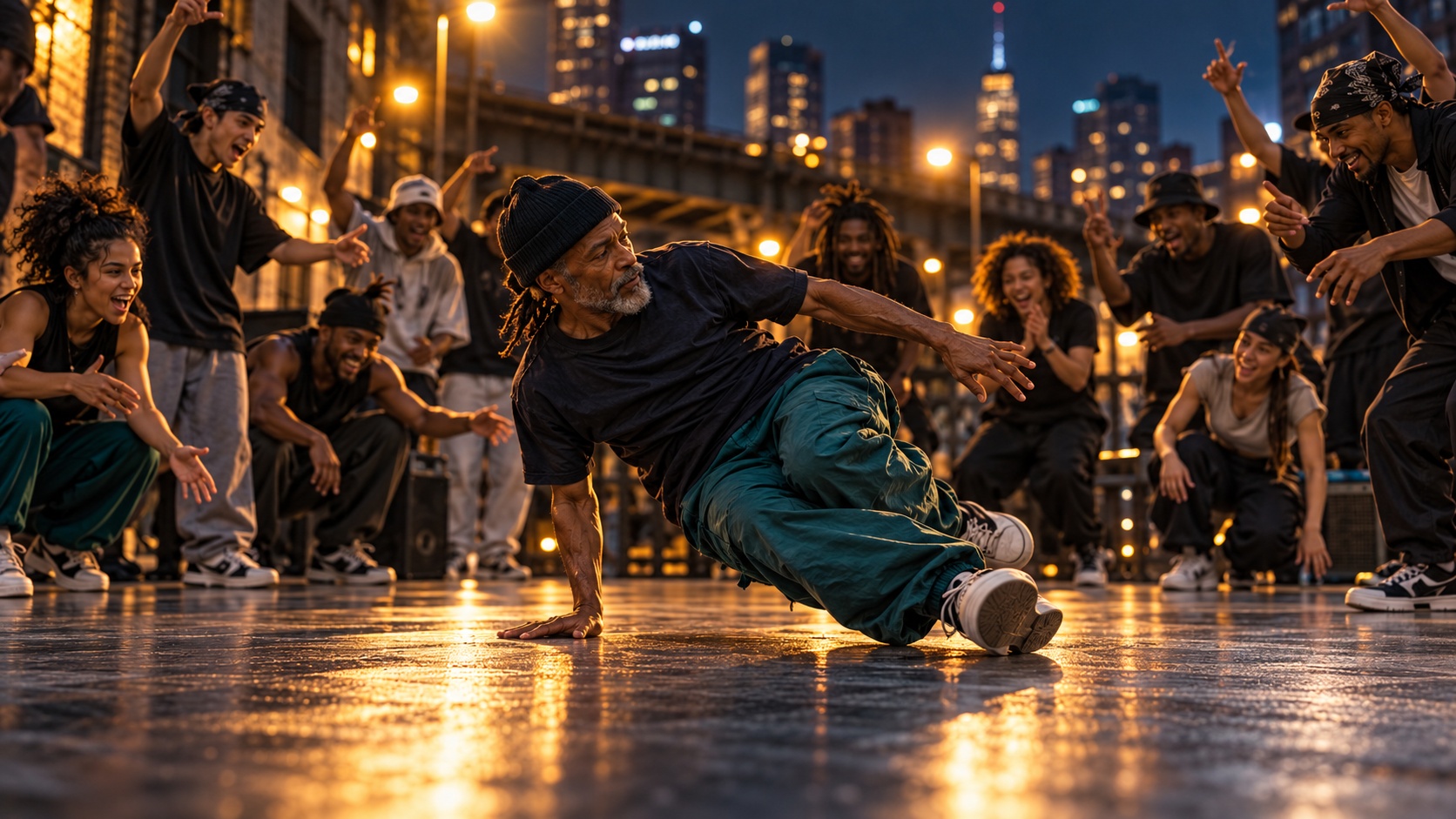
Illustration: Dance Mogul Magazine. Characters are fictional.
Case File 02
DANCE ON ENSEMBLE — Berlin
The lesson: when an institution decides older dancers are worth building around, world-class artists show up to create for them.
Source: Onassis Foundation
Case File 03
New York Liberty Timeless Torches — WNBA
The lesson: this is one of the clearest documented cases of an organization holding real auditions and paying dancers over 40.
“Just because you’re a certain age, life doesn’t end.”
— Margaret Hamilton, Timeless Torches team captain, to Gothamist, 2025
Case File 04
Golden State Warriors Hardwood Classics — NBA
The lesson: real auditions, real rehearsals and real arena crowds exist after 55. Whether a booking is a paycheck is a separate question to ask every time.
Source: NPR, 2023; San Francisco Standard, 2026
“You can continue pursuing your dreams.”
— Tracy Perrilliat, Hardwood Classics dancer, to the San Francisco Standard, 2026
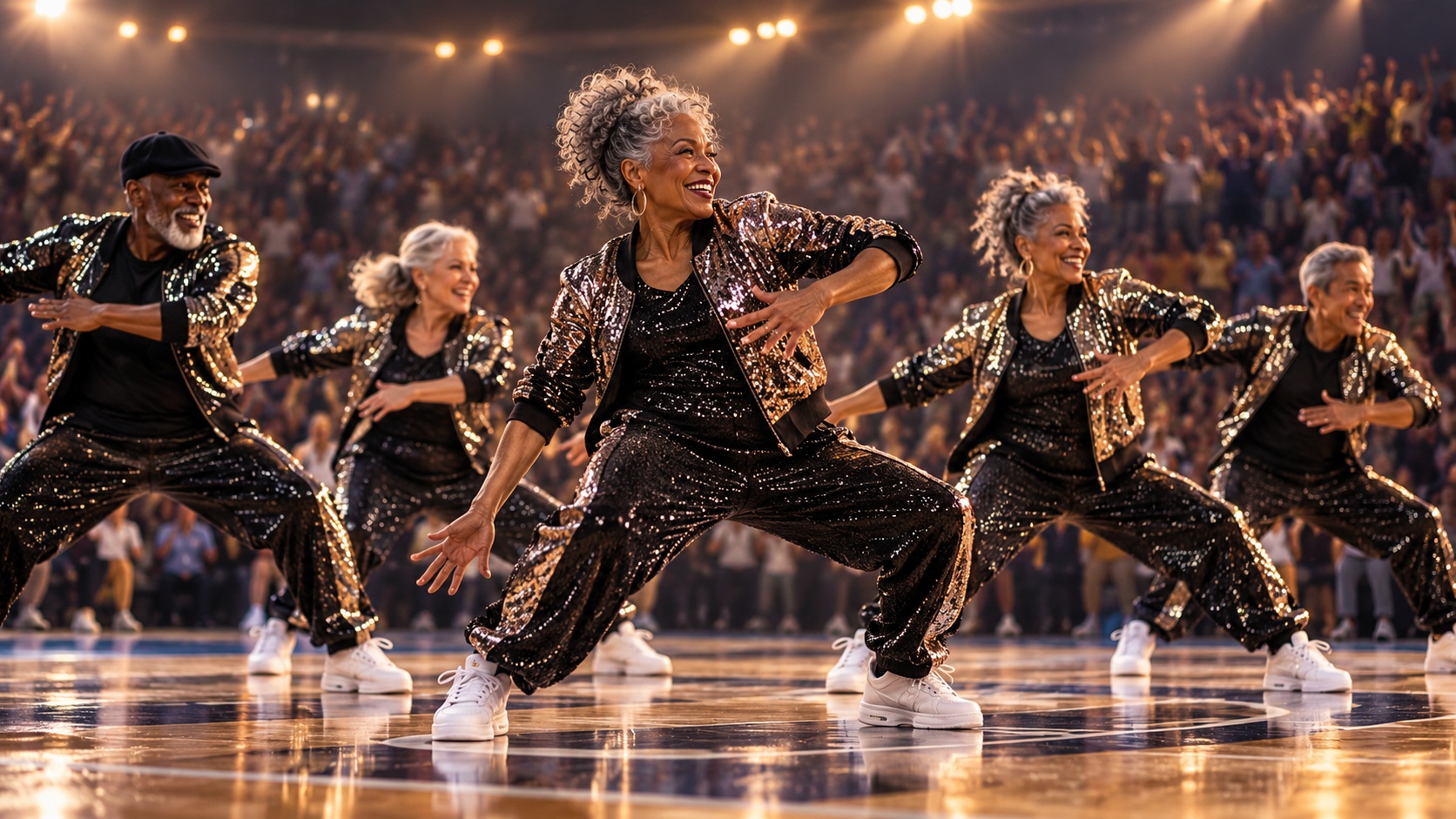
Illustration: Dance Mogul Magazine. Characters are fictional.
Case File 05
Stayin’ Alive Crew — Atlanta
The lesson: high-profile stages are open after 50. Many senior groups are community nonprofits, which is a joy, not a salary. Know which one you are joining.
Source: Atlanta Journal-Constitution, Dec. 2025; KWHI, Nov. 2025
Case File 06
Jay Day — Harlem Breeze Team, Times Square
The lesson: some dancers never wait to be cast. They build their own stage, their own crew and their own income, and they become mentors in the process.
Source: amNY, Mar. 2026
“I make a living off it.”
— Jay Day, 56, founder of the Harlem Breeze Team, to amNY, 2026
The Hard Part: Admiration Is Not Employment
Here is the uncomfortable truth these stories can hide. A viral video of an 80-year-old dancer gets millions of likes. That is admiration. It is not the same as a qualified 50-year-old dancer being able to pay rent from dance work.
Senior dance teams are wonderful, and some pay. But many are community groups, many are tied to a single franchise, and none of them fixes age bias in mainstream casting. Celebrating older performers on social media can make the industry feel inclusive while the actual hiring pipeline for commercials, tours and company contracts barely changes.
DMM’s position is straightforward: the measure of progress is paid opportunity. Not applause, not views, not a feel-good segment. When readers see a senior dance story, the next question should always be: Were they paid, and could someone build a living on this?
Career Longevity Is Bigger Than Performance Longevity
Some of the most powerful careers in dance kept growing after the performing years changed shape. Debbie Allen, the dancer, choreographer and director who founded the Debbie Allen Dance Academy in 2001 and has been an executive producer of Grey’s Anatomy since 2015, directed the 2026 Broadway revival of August Wilson’s Joe Turner’s Come and Gone, starring Taraji P. Henson and Cedric the Entertainer. The production received five Tony nominations (Tony Awards; Broadway News; NY1). Her dance training became leadership, and leadership gave her a career with no expiration date.
Then there are the dancers who simply refuse to stop. Toni Basil, the pioneering choreographer whose work helped carry locking and street dance onto screens worldwide, was still judging street-dance competitions and teaching classes at 80, according to a 2024 profile in The Telegraph (The Telegraph).
“I’ll never stop dancing if I can help it.”
— Toni Basil, to The Telegraph, 2024
DMM’s own archive is full of these turns. Nasha Thomas carried the Alvin Ailey stage into arts education for young people. Desmond Richardson went from the house parties of Queens to American Ballet Theatre and co-founded his own company, Complexions. The Wondertwins turned decades of performing into productions of their own, such as To Hip-Hop, With Love. Not one of them had only one way to be in the room.
A caution belongs here. Teaching and directing are not a consolation prize, and they are not the only acceptable path. Some dancers want to keep performing, and that desire deserves to be taken seriously. The goal is choice, not a polite push toward the exit.
Your Dance Career at Every Age
This is DMM’s map, built from the research above and from decades in dance culture. It is guidance, not a rule. Every body and every style is different, but every stage has work to do.
A Dancer’s Career Map — DMM Guidance
Teens — Train widely, not just hard. Learn more than one style. Take care of injuries the first time, not the third. Notice whether you like teaching younger kids or making up choreography; those are early signs of future income. Start a simple record of every performance and credit.
20s — Perform as much as you can, and take every audition you are ready for. Save something from every check, even a small amount. Learn contracts, invoices and taxes. Build a reputation as reliable. Start teaching or assisting a choreographer on the side so the skill is ready later.
30s — This is the decade the 2004 study points to as the average performing turn. Don’t panic; prepare. Pick one or two directions to grow: choreography, teaching, directing, production, judging, health and fitness, or business. Get any certification or schooling you need while you are still earning from performing.
40s — Specialize in what experience makes you better at: musicality, character, leadership, coaching, creating. Seek out age-inclusive companies, productions and teams. Build a body of your own work. Mentor; it builds your network as much as theirs.
50s and beyond — Perform on your own terms, in styles that fit your body, in groups that value you, and ask about pay every time. Pass on what you know through teaching, archives and interviews. Your history is a professional asset; document it.
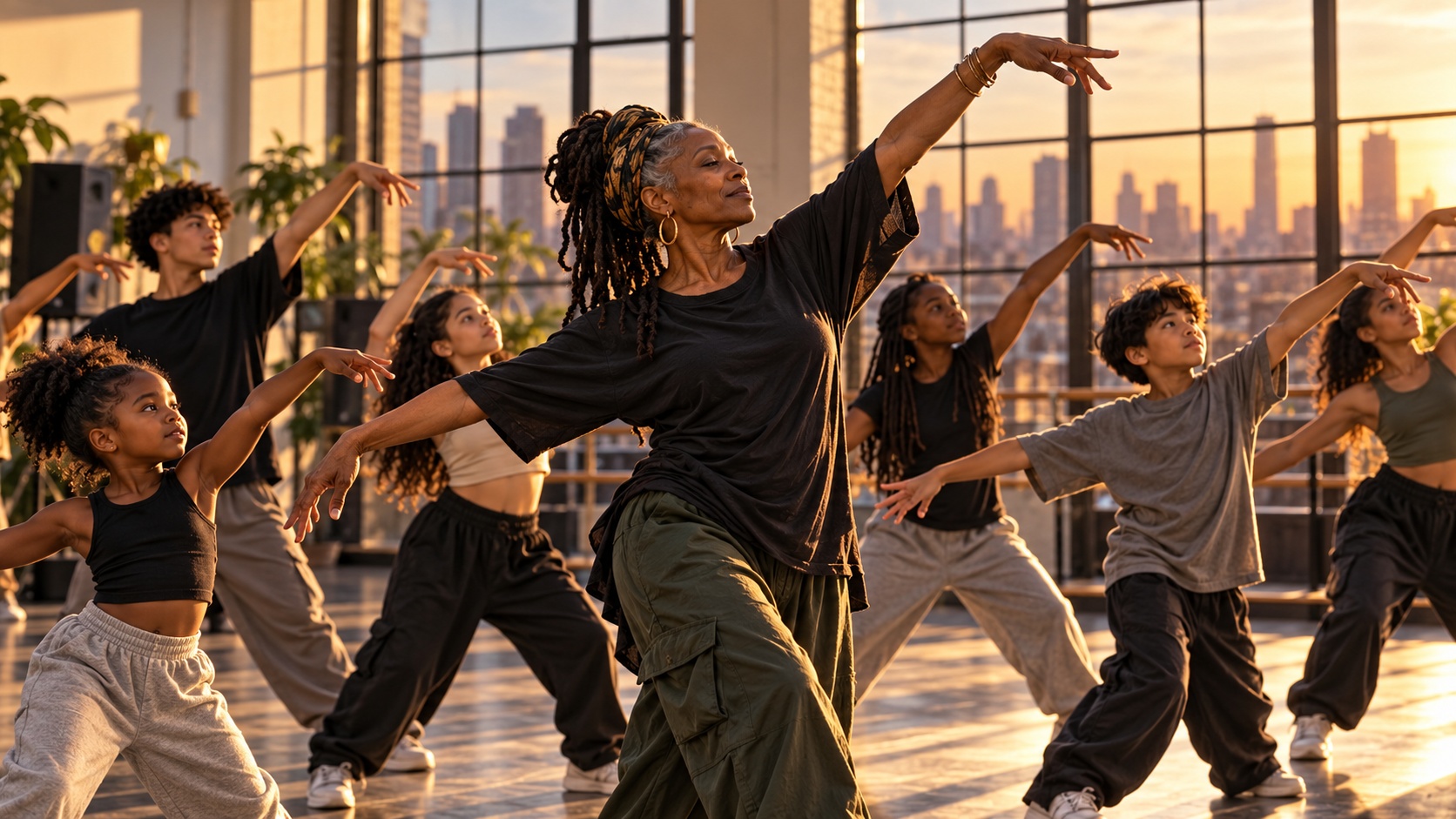
Illustration: Dance Mogul Magazine. Characters are fictional.
For young dancers: see the whole dream
Your passion is real, and it is your fuel. But the dream is bigger than the stage. It includes your body at 40, your bank account at 50 and the person you want to be when the music changes. The dancers who last are the ones who learn early that performing is one room in a very large house. Walk through the other doors while you are young, and you will never be trapped.
For experienced dancers: name your options
If the auditions have slowed, write down every way you could still work in dance. You will likely find more paths than you expected:
- Performing with age-inclusive companies, productions and senior dance teams
- Self-produced work: street performance, showcases, your own production or tour
- Teaching: studios, schools, community centers, master classes, online classes
- Choreographing for schools, theatre, competitions, music artists and events
- Directing, rehearsal directing and creative directing
- Judging battles and competitions; hosting and emceeing
- Studio ownership and dance business
- Arts administration, programming and producing
- Dance fitness, movement coaching and wellness work
- Archiving and sharing culture: interviews, lectures, documentaries and books

Illustration: Dance Mogul Magazine. Characters are fictional.
The Plan: Five Steps to Stay in Dance on Your Terms
Run an honest body audit. Separate what your body truly can’t do anymore from what you’ve been told you shouldn’t do at your age. See a dance-medicine or sports-medicine professional, adjust training for recovery, and choose styles and roles that use your strengths.
Build income that doesn’t depend on auditions. Teaching, choreography, workshops and private coaching smooth out the gaps between bookings. The BLS notes part-time work is common in dance; plan around it instead of hoping it changes.
Document your career. Keep a current résumé, reel, credits list and press file. Experience only counts in a hiring room if someone can see it.
Use transition help before you need it. In Making Changes, dancers who understood transition challenges early were more likely to report higher incomes afterward, and most dancers had never used available transition programs. Almost 30% earned less after leaving the stage, and U.S. retraining averaged about $27,000 in 2004 dollars, mostly paid out of pocket. Start early and use the free help that exists.
Decide what “still dancing” means to you. Performing every week? Teaching full time? Creating one show a year? Write it down. A clear definition turns a fear into a plan.
For employers, casting directors and promoters
Ageism lives in the brief before it lives in the room. If an older dancer can do the choreography and carry the story, the casting call shouldn’t screen them out with an age range nobody can justify. Write breakdowns around skills, not birth years. Pay senior performers the same rates as everyone else. And when you book a senior team for a feel-good moment, make sure the dancers are paid like professionals, because they are.
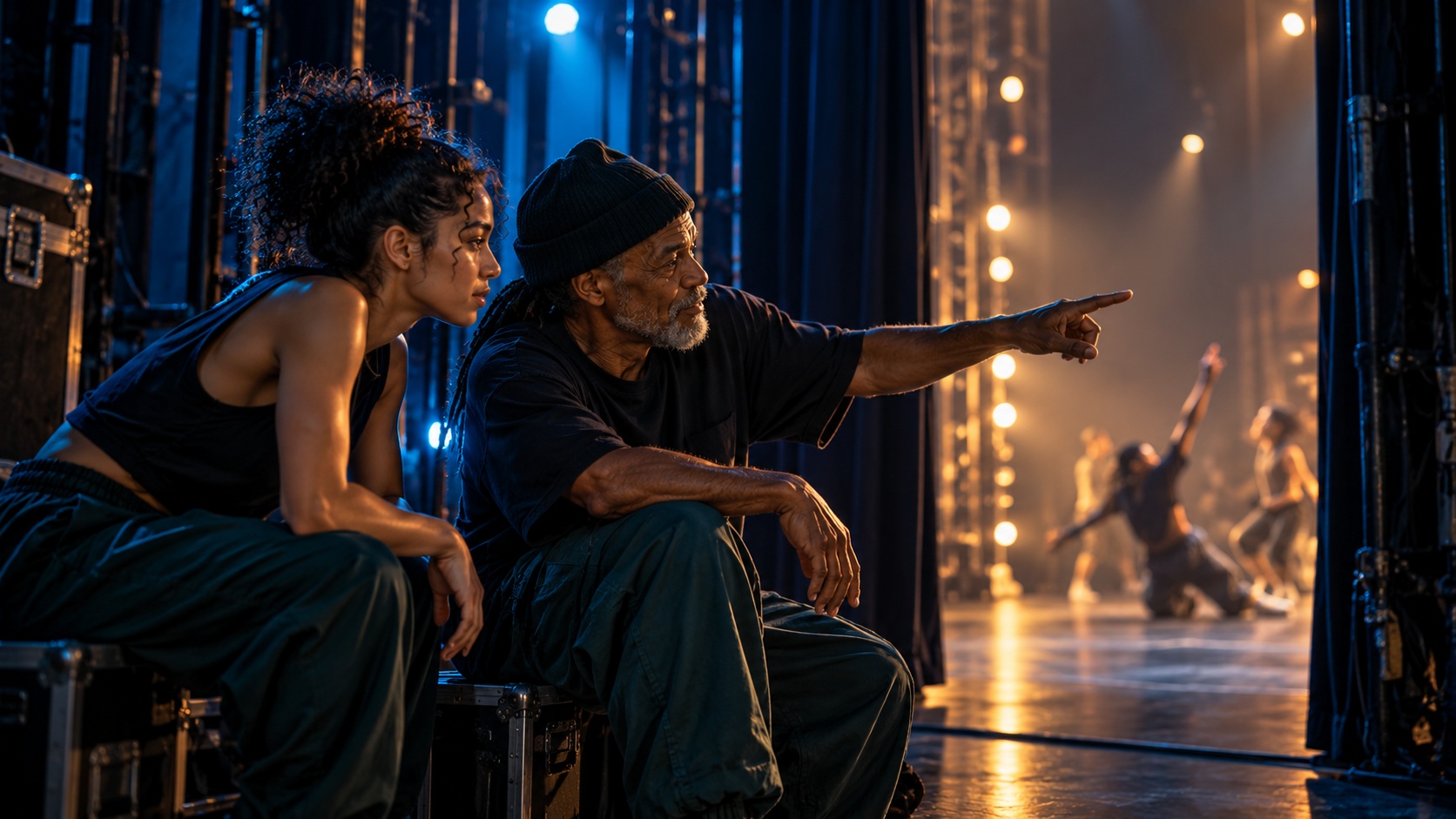
Illustration: Dance Mogul Magazine. Characters are fictional.
Resources for Every Stage
• Career Transition For Dancers — Entertainment Community Fund — Career counseling, scholarships, seminars and webinars for current and former dancers, plus The Dancers’ Resource for financial assistance and mental health support. Offices serve the Eastern, Central and Western U.S.
• Dancers Over 40, Inc. — A nonprofit that celebrates and supports mature dancers, with events, a member directory and “Cast Us! Hire Us!” listings for casting directors.
• Harkness Center for Dance Injuries, NYU Langone — Dance-specific injury care, physical therapy and injury-prevention workshops, with some subsidized and free services.
• International Organization for the Transition of Professional Dancers (IOTPD) — Connects dancer transition programs around the world, including Canada’s Dancer Transition Resource Centre.
• U.S. Bureau of Labor Statistics: Dancers and Choreographers — Current national pay, job outlook and work conditions.
• Still Moving by Sonia York-Pryce — A book of conversations with twenty senior professional dancers from five regions who are still performing.
Tell Us Your Story
DMM wants to hear from dancers at every age. Your experience could help someone who is quietly asking the same question.
• When did you first feel age affect your bookings?
• What did you wish someone had told you at 20?
• What new path did dance open for you after performing changed?
• If you hire dancers, what would make casting fairer?
Share your story through our contact page.
Why This Matters to Dance Mogul Magazine
Dance Mogul Magazine was built on lived experience. Our roots are in street dance, where the pioneers are now in their fifties, sixties and seventies, and where many of the people who created a global culture never had a retirement plan, a pension or a roadmap. We have watched great dancers disappear from view not because their talent ended, but because no one told them where else their talent could go.
That is why The Elephant in the Room exists: to say out loud what dancers whisper, and to always leave readers with a way forward. Our editorial question for every story is how it helps someone become a better version of themselves. For this one the answer is clarity. A young dancer who sees the whole map makes better choices. An experienced dancer who sees every option stops feeling like a failure and starts acting like what they are: a professional with decades of value.
Dance is the foundation. A life in dance is the goal.
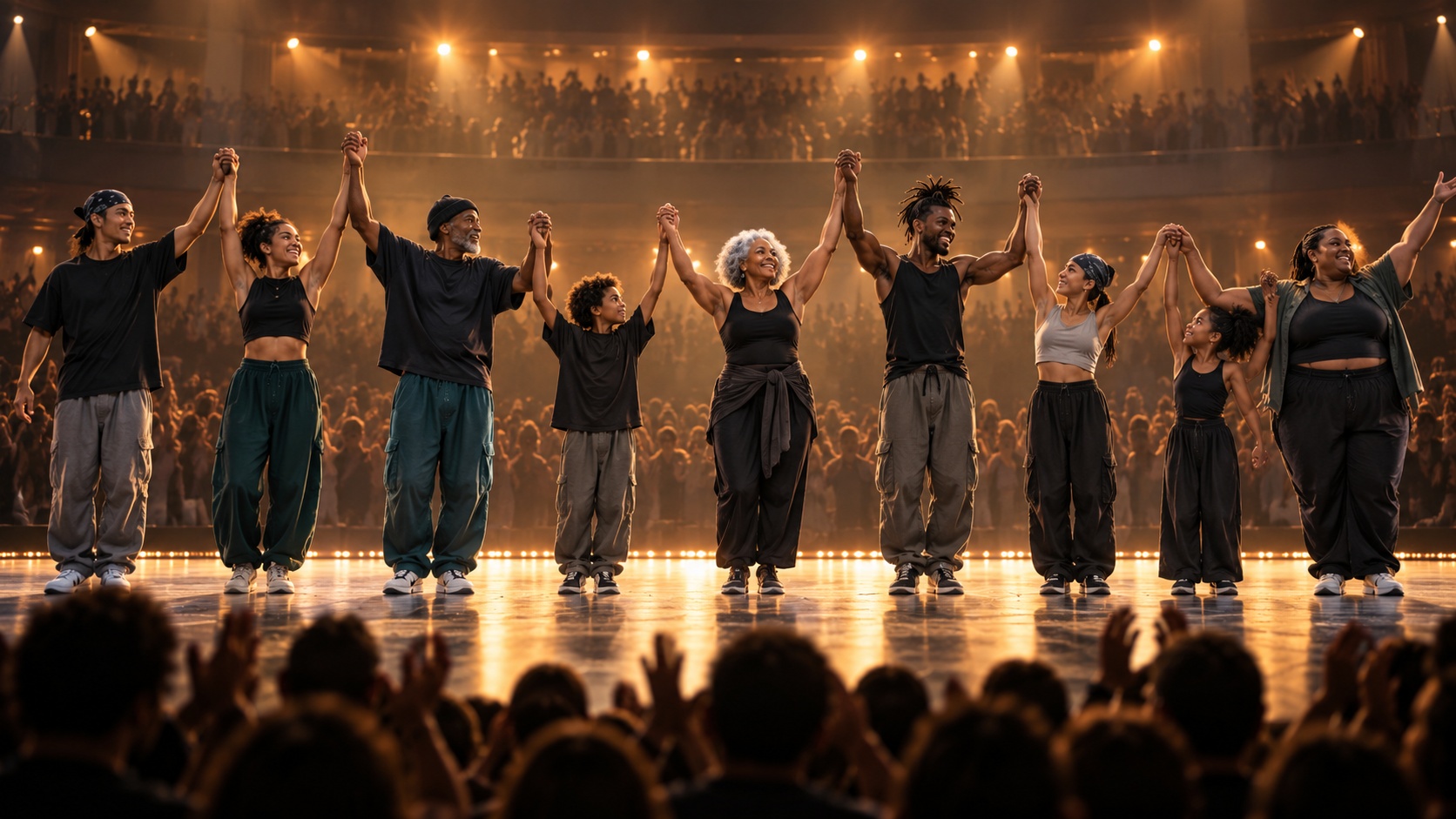
Illustration: Dance Mogul Magazine. Characters are fictional.
Frequently Asked Questions
Am I too old to dance professionally?
Not automatically. Age closes some doors, especially youth-focused commercial and company auditions, but paid and professional work exists after 40 and after 50. Examples include the New York Liberty’s Timeless Torches (40 and over), the Golden State Warriors’ Hardwood Classics (55 and over), the DANCE ON ENSEMBLE (40 and over), multigenerational street-dance productions such as Bboyizm’s In My Body, and self-produced street performance. The bigger question is which kind of dance work you want and whether you have more than one path to it.
At what age do most dancers stop performing?
There is no official retirement age. A 2004 study of dancers in Australia, Switzerland and the United States, Making Changes by William Baumol, Joan Jeffri and David Throsby, found the average age at which dancers stopped performing was a little under 34, while most had expected to keep going into their late thirties. In Canada the Dancer Transition Resource Centre reported an average transition age of 36. These figures are dated and vary by style; street dancers, teachers and choreographers often work much longer.
Do older dancers actually get paid?
Some do. A New York Liberty representative told Women’s Health in 2025 that the Timeless Torches are a professional team paid for rehearsals, performances and appearances, without disclosing rates. Street performers such as Jay Day of the Harlem Breeze Team say they make a living from performing. Other senior groups are nonprofits whose members pay for their own costumes. Always ask about pay before you accept a booking.
What jobs can a dancer move into after performing?
The U.S. Bureau of Labor Statistics notes that some dancers become choreographers or dance teachers, and choreographers typically begin as dancers. Other paths include directing, rehearsal direction, judging, studio ownership, arts administration, dance fitness, dance medicine and therapy fields, content production and producing your own shows. These paths can diversify income and extend a career, although compensation and stability vary by role and location.
What should a young dancer do now to plan for later?
Train for longevity, not just for this season: take care of injuries early, learn more than one style, learn to teach and to choreograph, save part of every check, keep records of your work, and learn the business side such as contracts, grants and self-promotion. Research shows dancers who understood transition challenges early were more likely to report higher incomes afterward.
Where can dancers get career transition help?
In the U.S., the Entertainment Community Fund runs Career Transition For Dancers, with career counseling, scholarships and seminars, plus The Dancers’ Resource for financial assistance and mental health support. Dancers Over 40, Inc. connects mature dancers with community and casting listings. The Harkness Center for Dance Injuries at NYU Langone offers some subsidized and free services. Outside the U.S., the International Organization for the Transition of Professional Dancers (IOTPD) connects national programs.
Continue Your Journey
• I Wanted to See You Win — An honest look at envy, support and success in dance culture
• Toni Basil — A pioneer who never stopped dancing
• Nasha Thomas — From the Ailey stage to shaping young lives
• Desmond Richardson — From Queens house parties to American Ballet Theatre
• The Wondertwins — Decades of performing and creating
• Dance Creating Stability — How dancers build financial and creative independence
• The Legacy — DMM’s archive of the artists who built dance culture
• Join the Dance Mogul Community — Connect with the global dance community
Sources: U.S. Bureau of Labor Statistics, Occupational Outlook Handbook (May 2025 pay, 2025–35 projections); Baumol, Jeffri & Throsby, Making Changes (aDvANCE Project, 2004); Actors’ Equity Association (Apr. 9, 2025); Markula et al., Frontiers in Sports and Active Living (2022); National Arts Centre (2022); Southbank Centre (2024); DanceHouse (2023); Onassis Foundation; Gothamist (Apr. 16, 2025); Women’s Health (Jul. 16, 2025); NPR (May 10, 2023); San Francisco Standard (Apr. 14, 2026); Atlanta Journal-Constitution (Dec. 22, 2025); KWHI (Nov. 12, 2025); amNY (Mar. 21, 2026); Tony Awards (2026); Broadway News (Apr. 15, 2026); NY1 (May 16, 2026); The Telegraph (Apr. 27, 2024). Figures are as reported on those dates; checked October 26, 2026.
© 2026 Dance Mogul Magazine LLC | dancemogul.com | Inspiring Self-Empowerment Through Dance Culture