Dance Mogul Magazine · Culture · DWTS Season 35
Ezra Frech, Disability Representation and the Art of Adaptive Dance
Ezra Frech is changing what audiences understand about dance and disability: one running blade, one perfect jive and one word chosen with care.
November 18, 2026 · Dance Mogul Magazine
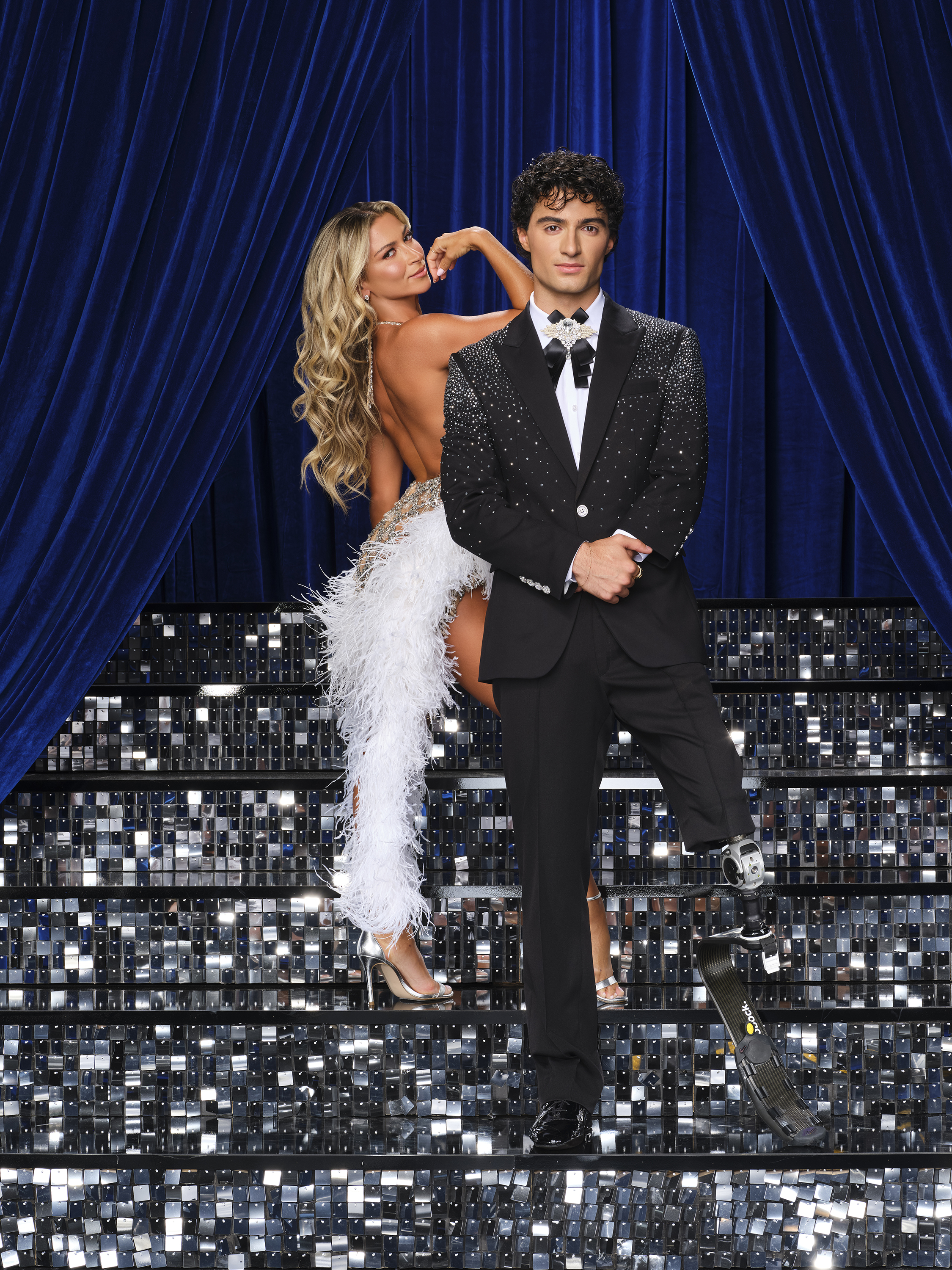
The jive ended, the judges held up three 10s, and Bruno Tonioli was on his feet declaring that a star was born. It was Ezra Frech’s first perfect score of the season, in the semifinals of Dancing with the Stars, for a jive to Kenny Loggins’ “Footloose.” Then co-host Julianne Hough, warm and plainly moved, told him he was an inspiration to the “differently abled community.”
Frech smiled, called the moment the honor of a lifetime, and thanked the “disabled community” for its support. He did not stop to explain the swap. He simply used the word he uses for himself. Entertainment Weekly called it a subtle correction and noted that he did not appear bothered. Many viewers who live with disability heard it at once.
That exchange, a few seconds long, captures what Frech has done all season: he has made the ballroom adjust to the way he moves and the way he names himself, without asking anyone to treat him as an exception.
An Athlete Who Became a Dancer
Frech arrived as a two-time Paralympic gold medalist from the Paris 2024 Games, a USC student and, by USC Annenberg Media’s account, the first above-the-knee amputee to join a Division I track and field program. Sports Illustrated reports that he was born without a left knee or fibula and without four fingers on his left hand. He arrived, in his own description, as a near-blank slate in ballroom.
His record since then is one of steady construction: a 20/30 tango at the premiere, 21s in the next two weeks, a 24/30 rumba on Mariah Carey Night, then a run of 36, 37, 35 and 37 out of 40, including a salsa that tied for the top score on Super Bowl Night. On Grammy Night he lost a rumba dance-off to Amber Glenn and still advanced. In the semifinals he scored 27 for a quickstep and 30 for the jive. He and Daniella Karagach were the other couple still waiting when the result was announced; the show does not publish the vote order, so that does not show where they ranked. They advanced to the finale.
Choreography Built Around the Dancer
The most important decision of Frech’s season was made before the premiere. He expected to dance on his walking prosthesis, which is more stable and has a foot that fits inside a ballroom shoe. Instead he chose his running blade, the one he wore to win in Paris. On the walking leg, he told Sports Illustrated, his range of movement on the floor dropped by about half, and he did not feel like the same dancer.
The blade is a trade. It lets him travel freely, but only a few centimeters of it touch the floor, so a misstep can mean a fall, and his technical adviser, a fellow above-the-knee amputee, warned him about the risk. The blade also stores and returns energy, which can turn a powerful ballroom step choppy; Frech said he is learning to absorb that force through his hip and his right leg.
Karagach’s method answers that trade one week at a time. She starts each routine with movement: side steps, shifts and progressions, noting which look smooth and which look clunky, then builds the choreography around what works. In the premiere tango his knee buckled on forward steps, so she turned the travel onto diagonals. In the foxtrot, his rises and falls had to land on planned sides, a problem she told Sports Illustrated she had never faced. Frech describes these as tweaks that make a step look effortless, not limits on what he can do. Their rehearsals were physical, too: his prosthetic left bruises on her legs, and he credits the trust they built through those sessions.
Know the Form: Adaptive Choreography
Adaptive choreography is not simplified choreography. It starts from how a particular body receives weight, stores and releases energy, balances and travels, and builds recognizable technique from those mechanics. The goal is the same as any good teaching: make the dancer look like the best version of themselves, not like a copy of someone else.
Showing the Prosthetic, Not Hiding It
Frech and Karagach decided early that his prosthetic would be part of the picture, not something to disguise. Karagach told Extra they feature it in every routine because it makes a striking shape on the floor; on Super Bowl Night, at his request, it was decorated to match his costume. Frech described the prosthetic as technology he uses every day and said he hopes other people with prosthetics will decorate theirs too.
He has also placed himself in a lineage. Paralympian Amy Purdy, the Season 18 runner-up with Derek Hough in 2014, told People in October that Frech is taking disability representation further than she felt able to; Frech credited the disabled contestants before him with making his season possible and said that normalizing disability matters more than treating it as an exception. To USC Annenberg Media he said the most rewarding part of the season has been the support from disabled viewers online, including children with limb differences and girls who dance in wheelchairs.
Inside the Performance: Music, Movement and Meaning
Inside the Performance: Five Elements
Music
“Footloose” is the 1984 title song of a film about a town that bans dancing, and Loggins’ rock-and-roll drive sits squarely in the jive’s swing-era roots. Its relentless tempo leaves no room to recover between figures. For a dancer whose story is about being let onto the floor on his own terms, the song choice carried its own meaning.
Movement
The jive runs on kicks and flicks from the knee, bounced triple steps and constant speed. The judges praised the control inside that speed: Carrie Ann Inaba called it controlled yet dynamic, and Tonioli said he outshone the original. One reasonable reading of the routine, DMM’s analysis rather than a description of their rehearsals, is that the blade’s stored energy, a problem in slow ballroom, becomes an asset in a dance built on rebound.
Atmosphere
Three 10s; Tonioli standing; Derek Hough moved by the performance. It came after a 27/30 quickstep in the first round, in a semifinal where four of six couples earned at least one perfect score.
Human significance
Frech has described dancing as the chance to commit fully to a demanding art form and to learn from one of the best dancers in the world. The perfect score is the result of a season of that commitment, built step by step with Karagach.
Reader takeaway
Performance quality is produced, not bestowed. Teaching, trial and error, trust between partners and a willingness to change the plan made this jive possible. Anyone learning a skill in a body or circumstance the instructions were not written for can use the same method.
What to Watch For
Watch the speed of the triple steps and how Frech keeps them on the beat, then watch the kicks: power from the hip, released cleanly, and recovered without a stutter. Notice how often the choreography travels sideways and on diagonals, and how Karagach shares the rhythm with him rather than dancing around him.
The first round: a quickstep under pressure
What to Watch For
The quickstep asks for the opposite discipline: a quiet, closed frame over fast traveling feet. Tonioli praised the difficulty of the choreography and Inaba asked for more control. Watch where the routine travels and where it holds, and compare the frame with the jive’s open, rhythmic play.
Why One Word Mattered
Hough’s phrase was meant kindly, and the exchange was warm on both sides. But “differently abled” is one of several euphemisms that many disability advocates ask people to retire. The National Education Association’s language guide encourages the plain words “disabled” and “disability,” and the ADA National Network’s writing guidelines call terms like “differently-abled” condescending. The objection is not to kindness; it is to the idea, carried by the euphemism, that disability is something to soften or hide.
Language preferences still vary. Some people prefer “person with a disability”; others, as an expression of identity and pride, prefer “disabled person.” The guidance that runs through every source is the simplest: follow the person’s lead. Frech’s lead has been consistent all season. After the premiere he said it meant the world to represent the “disabled community” on such a stage; in the semifinals he used the same words again.
“Means the world to get to represent the disabled community…”
— Ezra Frech, after the Season 35 premiere (as reported by EntertainmentNow, September 2026)
DMM Dance Lens
DMM has tracked Frech since the premiere with one question: could athletic power become continuous, rhythmic dancing? The jive is the clearest answer yet. The language moment and the choreography are the same story told twice. Inclusion means making room for different ways of moving, teaching, speaking and identifying, not expecting everyone to conform to a single standard.
What We Can Take Away
Inspiration is a lazy word for what Frech has done. He did not succeed by overcoming a body; he succeeded by working with it, alongside a teacher willing to rebuild her method every week. That is a lesson for any classroom, studio or workplace: the standard should be excellence, and the path to it can be designed around the person.
And when someone tells you the word they use for themselves, use it. Frech showed how to make that correction with grace. The rest of us can make it unnecessary.
What Comes Next
Frech and Karagach are one of five couples in the Season 35 finale on Tuesday, November 24, from 8 to 11 p.m. ET, the first DWTS finale to air live in every U.S. time zone. TheWrap reports three rounds per couple: a judges’ choice dance, the instant dance challenge and a freestyle. The instant dance will test the method above under the hardest condition yet, almost no time to adapt. The freestyle will ask what the partnership wants to say when no single style sets the rules. Songs and styles had not been announced when this article was published.
Continue Exploring Dance Mogul Magazine
Ezra Frech’s reply on disability language in the DMM Newsroom →
DWTS Semifinals 2026 results: every score and all 12 songs and dances →
Ezra Frech and Daniella Karagach’s full season on the Live Dashboard →
How to watch and vote in the finale →
Dedication Night 2026: songs, dances and tributes →
Sources & Attribution
The semifinal exchange and the result announcement: Entertainment Weekly, November 17, 2026. Scores and judges’ comments: ABC7/On The Red Carpet, November 18; TheWrap, November 17.
Blade, walking leg and choreography: Sports Illustrated, October 6, 2026; USC Annenberg Media, September 29. Prosthetic on display: EntertainmentNow, October 14. Premiere remarks: EntertainmentNow, September 2026. Amy Purdy: People, October 4. Paralympic record: International Paralympic Committee, September 24; ABC/Disney Television Press biography.
Language guidance: National Education Association, “Words Matter! Disability Language Etiquette”; ADA National Network, Guidelines for Writing About People with Disabilities. Season scores: DMM’s Season 35 Live Dashboard. Videos: Dancing with the Stars official YouTube channel. Analysis is original DMM editorial; no rehearsal access is claimed.
© 2026 Dance Mogul Magazine LLC · Inspiring Self-Empowerment Through Dance Culture
Dancing with the Stars is a trademark of its owner. Dance Mogul Magazine is an independent publication and is not affiliated with ABC or Disney.