Dance Mogul Magazine · Culture · DWTS Season 35
Tatyana Ali on DWTS: Healing Through Dance After Childbirth Trauma
In the semifinals, Tatyana Ali connected her rehearsals to the birth of her first son ten years ago. Her story is about being heard, being cared for, and finding something in movement she did not expect.
November 18, 2026 · Dance Mogul Magazine
The Short Version
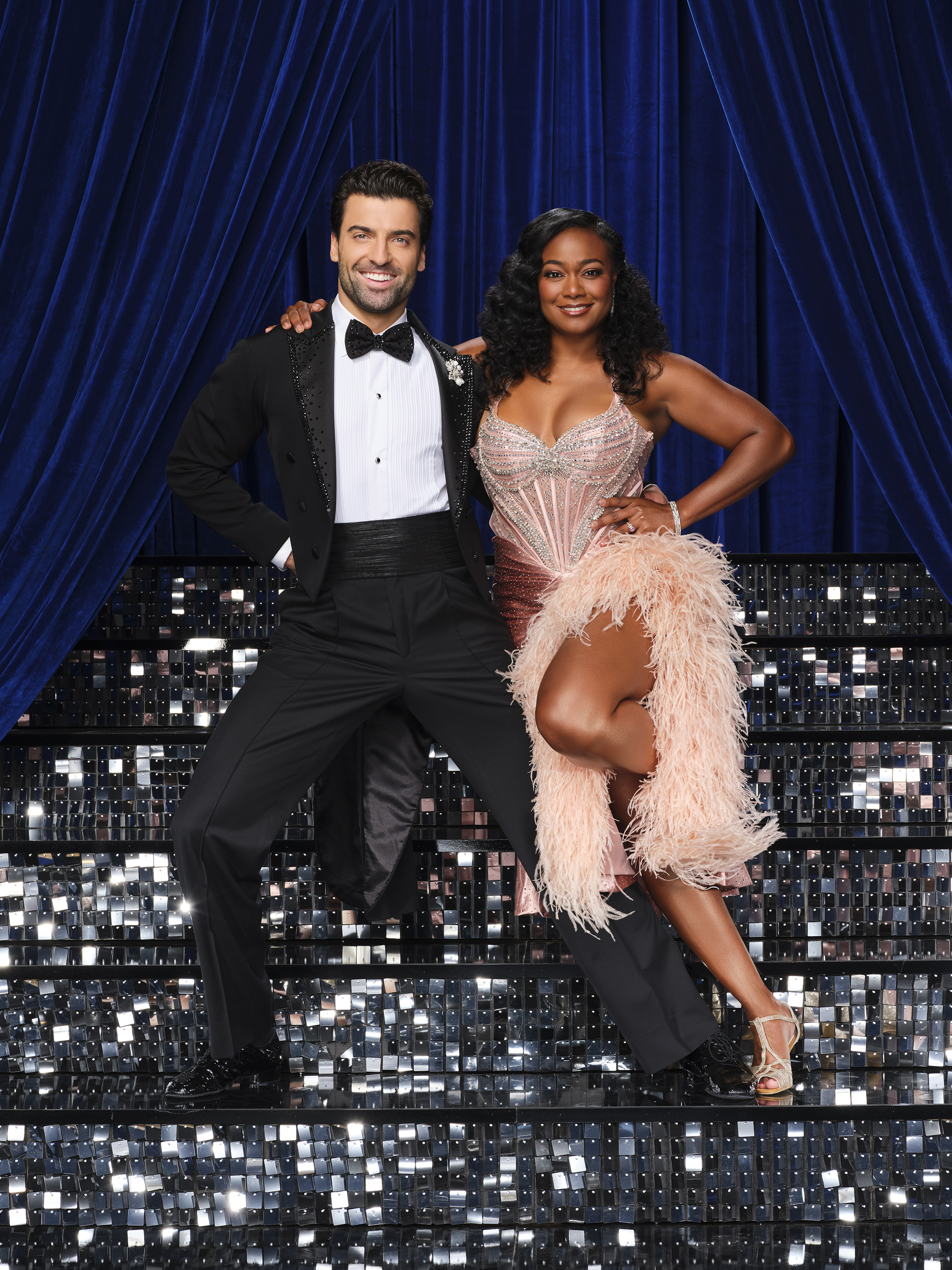
In a rehearsal package that aired before her semifinal cha-cha on November 17, Tatyana Ali connected her Dancing with the Stars training to the traumatic birth of her first son in 2016. Ali, who described that birth to Congress in 2021 and now helps fund Black and Indigenous birth workers through her company, Baby Yams, said dance had lifted something she expected to carry for life. She and Jan Ravnik scored 55 out of 60 and dance in the November 24 finale. This is her account; DMM makes no medical claim.
In this story: November 17 · October 6 · 2016 · 2019 · Baby Yams · The numbers · Inside the performance · Her season · FAQ
November 17: The Rehearsal That Reached Back Ten Years
Eleven episodes into a competition that scores every step, Tatyana Ali used her last semifinal package to talk about something no judge could mark. In the rehearsal footage that introduced her cha-cha with Jan Ravnik, she returned to the birth of her first son, Aszi, in 2016, a delivery she has described in public for years as traumatic. Entertainment Weekly reported that both she and Ravnik cried while they practiced. TheWrap reported that she told Ravnik she feels lighter now, and that she has let go of things she once expected to carry as a new mother.
Her own summary, as Entertainment Weekly quoted it, was simple: “I didn’t know dance could do that.”
Then she danced it. The cha-cha to Pete Rodríguez’s “I Like It Like That” drew a 10 from Carrie Ann Inaba, the first 10 of Ali’s season, and scored 28 out of 30. Inaba called it perfection. Earlier in the night, the couple’s waltz to Journey’s “Open Arms” had scored 27. With viewer votes added, the 55-point night sent Ali and Ravnik to the finale.
That moment is Ali’s account of her own body and history. It is not evidence that dance treats trauma, and she has not presented it that way. It shows a performer describing, in public, a freedom she says she did not have before, and choosing to tell other women about it.
The routine the package introduced
What to Watch For
The cha-cha is built from quick, compact steps and sharp timing, and “I Like It Like That” gives it a swinging, party-room groove. The judges’ note to Ali all season was to expand. Watch whether her hips, arms and focus reach the full end of each phrase; afterward Derek Hough told her, “Your confidence is crazy!”
Accuracy Note
Entertainment Weekly’s recap places this rehearsal package, and Inaba’s “perfection” remark, with the waltz. TheWrap and Sports Illustrated place both with the cha-cha, and ABC7 and Sports Illustrated record Inaba’s 10 on the cha-cha. DMM follows that record and will correct this story if the broadcast shows otherwise.
October 6: The Back Bend That Brought the Tears
The semifinal moment had a beginning. On October 6, the day of Mariah Carey Night, Ali shared an Instagram video about a rehearsal earlier in the season. As Good Morning America reported it, a move that asked her to bend her back unlocked something, and tears came before she could explain them. She said she had not expected that “stuff” to come out. Ravnik, she said, stayed with her and reassured her that the reaction was normal.
Ali tied the experience to her work as a maternal health advocate and to her first son’s birth. “If they say that trauma is locked in the body, believe me,” she said in the video. Then she turned the message outward, to mothers. “Moving is healing,” she said, in whatever way a person is able to move, and she closed with an invitation: “dance with me.”
The message traveled through the cast: TheGrio reported that Harry Shum Jr. praised Ali for sharing it and that co-host Julianne Hough echoed her words. Six weeks later, the semifinal package returned to the same subject with a full season behind it.
Watch Ali’s Own Statement
Ali’s October 6 video is on her own account: Tatyana Ali on Instagram. DMM links to it rather than copying it. Good Morning America’s report quotes it at length; the video player at the top of that page shows Ali singing “Daydreamin’” on the program, not this statement.
Content Note
The next section summarizes Ali’s public account of a traumatic hospital birth, including physical restraint and an emergency cesarean, without graphic detail. DMM is not offering medical advice. If reading it brings up your own birth experience, a clinician or a perinatal mental health specialist can help.
2016: What She Has Said Happened
Ali has told this story many times, most formally in written testimony to Congress in May 2021 and most recently in an NPR interview published in September. Its outline is consistent. Her pregnancy with Aszi was normal, and she remembers the days of waiting as joyful; she told NPR she sang the song her own mother had sung while waiting for her. In the hospital, she says, her birth plan was set aside. Staff kept pressing an epidural she had not planned on, and when she tried to move onto her hands and knees to push, she was put back on her back. She told NPR she was physically restrained.
After repeated attempts at a vacuum delivery, she asked for a cesarean. Her testimony and NPR describe a rare, last-resort procedure, the Zavanelli maneuver, in which a doctor pushes a baby back into the birth canal; she says it was done without the risk being explained to her. She lost consciousness, and her son was delivered by emergency cesarean. Aszi spent several days in the neonatal intensive care unit before he was strong enough to go home.
It took her time, she has said, to find words for what happened. The words she uses now are “obstetric violence.” That is her description of her own care, and DMM reports it as hers; no court or medical board finding is part of this story. NPR reports that she came to see it as systemic after hearing similar stories from other women of color. Her request to Congress was direct: “We need to be heard and we need to be believed.”
2019: A Birth Built on Listening
When Ali became pregnant again, she and her husband, Vaughn Rasberry, hired a Black midwife. Her testimony describes care that began with time and permission: long visits to get to know the family, and asking before touching her belly. Ali says she was given options at every turn. The family planned a home birth, with a plan for every scenario, including a hospital they had already chosen.
They needed that plan. Days before her due date, the baby shifted into a sideways position, and the family went to the hospital. Alejandro, born in August 2019, was also delivered by cesarean. The surgery was the same; the experience, in her account, was not. The midwife stayed with her, held her feet and led a prayer, and Ali walked into the operating room on her own. Afterward came breastfeeding support and check-ins on her body, her nutrition and her emotions.
Her testimony puts the difference in one sentence: “Aszi and I were not safe, Alejandro and I were.” She told NPR that this time her wishes were respected, and added, “We deserve to be cared for.” The lesson she draws is not that hospitals are the enemy or that midwives replace doctors. Both of her sons were born by cesarean in a hospital. The difference she describes is consent, continuity and being listened to.
From Testimony to Infrastructure: Baby Yams
Ali gave that testimony on May 6, 2021, to the House Committee on Oversight and Reform, for a hearing titled “Birthing While Black: Examining America’s Black Maternal Health Crisis.” Her written statement asked Congress to train and fund more Black midwives, Black doulas and culturally competent birth workers, to require health plans to cover their care, to require training on racial bias and trauma, and to support families after birth. She also put a number on the gap: her midwife’s $8,000 fee was paid up front, and the insurer reimbursed $5,500 only after about a year and a half.
Five years later, her advocacy has a business behind it. Baby Yams, the company she founded, makes heritage baby quilts from ankara and batik fabrics. NPR reports that it donates part of its proceeds to the Birth Future Foundation, which gives grants to midwives, doulas and student birth workers, with a focus on Black and Indigenous communities.
NPR also introduced one person that support has reached. Nadia Gramby, a 41-year-old midwife in Alabama, began as a doula and completed her midwifery licensing requirements with a Birth Future Foundation scholarship funded by Ali. That is what turns a celebrity’s hard story into something larger. Ali did not stop at describing what went wrong; she has helped pay for the training of the kind of caregiver who changed her second birth.
The Numbers Behind Her Advocacy
Ali’s story sits inside a national pattern. In its final data for 2024, published in March 2026, the CDC’s National Center for Health Statistics counted 649 maternal deaths in the United States, a rate of 17.9 per 100,000 live births. The rate for non-Hispanic Black women was 44.8, which the report calls significantly higher than the rate for non-Hispanic White women, 14.2: a little more than three times as high. In this report, a maternal death is a death during pregnancy or within 42 days of its end, from a cause related to or made worse by the pregnancy.
Statistics describe populations, not one woman’s care, but they explain why her story has found an audience. Dr. Tamika Auguste, chair of women’s and infants’ services at MedStar Washington Hospital Center, told NPR that hospitals have improved their protocols for complications such as hemorrhage, high blood pressure and heart conditions, but that bias remains a problem, including the false belief that Black patients feel less pain. Her answer is teamwork: physicians, midwives, doulas, nurses and anesthesiologists working together.
Inside the Performance: Music, Movement and Meaning
Ali danced twice on November 17, and the two routines told her story in two registers.
Inside the Performance: Five Elements
Music
Journey’s “Open Arms” is a 1980s power ballad of long held notes over a patient beat, the right weight for the waltz, the slowest of the ballroom dances, built on rise and fall. Pete Rodríguez’s “I Like It Like That” is a 1960s New York Latin boogaloo, a party record with a shouted refrain. Ali, whose hometown is on Long Island, closed her night on a sound from New York’s Latin dance clubs.
Movement
The waltz tested the note the judges had given her for weeks: extension. TheWrap reported that her waltz package focused on that note, and Hough credited her for reaching with her heart. The cha-cha asked for the opposite energy, quick feet and released hips. Hough praised the partnership and her confidence, and Bruno Tonioli enjoyed what Sports Illustrated reported as her “sultry, saucy” side.
Atmosphere
Hough said she looked “expensive” in the waltz and Tonioli called it “irresistibly romantic”; all three judges gave 9s, and Inaba told her she “makes us all believe we can.” Before the cha-cha, Ali shouted out the hometown bar on Long Island where family, friends and fans had gathered to watch. Then came Inaba’s 10.
Human significance
The order matters. The ballad came first; the package about her first birth came before the second dance, and the second dance was a celebration. DMM reads that sequence as the shape of her story: the weight first, then the release. That is our interpretation, not a claim about what the judges rewarded. The panel scores technique, and Ali’s technique had been rising for weeks.
Reader takeaway
Release is not the same as forgetting. A body can hold a memory and still learn something new, and joy can arrive after pain without erasing it. Ali’s semifinal is one person’s experience of that, offered openly.
The waltz
What to Watch For
A waltz should swell and settle on every bar of music. Watch for the extension the judges asked for, through Ali’s neck, arms and the line of her back, and for how long the couple lets each phrase of “Open Arms” breathe before the next rise.
A Season Measured in More Than Points
Read her scores with their scales, because the scale changed. She opened in September with a jive to “Knock on Wood” that scored 12 out of 30, a rough start she never hid, and was at 20 out of 30 for “Fantasy” on the night of her Instagram statement. On four-judge weeks, scored out of 40, she rose from a 29/40 salsa to a 33/40 contemporary routine to “Easy as Life” from Aida, with Heather Headley singing live. Her Grammy Night tango earned three 9s, though she lost the dance-off to Jenna Dewan and was the last couple called safe. In the semifinals she scored 27 and 28 out of 30.
No single number captures that arc, and DMM does not draw it as a straight line. What the record shows is a performer who kept taking notes, kept being voted through by viewers, and kept bringing her life into the room. Her Dedication Night Viennese waltz, sung in Ali’s own voice with Alfonso Ribeiro joining her, honored James Avery, her late Fresh Prince of Bel-Air co-star; DMM covered it in Tatyana Ali’s James Avery tribute. That dance was about family and legacy. The semifinal was about her own body. Both belong to the same artist.
Ravnik’s part in the story is partnership, not therapy. Ali described him to Good Morning America in September as a great teacher who believes she can do more than she thinks, and in her own telling he stayed beside her when the tears came in October. That is what a good dance partner does.
What We Can Take Away
Many readers will recognize what Ali described: carrying an old hurt in the body and finding, unexpectedly, that it has shifted. Tamara Akuna Hunter, an Atlanta dance and movement therapist and perinatal mental health specialist, described Ali’s October tears to TheGrio as a cathartic release.
But her story does not prove that dancing heals birth trauma, and it should not be read as a prescription. Not everyone finds movement safe or welcome, and Hunter herself urges people dealing with postpartum anxiety, depression or trauma to seek clinicians trained in perinatal mental health. What Ali’s experience does show is simpler and harder: that being listened to changes care, that a community can carry what one person cannot, and that an artist can use the biggest dance stage on television to say so.
What Comes Next
Ali and Ravnik are one of five couples in the Season 35 finale on Tuesday, November 24, from 8 to 11 p.m. ET on ABC and Disney+, the first DWTS finale to air live in every U.S. time zone. TheWrap reports a three-round format: a judges’ choice dance, an instant dance and a freestyle. Song and dance assignments have not been announced, and DMM does not predict winners.
Whatever the result, Ali has already answered her own October invitation. She asked mothers to move with her. Six weeks later, she was still moving, and still telling them why.
Frequently Asked Questions
What did Tatyana Ali say about healing through dance on DWTS?
In an Instagram video she shared on October 6, 2026, reported by Good Morning America, Ali said a rehearsal move with Jan Ravnik brought unexpected tears and that “moving is healing.” In a rehearsal package that aired during the November 17 semifinals, she connected her training to the birth of her first son and said dance had lifted things she expected to carry for life. This is her personal account, not a medical claim.
Did Tatyana Ali announce a pregnancy in 2026?
No. The story concerns the births of her two sons, in 2016 and 2019, and how she has reflected on them while competing on Dancing with the Stars Season 35.
What happened during Tatyana Ali’s first childbirth?
Ali has said publicly, including in written testimony to Congress in May 2021, that her birth plan was set aside, she was physically restrained and a rare emergency procedure was used before her son was delivered by emergency cesarean. He spent several days in neonatal intensive care. Ali calls it obstetric violence. This is her account, not a court or medical finding.
What is Baby Yams?
Baby Yams is Tatyana Ali’s company making heritage baby quilts from ankara and batik fabrics. NPR reports that it donates part of its proceeds to the Birth Future Foundation, which gives grants to midwives, doulas and student birth workers, with a focus on Black and Indigenous communities.
What did Tatyana Ali dance in the DWTS semifinals?
A waltz to Journey’s “Open Arms,” scored 27 out of 30, and a cha-cha to Pete Rodríguez’s “I Like It Like That,” scored 28 out of 30, including Carrie Ann Inaba’s first 10 of Ali’s season. Her total was 55 out of 60.
Is Tatyana Ali in the DWTS 2026 finale?
Yes. Tatyana Ali and Jan Ravnik advanced from the November 17 semifinals and dance in the finale on Tuesday, November 24, 2026, from 8 to 11 p.m. ET on ABC and Disney+.
Continue Exploring Dance Mogul Magazine
DWTS Semifinals 2026 results: every score and all 12 songs and dances →
Tatyana Ali’s James Avery tribute on Dedication Night →
Tatyana Ali and Jan Ravnik’s full season on the Live Dashboard →
The semifinal results in the DMM Newsroom →
DWTS Season 35 Newsroom: every update, newest first →
Sources & Attribution
Semifinal rehearsal package and judges: Entertainment Weekly (via Yahoo), November 18, 2026; TheWrap (via Yahoo), November 18; Sports Illustrated, November 18; Deadline (via Yahoo), November 18. Scores: ABC7/On The Red Carpet, November 18, and DMM’s Season 35 Live Dashboard season record.
October 6 statement: Good Morning America, October 6, 2026; Tatyana Ali on Instagram; TheGrio, October 7. Movement and postpartum context: TheGrio, October 8. Ali on Ravnik: Good Morning America, September 16.
Her births and advocacy: Tatyana Ali, written testimony to the House Committee on Oversight and Reform, May 6, 2021 (hearing listing); NPR, Kristin Wright, September 13, 2026; Essence, 2019. Maternal mortality: CDC National Center for Health Statistics, Health E-Stat 113, March 2026. Finale format: TheWrap.
Quotes are as reported by the outlets named; DMM did not interview Ali or Ravnik for this story. Analysis is original DMM editorial. Videos: Dancing with the Stars official YouTube channel.
© 2026 Dance Mogul Magazine LLC · Inspiring Self-Empowerment Through Dance Culture
Dancing with the Stars is a trademark of its owner. Dance Mogul Magazine is an independent publication and is not affiliated with ABC or Disney.