
Dance Mogul Magazine · From the Editor-in-Chief · Archive
Flo Jenkins: What’s Your Brand — Perceived Image or Reality?
In 2014 Dance Mogul Magazine’s editor-in-chief asked artists a hard question about image and truth. Her answer still holds, and the dancers she named have since become history.
By Flo Jenkins · Originally published August 11, 2014 · Updated and expanded November 2026
About this piece
Flo Jenkins wrote this essay while serving as Consultant and Editor-in-Chief of Dance Mogul Magazine. She came to the role after leading Right On!, the teen entertainment magazine that covered Black artists for a generation. Her full essay is reproduced below exactly as published, followed by what has happened since.
Flo Jenkins did not write about branding as a marketing trick. She wrote about it as a question of character: does the picture you show the world match the person doing the work? In August 2014 that was an unusual thing to tell young dancers, who were being taught to build a following first and a body of work second.
Twelve years later the essay reads less like advice and more like a record. Jenkins pointed to the Soul Train dancers as proof that a small platform, used honestly, can carry a career around the world. Two of the pioneers she named have since passed on, and the magazine she once ran has changed hands. Her argument has not aged at all.
The Original Essay by Flo Jenkins
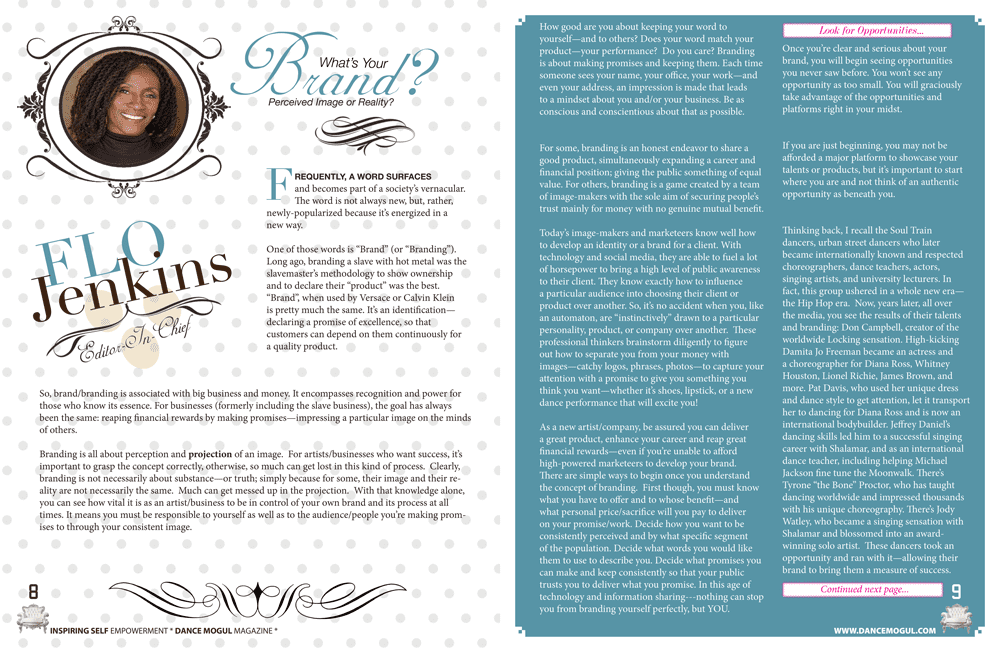
Frequently, a word surfaces and becomes part of a society’s vernacular. The word is not always new, but, rather, newly-popularized because it’s energized in a new way. One of those words is “Brand” (or “Branding”). Long ago, branding a slave with hot metal was the slavemaster’s methodology to show ownership and to declare their “product” was the best. “Brand”, when used by Versace or Calvin Klein is pretty much the same. It’s an identification—declaring a promise of excellence so that customers can depend on them continuously for a quality product.
So, brand/branding is associated with big business and money. It encompasses recognition and power for those who know its essence. For businesses (formerly including the slave business), the goal has always been the same: reaping financial rewards by making promises—impressing a particular image on the minds of others.
Branding is all about perception and projection of an image. For artists/businesses who want success, it’s important to grasp the concept correctly, otherwise, so much can get lost in this kind of process. Clearly, branding is not necessarily about substance—or truth; simply because for some, their image and their reality are not necessarily the same. Much can get messed up in the projection. With that knowledge alone, you can see how vital it is as an artist/business to be in control of your own brand and its process at all times. It means you must be responsible to yourself as well as to the audience/people you’re making promises to through your consistent image.
“Branding is about making promises and keeping them.”
How good are you about keeping your word to yourself—and to others? Does your word match your product—your performance? Do you care? Branding is about making promises and keeping them. Each time someone sees your name, your office, your work—and even your address, an impression is made that leads to a mindset about you and/or your business. Be as conscious and conscientious about that as possible.
For some, branding is an honest endeavor to share a good product, simultaneously expanding a career and financial position; giving the public something of equal value. For others, branding is a game created by a team of image-makers with the sole aim of securing people’s trust mainly for money with no genuine mutual benefit.
Today’s image-makers and marketers know well how to develop an identity or a brand for a client. With technology and social media, they are able to fuel a lot of horsepower to bring a high level of public awareness to their client. They know exactly how to influence a particular audience into choosing their client or product over another. So, it’s no accident when you, like an automaton, are “instinctively” drawn to a particular personality, product, or company over another. These professional thinkers brainstorm diligently to figure out how to separate you from your money with images—catchy logos, phrases, photos—to capture your attention with a promise to give you something you think you want—whether its shoes, lipstick or new dance performance that will excite you!
As a new artist/company, be assured you can deliver a great product, enhance your career and reap great financial rewards—even if you’re unable to afford high-powered marketers to develop your brand. There are simple ways to begin once you understand the concept of branding. First though, you must know what you have to offer and to whose benefit—and what personal price/sacrifice will you pay to deliver on your promise/work. Decide how you want to be consistently perceived and by what specific segment of the population. Decide what words you would like them to use to describe you. Decide what promises you can make and keep consistently so that your public trusts you to deliver what you promise. In this age of technology and information sharing—nothing can stop you from branding yourself perfectly, but YOU.
Look for Opportunities
Once you’re clear and serious about your brand, you will begin seeing opportunities you never saw before. You won’t see any opportunity as too small. You will graciously take advantage of the opportunities and platforms right in your midst.
If you are just beginning, you may not be afforded a major platform to showcase your talents or products, but it’s important to start where you are and not think of an authentic opportunity as beneath you.
Thinking back, I recall the Soul Train dancers, urban street dancers who later became internationally known and respected choreographers, dance teachers, actors, singing artists, and university lecturers. In fact, this group ushered in a whole new era—the Hip Hop era. Now, years later, all over the media, you see the results of their talents and branding: Don Campbell, creator of the worldwide Locking sensation. High-kicking Damita Jo Freeman became an actress and a choreographer for Diana Ross, Whitney Houston, Lionel Richie, James Brown, and more. Pat Davis, who used her unique dress and dance style to get attention, let it transport her to dancing for Diana Ross and is now an international bodybuilder. Jeffrey Daniel’s dancing skills led him to a successful singing career with Shalamar, and as an international dance teacher, including helping Michael Jackson fine tune the Moonwalk. There’s Tyrone “the Bone” Proctor, who has taught dancing worldwide and impressed thousands with his unique choreography. There’s Jody Watley, who became a singing sensation with Shalamar and blossomed into an award-winning solo artist. These dancers took an opportunity and ran with it—allowing their brand to bring them a measure of success.
“Get a bigger vision for yourself, then, no legitimate platform will be too small.”
Before they had a national platform, they were young urban street dancers whose first platform was probably at family gatherings, at school, in local park productions, or in teen nightclubs. They seized opportunities and were discovered right where they were.
Whatever credible small platform is available, use it to build your brand and grow your career. Get a bigger vision for yourself, then, no legitimate platform will be too small. Some thought the platform of Dance Mogul Magazine was too small—mainly because it was new—and different. Our purpose and content is innovative. Now, many dancers and others in various walks of life are beginning to capture the Dance Mogul Magazine vision and understand that no platform is too small to get their message out.
Our recent cover subject, legendary dancer/choreographer/director, Debbie Allen understands platforms and branding. She graced our cover despite what others may have considered a small publication. Ms. Allen understood that “small” is only a perception. She understood excellence, great intent, and purpose. If you’re like Debbie and some who have appeared in our publication, embrace the value of an opportunity, and use our platform to your advantage. Use it to help you introduce your brand and to develop it further. Others are validating our brand. Just as we see their value to a greater community, they see ours in our efforts to inspire and empower others to go for their dreams. In that way, our brands are in synch.

Who are you? How do you want to be branded? Are you and the image you want to project one and the same? Decide. It’s difficult to pretend you’re something you’re not—because the real you will eventually show up! You have to decide who you are and whether you and your projected image are one. Don’t be just an image—be the best of who you are, that way your life is not a lie, and neither is your work. That way, your brand becomes more than just a projected perception, but a reality.
“Don’t be just an image—be the best of who you are, that way your life is not a lie, and neither is your work.”
Who Is Flo Jenkins?
Flo Jenkins built her name in magazines long before Dance Mogul existed. According to her biography published by the Los Angeles Philharmonic, her career rose to worldwide prominence when she became the youthful Executive Editor of Right On!, the national teen entertainment magazine. Right On! launched in the early 1970s and built its first audience on close coverage of the Jackson 5, then went on to cover Black performers across music, film and television.
The same biography describes her as an award-winning writer and editorial consultant whose work has crossed television, recording, stage, publishing and advertising. It also records her time with this magazine: she served as Consultant and Editor-in-Chief of Dance Mogul Magazine, and it credits her skills and reputation with helping the publication earn national respect.
Teaching is the other half of her work. The biography lists her How to Get Published classes and a workshop series called Telling Our Stories Ourselves Worldwide, written for senior citizens, teenagers and pre-teens. That title says a great deal about the essay above. Flo Jenkins has spent a career telling people that their own story, told honestly, is the brand.
Readers who want more of her writing for this magazine can go to History Through the Pure Intent of Visionaries and to her essay on thought processes and solutions for a mind that is enslaved, both published in 2014.
What Has Happened Since 2014
The essay named six Soul Train dancers as examples of a brand built from the ground up. Here is what the public record shows about the people and institutions in it since the piece first ran.
2014
Right On! ended regular print publication, according to its published history. The title was acquired by a new company in 2016 and continues as a digital platform.
2014
Debbie Allen appeared on the cover of Dance Mogul Magazine, the cover Jenkins refers to in the essay. Her story with this magazine continues in our Debbie Allen feature.
March 30, 2020
Don “Campbellock” Campbell, creator of locking, died at his home in Santa Clarita, California, at 69. The New York Times obituary called him a hip-hop dance innovator. Our tribute is at Don Campbellock Campbell.
June 2020
Tyrone “the Bone” Proctor, who carried waacking from Soul Train to classrooms around the world, died at 66. The Philadelphia Inquirer recorded his life. Read our profile of Tyrone the Bone Proctor.
Today
Dance Mogul Magazine, the platform Jenkins said some people thought was too small, has now been publishing for sixteen years.
Jenkins wrote that these dancers “took an opportunity and ran with it.” The years since have shown how right she was to treat them as history in the making. Campbell and Proctor are now studied by dancers who were not born when Soul Train first aired, and the styles they shaped are taught on every continent.
Why It Matters to DMM
Dance Mogul Magazine was founded on the idea that a story should help someone become a better version of themselves. This essay is that idea in one page. It does not tell a young artist how to get noticed. It tells them to decide who they are first, and then let the work prove it.
It also explains something about this magazine’s own path. Flo Jenkins had already run a national publication when she chose to put her name on a new, independent, Black-owned dance magazine. She did what she told readers to do. She saw the purpose behind a small platform and treated it as worth her best work.
For dancers reading today, the lesson fits in one line of her essay: branding is about making promises and keeping them. A following can be bought or borrowed. A reputation for keeping your word has to be earned one performance, one class and one conversation at a time.
Continue the coverage
Keep reading: the Debbie Allen Dance Academy; and our Exclusive Interviews archive.
© Dance Mogul Magazine. Essay first published August 11, 2014. Updated November 2026.