
Legacy Artist Feature · Tap
Savion Glover: The Hoofer Who Turned Tap Back Into Music
A Newark drummer who learned his steps from the last great generation of jazz hoofers — and honored them by refusing to let tap stand still.
By Dance Mogul Magazine | Legacy Artist Feature | October 2026

Savion Glover at a Glance
Born: November 19, 1973 — Newark, New Jersey
Known as: Hoofer, choreographer, director, educator
First instrument: Drums
Broadway debut: The Tap Dance Kid (1984), as a child
Defining work: Bring in 'da Noise, Bring in 'da Funk (1996) — Tony Award, Best Choreography
Mentors: Gregory Hines, Jimmy Slyde, Buster Brown, Bunny Briggs, Lon Chaney, Sammy Davis Jr., Dianne Walker, Henry LeTang
Institution he built: HooFeRzClub School for Tap, Newark (2009)
Dance Mogul connection: Exclusive DMM interview and STePZ review, 2013
1996
Tony Award, Choreography
40+
Years on Professional Stages
14
Age He Began Teaching
Who Is Savion Glover?
Close your eyes at a Savion Glover performance and you will not lose the show. That is the first thing to understand about him. Most dancers ask to be watched. Glover asks to be heard. The heel is a bass drum, the toe a snare, the edge of the shoe a cymbal, the wooden floor beneath him an amplifier he tunes as he goes. For more than four decades he has made a case that tap dance is not decoration laid on top of music — it is music, and the hoofer is a member of the band.
He is the Tony Award-winning choreographer of Bring in 'da Noise, Bring in 'da Funk, a child star of Broadway and Sesame Street, the feet behind the dancing penguin Mumble in Happy Feet, and the founder of a tap school in the same Newark building where he once took music lessons as a boy. But the credits are not the story. The story is a question that runs underneath every one of them — the same question this magazine keeps returning to:
How does dance knowledge survive?
In Savion Glover's case, it survived because a group of aging masters decided to pour everything they knew into one gifted kid from Newark — and because that kid understood that the most respectful thing he could do with their gift was to keep it moving.
Newark, Where the Music Came First
Savion Glover was born on November 19, 1973, in Newark, New Jersey, and raised by his mother, Yvette Glover, alongside his brothers. Music was already in the family bloodline before he took a single step. His grandmother, Anna Lundy Lewis, directed music at New Hope Baptist Church. His grandfather, Bill Lewis, was a big band pianist. His great-grandfather, Dick Lundy, managed teams in baseball's Negro Leagues, including the Newark Eagles. This was a family that understood excellence as something you practiced in rooms the larger world did not always see.
Glover's first instrument was not his feet. It was the drum kit. As a young boy he studied at the Newark Community School of the Arts and, by around seven, was drumming in a group called Three Plus One — where, by the most-repeated account, he could not stop dancing while he played. Tap lessons followed soon after. The sequence matters. Glover did not arrive at rhythm through dance; he arrived at dance through rhythm. He learned to think like a drummer first, and he never stopped.
That beginning explains nearly everything that came later: the obsession with tone, the way he "tunes" a stage by listening to how each board responds, the habit of building pieces around John Coltrane rather than around a storyline. To Glover, a tap shoe is a percussion instrument with several voices, and a dancer who cannot hear the difference between them is only half playing.
The Sponge: An Education From the Last Great Hoofers
Here is the part of Glover's story that cannot be repeated by anyone born later. He did not learn the masters from grainy footage. He learned them in person.
As a child performer in the 1980s, Glover landed in the middle of the last living generation of jazz-era tap dancers — men and women who had danced the Black vaudeville circuits, the nightclubs and the Apollo, and who had watched their art fall out of fashion in the decades after World War II. Gregory Hines. Jimmy Slyde. Buster Brown. Bunny Briggs. Lon Chaney. Sammy Davis Jr. Dianne Walker. The legendary teacher-choreographer Henry LeTang, who nicknamed the boy "the Sponge" because he absorbed everything put in front of him. Honi Coles and Chuck Green are part of that lineage too.
What they handed him was larger than steps. In interviews over the years, Glover has described these elders as guides in how to carry himself — what respect looks like, what professionalism looks like, how a Black man moves through an industry and a country that will not always make room for him. Jimmy Slyde, the master of the sliding, bebop-phrased style, became something close to a father figure. Gregory Hines became a collaborator, a champion and a model of how to bring tap to mass audiences without cheapening it. Slyde believed, as CBS News reported in 2000, that this young dancer would keep tap from being forgotten.
This is oral tradition in its purest form: master to apprentice, mouth to ear, foot to floor. No curriculum could reproduce it. And Glover has never pretended otherwise. Asked by Dance Mogul Magazine in 2013 about Bill "Bojangles" Robinson, the Nicholas Brothers, the Berry Brothers and the Hines Brothers, he answered without hesitation:
“These are all great and wonderful contributors that we have had in the art form. Without them, there would be no me. I pay tribute to them and their legacies every time I dance, perform and even during my daily course of life.”
— Savion Glover to Dance Mogul Magazine, 2013
Read more about the masters behind him in our Legacy profiles of Gregory Hines, Jimmy Slyde, Bill "Bojangles" Robinson and the Nicholas Brothers.
A Child on Broadway, a Teenager Among Legends
Glover's Broadway debut came in 1984, when he stepped into the title role of The Tap Dance Kid while still a child. It was the beginning of an apprenticeship conducted in public. In the late 1980s he joined Black and Blue, the revue that put veteran Black tap masters back on a Broadway stage, and he was playing beside many of them nightly while most kids his age were in middle school. Before he was out of his teens he had earned a Tony nomination as a featured performer.
In 1989 came the film Tap, where he shared the screen with Gregory Hines, Sammy Davis Jr. and a cast of tap elders — a movie that today reads almost like a documentary of the handoff between generations. In 1992 he played the young Jelly Roll Morton in Jelly's Last Jam, again beside Hines, earning a Drama Desk nomination. And for five seasons in the 1990s he was a regular on Sesame Street, quietly teaching a generation of children that tap was something a young Black kid in sneakers-and-taps could own.
He also started teaching. By his own account, Glover began passing tap along at 14 — a teenager already behaving like a custodian of the form. He graduated from Newark Arts High School in 1991.
Bring in 'da Noise, Bring in 'da Funk: When Rhythm Became History
Every great career has a work that changes what people think the art form is for. For Glover, that work is Bring in 'da Noise, Bring in 'da Funk.
Conceived with director George C. Wolfe, the production opened at New York's Public Theater in 1995 and moved to Broadway's Ambassador Theatre in 1996, where it ran into 1999. On paper it was a musical. In practice it was something no one had seen on that scale: the history of Black America told through the feet. Slavery, labor, the Great Migration, the Harlem stage, the Hollywood era that made Black dancers smile for white audiences, the city streets of the late twentieth century — all of it rendered in rhythm.
That was the revolution. For much of the twentieth century, mainstream audiences had been taught to see tap as cheerful — a charming novelty, a grin and a shuffle. Noise/Funk took that cheerfulness apart. It argued that tap had always been carrying something heavier: the memory of people who were forbidden drums and kept the beat anyway. Rhythm became narrative. Sound became testimony.
Glover won the 1996 Tony Award for Best Choreography. The production also brought him the Drama Desk and Outer Critics Circle awards, and over this period he collected two Obie Awards and two Fred Astaire Awards. Reviewers noticed what longtime tap fans already knew: he could demonstrate the signature of each master who came before him with care and precision — and then fold them all into a style that belonged to no one but himself.
“The dance should be respected. It should be like an opera.”
— Savion Glover, CBS News, 2000
Broadway Record
The original Broadway production of Bring in 'da Noise, Bring in 'da Funk opened April 25, 1996 and ran 1,135 performances through January 10, 1999. Glover won the 1996 Tony Award for Best Choreography and was also nominated that year for Best Actor in a Musical. His Broadway record also includes The Tap Dance Kid, Black and Blue, Jelly's Last Jam, and a 2016 Tony nomination for choreographing Shuffle Along. That chronology matters: Glover was not simply a featured tap virtuoso; Broadway repeatedly entrusted him with carrying tap's language into new theatrical generations.
Tradition Is a Language, Not a Museum
There is a lazy way to tell Savion Glover's story, and it goes like this: tap was dying, and a prodigy saved it. The truth is more interesting, and more useful to anyone who inherits a tradition.
Glover did not save tap by preserving it exactly as he received it. He honored it by refusing to let it stop evolving. His elders danced upright and elegant, in tuxedos, often with their weight carried high. Glover danced low, grounded and hard — "young and funk," as he has described it — with a heavy, driving attack that sounded like the city he came from. His teenage dancing was rough-edged on purpose; it reflected a Newark of sirens and street noise. Over the years the work changed again, becoming more spacious, more exploratory, more openly spiritual.
That is the distinction younger artists most need to hear. Imitation copies the outside of a master. Inheritance takes the inside — the musicianship, the discipline, the respect, the improvisational courage — and lets it speak in your own voice. Glover can still "speak" Jimmy Slyde or Gregory Hines on a stage when he chooses. But nobody has ever mistaken him for either of them. He calls the core of his approach "hitting": the ability to complete a phrase and actually say something with it. Steps are vocabulary. Hitting is speech.
On Screen: From Bamboozled to Happy Feet
Glover's film work rarely asked him to be decorative either. In Spike Lee's Bamboozled (2000), a searing satire about blackface minstrelsy and the entertainment industry, he played Manray, a gifted street hoofer turned into the star of a modern minstrel show — a role that forced audiences to confront the uglier history that tap's "cheerful" image had covered over. Around the same time he toured with Barbra Streisand's Timeless concerts as "Brother Time," where the time step he created became informally known among dancers as the Savion Glover time step.
Then came the film that introduced him to millions of children who had never heard his name. In Happy Feet (2006), the Academy Award-winning animated feature, Glover's motion-captured dancing became the feet of Mumble, the penguin who can't sing but can't stop tapping. He returned for Happy Feet Two (2011). A whole generation learned what tap sounded like from a penguin — and it was Glover's sound.
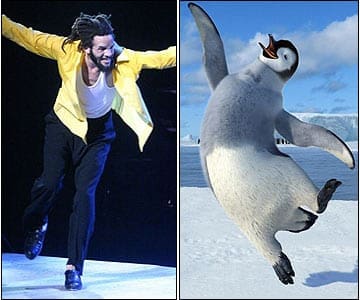
Savion Glover's dancing brought Mumble to life in Happy Feet.
The Concert Hoofer — and the Night DMM Was in the Room
Through the 2000s and 2010s, Glover increasingly built evening-length concerts that treated the tap floor like a bandstand: Improvography, Classical Savion (tap set against Vivaldi, Bach and Mendelssohn), Bare Soundz, Solo in Time, OM, Sole Sanctuary — a meditation on his artistic ancestors — and STePz.
STePz premiered at New York's Joyce Theater in the summer of 2013, opening with John Coltrane's "Miles Mode." That fall it traveled to the Brooklyn Center for the Performing Arts, and Dance Mogul Magazine was there. Before the show, Glover sat down with DMM for an exclusive interview and explained the idea: a tribute to every tap dancer who ever used stairs or risers, from Bojangles to the Nicholas Brothers, performed with Marshall Davis Jr. on a set of staircases and scored to music from Coltrane, Stevie Wonder and Prince to Shostakovich. On November 2, 2013, three DMM writers from three different generations watched it together and gave it five stars.
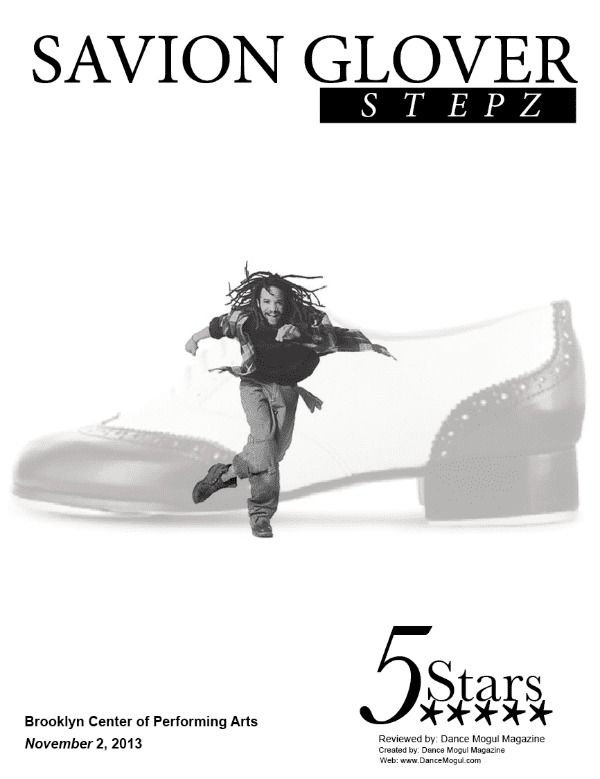
STePz, Brooklyn Center for the Performing Arts, November 2, 2013.
Building the House: HooFeRzClub, NJPAC and Shuffle Along
The clearest proof that Glover understood his inheritance as a responsibility is what he built in Newark. In 2009 he opened the HooFeRzClub School for Tap on Brunswick Street — in the former home of the Newark arts school where he studied as a boy. He has said he bought the building almost the moment a friend pointed it out. The school's philosophy is unusual: new students reportedly spend months on history and theory before the physical training begins, because Glover wants dancers who understand tap as a language, not a trick.
“What we're looking for at my school is intellectuals.”
— Savion Glover, New Jersey Monthly, 2016
His bond with his city extends to the New Jersey Performing Arts Center (NJPAC), where he has served as a dance advisor and ambassador and as a member of its Board of Directors. In September 2019, he came full circle: Glover directed and choreographed a production of The Tap Dance Kid at NJPAC's Victoria Theater — the very show that made him a Broadway kid 35 years earlier — this time with a young Newark-area cast learning from him. Of the show, he said simply that while it was entertainment to others, to him it was a statement of his life.
In 2016, he and George C. Wolfe reunited for Shuffle Along, or, the Making of the Musical Sensation of 1921 and All That Followed, a Broadway excavation of the landmark all-Black musical that helped launch the Harlem Renaissance on stage. Choreographing a show for which almost no footage survives meant reconstructing a lost era from instinct, research and inheritance. The work earned him a Tony nomination for Best Choreography. Speaking about it, Glover said what mattered most to his art form was that the men and women who “graciously shared knowledge be remembered.” Montclair State University has also recognized his contributions with an honorary Doctor of Fine Arts degree.
In His Own Words: Why Our Stories Must Be Told by Us
At the close of his 2013 conversation with Dance Mogul Magazine, Glover was asked whether it was necessary to have a Black-owned magazine committed to documenting the history of Black dance properly. His answer has become one of the clearest statements of purpose this publication has ever received — and it is the reason this profile exists.
“It’s always important to have our own, to document everything that we do so it can be preserved in the proper hands. A lot of times when we give other people a chance to write our history, that’s exactly what they do. They re-write our history. So it’s very important to have those that witness it and that are close to the heritage of these art forms to write about it.”
— Savion Glover to Dance Mogul Magazine, 2013
In the same interview he spoke about why he performed so often for young people — so they could see "the humble beginnings and what success looks like in the art form" — and credited his longevity to maturity and faith: "this is God's journey for me, and I'm just along for the ride."
Savion Glover — Career Timeline
1973 — Born November 19 in Newark, New Jersey
c. 1980 — Drumming in the group Three Plus One; tap lessons begin
1984 — Broadway debut in the title role of The Tap Dance Kid
1989 — Black and Blue on Broadway; film Tap with Gregory Hines and Sammy Davis Jr.
1990s — Five seasons as a Sesame Street regular
1991 — Graduates Newark Arts High School
1992 — Jelly's Last Jam (Young Jelly), Drama Desk nomination
1995–1996 — Bring in 'da Noise, Bring in 'da Funk, Public Theater to Broadway
1996 — Tony Award, Best Choreography
2000 — Stars as Manray in Spike Lee's Bamboozled
2003 — Mentor Gregory Hines dies
2006 — Dances Mumble in Happy Feet (motion capture); returns for Happy Feet Two (2011)
2009 — Opens HooFeRzClub School for Tap in Newark
2013 — STePz premieres at the Joyce; Brooklyn performance reviewed by DMM
2016 — Shuffle Along on Broadway; Tony nomination, Best Choreography
2019 — Directs and choreographs The Tap Dance Kid at NJPAC
Awards & Honors
Tony Award, Best Choreography — Bring in 'da Noise, Bring in 'da Funk (1996)
Drama Desk Award and Outer Critics Circle Award — Noise/Funk
Two Obie Awards · Two Fred Astaire Awards
Dance Magazine Award
Tony nomination as a featured performer (as a teenager)
Drama Desk nomination — Jelly's Last Jam
Tony nomination, Best Choreography — Shuffle Along (2016)
Honorary Doctor of Fine Arts — Montclair State University
Where Is Savion Glover Now?
Glover has never been a constant presence in the celebrity news cycle, and that appears to be by design. His recent public work has centered on Newark: teaching through HooFeRzClub, his advisory and board role at NJPAC, and concerts with his jazz ensemble PROjECt.9, presented at NJPAC's Victoria Theater as a celebration of sound drawing on what the center described as ancestral codes of rhythm. He remains, as he has been since the 1990s, a touring concert artist whose appearances are announced engagement by engagement rather than in long Broadway runs.
NJPAC's own institutional record adds an important dimension to that work. Glover has served as a member of the Arts Center's board, taught dance performance and choreography to its students, and directed and choreographed an NJPAC production of The Tap Dance Kid — returning as an educator to the Broadway work that helped introduce him to the professional stage. It is a full-circle chapter in his legacy: the child who entered the tradition became one of the artists responsible for transmitting it.
Dance Mogul Magazine will update this section as new productions, residencies and teaching programs are announced. If you represent Mr. Glover or HooFeRzClub, contact our editorial team.
What the Next Generation Should Learn
Find your elders while they are still here. Glover's greatest advantage was proximity. Footage teaches steps; people teach meaning. Seek out the veterans in your own style — the original b-boys, lockers, house heads, Jersey Club pioneers, studio owners — and ask them questions before the chance is gone.
Learn an instrument, even if it is your body. Glover's dancing makes sense because he thinks like a drummer. Whatever you dance, study the music underneath it: tempo, phrasing, call and response, silence.
Preservation is not imitation. Master the tradition well enough to quote it — then say something new with it. The masters did not hand Glover their vocabulary so he could repeat their sentences.
Know the history your art carries. Noise/Funk proved that a dance form can hold an entire people's memory. When you know that history, you dance with more weight — and you protect the form from people who would reduce it to a gimmick.
Build something that outlives you. The child who learned in a Newark arts school became the man who bought the building and turned it into a school. Success is not finished until it becomes someone else's opportunity.
Why Savion Glover Matters to Dance Mogul Magazine
Dance Mogul Magazine was born in Newark's street dance culture, and Savion Glover is one of Newark's greatest gifts to the world. But the deeper reason he belongs in our Legacy library is that his life answers the question at the center of our mission: how does dance knowledge survive?
It survives person to person. It survives when elders choose to teach and young people choose to listen. It survives when the people who carry a tradition also write it down, record it, and tell it in their own words — which is exactly what Glover asked of us in 2013. And it survives when each new generation is brave enough to make it sound like their own time.
Read this story alongside our companion feature on Toni Basil, whose life shows the other path dance knowledge travels — from the clubs and social spaces where it is created to the television, concert and film stages where the world first sees it. Glover's story is about inheritance. Basil's is about translation. Together they show what it takes to keep a culture alive.
Watch: From the Dance Mogul Magazine Archive
Archival viewing connected to DMM's Savion Glover coverage: the Berry Brothers, whom Glover named among the tap ancestors who made his own career possible, followed by a video preserved from DMM's 2013 interview.
Frequently Asked Questions
Where is Savion Glover from?
Newark, New Jersey. He was born there on November 19, 1973, attended Newark Arts High School and founded his HooFeRzClub School for Tap in the city in 2009.
What did Savion Glover win a Tony Award for?
Best Choreography for Bring in 'da Noise, Bring in 'da Funk in 1996, a production he created with director George C. Wolfe that told the history of Black America through tap.
Who were Savion Glover's mentors?
He learned from the last great generation of jazz hoofers, including Gregory Hines, Jimmy Slyde, Buster Brown, Bunny Briggs, Lon Chaney, Sammy Davis Jr., Dianne Walker and teacher Henry LeTang, who nicknamed him "the Sponge."
Did Savion Glover dance in Happy Feet?
Yes. His motion-captured tap dancing created the steps of Mumble the penguin in Happy Feet (2006) and Happy Feet Two (2011).
What makes Savion Glover's style different?
He approaches tap as music first. A drummer before he was a dancer, he treats each part of the shoe as a different percussion voice and dances low, grounded and improvisational — rooted in tradition but unmistakably his own.
Did Savion Glover speak with Dance Mogul Magazine?
Yes. He gave DMM an exclusive interview in 2013 ahead of STePz at the Brooklyn Center for the Performing Arts.
Sources & Further Reading
Dance Mogul Magazine, Savion Glover | STePZ | Brooklyn Center of Performing Arts (exclusive interview, 2013)
Dance Mogul Magazine, STePZ review (2013)
CBS News, "The Man Who Saved Tap Dancing" (2000)
New Jersey Monthly, "Savion Glover: Footwork Fancier" (2016)
LA Magazine, interview on choreographing Shuffle Along (2016)
New Jersey Stage, "Savion Glover Directs The Tap Dance Kid" (2019)
NJPAC event archive and institutional biography; IBDB / The Broadway League production and artist records; Krannert Center program biography; Library of Congress and The HistoryMakers oral history collections
Continue Your Journey
Explore more from The Legacy, Dance Mogul Magazine's library of the dancers and choreographers who built the culture.
• Toni Basil — The choreographer who carried street dance onto the world's stages
• Gregory Hines — The tap virtuoso who led the 1980s revival
• Jimmy Slyde — Master of slide-style tap and Glover's mentor
• Celebrating Black Creative Directors & Choreographers — The visionaries behind the movement
• More Tap Stories — The full DMM tap archive
• Kiki Ely on Step Up: High Water — Where Glover's artistry met a new screen generation
© 2026 Dance Mogul Magazine LLC | dancemogul.com | Inspiring Self-Empowerment Through Dance Culture