
← Beyond Wealth / Family Foundations
Family Foundations · Stability
Family Stability: Creating a Floor Before the Storm
Stability is not perfection or wealth. It is the set of routines, relationships, and reserves that help a family recover when life changes.
By Dance Mogul Magazine | Beyond Wealth · Family Foundations, Article 3 of 5

What follows is really a story about family stability. When the job ended, the family lost more than income. Their whole weekday rhythm disappeared with it. The parent who had always left first was suddenly home all day. The children noticed every whispered conversation. Bills turned tense. Small decisions started carrying the weight of much larger fears nobody was saying out loud.
What helped was not a perfect emergency fund or a flawless plan. It was a collection of smaller supports that were already in place. Relatives who knew the truth. A weekly family meal that continued even when the menu got simpler. Clear household jobs. One trusted neighbour. A short list of essential expenses. And a habit of talking before rumours filled the silence.
The disruption was real, and stability did not prevent it. Stability gave the family something to stand on while they figured out what to do next.
Why This Matters Right Now
Many people picture family stability as a permanent condition you reach once you have enough income, the right house, or a tightly controlled schedule. But every family eventually meets change. Illness. A work transition. Caregiving. Grief. A move. Rising costs. A child entering a new and harder stage. Stability that depends on nothing ever going wrong is not stability at all.
It is more useful to think of family stability as capacity. It is a family’s ability to absorb pressure, keep communicating, meet its essential needs, and recover without every setback becoming a crisis of identity.
The tools researchers use to measure family life keep including the same quiet ingredients. Organisation. Predictability. Trust. Dependability. Support. Stability is not only about money. It is also about whether people know what happens next and who they can count on when it does.
“A stable family is not one that never gets shaken. It is one that has built enough support to find its footing again.”

The Five Layers of Family Stability
Emotional stability means family members can name fear, disappointment, or uncertainty without being punished for having a feeling. It does not mean adults hand every worry to their children. It means children are not left alone to invent explanations for changes they can already see.
Relational stability means people trust that the relationship can survive a disagreement. Boundaries are clear. Care is not used as leverage. Help is not offered in a way that quietly creates control.
Practical stability means the household has workable routines, shared responsibilities, emergency contacts, access to essential information, and a backup plan for the disruptions that are actually predictable.
Financial stability means the family understands its essential expenses, its debts, its available resources, and the difference between helping and overextending. Unclear money arrangements inside a family can create both relational strain and real hardship, so clarity here protects more than the bank balance.
Community stability means the family is not trying to survive alone. Trusted relatives, neighbours, schools, faith communities, mentors, and local organisations can form a wider circle that catches what one household cannot.
Predictability Creates Breathing Room
Routines reduce the decisions you have to renegotiate
A routine cannot remove uncertainty, but it can shrink the number of choices a family remakes every single day. A regular meal, a weekly planning conversation, a consistent bedtime, a shared calendar, or a known way to ask for help all give people a sense of order even in the middle of change.
Predictability should not harden into rigidity
The purpose of a routine is to support people, not to punish them when life needs them to adapt. A stable system can bend without breaking. If a routine is causing more stress than it relieves, the routine is the thing to change.
Make the invisible work visible
Most households run on labour no one sees. One person remembers appointments, notices what is running low, tracks the school forms, and anticipates everyone’s needs. Stability gets fragile when one person becomes the family’s only operating system. List the recurring jobs, give each an owner, and name a backup. Children and teens can take an age-appropriate share.
Three Misreadings of Stability
“Stability requires a high income”
Money genuinely affects your options, so this belief is not foolish. But stability also comes from communication, routines, shared responsibilities, accurate information, realistic budgeting, and dependable relationships, and none of those has a price tag.
“A stable family hides its stress from the children”
The instinct to protect children is right. Total concealment usually backfires, because children sense the change and fill the silence with something scarier than the truth. Age-appropriate honesty is more stabilising than a brave face.
“Routines are always good”
Routines help when they create clarity and support. They turn harmful when they become rigid, unrealistic, or a way to control people rather than serve the household. The test is whether the routine is working for the family or the family is working for the routine.
Two Families, Two Floors
These are composites created for illustration, not real individuals.
A single parent bracing for a medical leave. Surgery is coming and income will pause. Instead of one overwhelming plan, they build a floor in pieces. A one-page list of essential bills. Two relatives who agree to cover school pickup. A neighbour with a spare key. A frank conversation with the children about what will change and what will not. The leave is still hard. It is not chaotic, because the first questions already have answers.
A family where one person carries everything. One adult tracks every appointment, bill, and school form for the whole household, and burns out quietly until a missed deadline turns into a crisis. Their fix is not gratitude. It is a written list of recurring responsibilities with an owner and a backup beside each one. The teenager takes the recycling and the pet. The other adult takes the bills. The load stops living in one exhausted head.
What the Dance Community Already Knows About This
A performance can look effortless because the foundation was laid long before the lights came up. Conditioning. Rehearsal. Spacing. Timing. A plan for what happens if a lift goes wrong or a dancer goes down. Across the work we cover at Dance Mogul Magazine, the audience sees a single seamless moment. The dancers feel the structure underneath it the whole time.
Every serious company also has an understudy, a stage manager who knows the cues, and an agreement about who does what when something breaks mid-show. None of that reduces the artistry. It is what lets the artistry continue when the unexpected arrives, which in a live performance it always does.
Family stability works the same way, and you do not need a stage to build it. The quiet, repetitive supports are the ones that matter most when something goes wrong and everyone needs the next step to already exist. Our workbooks walk families through building that structure before it is needed, which is the only time it can be built calmly.
“Children do not remember the crisis nearly as clearly as they remember whether the floor held.”
Reflection
- Which part of my family’s stability depends too heavily on one person?
- What routine helps us feel grounded, and are we protecting it?
- Where are we relying on assumptions instead of shared information?
- Who is in our wider support circle, and do they know it?
- What small disruption keeps becoming a larger crisis, and what system would prevent that?
Talk About It With Your Family
- What helps our home feel steady?
- Which responsibilities need a clearer owner or a backup?
- Who should we call first during an emergency?
- How do we decide when financial help is safe to give?
- What one routine should we protect during a difficult season?

Your Small Action Step: Build a One-Page Stability Map
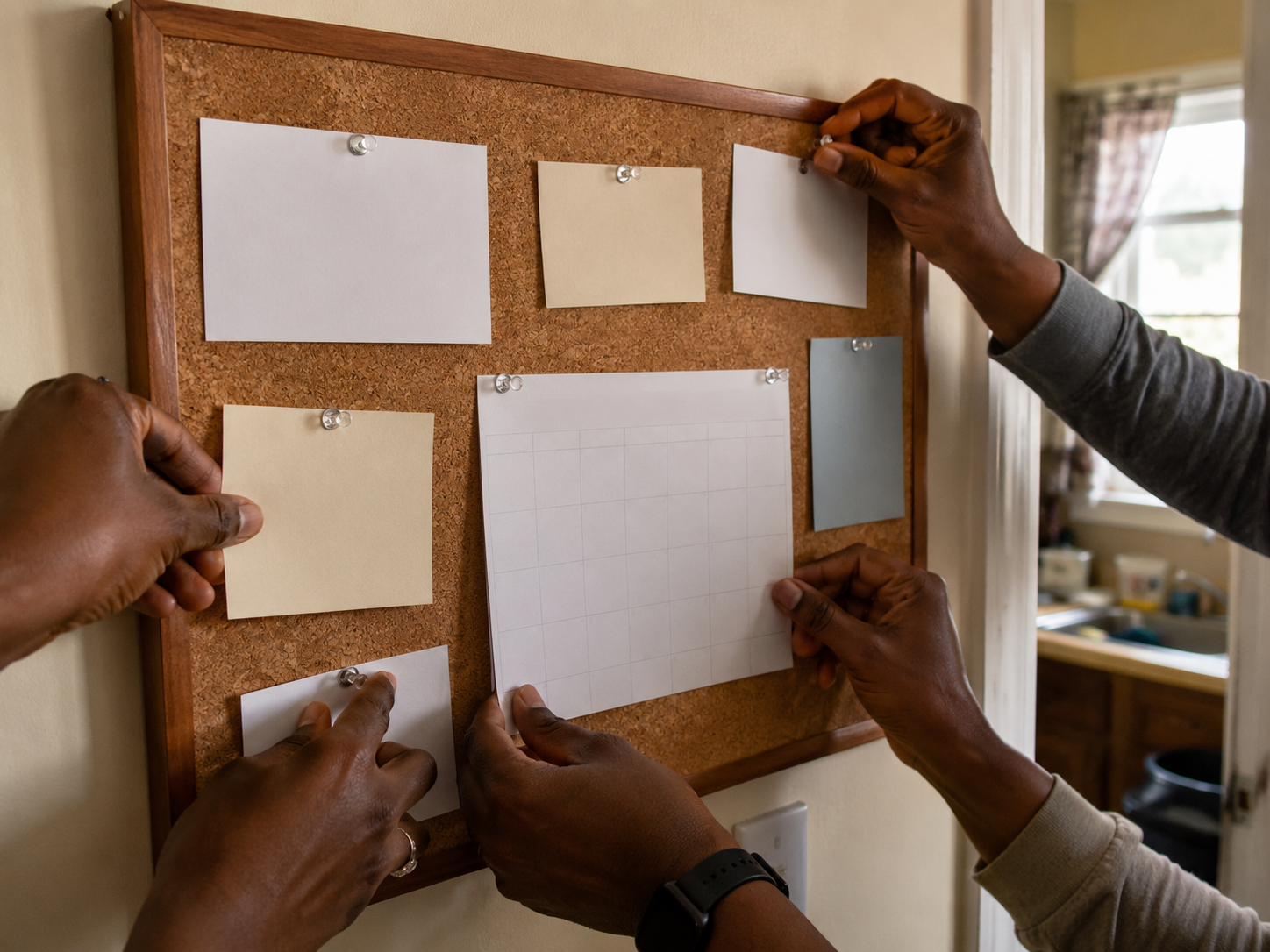
On a single page, write five short lists. Your essential monthly needs. Three emergency contacts. Where your important information is kept. Five recurring household responsibilities and who owns each. And the first three actions to take during a disruption. Then review it with the people who might actually need to use it. The map does not have to solve the future. It only has to answer the first frightened questions clearly enough to prevent panic.
Download the free One-Page Stability Map →
If your family is navigating a financial stretch, our Beyond Wealth library has companion tools for budgeting essentials and talking about money without blame.
Key Takeaways
- Family stability is capacity, not perfection.
- Emotional, relational, practical, financial, and community supports work together.
- Predictable routines reduce needless uncertainty but should stay flexible.
- Invisible labour should be named and shared before one person is overwhelmed.
- A simple stability map makes the first hours of a disruption far less confusing.
- The floor is built in calm seasons, which is the only time it can be built well.
Frequently Asked Questions
Does family stability require a high income?
No. Income affects options, but stability also comes from communication, routines, shared responsibilities, accurate information, realistic budgeting, and dependable relationships.
How can a family build stability during financial stress?
Begin with essential needs, clear information, and honest communication. Avoid pretending nothing has changed, and get qualified help when decisions involve debt, housing, taxes, or legal obligations.
Are routines always good for families?
Routines help when they create clarity and support. They become harmful when they are rigid, unrealistic, or used to control people rather than serve the household.
What should be on a family emergency list?
Key contacts, medical and school information, insurance contacts, medication details where appropriate, utility information, and the location of important documents. Protect sensitive information carefully.
How can relatives help without creating conflict?
Clarify whether the support is a gift, a loan, a shared expense, or a temporary arrangement. Discuss expectations, timing, any repayment, and boundaries before money or housing changes hands.
Next: Family Traditions
Stability helps a family stay standing. It does not tell the family what it is standing for. The next article, Family Traditions: How Rituals Build Identity, Belonging, and Memory, looks at how repeated acts create belonging, preserve stories, and connect one generation to the next.
The Family Foundations Path
- 1. Healthy Family Communication
- 2. Shared Family Values
- 3. Family Stability: Creating a Floor Before the Storm ← you are here
- 4. Family Traditions: Identity, Belonging, and Memory
- 5. Planning Together: Preparing a Family for Life’s Changes

Dance Mogul Magazine publishes the Beyond Wealth collection for educational and inspirational purposes. It is not financial, legal, tax, medical, or mental-health advice, and it is not a substitute for guidance from a licensed professional who knows your situation. The people described in the examples are composites created for illustration and do not represent real individuals.
© 2026 Dance Mogul Magazine LLC | dancemogul.com | Inspiring Self-Empowerment Through Dance Culture