
Featured Artist | Waving & Popping | Red Bull Dance Your Style
Jesse Sykes: The Utah Waver Who Made Subtlety Go Viral
An Air Force kid who moved every few years found his people in a Salt Lake City cypher at fifteen. Eighteen years later, a style built on stillness and control had Red Bull reposting his rounds by popular demand — and carried him to the national final four in Tampa.
By Dance Mogul Magazine | Featured Artist | September 2026
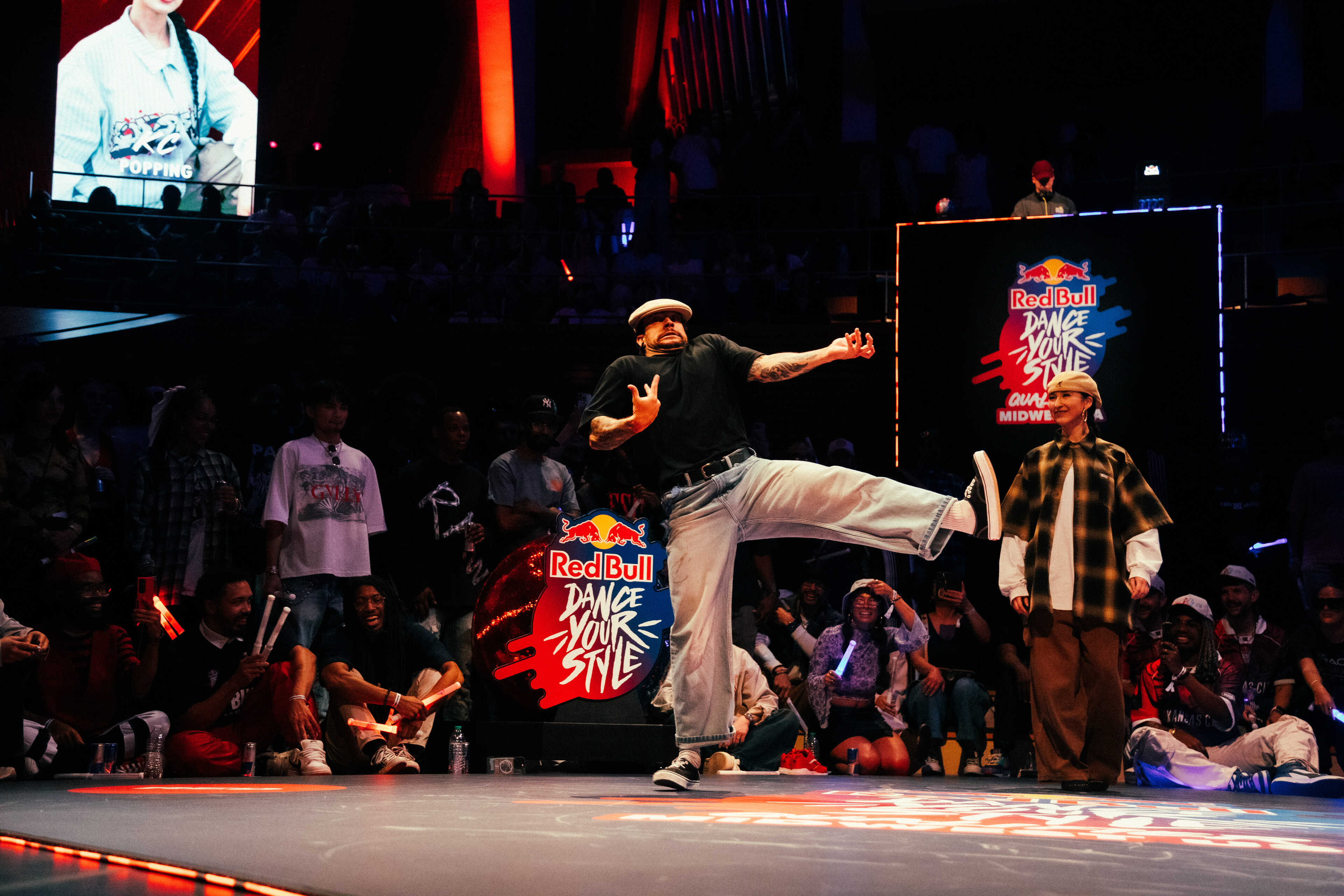
Jesse Sykes | Photographer Credit Marina Oya / Red Bull Content Pool
Artist Spotlight
Jesse Sykes is a waving and popping dancer from Layton, Utah, who grew up in an Air Force family, started dancing at fifteen in a Salt Lake City cypher, and has spent roughly eighteen years battling, teaching, judging and leading workshops around the world. He names two early mentors, Robot Rob and Cirque du Soleil performer Micah Clark, and talks openly about dance as a tool for mental health. In spring 2026, Red Bull’s main social accounts posted one of his rounds, danced to Timbaland’s “The Way I Are,” and then reposted it after viewers asked for “just the dance.” On September 19, 2026, he reached the final four of the Red Bull Dance Your Style USA National Final in Tampa.
File // At a Glance
NAME — Jesse Alexander Sykes
HOMETOWN — Layton, Utah (an Air Force family that moved every few years)
SCENE — Salt Lake City
STYLES — Waving (primary) | popping | robot and animation roots
STARTED — Age 15, at the FUNK Night cypher in downtown Salt Lake City
MENTORS — Robot Rob | Micah Clark
EARLY CREW — Boogietechz (Salt Lake City; known then as “Crank”)
INFLUENCES — Michael Jackson | Prince | Usher | B2K | Sade
WORK — Teaching worldwide | workshops and panels | judging
RED BULL 2026 — Viral “The Way I Are” round | Tampa final four
|
15 Age at His First Cypher |
18+ Years in Street Dance |
2 Mentors He Names |
4 Tampa Final Four |
Waving should not go viral. It is a quiet style: a ripple that seems to travel through a dancer’s arms and body while everything else holds perfectly still. It does not jump, flip or spin. In a crowd-voted battle, where big shapes usually win the room, a waver is making a bet that thousands of strangers will lean in and watch something small.
In 2026, Jesse Sykes won that bet in public. Red Bull’s main social accounts — not only its dance channel — posted one of his rounds, danced to Timbaland’s “The Way I Are,” and then posted it again because viewers wanted a cleaner look: “y’all wanted just the dance, so we ran it back.” By September he was in the national final four in Tampa, one of four dancers left from a field of touring professionals, studio owners and regional champions.
This profile makes two arguments. The first is that subtlety becomes spectacular when it is honest, and that the crowd can tell the difference. “In dance, you can’t lie,” he has said. The second matters more to Dance Mogul Magazine. Jesse Sykes is an Air Force kid who moved every few years and found his first real community in a Salt Lake City cypher, and he has spent the years since handing that feeling to other people — while naming the mentors who handed it to him.
An Air Force Kid Looking for a Place
His father served in the Air Force, and the family moved every two or three years, he told the street dance outlet Step X Step in 2015. A childhood like that teaches you to arrive, adjust and leave. What it rarely gives you is a community that lasts. When the family settled in Utah, the first impression was not promising. “I thought that we ended up in a place without a dynamic culture,” he recalled in a 2025 profile.
Music was already in the house. His mother is Puerto Rican, and his father and uncles were singers. His early influences read like a short course in American rhythm and showmanship: Michael Jackson, Prince, Usher, B2K and Sade.
Then, at fifteen, he found FUNK Night, a street dance cypher in downtown Salt Lake City. The way he describes it is the way many dancers describe the first time a scene opens its circle to them. “It was like I walked into Narnia for a moment. It all made sense,” he said. And then, more simply: “I knew I needed that feeling.”
Here is what a young dancer should take from that. The cypher is not only a place to practice. For a kid who has moved every few years, it can be the first place that feels like home. Utah, the state he thought had no dynamic culture, turned out to have one. He just had to find the room where it met.
Robot Rob, Micah Clark and a Crew Called Boogietechz
Ask Jesse Sykes how he learned, and he gives you names. His first mentor was Robot Rob, who introduced him to popping, robot and animation — the precise, hit-driven styles that became his foundation. Another early supporter was Micah Clark, a Cirque du Soleil performer, and Sykes described him to Step X Step in words worth reading slowly: Clark “always pushed me to keep doing it, I still wasn’t even considered a member of the scene and he just accepted me regardless.”
That sentence describes the most important thing an established dancer can do for a new one. Not a correction. Not a combo. Acceptance before it has been earned. Micah Clark treated a kid who was not yet part of the scene as if he already belonged, and the kid stayed.
By 2015, Step X Step was profiling him under the battle name Crank as a member of Boogietechz, a Salt Lake City crew working to revive the local popping community through free weekly sessions. Read that detail twice. The dancer who found his home in a free cypher was, within a few years, helping run free sessions for the next wave of kids. That is how a scene reproduces itself.
Know the Form: What Waving Is, and Why Stillness Wins a Battle
Waving is a dance style built from movements that make it look as if a wave is traveling through the dancer’s body. It is thought to have grown out of the popping and funk scene, and it is still often danced alongside popping, though many dancers now practice it on its own. The classic armwave sends motion from the fingertips of one hand, through the wrist, elbow and shoulder, across the chest and out the other arm. A bodywave carries it through the torso, knees and ankles. The rule that makes it work is harsh: everything the wave is not passing through must look perfectly still.
Why it matters in a battle: stillness is what lets a crowd see the music. When a waver holds the body frozen and lets one ripple move on a melody, the audience watches the sound travel. Big moves grab attention; control holds it. That is how a quiet style can win a loud room. Our Dance Knowledge Hub breaks down other forms the same way, and our profile of popping choreographer Marina Molina shows the wider family waving belongs to.
Choosing Dance at Eighteen, and Losing Early
After high school, he told Step X Step, he chose dance over continuing with school and sports, and committed to training hard enough to challenge the stereotypes attached to street dancers. It is a familiar decision and a frightening one, especially for a kid from a military family, where structure and a clear path tend to be valued.
The early results were humbling. At his first out-of-state battle, in Arizona, he went out in the semifinals, and he did not blame the judges or the music. Looking back in 2015, he described his younger self as “extremely egotistical.”
Here is the part young dancers should read twice. That self-assessment is the most useful line in his early story. Every dancer loses. The ones who last are the ones who can look at a loss and find the part that was theirs to fix. Eleven years after that interview, the dancer who called himself egotistical was reaching a national final four — in a format that rewards the opposite of ego, because the crowd can feel when a dancer is performing at them instead of with them.
“In dance, you can’t lie. If you are experiencing chaos in your life, it will show in your dance.” — Jesse Sykes (Timothy Features, January 2025)
The Superpower Larger Than Dance
A January 2025 profile of him ran under the headline “Dance and Mental Health: Jesse Sykes, Dancing With Joy,” and his own words explain why. “Dance has a superpower that is larger than dance itself,” he said. “It is about self-worth and a sense of communication, another language to speak through movement and channel energy.”
That belief shapes how he teaches. The same profile describes a teaching philosophy that puts the person ahead of the technique and makes room for conversations about mental health. His advice to students is plain: “Focus on the human aspect to give your movement a sense of purpose.” And when motivation fades: “Think about why you started dancing in the first place. Remind yourself of that.” His judge biography at the Dance Fierce competition states the mission the same way: to inspire others “by exemplifying the power of authenticity.”
The profile also recorded a setback that any dancer will understand. He had torn his right Achilles tendon while performing the previous October — the kind of injury that takes months to recover from and can end careers built on the legs. Put that beside the result that closes this story. The dancer who had torn an Achilles tendon on stage was, by September 2026, one of the last four standing on a national final floor.
Note what this adds to the viral clips. The audience sees a few smooth minutes. Behind them is a person who talks openly about self-worth, teaches students to protect their own reasons for dancing, and rebuilt his body after a serious injury. “Dance is everywhere,” he said. “It doesn’t have to be a specific space.”
The Round Red Bull Ran Back
Viral moments in battle dance usually belong to the flashiest dancer in the room. Jesse Sykes’s belonged to a waver dancing to Timbaland’s “The Way I Are,” the 2007 hit built on a looping synth riff — exactly the kind of melody a wave can ride.
The round spread through Red Bull’s own channels in a way few battle clips do. Red Bull’s main accounts, which reach far beyond the dance world, posted it under the line “these moves were CLEAN.” Then the audience asked for more, and Red Bull answered with a second version: “y’all wanted just the dance, so we ran it back.” On TikTok, Red Bull’s main account posted it as a reply to viewers in early May 2026. Red Bull’s dance channel added a clip titled “How to wow the crowd,” and in mid-May posted his battle with Zenta.
“The aura when it’s your favorite jam” — Red Bull Dance’s clip of Jesse Sykes | Video: Red Bull Dance/YouTube
Why would a quiet style travel so far? Because it is easy to feel and hard to fake. A viewer does not need to know the word waving to see a ripple land exactly on a note, or to notice that nothing else in the body moved. The comment sections asked for “just the dance” because people wanted to watch the control without distraction. That is the audience telling Red Bull what it valued, and Red Bull listening.
For young dancers, the lesson is not “go viral.” Nobody controls that. The lesson is that eighteen years of unglamorous control work produced a clip strangers wanted to watch twice. The virality was not the achievement. It was the receipt.
The Road to Tampa
The 2026 season filled the National Final two ways: the top two dancers from each regional qualifier, plus eight invited wildcards. Which door Jesse Sykes came through is not something we could confirm in the sources available to us before publication, and we are not going to guess at it. What the record does show is what he did once he was in the room.
That is worth pausing on. A national final is not a single good round. It is several crowd-voted battles in a row against dancers with entirely different vocabularies, and it rewards exactly what he has spent years building: consistency.
Tampa: Past Surge, Into the Final Four
On September 19, 2026, at the Tampa Convention Center, he came through the field of sixteen and into the final eight. Red Bull’s photograph of Houston’s Surge in mid-air shows the arena screens billing the next matchup: Surge, Freestyle, against Jesse Sykes, Waving. It was the most extreme contrast in the bracket — an acrobat whose power fills the air against a waver whose power is stillness — and the crowd sent the waver through.
“After four riveting matchups,” Red Bull’s recap reported, “Kidd The Monster, Lily Frias, JREAMZ and Jesse Sykes stood strong.” That was the final four. The recap does not say who he faced next, and we will not guess. The final went to JREAMZ, who beat Kidd The Monster for the American place at the World Final in Zurich; Lily Frias shared the final four with him. The rest of the final eight were Surge, Tyler D. Creator, Marlee Hightower and Harini Nilakantan. The full field is tracked in our Red Bull Dance Your Style Newsroom.
Look at the shape of the final four. Two of the four — Frias with popping and Sykes with waving — came from popping’s family of precision styles. In a room built to reward the obvious, half of the last four specialized in the exact.
Teaching, Judging and the Free Session
His biographies describe a working life that looks more like a teacher’s than a competitor’s. He teaches around the world and leads workshops and panels, according to the Bridge Street Dance biography, which names waving as his primary focus. He judges competitions, per his Dance Fierce biography. As far back as 2015 he was teaching at studios including Millennium Dance Complex while helping host two or three free open sessions a week with Boogietechz. His Patreon page carries a three-word motto: intention, attention, direction.
The free sessions deserve the emphasis. A free weekly session has no ticket, no guaranteed audience and no income. It exists because somebody decided the next kid who walks in off the street should find what he found at FUNK Night. That is the service record underneath the viral clips, and it is the part of his story most likely to outlast them.
“I still wasn’t even considered a member of the scene and he just accepted me regardless.” — Jesse Sykes, on mentor Micah Clark (Step X Step, 2015)
The Honors, and a Style Without Named Founders
2026 — Final four, Red Bull Dance Your Style USA National Final. Tampa, September 19.
2026 — Featured repeatedly across Red Bull’s main and dance channels. Including the “ran it back” repost of his “The Way I Are” round.
Judge, Dance Fierce.
Here is the honest part, and Dance Mogul Magazine would rather print it than pad a page: there is no comprehensive, publicly maintained record of Jesse Sykes’s full battle history. Not because the work was not honored, but because the industry has never built the infrastructure to track dance credit properly. Eighteen years of cyphers, workshops and judging leave very little written behind.
Why waving needs its names
The credit problem in waving is not an argument. It is visible on the page. Look up the style in a standard encyclopedia and you will learn that it “is thought to have grown out of the popping and funk dance scene” — and nothing about who first did it, where or when. A style that millions of people have watched in viral clips does not have a documented founder in the most common reference work on the internet.
That is what happens when movement travels by video and nobody writes down the names. The fix is the one Jesse Sykes practices in every interview: say who taught you. Robot Rob. Micah Clark. The crew that ran free sessions. Every name spoken is one more piece of a record that would otherwise vanish. It is why The Legacy exists on this site, and why we trace the American social dance movement back to the people who built it. If you know waving’s early history firsthand, we want to hear it through our contact page.
Where Jesse Sykes Is Now
As of late September 2026, Jesse Sykes is a Utah-based waving and popping dancer and teacher coming off a national final four, with a spring of viral clips behind him and a teaching practice that reaches well beyond Utah.
Beyond that, we are not going to invent a schedule for him. When there is verified news, this publication will report it.
A championship is a night. A career is a decade. His is nearly two decades old, and it started with a kid walking into a cypher and deciding he needed that feeling. Dance Mogul Magazine will keep following it.
Career Timeline
CHILDHOODGrows up in an Air Force family that moves every two or three years, in a house full of singers; the family settles in Utah.
AGE FIFTEENWalks into the FUNK Night cypher in downtown Salt Lake City and starts dancing; first mentor Robot Rob introduces him to popping, robot and animation.
AFTER HIGH SCHOOLChooses dance over school and sports; Cirque du Soleil performer Micah Clark encourages him before the scene fully accepts him.
FIRST ROAD BATTLELoses in the semifinals of his first out-of-state battle, in Arizona, and later calls his younger self “extremely egotistical.”
2015Profiled as “Crank” of Boogietechz, the Salt Lake City crew hosting free weekly sessions; teaching at studios including Millennium Dance Complex.
JANUARY 2025Profiled as “Dancing With Joy” in a feature on dance and mental health, which reports that he had torn his right Achilles tendon while performing the previous October.
MAY 2026Red Bull’s main and dance channels spread his “The Way I Are” round, reposting it after viewers asked for “just the dance.”
SEPTEMBER 19, 2026Beats Surge in the final eight and reaches the final four at the USA National Final in Tampa.
What He Represents to Young, Up-and-Coming Dancers
The assumption he broke is that a crowd-voted room belongs to the loudest dancer. It can belong to the most controlled one. Read as a method, his path shows five stages any serious dancer can locate himself on.
1. Find the room where you belong, then keep showing up
A kid who moved every few years found home in a cypher at fifteen. If you have not found your room yet, keep looking. It may be the one you least expected.
2. Name the people who accepted you early
Robot Rob. Micah Clark. He says their names. Somebody made room for you before you had earned it. Put their name on the record.
3. Own your losses honestly
He called his younger self egotistical in print. The dancers who improve are the ones who can find their own part in a loss.
“Think about why you started dancing in the first place. Remind yourself of that.” — Jesse Sykes (Timothy Features, January 2025)
4. Train the control nobody sees
The viral clip was a receipt for years of stillness drills. Big moves get attention; control keeps it. Practice the parts of your dance that do not look impressive yet.
5. Give away what you were given
Free weekly sessions, workshops, open conversations about mental health. Pass on the feeling that kept you in dance. If you are building the discipline behind a plan of your own, our workbooks were made for it.
Why Jesse Sykes Matters to Dance Mogul Magazine
Dance Mogul Magazine has published for over fifteen years on a single conviction: dance is the foundation, not the ceiling. Jesse Sykes says the same thing in his own words — that dance has “a superpower that is larger than dance itself” — and his story shows it: belonging for a kid who kept moving, self-worth, a language for hard feelings, and a way back after injury.
The movement vocabulary that drives mainstream entertainment is overwhelmingly born in Black and Latino communities, in club culture, in street dance and hip-hop, and is then absorbed upward into pop, film and television — frequently without credit traveling with it. Popping and its family of styles, waving included, are a textbook case. As a father and son Black owned dance publication, documenting that chain of authorship is not a side project for us. It is the work. A viral waver who uses his platform to name his mentors is doing that work in public.
If his story lands with you, keep going: read our street dance coverage, explore the full range of forms in our Dance Styles Hub, and study the artists shaping the industry in Black Creative Directors & Choreographers.
Frequently Asked Questions About Jesse Sykes
Who is Jesse Sykes?
Jesse Sykes is a waving and popping dancer and teacher from Layton, Utah, who reached the final four of the 2026 Red Bull Dance Your Style USA National Final in Tampa. He started dancing at fifteen in a Salt Lake City cypher and has about eighteen years in street dance.
What dance style does Jesse Sykes do?
Waving is his primary style. He started in popping, robot and animation, the family of precision styles waving grew out of, and Red Bull’s Tampa screen billed him under waving.
Why did Jesse Sykes go viral?
Red Bull’s main social accounts posted his round to Timbaland’s “The Way I Are” in spring 2026, then reposted it after viewers asked for “just the dance.” Red Bull’s dance channel shared more of his rounds, including a clip titled “How to wow the crowd.”
How did Jesse Sykes do at Red Bull Dance Your Style 2026?
He beat Surge in the final eight and reached the final four at the USA National Final in Tampa on September 19, 2026. JREAMZ won the title.
Who trained Jesse Sykes?
He names Robot Rob as his first mentor, who introduced him to popping, robot and animation, and Cirque du Soleil performer Micah Clark as an early supporter who accepted him before the scene did.
What is waving in dance?
Waving is a style built from movements that make it look as if a wave is traveling through the dancer’s body, while every other part stays still. It grew out of the popping and funk scene.
What does Jesse Sykes say about dance and mental health?
He describes dance as a superpower larger than dance itself, about self-worth and communication, and says that in dance you cannot lie. His teaching puts the person ahead of the technique and makes room for conversations about mental health.
Keep Exploring
Dance Mogul Magazine documents the artists who build the culture and the careers that grow out of it. Start with the Featured Artist series, dig into the Archive, follow the season in the Red Bull Dance Your Style Newsroom, and browse everything we have published in the Article Library.
Reporting sources: Timothy Features (January 2025); Step X Step (October 2015); Jesse Sykes’s Bridge Street Dance and Dance Fierce biographies; Red Bull’s USA National Final recap (September 2026) and season schedule; Red Bull, Red Bull USA and Red Bull Dance social posts from the 2026 season; Red Bull Content Pool photo records; Dance Mogul Magazine’s Tampa newsroom; and published descriptions of waving and popping. Career details reflect verified public reporting as of September 2026. Where the record is incomplete, this article says so.
Jesse Sykes Waving Popping Utah Street Dance Salt Lake City Dance and Mental Health Red Bull Dance Your Style Viral Dance Freestyle Battle Dance Lineage Featured Artist Tampa 2026
© 2026 Dance Mogul Magazine LLC | dancemogul.com | Inspiring Self-Empowerment Through Dance Culture
Red Bull and Red Bull Dance Your Style are trademarks of their respective owners. Dance Mogul Magazine is an independent publication and is not affiliated with, endorsed by, or sponsored by Red Bull.