
The Legacy / Camille A. Brown
Dance Mogul Magazine / The Legacy / Concert Dance, Broadway & Opera
CamilleA. Brown.
From a Small Voice in Queens to Broadway, the Met and Dreamgirls
She was the shy girl in Jamaica, Queens, teased because her voice was small, so she spoke with her body. Today Camille A. Brown is a five-time Tony nominee, the first Black artist to direct a mainstage production at the Metropolitan Opera, and the woman chosen to direct and choreograph the first newly staged Broadway Dreamgirls.
November 1, 2026 · Dance Mogul Magazine · The Legacy
5
Tony Award nominations
2019 to 2025
1st
Black artist to direct a
Met Opera mainstage production
6
Broadway productions
she has staged
20
Years of Camille A. Brown
& Dancers, 2006 to 2026
Prologue
September 27, 2021. The girl from across the street walks in the front door.
On the night the Metropolitan Opera reopened after 18 dark months, the curtain rose on Fire Shut Up in My Bones, Terence Blanchard’s opera based on Charles M. Blow’s memoir. It was the first opera by a Black composer the Met had performed since it was founded in 1883. One of its two directors was the first Black artist ever to direct a mainstage production in that house. Her name was Camille A. Brown.
In the third act, Brown did something the Met had never seen. She brought a line of young men onstage to step, the percussive art of stomps, claps and chants built in Black fraternities and sororities. The New York Times said the long step scene stopped the show. On opening night, as her alma mater later reported, one of her numbers drew more than a minute of applause.
Here is the detail almost nobody mentions. Brown went to high school at LaGuardia High School of Music & Art and Performing Arts, which sits across Amsterdam Avenue from Lincoln Center, steps from the back of the Metropolitan Opera House. As a teenager she studied in the opera house’s shadow. Two decades later her name was in its history books.
And before any of that, she was a shy little girl in Jamaica, Queens, who got teased because her voice was small. So she found another way to talk. “I didn’t always have a big voice and it was even smaller when I was little,” she told Rolling Out in 2019, “so I used to dance to communicate.”
That is the thread of this story. Camille A. Brown has spent her life giving voice to people who are not always heard: Black girls at play, Black performers inside old stereotypes, Black families at church and on the dance floor. She did it in her own company, then on Broadway, at the Met, in film and in free classes for anyone with an internet connection. Now, as she prepares to direct and choreograph the first newly staged Broadway Dreamgirls, Dance Mogul Magazine is telling her whole story while she is still writing it.
I found my voice and discovered that I didn’t have to wait for anyone to tell me when to dance. I could create the dance myself.
Camille A. Brown, interviewed by Kamilah Forbes for SDC, 2018
No. 01 / The File
Camille A. Brown at a Glance
Before the story / The map
One quiet girl, ten rooms.
Every room below is a real place in her life. If you are a young dancer who feels unseen, find the room you are standing in right now. She stood there too.
1
The living room
Making up dances to the opening credits of her cartoons.
2
The first studio
Bernice Johnson Cultural Arts Center in Queens: ballet, tap and African dance, before she turned five.
3
The second studio
Carolyn DeVore’s dance center, where Afro-Cuban and West African roots took hold.
4
The school by the Met
LaGuardia High School, where Ailey dancers visited and a career came into view.
5
The Ailey School
Training at the school of the company that showed her what was possible.
6
The composition class
North Carolina, where she was kept out of shows and found her voice as a maker.
7
The company
Ronald K. Brown/EVIDENCE, her professional home from 2001.
8
Her own company
Camille A. Brown & Dancers, founded in 2006.
9
The great stages
Broadway’s Booth, Shubert and Majestic theaters, and the Metropolitan Opera House.
10
The open classroom
Black Girl Spectrum, Social Dance for Social Change, and now USC.
No. 02 / The Beginning
A Small Voice, and a Body That Wanted to Talk
Camille A. Brown was born in Queens on December 11, 1979, and grew up in Jamaica, Queens. By her own account she was a quiet child. “I was always shy and didn’t participate in class because I was so nervous about saying the wrong thing,” she told Ms. magazine in 2022. “I was teased because my voice was small. Movement gave me the opportunity to express myself.”
So she moved. She told the Stage Directors and Choreographers Society that as a child she made up dances to the opening credits of the cartoons she watched. She grew up on Soul Train and on the videos of Michael and Janet Jackson. She also played the clarinet. “I didn’t love it like I loved dance,” she said in 2012, “but I think it’s one of the reasons why I’m known to be very musical.” Anyone who has watched her rhythm-driven choreography can hear that clarinet in it.
Her mother opened the next door. She loved musicals and brought her daughter into the world of theater. Even then, Camille was not dreaming about standing in the spotlight. “I was more so fascinated with how the shows were made,” she told Black Enterprise. “Who did the choreography?” The little girl who could not always find her words was already studying the people who arranged bodies in space to tell a story.
Her mother also gave her a sentence she carried for decades: “Don’t let anyone take your stuff away.” Hold on to that line. It comes back later in this story, in a way nobody could have planned.
No. 03 / The Studio
Queens Royalty: The Bernice Johnson Line
Before she turned five, Brown was enrolled at the Bernice Johnson Cultural Arts Center in Queens, taking ballet, tap and African dance in the class for three- to six-year-olds. That studio is one of the great unsung institutions of Black American dance.
Bernice Johnson ran her school in Queens for close to 50 years. Its alumni include the Tony- and Emmy-winning choreographer Michael Peters, and Dance Mogul Magazine readers already know another of its daughters: Nasha Thomas, who grew up there before Alvin Ailey chose her for his company. Camille A. Brown belongs to that same Queens line.
At Bernice Johnson’s she met the teachers who shaped her, among them Carolyn DeVore, Brian Hawthorn and Roger C. Jeffrey. “They helped me to set my own standard that was really, really high,” she told UNCSA in 2023. She went on to train at Carolyn DeVore’s own dance center. In the PBS documentary about Brown, DeVore remembers that her student’s roots began there with Afro-Cuban dance, then West African dance, and that Camille later took that study to a new level, researching the roots of her people.
Those roots matter. Long before she was known for it, Brown was soaking in the social dances of her neighborhood, the parties, the playgrounds and the television. “I’ve always loved social dance,” she says. “It sets place and time and the idea of culture for me.” The studio gave her technique. Queens gave her a vocabulary.
No. 04 / The Door
The High School Across From the Opera House
Brown went on to Fiorello H. LaGuardia High School of Music & Art and Performing Arts in Manhattan, across Amsterdam Avenue from Lincoln Center and the back of the Metropolitan Opera House. She also studied at The Ailey School.
It was there that dance became something she could imagine doing for a living. “I started dance class at 4 years old,” she told Ms., “but I didn’t know it was something I could do professionally until I went to LaGuardia High School and the Alvin Ailey dance company would visit.”
Possibility came with a hard question. “I didn’t know if it was really possible for me, as a Black woman, to have a successful career,” she said. The world of theater choreography she admired was, as she told Black Enterprise, predominantly white men. What changed her mind was a line of women who came before her. She has named them: Katherine Dunham, Dianne McIntyre, Marlies Yearby, Debbie Allen, Hope Clarke, Mabel Robinson and Paula Moss. “These women made me believe,” she told Black Enterprise.
Debbie Allen mattered in a second way. UNCSA’s magazine tells how Allen, a role model to the young dancer, had herself once been denied admission to the North Carolina School of the Arts, and how that story led Brown to look at the school. She auditioned, was accepted, and headed south.No. 05 / The Turn
Told She Wouldn’t Fit the Costumes
College should have been her launch. Instead, it was where the industry’s ideas about the “right” dancer’s body hit her hardest.
“I had teachers who believed in me and would help me achieve my goals,” she told Kamilah Forbes in 2018, “I also had teachers for whom I didn’t fit ‘the ideal’ body type.” There was a specific look, she said, and she didn’t have it. “Those classes were a struggle. I felt invisible and like a failure.”
For her first two years at the school, she didn’t dance in any of the shows. She wasn’t even asked to audition. “I was told I wouldn’t fit the costumes,” she said.
So she turned toward the classes nobody could keep her out of: composition and improvisation. Her composition teacher, Trish Casey, helped her see how a person’s personality could shape movement. Associate Dean Brenda Daniels taught her the structure and craft of making a dance. Casey still remembers the student she met: “from the very start she studied with an indomitable will, curiosity, careful note-taking and a very large gift for and love of dance.”
That is where the sentence at the top of this story was born. She stopped waiting for permission. She would make the dance herself. Brown earned her B.F.A. in 2001, and when she returned to give UNCSA’s commencement address in 2023, receiving an honorary doctorate, she told the graduates that rejection had been her “greatest liberator.” UNCSA’s Dean of Dance, Endalyn T. Outlaw, put it this way: “She’s a mighty force that overcame some challenges and was successful despite those things, not because of those things.”
Rejection has been my greatest liberator.
Camille A. Brown, as quoted by the University of Washington
No. 06 / The Apprenticeship
2001 to 2006: A Dancer Becomes a Maker
Right out of school in 2001, Brown joined Ronald K. Brown/EVIDENCE, A Dance Company, one of the most respected companies working in African diasporic movement. (The two Browns are not related.) She danced with the company for six seasons and performed with it at Jacob’s Pillow in 2002, 2004 and 2005.
At the same time, the choreographer in her was getting louder. In 2002 she received her first commission, from Hubbard Street 2 in Chicago. More followed, for Ailey II, Urban Bush Women, Philadanco!, Complexions and, in 2007, for the Alvin Ailey American Dance Theater itself, which premiered her The Groove to Nobody’s Business at Sadler’s Wells in London.
In 2006 the Princess Grace Foundation gave her its Choreography Award. Jacob’s Pillow records that she was the first woman to receive the Princess Grace Award in Choreography. It would be the first of several Princess Grace honors.
That same year she founded Camille A. Brown & Dancers. She is honest that she did not set out to lead a company. “At the root of it I didn’t want to have a company,” she told the Kennedy Center. “I was working out of fear that I didn’t know my voice, but I started creating works for other companies, and I wanted a more intensive experience with dancers.”
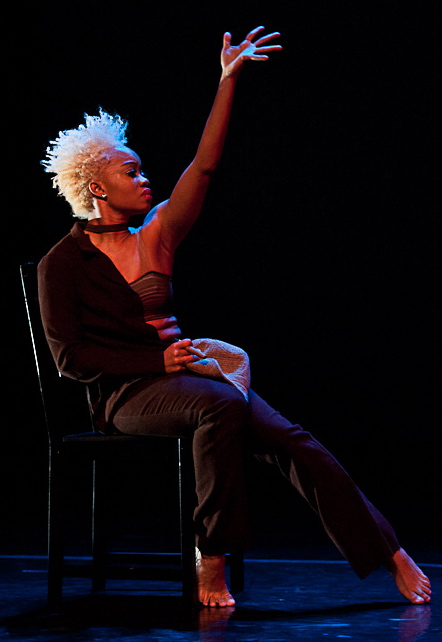
The early company works already carried her signature. New Second Line (2006) answered Hurricane Katrina with the brass-band processions and second-line dancing of New Orleans. The Evolution of a Secured Feminine, the work in our cover photograph, premiered at New York City Center’s Fall for Dance festival in 2007. City of Rain (2010) honored her friend and fellow dancer Gregory “Blyes” Boomer, who died in 2009 after a disease left him paralyzed. “Our friendship will last forever,” she wrote.
No. 07 / The Trilogy
Writing Our Own Stories in Ink
Between 2012 and 2017, Brown made three evening-length works that announced her as one of the most important voices in American dance. Together they form a trilogy about culture, race and identity.
Mr. TOL E. RAncE (created 2012; New York premiere at The Kitchen, April 2, 2013) took on the long history of Black performers forced to smile inside stereotypes. It drew on Mel Watkins’s history of Black humor On the Real Side, Spike Lee’s Bamboozled, Dave Chappelle’s commentary on dancing and shuffling, and W. E. B. Du Bois’s idea of double consciousness. It won the 2014 Bessie Award for Outstanding Production, and its 2022 revival was nominated again in 2023. BLACK GIRL: Linguistic Play (Joyce Theater, September 22, 2015) turned to joy. Built from Double Dutch, hand-clapping games, stepping, juba and the ring shout, it followed Black girlhood from the playground to womanhood. “How often do we get the chance to see ourselves through a black girl’s eyes?” Brown asked in a 2017 KQED interview. “It’s culturally specific, but the themes are universal.” In her program note she called the piece “a gift to myself and black girls everywhere.” It earned a 2016 Bessie nomination. ink (Kennedy Center, December 2, 2017) completed the cycle, mixing African diasporic gesture with blues, jazz, swing, hip-hop and live percussion. Its title is a statement of ownership. The work, she explained, is about Black people seeing themselves through their own lens and “writing our own stories in ink.”Culture note / What the girls are playing
Juba grew out of African-derived rhythmic footwork, clapping and body percussion that enslaved people preserved in America. The ring shout is a communal movement and song tradition kept alive by African American communities, especially the Gullah-Geechee people of coastal Georgia and South Carolina. Stepping developed in historically Black fraternities and sororities. Double Dutch has long been a space where Black girls make music, compete and create together. BLACK GIRL puts all of them on a concert stage.
How often do we get the chance to see ourselves through a black girl’s eyes?
Camille A. Brown to KQED, 2017
No. 08 / The Classroom
Every Body Move: Giving the Dance Back
Brown has never kept her knowledge inside the theater. In 2015 she was named a TED Fellow, and in 2016 she released a short TED film, A Visual History of Social Dance in 25 Moves, danced by kids, by her company and by Brown herself. It has been watched millions of times across TED and social media.
Its central idea is one she lives by. “A social dance isn’t choreographed by any one person,” she says in the talk. “It can’t be traced to any one moment.” In her telling, African American social dances began as a way for enslaved Africans to keep their traditions alive and hold on to an inner freedom, and every generation since has added a step.
In 2014 she launched EVERY BODY MOVE, her company’s community engagement platform. Its flagship initiative, Black Girl Spectrum, centered Black girls and women. Its first symposium, in 2016, was titled “Social Dance for Social Change” and was held at Dr. Barbara Ann Teer’s National Black Theatre in Harlem. In 2015 she also co-directed a social dance program at The School at Jacob’s Pillow with the dance historian E. Moncell Durden.
When the pandemic closed theaters in May 2020, her company opened a free virtual school, Social Dance for Social Change, with social dance classes led by company dancers and lectures by artists and scholars. That year she was named an Emerson Collective Fellow.
“As a young choreographer, I didn’t always believe in my dreams,” she told the Dance Data Project, “but it was my community and the people who came before me who inspired me to keep going. I am doing what I was taught – to pay it forward.”
No. 09 / The Main Stem
Broadway Calls Her Name, Five Times
Brown made her Broadway debut in 2012, choreographing A Streetcar Named Desire. Over the next decade she became one of the most sought-after creative leaders on Broadway.
She choreographed the revival of Once on This Island (2017–2019) and Tarell Alvin McCraney’s Choir Boy (2019), which earned her a first Tony nomination. She choreographed NBC’s Jesus Christ Superstar Live in Concert (2018) and Netflix’s Ma Rainey’s Black Bottom (2020).
Then came Ntozake Shange’s for colored girls who have considered suicide/when the rainbow is enuf, which opened at the Booth Theatre on April 20, 2022, with Brown as director and choreographer. It earned seven Tony nominations, two of them hers, for direction and for choreography. With it she became, in the wording of Jacob’s Pillow and the American Academy of Arts and Sciences, the first Black woman to direct and choreograph a Broadway play since Katherine Dunham in 1955.
Remember her mother’s sentence? “Don’t let anyone take your stuff away.” Brown told Ms. that only a couple of years before the revival did she learn it is a line from one of the poems in Shange’s play. “So I grew up with this in my life,” she said. The words her mother had given her as a girl were waiting for her inside the show she would bring back to Broadway.
She was nervous about honoring a work so beloved by Black women. A friend told her to think of the production as “an offering,” she told UNCSA, and that changed how she approached it.
In 2024 she choreographed Alicia Keys’s Hell’s Kitchen at the Shubert Theatre, winning the Chita Rivera Award and the Audelco Award and earning a fourth Tony nomination. Months later, on December 19, 2024, the revival of Gypsy opened at the Majestic with her choreography, bringing her fifth nomination in 2025. That made five Tony nominations in seven seasons, across both choreography and direction.
No. 10 / The Opera House
The Met: Step Dance Where It Had Never Been
Brown first choreographed at the Metropolitan Opera for its 2019 production of Porgy and Bess. Two years later she was back as co-director, with James Robinson, and choreographer of Terence Blanchard’s Fire Shut Up in My Bones.
Before opening night she admitted to PBS NewsHour how nervous she was when Blanchard first came to watch a rehearsal. “Because it’s Terence Blanchard,” she said. “And I don’t want to disappoint.” She also knew what she was bringing into the building: step dance and the Black church, she said, things Met audiences had probably never seen on that stage.
The New York Times headlined its take simply: “Hello, Opera? Meet Social Dance. It’s a showstopper.” The Met itself now describes the production as including “what is surely the only step dance in opera.” It returned to the Met’s repertory in 2024, and the 2022 Bessie Awards nominated Brown as Outstanding Choreographer/Creator for it.She did all of this in the same season she brought for colored girls to Broadway. In 2023 she was back at the Met again, choreographing Blanchard’s Champion, the life story of the boxer Emile Griffith. For it she studied Caribbean carnival dance from St. Thomas, reworked the Twist and the Mashed Potato for a nightclub scene, and watched boxers’ warm-up videos so the fights would feel real.
No. 11 / Signature Work
The Work That Defines Her
Ten landmarks from twenty years of making. Each one moved the conversation about who gets to tell Black stories on America’s biggest stages.
01
2006 · Washington, D.C.
New Second Line
A response to Hurricane Katrina built on New Orleans brass bands and second-line dancing.
02
2007 · New York City Center
The Evolution of a Secured Feminine
Premiered at Fall for Dance; the work in our cover photograph.
03
2010 · The Joyce Theater
City of Rain
An homage to her late friend Gregory “Blyes” Boomer.
04
2012–2013 · The Kitchen
Mr. TOL E. RAncE
Black performance, humor and the mask of minstrelsy.
05
2015 · The Joyce Theater
BLACK GIRL: Linguistic Play
Double Dutch, hand games and sisterhood, seen through a Black girl’s eyes.
06
2017 · Kennedy Center
ink
Black life told in its own words, with live music.
07
2021 · Metropolitan Opera
Fire Shut Up in My Bones
Co-director and choreographer; the step dance that stopped the show.
08
2022 · Booth Theatre
for colored girls…
Director and choreographer of Ntozake Shange’s choreopoem.
09
2024 · Shubert Theatre
Hell’s Kitchen
Alicia Keys’s New York story, moved by the city Brown grew up in.
10
2024–2025 · Jacob’s Pillow & The Joyce
I AM
Her fourth evening-length company work: Black joy with HBCU drumline rhythms, voguing, waacking, New Jack Swing and breaking.
No. 12 / The Screening Room
Watch & Listen
Films and conversations chosen to help you see her dances and hear the woman who made them.
Featured · Selected by Dance Mogul Magazine
A Visual History of Social Dance in 25 Moves
Start here. In a few minutes Brown, her dancers and a group of young people travel from the ring shout to today’s viral steps, and show why no one person owns a social dance.
Video: TED
Camille A. Brown: Giant Steps
The 15-minute documentary from American Masters and Firelight Media, co-directed by Michelle Parkerson and Shellée M. Haynesworth, follows her from her Queens neighborhood to Broadway and classrooms around the world.
Watch on PBS ↗The Evolution of a Secured Feminine
Archival footage of the work in our cover photograph, performed at Jacob’s Pillow.
Watch at Jacob’s Pillow ↗BLACK GIRL: Linguistic Play
The Pillow’s video record of the trilogy’s second chapter, with notes on Brown’s career.
Watch at Jacob’s Pillow ↗I AM: The World Premiere
The program that premiered I AM in the Ted Shawn Theatre, with Turf from ink.
Watch at Jacob’s Pillow ↗How Can We Tap Into Our Creative Expression Through Dance?
Brown talks about the “ideal” dancer’s body, finding choreography, and the roots of social dance.
Listen at NPR ↗The Met’s Historic Opening Night
Report from the night Fire Shut Up in My Bones opened the Met season, with Brown in rehearsal.
Watch at PBS NewsHour ↗No. 13 / On the Road
The Stages Tracker
A legacy is also a calendar. These are dated, documented moments when Camille A. Brown’s work reached a stage, newest first. In 2026 and 2027 her company is carrying I AM from Arizona to Abu Dhabi to California.
| Date | Work / event | Place | Role |
|---|---|---|---|
| Apr 15, 2027 | I AM (scheduled) | Granada Theatre, Santa Barbara, CA | Company tour |
| Jan 21, 2027 | I AM (scheduled) | The Arts Center, NYU Abu Dhabi, UAE | Company tour |
| Mar 19, 2026 | I AM | Arizona Arts Live, Arizona | Company tour |
| Oct 10, 2025 | Hell’s Kitchen national tour opens | Touring, United States | Choreographer |
| Sept 12–14, 2025 | I AM, West Coast premiere | Ahmanson Theatre, Los Angeles | Company |
| 2025 | I AM, New York premiere | The Joyce Theater, New York | Company |
| Dec 19, 2024 | Gypsy opens | Majestic Theatre, Broadway | Choreographer |
| Jul 31–Aug 4, 2024 | I AM, world premiere | Jacob’s Pillow, Becket, MA | Company |
| Apr 20, 2024 | Hell’s Kitchen opens | Shubert Theatre, Broadway | Choreographer |
| May 2023 | Commencement speaker, honorary doctorate | UNCSA, Winston-Salem, NC | Speaker |
| 2023 | Champion | Metropolitan Opera, New York | Choreographer |
| Apr 20, 2022 | for colored girls… opens | Booth Theatre, Broadway | Director & choreographer |
| Sept 27, 2021 | Fire Shut Up in My Bones opens the season | Metropolitan Opera, New York | Co-director & choreographer |
| Apr 25, 2019 | ink, UAE debut | NYU Abu Dhabi, UAE | Company |
| Jan 8, 2019 | Choir Boy opens | Broadway | Choreographer |
| Feb 1–4, 2018 | ink | Peak Performances, Montclair, NJ | Company |
| Jan 26–27, 2018 | Lecture and ink | Hancher Auditorium, Iowa City | Company & speaker |
| Dec 2, 2017 | ink, world premiere | Kennedy Center, Washington, D.C. | Company |
| Dec 3, 2017 | Once on This Island opens | Broadway | Choreographer |
| Aug 9–13, 2017 | BLACK GIRL, first Ted Shawn Theatre engagement | Jacob’s Pillow, Becket, MA | Company |
| Sept 22, 2015 | BLACK GIRL, premiere | The Joyce Theater, New York | Company |
| 2015 | Social Dances: Jazz to Hip-Hop | The School at Jacob’s Pillow | Co-director with E. Moncell Durden |
| Apr 2, 2013 | Mr. TOL E. RAncE, New York premiere | The Kitchen, New York | Company |
| Apr 22, 2012 | A Streetcar Named Desire opens | Broadway | Choreographer |
| 2010 & 2011 | Company engagements | Jacob’s Pillow, Becket, MA | Company |
| Aug 9, 2010 | City of Rain | The Joyce Theater, New York | Company |
| Sept 2007 | The Groove to Nobody’s Business | Sadler’s Wells, London | Choreographer (Ailey) |
| Sept 2007 | The Evolution of a Secured Feminine | New York City Center, Fall for Dance | Choreographer |
| Aug 2006 | New Second Line | Washington, D.C. | Choreographer |
| 2002, 2004, 2005 | Ronald K. Brown/EVIDENCE | Jacob’s Pillow, Becket, MA | Dancer |
Documented listings above, by period · bars drawn to scale
A floor, not a full count: this list holds only dated, located engagements found in public records. It leaves out most tour stops, residencies, master classes and the eight-shows-a-week life of a Broadway run.
No. 14 / The Lineage
The Lineage
Shaped by
Her mother
Musicals, and “don’t let anyone take your stuff away”
Bernice Johnson Cultural Arts Center
First studio, Queens
Carolyn DeVore
Teacher and studio, Queens
Brian Hawthorn & Roger C. Jeffrey
Early teachers
LaGuardia & The Ailey School
Where a career came into view
Trish Casey & Brenda Daniels
Composition and craft, UNCSA
Ronald K. Brown/EVIDENCE
Her first company
The women who made her believe
Katherine Dunham
Dianne McIntyre
Marlies Yearby
Debbie Allen
Hope Clarke
Mabel Robinson
Paula Moss
Camille A. Brown
Dancer · Choreographer · Director · Educator
Collaborators
Camille A. Brown & Dancers
Dancers and musicians since 2006
Kamilah Forbes
Collaborator and interviewer
Terence Blanchard & James Robinson
The Met
Alicia Keys
Hell’s Kitchen
E. Moncell Durden
Social dance teaching
Passing it on
Black Girl Spectrum
Since 2014
Social Dance for Social Change
Free virtual school, 2020
UNCSA
Guest artist and master classes
USC Kaufman
Named Mann Endowed Artist, 2026
Names come from Brown’s interviews, UNCSA, Black Enterprise and her company records. Students are shown as programs and institutions, not as individuals we cannot document.
No. 15 / By the Numbers
By the Numbers: The Economy Around Her Art
Applause is hard to measure. Careers, productions and public support are not. Every figure below is labeled with its scope and source.
5 Tony
Nominations in seven seasons, 2019 to 2025: Choir Boy · for colored girls… (direction and choreography) · Hell’s Kitchen · Gypsy
A career in years · bars drawn to scale
Tier 1 / The productions she shaped
| Measure | Figure | Scope | Source |
|---|---|---|---|
| Tony nominations, for colored girls… (2022) | 7 | The production, two of them Brown’s | Tony Awards / Broadway.com |
| Hell’s Kitchen Broadway run | Apr 20, 2024 – Feb 22, 2026 | Shubert Theatre; tour from Oct 10, 2025 | IBDB |
| Gypsy Broadway run | Dec 19, 2024 – Aug 17, 2025 | Majestic Theatre | IBDB |
| Once on This Island Broadway run | Dec 3, 2017 – Jan 6, 2019 | Revival; national tour 2019–2020 | IBDB |
| Original Dreamgirls run | 1,521 performances | Imperial Theatre, 1981–1985 | Broadway News |
| Met history, Fire Shut Up in My Bones | 1st | First opera by a Black composer in the Met’s history (founded 1883) | Metropolitan Opera |
These figures describe the productions, not Brown’s share of them.
Public support for her work · bars drawn to scale
Grants and awards found in public records: the Ford Foundation grants database, Ford’s 2017 fellowship announcement, Jacob’s Pillow, UNCSA (as reported by DMM in 2019) and NEFA. Together they add up to $568,000 ($450,000 + $50,000 + $25,000 + $20,000 + $10,000 + $8,000 + $5,000). Most of it supports her company, its tours and new work. It is not her personal income and not a complete funding history.
Tier 2 / The profession she leads · U.S. Bureau of Labor Statistics, May 2025
$26.59/hr
Median wage, choreographers
$24.80/hr
Median wage, dancers
The government notes that nearly all choreographers begin as dancers, exactly as Brown did. Her path shows how far that ladder can go: from dancer to company founder, Broadway director and a named, endowed post at a major university.
Tier 4: Brown’s personal earnings, Broadway royalties and fees are not public. DMM does not estimate them.
No. 16 / Context
What Belongs to Everyone
Honoring Camille A. Brown means keeping every credit in its place, and she would be the first to insist on it.
The social dances in her work belong to communities, not to any one choreographer. Stepping grew up in historically Black fraternities and sororities. Juba and the ring shout were carried by enslaved people and their descendants. Double Dutch belongs to generations of Black girls on city sidewalks. Brown’s gift is arrangement, research and storytelling: she brings those traditions onto concert, Broadway and opera stages with their history attached.
The milestones are worded carefully for the same reason. She was the first Black artist to direct a mainstage production at the Met, co-directing with James Robinson. On Broadway, she was the first Black woman to direct and choreograph a play since Katherine Dunham in 1955, which means Dunham came first. And the original Dreamgirls belongs to its creators, the writer Tom Eyen, the composer Henry Krieger and the director Michael Bennett, who shared that show’s 1982 Tony for choreography with Michael Peters.
No. 17 / Today
Where Is Camille A. Brown Now?
As of November 1, 2026, Camille A. Brown is the announced director and choreographer of the first Broadway Dreamgirls to be newly directed and choreographed since the 1981 original.
The revival was announced on September 15, 2025, by Sonia Friedman Productions, Sue Wagner, John Johnson and LaChanze, with a worldwide search for the three Dreams. Jennifer Hudson, who won an Oscar as Effie in the 2006 film, joined the producing team in February 2026. On August 25, 2026, producers said the show would no longer open in fall 2026. “The new Broadway production of Dreamgirls, directed and choreographed by Camille A. Brown, is absolutely moving forward,” they said. “We look forward to announcing the theatre, dates and casting when they are confirmed.” As of this writing, no theater, dates or cast have been announced.
In September 2026 the USC Glorya Kaufman School of Dance named her its next Claude and Alfred Mann Endowed Artist in Dance, following William Forsythe and Kyle Abraham. USC’s announcement places the start of her appointment in fall 2027.
Her company is in its twentieth year. I AM, its fourth evening-length work, premiered at Jacob’s Pillow in 2024, reached The Joyce in 2025, and is booked for NYU Abu Dhabi on January 21, 2027 and Santa Barbara on April 15, 2027. “This is who ‘I AM,’ as a Black woman,” she told the Amsterdam News. The Hell’s Kitchen national tour continues with her choreography. In 2025 she was elected to the American Academy of Arts and Sciences, and PBS American Masters released Camille A. Brown: Giant Steps. In 2026 the International Black Theatre Festival named her a Special Recognition Award honoree.
No. 18 / Why Now
The Dreamgirls Circle
There is a reason this moment feels like more than the next job on a busy calendar.
In 1982, the Tony for choreographing the original Dreamgirls went to Michael Bennett and Michael Peters. Peters, who went on to stage Michael Jackson’s most famous videos, was one of the dancers who came out of Bernice Johnson’s school in Queens. More than four decades later, a girl from that same Queens studio has been chosen to give Dreamgirls its first new staging on Broadway.
Dance Mogul Magazine does not know whether Brown has ever thought about that circle. We noticed it, because preserving these lines is what we do. A neighborhood studio in Queens trained the choreographer of the original, and now it has produced the woman reimagining it.
That is why we are writing this now, while the story is still moving. Documenting a living legacy lets the record be accurate while the artist can still correct it. It lets young dancers see a path while they can still walk it. And it turns a life’s contribution into recognized history before the next generation has to go searching for it.
No. 19 / The Archive
The DMM Archive Connection
On April 23, 2019, Dance Mogul Magazine reported that Camille A. Brown and fellow alumnus Juel Lane had been named UNCSA’s Alumni Artpreneurs of the Year. Read DMM’s 2019 report.
Brown’s $20,000 award was given for creative enterprise, to sustain Camille A. Brown & Dancers. At the time she was touring ink, and Lane was dancing in her company. Seven years later, this feature picks up where that report left off.
She also belongs to a Queens family of artists DMM has already honored: Nasha Thomas, a fellow Bernice Johnson student, and Desmond Richardson, who grew up in Queens and rose through Ailey to American Ballet Theatre.
No. 20 / Our Mission
Why Camille A. Brown’s Legacy Matters to Dance Mogul Magazine
DMM exists to show young people that their lives, their neighborhoods and their culture are worth building on. Camille A. Brown’s life is that message in motion.
She is a lesson in character before celebrity: a woman who was kept off the stage and responded by learning to build the stage. She is a lesson in contribution before attention: her free classes, her girls’ programs and her research into where our dances come from were never the flashy part of her résumé, and she did them anyway. And she is a lesson in people before popularity. Her biggest productions are about ordinary Black lives told with dignity, from girls jumping rope to young men stepping in a fraternity line.
For the Black girl who has been told she has the wrong body, the wrong voice or the wrong neighborhood, Brown’s career answers back. That is the kind of story DMM was founded to tell.
No. 21 / The Measure
What Dance Would Be Missing Without Camille A. Brown
A Black woman’s name in Met history
The first Black artist to direct a mainstage production at the Metropolitan Opera, and step dance on that stage.
for colored girls for a new generation
Shange’s choreopoem, directed and choreographed by a Black woman, back on Broadway with seven Tony nominations.
A trilogy that changed concert dance
Mr. TOL E. RAncE, BLACK GIRL and ink: minstrelsy confronted, girlhood celebrated, Black life written in its own ink.
Black girlhood on the concert stage
Double Dutch and hand games treated as art, not afterthought.
A free school when the world shut down
Social Dance for Social Change, open to anyone during the pandemic.
A history lesson millions have watched
Twenty-five moves that show where America’s dances come from.
No. 22 / For the Young Dancer Reading This
What Future Generations Can Learn From Camille A. Brown
01
A small voice is still a voice.
She was teased for speaking softly, so she spoke with movement. Find the language that is yours.
02
Don’t wait for permission.
“I didn’t have to wait for anyone to tell me when to dance. I could create the dance myself.”
03
Let rejection redirect you.
Kept out of college shows, she found choreography. She calls rejection her “greatest liberator.”
04
Know where your dance comes from.
“A social dance isn’t choreographed by any one person.” Learn the history in your steps.
05
Don’t let anyone take your stuff away.
Her mother’s words, and a line from the play she would one day direct. Protect your gift.
06
Build community before the curtain.
“If you are trying to create a world of community on stage, that has to happen before you get on stage,” she told the Boston Globe.
07
Pay it forward.
“I am doing what I was taught – to pay it forward.” Teach what you were given.
No. 23 / The Timeline
Career & Cultural Timeline
Culture = the world around her · Career = her own work · Teaching = passing it on
1979
CAREER
Born December 11 in Queens, New York; raised in Jamaica, Queens.
Early 1980s
CULTURE
Begins ballet, tap and African dance at the Bernice Johnson Cultural Arts Center before age five; grows up on Soul Train and Michael and Janet Jackson videos.
1990s
CAREER
Trains with Carolyn DeVore; attends LaGuardia High School and The Ailey School.
2001
CAREER
B.F.A. in Dance, UNCSA; joins Ronald K. Brown/EVIDENCE.
2002
CAREER
First choreographic commission, from Hubbard Street 2.
2005
CULTURE
Hurricane Katrina; the next year she answers with New Second Line.
2006
CAREER
Founds Camille A. Brown & Dancers; receives the Princess Grace Award in Choreography.
2007
CAREER
The Evolution of a Secured Feminine at Fall for Dance; Ailey premieres The Groove to Nobody’s Business in London.
2010
CAREER
City of Rain premieres at The Joyce.
2012
CAREER
Broadway debut, A Streetcar Named Desire; creates Mr. TOL E. RAncE.
2014
TEACHING
Launches EVERY BODY MOVE and Black Girl Spectrum; Bessie Award for Mr. TOL E. RAncE.
2015
CAREER
BLACK GIRL: Linguistic Play; TED Fellow; Doris Duke Artist Award; United States Artists Fellow.
2016
TEACHING
TED film on social dance; Jacob’s Pillow Dance Award; Guggenheim Fellowship; first Black Girl Spectrum symposium.
2017
CAREER
ink premieres at the Kennedy Center; Once on This Island opens; Ford Foundation Art of Change Fellow.
2019
CAREER
Choir Boy brings her first Tony nomination; choreographs Porgy and Bess at the Met.
2020
TEACHING
Free virtual school Social Dance for Social Change; Obie Award; Ma Rainey’s Black Bottom.
2021
CAREER
Co-directs Fire Shut Up in My Bones, the first Black artist to direct a Met mainstage production.
2022
CAREER
Directs and choreographs for colored girls… on Broadway; two Tony nominations.
2023
TEACHING
Honorary doctorates from UNCSA and Drew; UNCSA commencement speaker; Champion at the Met.
2024
CAREER
Hell’s Kitchen (Chita Rivera Award, Tony nomination); I AM premieres; Gypsy opens.
2025
CULTURE
Elected to the American Academy of Arts and Sciences; PBS releases Giant Steps; Dreamgirls revival announced; fifth Tony nomination.
2026
TEACHING
Company’s 20th year; named USC Kaufman’s Mann Endowed Artist in Dance; Dreamgirls moved beyond fall 2026.
No. 24 / Coda
The Voice Was Never Small
It began in a Queens living room, with a shy girl dancing to cartoon theme songs because the words would not come.
She took that language to a studio on a Queens avenue, to a high school steps from the opera house, and to a college where she was told she would not fit the costumes. She kept making dances anyway. Then she made a company, a trilogy, a free school, a Broadway revival that earned her two Tony nominations, and a showstopper at the Met.
Now she is preparing to stage Dreamgirls, a musical about three young Black women learning how big their voices are.
Camille A. Brown’s voice was never small. It was waiting for a stage big enough to hold it, and she built that stage herself.
Questions / Answers
Camille A. Brown: Frequently Asked Questions
Who is Camille A. Brown?
Camille A. Brown is an American choreographer, director, dancer and educator from Jamaica, Queens, New York. She founded Camille A. Brown & Dancers in 2006, has received five Tony Award nominations, and in 2021 became the first Black artist to direct a mainstage production at the Metropolitan Opera.
Where did Camille A. Brown train?
She began at the Bernice Johnson Cultural Arts Center in Queens before age five, trained with Carolyn DeVore, attended LaGuardia High School and The Ailey School, and earned a B.F.A. in Dance from the University of North Carolina School of the Arts in 2001.
Is Camille A. Brown directing Dreamgirls on Broadway?
Yes. She is the announced director and choreographer of the Broadway revival of Dreamgirls, first announced in September 2025. On August 25, 2026, producers said it would no longer open in fall 2026 but is moving forward. As of November 1, 2026, the theater, dates and cast have not been announced.
How many Tony nominations does Camille A. Brown have?
Five: Best Choreography for Choir Boy (2019), Best Direction of a Play and Best Choreography for for colored girls who have considered suicide/when the rainbow is enuf (2022), and Best Choreography for Hell’s Kitchen (2024) and Gypsy (2025).
What history did Camille A. Brown make at the Metropolitan Opera?
As co-director, with James Robinson, of Terence Blanchard’s Fire Shut Up in My Bones, which opened the Met’s season on September 27, 2021, she became the first Black artist to direct a mainstage production there. She also choreographed the production, including its celebrated step-dance scene.
Is Camille A. Brown related to Ronald K. Brown?
No. She danced with Ronald K. Brown/EVIDENCE, A Dance Company, beginning in 2001, but the two Browns are not related.
What is Camille A. Brown & Dancers?
Camille A. Brown & Dancers (CABD) is the New York company she founded in 2006. Its repertory includes Mr. TOL E. RAncE, BLACK GIRL: Linguistic Play, ink and I AM, and its EVERY BODY MOVE platform runs Black Girl Spectrum and the Social Dance for Social Change school.
What will Camille A. Brown do at USC?
In September 2026 the USC Glorya Kaufman School of Dance named her its next Claude and Alfred Mann Endowed Artist in Dance, an appointment USC says begins in fall 2027. She follows William Forsythe and Kyle Abraham in USC Kaufman’s Mann endowed post.
The Legacy Collection
The Queens line.
Read the legacy →
Nasha Thomas
a fellow Bernice Johnson student
Read the legacy →
Desmond Richardson
Queens to Ailey to ABT
Read the legacy →
Michael Peters
Bernice Johnson alum, original Dreamgirls Tony
Read the legacy →
Debbie Allen
one of the women who made her believe
Read the legacy →
Alvin Ailey
the company that showed her the way
Read the legacy →
Judith Jamison
Ailey’s great leader
You are here
Camille A. Brown
Queens to Broadway, the Met and Dreamgirls
Dance Mogul Magazine / The Legacy
Artistry in motion.
Preserving the stories of dancers who changed what the world could see, and handing the next generation the map. Dance Mogul Magazine is a Black-owned dance and empowerment publication, documenting legacies since 2010.
Explore The Legacy ↗Camille A. Brown & Dancers ↗Sources & further reading
IBDB: Camille A. Brown credits and awards ↗
UNCSA Scene: The ever-expanding universe of Camille A. Brown (2023) ↗
UNCSA: The Evolution of Camille A. Brown ↗
UNCSA: 2023 commencement and honorary doctorate ↗
SDC: Illuminating the Invisible, interview by Kamilah Forbes ↗
Ms.: Camille Brown on Movement, Power and Creative Identity (2022) ↗
Rolling Out: Camille A. Brown on her journey (2019) ↗
Black Enterprise: Cool Jobs, Broadway Choreographer Camille A. Brown ↗
Wesleyan University: interview (2012) ↗
KQED: Black Girlhood Through Black Girls’ Eyes (2017) ↗
The Kennedy Center: Camille A. Brown ↗
TED: A visual history of social dance in 25 moves ↗
PBS NewsHour: Black experience finds its way to the Met stage (2021) ↗
Metropolitan Opera: Blaze of Glory ↗
PBS American Masters: Camille A. Brown: Giant Steps ↗
Jacob’s Pillow: 2017 press release ↗
Jacob’s Pillow Dance Interactive: Camille A. Brown ↗
Hancher Auditorium: ink program (2018) ↗
Cal Performances: BLACK GIRL program notes (2017) ↗
Boston Globe: I AM at Jacob’s Pillow (2024) ↗
Amsterdam News: I AM at The Joyce (2025) ↗
Dance Data Project: Choreographer Profile ↗
Playbill: Dreamgirls Delays Broadway Return (Aug 25, 2026) ↗
Deadline: Dreamgirls revival postponed (Aug 2026) ↗
ABC News: Dreamgirls revival announced (Sept 15, 2025) ↗
JBHE: USC Kaufman appointment (Sept 2026) ↗
American Academy of Arts and Sciences: Camille A. Brown ↗
Library of Congress: juba and the roots of tap ↗
U.S. Bureau of Labor Statistics: Dancers and Choreographers ↗
Published November 1, 2026. Dates, productions and schedules are current as of that day and will be updated as announcements are made. Cover photograph: Christopher Duggan.