
Dance Mogul Magazine · The Legacy · Before Hollywood · Breaking & Martial Arts
Donnie Yen Before Hollywood: The Kung Fu Star Who Breakdanced Into the Movies
Before Ip Man, Rogue One and John Wick, a young martial artist raised between Hong Kong and Boston performed breaking and a moonwalk in his first film, then played a hip-hop dancer in his second. Donnie Yen would go on to develop award-winning action choreography and direct his own John Wick spin-off, Caine. DMM examines what the films establish, what Yen has said about musical rhythm, and where the evidence stops.
October 13, 2026 · Dance Mogul Magazine · Legacy Feature
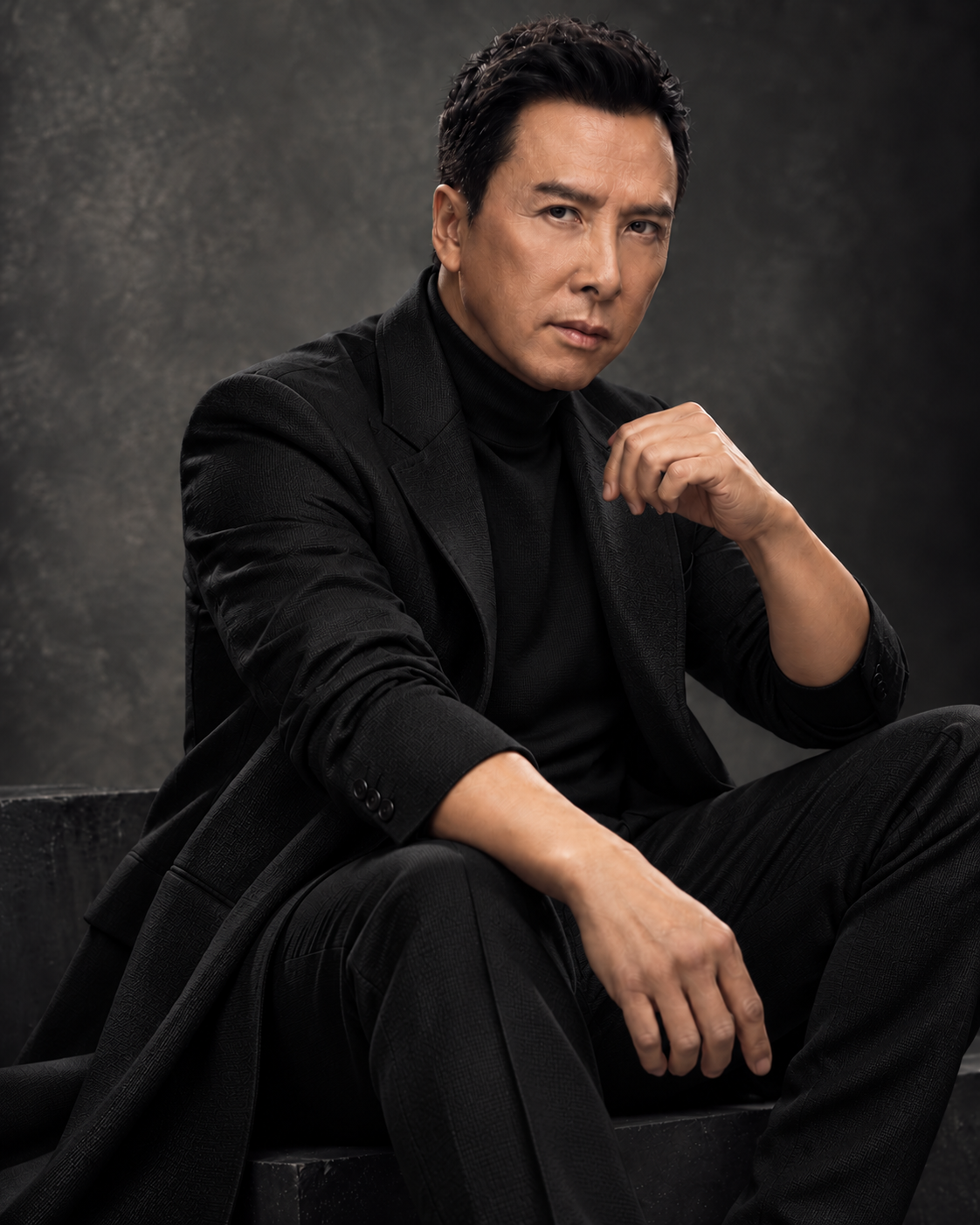
Editorial illustration representing Donnie Yen, whose early films Drunken Tai Chi (1984) and Mismatched Couples (1985) featured breaking and hip-hop dance alongside martial arts.
Editorial illustration Dance Mogul Magazine · Not an actual photograph of Donnie Yen.
A Dance-Off in a Kung Fu Movie
On April 3, 1985, Hong Kong audiences saw Mismatched Couples, a comedy starring Donnie Yen as Eddie, a hip-hop dancer. In one memorable sequence, Eddie faces a romantic rival in a choreographed dance-off. Yen was 21, and it was his second film as a leading actor.
His name was Donnie Yen. Today the world knows him as the Wing Chun master in the Ip Man films, the blind warrior Chirrut Îmwe in Rogue One: A Star Wars Story and the blind assassin Caine in John Wick: Chapter 4. The year before Mismatched Couples, his first starring role in Drunken Tai Chi (1984) had already slipped a breaking sequence, moonwalk included, into a traditional kung fu story.
Most people who stumble on those scenes treat them as a curiosity: look, the kung fu legend used to breakdance. Dance Mogul Magazine reads them differently. They are the first documented chapter of a career that keeps answering the question at the heart of our Before Hollywood series: where can a dancer go after the floor?
For Donnie Yen, screen movement opened a way to explore how rhythm, technique and storytelling work together. He later became an award-winning action choreographer, and in a 1999 interview he described film action in the language of musical composition. That connection is especially compelling for dancers, but DMM will not claim that breaking alone caused his later achievements. This feature traces the documented career and distinguishes firsthand evidence from editorial interpretation.
“When I look at a 2 hour movie, I look at two hours of composition. Music composition.”
Donnie Yen, interview with Rob Larsen, DrunkenFist.com / Shovel Magazine, January 1999
Donnie Yen at a Glance
File // At a Glance
Name — Donnie Yen Chi-tan (甄子丹)
Born — July 27, 1963, Guangzhou, China
Raised — Hong Kong from about age 2; Boston from age 11
First teacher — His mother, tai chi and wushu master Bow-sim Mark
Trained — Beijing Wushu Team, about two years from age 16
Dance on screen — Breaking and a moonwalk in Drunken Tai Chi (1984); hip-hop dancer Eddie in Mismatched Couples (1985)
Mentor — Director and action choreographer Yuen Woo-ping
Signature roles — Ip Man; Chirrut Îmwe (Rogue One); Caine (John Wick: Chapter 4)
Craft honors — 5 Hong Kong Film Awards and 3 Golden Horse Awards for Best Action Choreography
Director — Sakra (2023), The Prosecutor (2024), Caine (in production, 2026)
DMM series — Before Hollywood: performers whose movement roots opened other doors
A Musical House and a Martial Mother
Donnie Yen was born in Guangzhou on July 27, 1963, and moved with his family to Hong Kong at about age two. His mother, Bow-sim Mark, is a celebrated tai chi and wushu master; his father, Klyster Yen, worked as a newspaper editor and was also a musician. Reference biographies describe a musical household in which young Donnie was taught piano and other instruments alongside his martial arts.
When Yen was about 11, his family moved to Boston. His mother established herself as a martial-arts teacher there, and he continued learning from her. “I started off learning martial arts from her,” he told Boston Magazine in 2016.
Music and movement under one roof matter to this story. A pianist, martial artist and dancer all work with timing and repetition, but they do not necessarily learn them in the same way. Yen did, however, describe a concrete connection in his 1999 interview with Rob Larsen: his musical background helped him understand editing and pacing, and he explained that he approached a feature film as a kind of composition. That is direct testimony for the role of rhythm in his filmmaking, distinct from DMM’s interpretation of his breaking scenes.
Boston, the Combat Zone and a Ticket to Beijing
As a teenager, Yen described himself as rebellious. He later described himself, in a 1995 interview with the South China Morning Post, as an attention-hungry and rebellious kid. Profiles of his early life say he left school and spent too much time in Boston’s Combat Zone, the downtown district then known for nightlife and trouble.
His parents’ answer was discipline. At 16 he was sent to Beijing to train for about two years with the Beijing Wushu Team, one of China’s elite competitive programs, where contemporary wushu is built on big jumps, fast spins, acrobatic transitions and performance built for judges and audiences. It is the closest thing martial arts has to a dance company, and Yen trained in it at the most impressionable age.
1984: A Moonwalk in His First Starring Role
After studying wushu in China, Yen stopped in Hong Kong and met director and action choreographer Yuen Woo-ping, who was casting Drunken Tai Chi. In a 1999 interview, Yen explained the family connection: Yuen’s older sister had studied with Yen’s mother and told the director about him. Yuen arranged a screen test and cast him. The director would later choreograph action for The Matrix and Crouching Tiger, Hidden Dragon.
Yuen cast Yen as the lead in Drunken Tai Chi, released May 31, 1984, when Yen was 20. It follows a young man who learns tai chi after tragedy strikes his family. Alongside its martial-arts choreography, the film includes Yen performing breaking movements and a moonwalk, an unexpected element in a period kung fu picture.
The juxtaposition suited a cultural moment. Breaking reached wider international audiences in 1984 through movies including Breakin’ and Beat Street. DMM has documented that period through artists such as Michael “Boogaloo Shrimp” Chambers, whose popping and animation became part of the era’s screen-dance vocabulary. Yen’s early films show Hong Kong filmmakers responding to related movement trends, while combining them with existing martial-arts performance traditions.
1985: Mismatched Couples and the Hip-Hop Moment
Yuen Woo-ping cast him again, this time in a story built around the dance itself. In Mismatched Couples (1985), Yen plays Eddie, a hip-hop dancer, and the film works b-boying and other street styles of the period into its comedy and its kung fu. The South China Morning Post calls it a breakdancing movie in which Eddie starts a dance-off with his love rival. The film took in about HK$6.6 million at the Hong Kong box office.
It did not make him a star. Yen has said the mix of breakdancing, kung fu and slapstick in his second film nearly derailed his career before it began. He spent the next years building something sturdier: television work, supporting roles and, above all, the craft of designing fights.
A Dancer’s Note
Many Hong Kong action performers trained in Chinese opera traditions, which combine acrobatics, rhythm and stagecraft. Yen arrived through another route: family martial-arts instruction and formal wushu training, later displaying breaking and hip-hop movement in his early films. Both traditions demand control and precise presentation, but those parallels should not be mistaken for proof of an undocumented personal street-dance career.
What the Record Shows, and What It Doesn’t
Donnie Yen’s connection to breaking is real, and it is on film. But it is easy to overstate. Some online summaries describe him as a Boston street breaker or credit him with a hip-hop youth that his own published interviews do not describe. DMM’s standard is to separate what is documented from what is assumed, so here is the ledger.
| Claim | What the evidence shows | Status |
|---|---|---|
| Yen breaks on screen in his first starring role | Drunken Tai Chi (1984) includes a breaking sequence and a moonwalk (SCMP, 2023) | Documented |
| Yen plays a hip-hop dancer in a dance-off | Eddie in Mismatched Couples (1985) starts a dance-off with his love rival (SCMP, 2023) | Documented |
| He grew up in Boston from age 11 | Family settled in Boston; mother taught tai chi there (Boston Magazine, 2016; reference biographies) | Documented |
| He was a Boston street breaker or crew member | No interview or contemporaneous record found in DMM’s review | Not documented |
| Breaking shaped his fight choreography | Shared timing and phrasing is visible on screen; Yen has not described it this way in sources reviewed | DMM interpretation |
DMM reviewed interviews and reporting through October 13, 2026. If Yen or a contemporary of his documents his off-screen dance history, this record will be updated.
There is a timing detail worth knowing. Yen was in Beijing for martial-arts study around the turn of the 1980s, while breaking was gaining international visibility. The surviving films establish that he could perform these moves by 1984 and 1985; the evidence reviewed does not establish exactly where or from whom he learned them.
None of this takes anything away from him. It puts him where he belongs in dance history: not as a pioneer of breaking, which belongs to the Bronx crews who created it, but as one of the first martial arts stars to carry the dance into Asian action cinema, years before most of the world connected the two.
From the Dance-Off to the Fight Scene
Yen’s early years were not glamorous. He has recalled earning HK$600 a month when he started at the Hong Kong broadcaster TVB in the 1980s, eating most of his meals on set because they were free. His film breakthrough came in Tsui Hark’s Once Upon a Time in China II (1992), playing General Nap-lan opposite Jet Li, followed by Iron Monkey (1993).
Then came a difficult stretch. In his mid-30s, after films made through his own production company, including his directing debut Legend of the Wolf (1997), struggled commercially, Yen accumulated substantial debts. He continued working in performance and action design. Later, SPL: Sha Po Lang (2005) and Flash Point (2007) brought major choreography recognition. Both won Hong Kong Film Awards for Best Action Choreography, and Flash Point also earned the Golden Horse Award in that category.
Across his career he has won the Hong Kong Film Award for Best Action Choreography five times (2004, 2006, 2008, 2015 and 2022, the last two shared with co-choreographers) and the Golden Horse Award in the same category three times (2003, 2007 and 2011). Those are craft awards, the equivalent of a choreography prize. They recognize the person who designs the movement, not only the one who performs it.
The dancer never fully left. The South China Morning Post notes that he dances the rumba in Legend of the Fist: The Return of Chen Zhen (2010) and the cha-cha in Ip Man 3 (2015).
Ip Man and the Promise to Bruce Lee
Yen grew up idolizing Bruce Lee, and in the 1995 South China Morning Post interview he vowed not to let his hero down. In 2008 he was cast as Ip Man, the Wing Chun grandmaster who taught Bruce Lee. The film made him a superstar and launched a series of four films with Yen in the title role, released in 2008, 2010, 2015 and 2019, which together grossed about $422 million worldwide.
Ip Man also tells a story about teaching, patience and lineage. DMM sees a parallel with dance elders who preserve and pass on knowledge. It is an editorial connection, not evidence that Yen was part of an established breaking crew. His documented screen dance, formal martial-arts training and later performance as Bruce Lee’s teacher on film reveal a distinctive meeting of movement traditions.
Hollywood on His Own Terms
Hollywood offered Yen roles in which his action background could reach new audiences. In Rogue One: A Star Wars Story (2016), he played Chirrut Îmwe, a blind warrior who believes deeply in the Force. In xXx: Return of Xander Cage (2017), he played Xiang opposite Vin Diesel, who also produced the film. Both men have documented screen connections to breaking, although Yen’s off-screen experience remains less fully established.
He played Commander Tung in Disney’s live-action Mulan (2020) and then the blind assassin Caine in John Wick: Chapter 4 (2023), opposite Keanu Reeves. The John Wick filmmakers have said they studied his films; Asia Tatler reports that director Chad Stahelski and producer Basil Iwanyk used Flash Point and SPL as a study guide for their action. The Hong Kong choreography Yen built helped shape the franchise that hired him.
He has also moved firmly behind the camera, directing and starring in the wuxia epic Sakra (2023) and the legal action drama The Prosecutor (2024).
Watch: From the Dance-Off to Caine
This John Wick: Chapter 4 promotional clip offers a screen example of the choreography and character work associated with Yen’s role as Caine. The footage was promoted in July 2022 as a John Wick: Chapter 4 sneak peek. Confirm playback in the WordPress preview before publication.
Promotional video: John Wick: Chapter 4 — official Lionsgate “JW4 Sneak Peek” (July 2022). Playback still requires a live WordPress check.
Career Journey: From the Dance-Off to the Director’s Chair
■ Dance = the floor · ■ Martial arts = training and fight design · ■ Screen = film and life
1963 · LIFE
Born July 27 in Guangzhou; family moves to Hong Kong when he is about two.
Childhood · MARTIAL ARTS
Trains under his mother, Bow-sim Mark; learns piano and other instruments in a musical household.
c. 1974 · LIFE
Family settles in Boston when he is 11; his mother runs her tai chi school there.
c. 1979 · MARTIAL ARTS
Sent at 16 to train about two years with the Beijing Wushu Team.
1984 · DANCE
Lead role in Yuen Woo-ping’s Drunken Tai Chi (May 31), with a breaking sequence and a moonwalk.
1985 · DANCE
Plays hip-hop dancer Eddie in Mismatched Couples (April 3), complete with a dance-off.
1980s · SCREEN
Works at TVB for HK$600 a month, by his own account.
1992–1993 · SCREEN
Breakthrough in Once Upon a Time in China II; Iron Monkey.
1997 · SCREEN
Directs Legend of the Wolf; company setbacks bring him close to bankruptcy.
2003–2004 · MARTIAL ARTS
First Golden Horse and Hong Kong Film Award for Best Action Choreography (The Twins Effect).
2005–2007 · MARTIAL ARTS
SPL and Flash Point win action choreography honors and redefine Hong Kong fight design.
2008 · SCREEN
Ip Man makes him a superstar; sequels follow in 2010, 2015 (with a cha-cha scene) and 2019.
2016–2017 · SCREEN
Chirrut Îmwe in Rogue One; Xiang opposite Vin Diesel in xXx: Return of Xander Cage.
2020–2023 · SCREEN
Mulan; Caine in John Wick: Chapter 4; directs and stars in Sakra.
2024 · SCREEN
Directs and stars in The Prosecutor.
2026 · SCREEN
Begins directing Caine, the John Wick spin-off, on April 25 in Budapest.
Dates marked “c.” are calculated from his age at the time and are approximate.
By the Numbers: How Far the Floor Can Travel
Box office does not measure a person’s worth, and none of these figures are Donnie Yen’s personal earnings. They are worldwide theatrical grosses for films in which he appeared. They illustrate the international reach of his screen career, from his early dance-oriented roles to major action franchises.
of the four Ip Man films with Yen in the title role
Worldwide gross, selected films starring Donnie Yen · bars drawn to scale
Sources: The Numbers (checked October 13, 2026); xXx: Return of Xander Cage rounded from published reporting. These figures describe the films, not Donnie Yen’s share.
The Career Ladder in Real Numbers
The comparison also calls for context about early-career income. By Yen’s own account, his starting pay at TVB in the 1980s was HK$600 a month, with free meals on set doing a lot of the work. That is a recollection, not a payroll record, but it is a useful reminder that the path from the floor to the top of a call sheet usually starts near the bottom.
Today, according to the U.S. Bureau of Labor Statistics, the typical working dancer earns far less than a film star and works in a small field:
Source: U.S. Bureau of Labor Statistics, Occupational Outlook Handbook, Dancers and Choreographers (page updated September 2026). National figures; not specific to film or action work.
The comparison is illustrative, not a measurement of what a dancer can expect to earn. Yen combined martial-arts training, performance, choreography and directing over decades. His actual compensation is not established by these box-office figures, and DMM does not estimate it.
Where Can a Dancer Go After the Floor? The Donnie Yen Answer
Vin Diesel’s answer in this series was authorship and ownership. Cuba Gooding Jr.’s was the stage and the Oscar. Donnie Yen’s answer is craft that compounds: add a second discipline to the first, then learn to design the whole thing. Here is the documented ladder:
How the floor became a fight scene
1. The Floor. Breaking and hip-hop dance appeared in his earliest screen performances; these scenes documented his versatility.
2. The Form. Wushu training and his mother’s tai chi gave him technique and discipline.
3. The Fight Scene. He developed a distinctive action style and won eight major choreography awards; the exact influence of breaking is not established.
4. The Lead. Ip Man made him the face of a franchise and a symbol of Chinese martial arts.
5. The World Stage. Rogue One, Mulan and John Wick brought his style to global audiences.
6. The Director’s Chair. Sakra, The Prosecutor and Caine put the whole vision in his hands.
Transfer
Rhythm, timing and body control are relevant to both dance and screen action; the training paths are not identical.
Range
He kept dancing on screen, from a moonwalk in 1984 to the cha-cha in 2015.
Resilience
Near-bankruptcy in his 30s came before his biggest awards and his biggest roles.
Authorship
He moved from performing other people’s movement to designing and directing his own.
For today’s dancers, the lesson is practical. Stunt work, fight choreography, motion capture for games and film, and movement coaching for actors all reward exactly what a trained dancer already has: counts, spacing, repetition and the ability to make a phrase read on camera. Our features on Darrin Dewitt Henson and the After the Stage series on Paula Abdul, Rosie Perez and Jennifer Lopez trace other routes off the same floor.
What Belongs to the Culture, and What Belongs to Him
Breaking was created by Black and Latino youth in the Bronx in the 1970s and spread worldwide through crews, battles and, in 1984, the movies. It reached the Olympic stage at Paris 2024. Donnie Yen did not shape that history, and this feature does not claim he did.
What belongs to Yen is a documented meeting point between two movement worlds: he performed breaking on screen in early Hong Kong cinema and later earned major awards designing action for film. That does not make him an originator of breaking or prove that breaking caused his later choreography. It does place his films in a broader history of movement crossing cultures and industries. Credit also belongs to the stunt teams and action collaborators whose labor shaped those productions.
Where Is Donnie Yen Now?
Yen is directing and starring in Caine, Lionsgate’s standalone John Wick spin-off built around his character. The spin-off was announced in 2024, with Yen confirmed as its director in April 2025; filming began April 25, 2026, in Budapest, with a Hong Kong portion reported for later in the shoot. Reported cast members include Rina Sawayama, returning as Akira, along with Dacre Montgomery, Mason Thames and Bill Nighy. As of October 13, 2026, DMM has not confirmed an announced release date.
At 63, the man who performed a fictional dance-off on screen in 1985 is now directing an international action production.
Why Donnie Yen’s Story Matters to Dance Mogul Magazine
Dance Mogul Magazine exists to document lived stories that help people become better versions of themselves, with dance as the foundation and the bridge. Donnie Yen’s story fits that mission in three ways.
First, it shows character before celebrity. Early films that did not launch immediate stardom and later financial problems preceded his major awards and international franchises. Second, it shows contribution before attention: action-choreography awards recognize creative work beyond the performer visible on camera. Third, it shows how a family’s teaching can travel far. His mother’s martial-arts instruction formed part of a career that eventually reached global audiences.
For young dancers contemplating a broader future, Yen’s career offers a useful example of creative range: physical training, musical understanding, collaboration and filmmaking can reinforce one another. Every career is different, but the principle of continuing to develop new skills is worth studying.
What Future Generations Can Learn From Donnie Yen
- Learn from the people closest to you. His first teacher was his mother, and he still credits her.
- Discipline can redirect a restless kid. Two years with the Beijing Wushu Team turned rebellion into training.
- Be open to unexpected movement opportunities. A breaking sequence in a kung fu film became an unexpected part of his early screen identity.
- Rhythm is a transferable skill. The count that runs a routine also runs a fight scene.
- Setbacks are not the end of the story. Near-bankruptcy came before his greatest decade.
- Learn to design, not only to perform. Choreography awards opened the door to directing.
- Honor the lineage. He played the teacher of his own idol, and calls Yuen Woo-ping his master.
The Count Is Still Running
In 1985, Yen played a young man using dance to face a rival in a Hong Kong comedy. Four decades later, he is directing a film within the John Wick universe. The form has changed, but his commitment to movement and timing remains central to the work.
Donnie Yen: Frequently Asked Questions
Did Donnie Yen breakdance?
Yes, on screen. His first starring role, Drunken Tai Chi (1984), includes a breaking sequence with a moonwalk, and in Mismatched Couples (1985) he plays Eddie, a hip-hop dancer who starts a dance-off with his love rival.
What movie does Donnie Yen breakdance in?
Mismatched Couples (1985), directed by Yuen Woo-ping, is the best-known example; it is built around 1980s street dance. Drunken Tai Chi (1984) also features him breaking.
Was Donnie Yen a breakdancer in Boston?
That is not documented. Yen grew up in Boston from age 11 and left at 16 to train in Beijing. DMM found no interview or contemporary record of him breaking on Boston’s streets; his documented breaking is in his 1984 and 1985 Hong Kong films.
Who is Donnie Yen’s mother?
Bow-sim Mark, a tai chi and wushu master who taught martial arts in Boston. She was his first teacher.
Has Donnie Yen worked with Vin Diesel?
Yes. Yen played Xiang in xXx: Return of Xander Cage (2017), starring and produced by Vin Diesel, who also appears in DMM’s Before Hollywood series for his 1980s breaking.
Is Donnie Yen a choreographer?
Yes. He is an action choreographer with five Hong Kong Film Awards and three Golden Horse Awards for Best Action Choreography.
What is Caine?
Caine is Lionsgate’s John Wick spin-off starring Donnie Yen as the blind assassin he played in John Wick: Chapter 4. Yen is directing; production began April 25, 2026, and no release date had been announced as of October 13, 2026.
What can dancers learn from Donnie Yen?
That rhythm and body control transfer into other careers, from fight choreography and stunt work to directing, and that adding a second craft to dance can multiply its value.
The Legacy // Before Hollywood Collection
Vin Diesel — the breaker who turned the floor into a franchise
Cuba Gooding Jr. — from the 1984 Olympic floor to the Oscar stage
Donnie Yen You are here
Mario Lopez Coming soon
Michael DeLorenzo Coming soon
Also from the archive
Michael “Boogaloo Shrimp” Chambers — the face of 1984’s breaking boom
Dave Scott — a self-taught b-boy who built dance cinema
Henry “Link” McMillan — Elite Force co-founder
Paula Abdul · Rosie Perez · Jennifer Lopez — After the Stage
The Legacy · The American Social Dance Movement · Join the Dance Mogul Community
Sources & Further Viewing
- Rob Larsen, interview with Donnie Yen, January 1999 (originally Shovel Magazine) — first films, family connection, choreography and musical rhythm
- South China Morning Post, Donnie Yen turns 60: early roles, July 2023
- South China Morning Post, Donnie Yen on TVB pay and debt, 2019
- NextShark via Yahoo News, Donnie Yen’s vow to Bruce Lee (citing SCMP, 1995)
- Boston Magazine, Matt Juul, “Rogue One Star Donnie Yen Talks Boston Roots,” December 14, 2016
- Kung-fu Kingdom, Joseph Stannard, Profile of Donnie Yen, October 4, 2015
- Far East Films, Mismatched Couples review, April 24, 2015
- Mismatched Couples (1985), Wikipedia
- Drunken Tai Chi (1984), Wikipedia
- Hong Kong Film Award for Best Action Choreography, winners list
- Golden Horse Award for Best Action Choreography, winners list
- Asia Tatler, Donnie Yen on John Wick and Hong Kong action
- Deadline, Donnie Yen begins production on Caine, April 25, 2026
- The Numbers, Ip Man box office history
- The Numbers, Rogue One
- The Numbers, John Wick: Chapter 4
- xXx: Return of Xander Cage, Wikipedia (box office and credits)
- U.S. Bureau of Labor Statistics, Dancers and Choreographers
© 2026 Dance Mogul Magazine LLC | dancemogul.com | Inspiring Self-Empowerment Through Dance