
Dance Mogul Magazine · The Legacy · House Dance
Caleaf Sellers: Big Leaf, House Dance, and the Global Economy Around the Dance Floor
From a Brooklyn window powering neighborhood jams to Mop Top, Dance Fusion, Japan, commercial stages, Harvard and his own records, Caleaf “Big Leaf” Sellers shows what happens when social dance becomes global infrastructure, and why the social part still matters.
October 7, 2026 · Updated October 11, 2026 · Dance Mogul Magazine · Legacy Feature
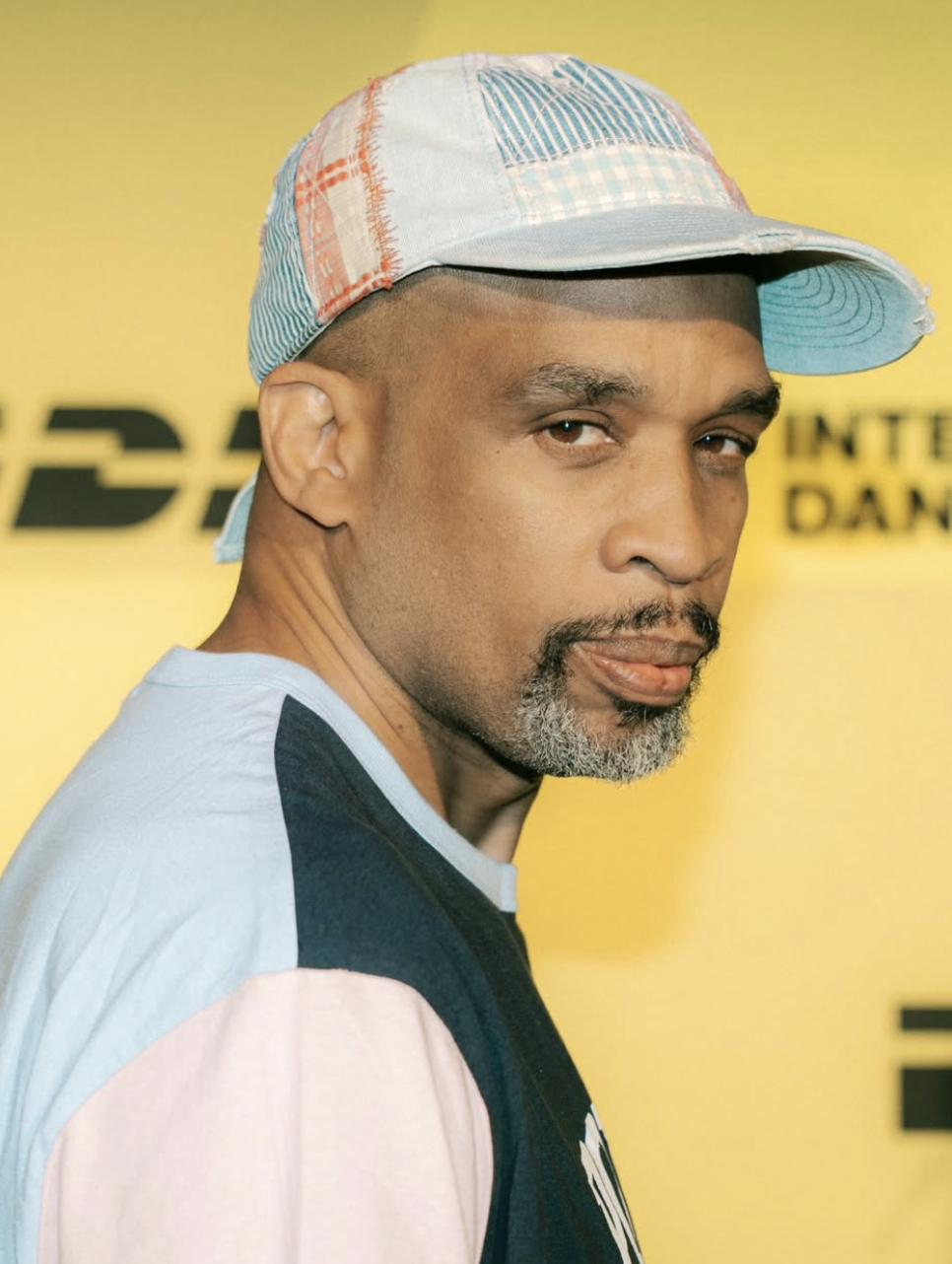
Caleaf Sellers can begin his story with a window. On the Brooklyn border of Canarsie and East New York, neighborhood organizers would knock on his family’s window and ask for electricity. Caleaf would check with his mother. A long extension cord ran from the house to the basketball court, and the sound system came alive. Birthday, cookout, homecoming: somebody always had something to celebrate.
Before house became a workshop title, before hip-hop became an industry category, that block taught him the oldest lesson in social dance: the music brings people into the same space, and the people make the culture.
Decades later he would carry another kind of current out of New York. Movement learned in homes, parks, clubs and cyphers went with him into music videos, tours, films, Japan’s festivals, studios and, eventually, Harvard. Generations of dancers know him as Big Leaf: an original Mop Top member, a founding member of Dance Fusion NYC, co-founder of 36 Chambaz of Stylez, and a dancer, choreographer, teacher, DJ, MC and producer.
That is the thesis of this feature, and the reason Dance Mogul Magazine is tracking him now. Caleaf Sellers is not a finished chapter. He is one of the human bridges through which New York house became internationally teachable without losing the social values underneath the steps, and in 2026 he is still judging, teaching, and being asked to explain the footage he appears in.
“Bring the love to the cypher.”
— Caleaf Sellers, Dance Chat, 2026
Caleaf Sellers at a Glance
File // At a Glance
Name — Caleaf Sellers, known as Big Leaf
Roles — Dancer, choreographer, teacher, judge, DJ, MC, producer, culture bearer
Origin — Brooklyn, New York, on the Canarsie / East New York border
Trained — Home and block parties first, his mother his first dance influence; New York clubs and street freestyle
Crews — Mop Top (original member); Dance Fusion NYC (founding member, 1997); Mop Top University; 36 Chambaz of Stylez (co-founder)
Signature — House and hip-hop club freestyle built on foundation, partner exchange and the cypher
Worked with — Diana Ross, Mariah Carey, Will Smith, Crystal Waters, CeCe Peniston, Heavy D, Doug E. Fresh, Pet Shop Boys, Public Enemy
Screen & stage — New Jack City, Strictly Business, Boomerang; Wreckin’ Shop (1992); music videos, TV, tour choreography
Music — Records as Big Leaf: Planets (2016), BEST SELLER (2018)
Reach — Documented activity in 3 countries on 3 continents, plus international judging
Current work — Japan Dance Delight judge (2024); Harvard visiting artist (2025, 2026); 2026 workshops and SEEDS history program
DMM connection — DMM exclusive video interview; featured in DMM’s American Social Dance Movement archive
1992
Wreckin’ Shop on PBS
1993
First trip to Japan Dance Delight
1997
Dance Fusion NYC founded
30
Japan Dance Delight volume he judged
His First Teacher Was His Mother
Caleaf’s story refuses the mythology that a culture begins when a professional opportunity appears. In his 2026 Dance Chat conversation he names his mother as his first dance influence. Music played while ordinary life happened. Dancing belonged to the household, the neighborhood and the celebrations outside.
That matters because house eventually became something people could buy by the hour: a class, a private lesson, a camp, a battle entry, a festival ticket. The source culture was not organized as a product. It was participation, knowledge carried through watching, remembering, sharing and being present. The dance floor came first. The industry came later.
Before Tutorials, You Had to Remember
You watched. You held the movement in memory. You went away and worked on it. No phone recorded every exchange from five angles; the body had to be camera and notebook. That method carried an ethic: learning from someone did not mean becoming them. Inspiration had to pass through your own body until it was personal. Originality was evidence that you had digested what you received.
It explains his teaching today. Foundation matters because it gives dancers material to transform. The vocabulary is not the destination. The dancer is.
The Tunnel, Rosie Perez and the Doorway Into an Industry
Then the room changed. In Caleaf’s telling, Henry Link encouraged him to come to The Tunnel on a Wednesday night. Rosie Perez was scouting dancers for a Diana Ross video, “Workin’ Overtime.” The dancers auditioned, and Caleaf got the job. The mechanism mattered more than the title: a nightclub had become a hiring hall. Culture created the talent pool, and the entertainment industry came into the room looking for it.
Peridance’s biography documents what followed: appearances in New Jack City, Strictly Business and Boomerang; television connected with Mariah Carey, CeCe Peniston and Crystal Waters; music videos for Diana Ross, Doug E. Fresh, Will Smith, Mariah Carey, Crystal Waters, Pet Shop Boys and Public Enemy; and tour choreography for Crystal Waters, CeCe Peniston and Heavy D. A step learned in a club became wages on a set. The camera did not make the culture valuable. It revealed value that was already there.
1992: The Camera Caught the Culture Before the Curriculum
In 1992 PBS aired Diane Martel’s black-and-white documentary Wreckin’ Shop: Live From Brooklyn, preserving a New York freestyle world not yet standardized into class descriptions. Caleaf appears alongside dancers including Buddha Stretch, Henry Link, Peter Paul and Ejoe. He is not demonstrating a combination. He is inside an exchange: timing, humor, risk and crowd response that disappear when a culture is reduced to named steps.
Thirty-four years later, on October 4, 2026, a New York program called SEEDS screened Wreckin’ Shop and placed Caleaf in a moderated conversation about the roots of house music and house dance. The dancer captured as part of the living scene was now interpreting it for people born after it was filmed. The evidence and the witness were in the room together.
1993: Japan Changed What It Meant to Be the Dancer
Commercial work put Caleaf behind recording artists. Japan gave him something else. He remembers traveling with Peter Paul to Japan Dance Delight in 1993 as invited dancers, judges and performers. For once no star stood in front of them. The audience had come to see the dancers.
That shift changes an economy. Once the dancer is the draw, promoter fees, judging fees, teaching fees, travel, festival tickets, studio rentals and videography gather around the dancer’s presence. The relationship lasted: at Japan Dance Delight Vol. 30 in 2024, the official report again listed Caleaf Sellers AKA Big Leaf as a judge, alongside Henry Link. The culture he helped carry across the Pacific had become durable enough to support a thirty-edition institution.
He Left Dance, and Learned What It Was Worth
Not every turning point happened under lights. Caleaf has described stepping away from dance for about two years to raise his family, working jobs with benefits, insurance and a pension path. He knew what a conventional job could provide. He also knew what it cost him to leave the work that gave his life meaning.
He came back in 1997, and he did not wait for the old phone to ring. He built relationships directly with studios across Japan instead of depending on invitations. That is entrepreneurship before social media made the word unavoidable, and maybe the most useful lesson in his story: talent gets discovered, but careers get built.
Mop Top, Dance Fusion and the Human Export System
No ministry of house dance sent delegations overseas. The export system was human. Dancers traveled, taught, judged, stayed after class, exchanged music and came back the next year; students traveled to New York. Relationships became routes. Dance Fusion NYC, established in 1997 with Caleaf as a founding member, became one of the collectives behind that international growth, alongside carriers including Ejoe Wilson, Brian “Footwork” Green, Brooklyn Terry, Tony McGregor, Marjory Smarth, Kim D. Holmes, Sekou Heru and Shannon Mabra. America exported house through people. The international scene was built by bodies on airplanes.
36 Chambaz: Start at the First Level
Years later Caleaf and Buddha Stretch created 36 Chambaz of Stylez, named for the logic of The 36th Chamber of Shaolin: students want the advanced chamber first, but mastery starts at the beginning. Foundation, technique, footwork, partner work, floor work, freestyle, history and cypher practice are taught as one connected culture.
Some sessions remove the two objects modern students take for granted: the mirror and the camera. Face somebody. Without watching yourself you have to notice the person across from you, listen differently and give energy as well as take it. The room becomes social again. That may be his most important contribution as an educator: he helped make house teachable while asking what gets lost when teaching drifts from the conditions that made house meaningful.
“Dancing to House music is a spiritual feeling.”
— Caleaf Sellers, Culture Lines interview
From the Club to the College Classroom
Knowledge once exchanged informally is now valuable enough for universities to invite the people who lived it. Mount Holyoke College brought Caleaf into its evolving dance curriculum and described his work as cultural storytelling, with students learning dozens of social-dance movements and combining them with their own movement histories. Harvard’s Office for the Arts lists him twice: a Supreme Foundation workshop, film viewing and Q&A in spring 2025, and a house panel in spring 2026.
That is an institutional correction. For years Black social dances shaped popular culture while their carriers stayed outside the institutions that decided what counted as serious study. When universities pay culture bearers, money, authority and legitimacy move closer to the source.
Big Leaf: When the Dancer Starts Making the Music
Caleaf did not stop at interpreting house. Recording as Big Leaf, he released the Planets EP in July 2016, described as a journey through decades of the dance floor, and the full-length BEST SELLER in November 2018, moving between East Coast hip-hop and deep house, with Buddha Stretch among the collaborators and Caleaf as executive producer. The dancer who moved to records began making them. The consumer of club music became a rights holder. Culture is more sustainable when its practitioners own more than one part of the value chain.
The Credit Record, Kept Honest
Credits blur over three decades. DMM separates what is documented for Caleaf individually from collective work and from his own recollections.
| Artist / project | Credit type | Source |
|---|---|---|
| Diana Ross, “Workin’ Overtime” video | Individual: dancer, cast through The Tunnel audition | Caleaf, Dance Chat (2026); Peridance |
| New Jack City, Strictly Business, Boomerang | Individual: film appearances | Peridance bio |
| Mariah Carey, CeCe Peniston, Crystal Waters (TV) | Individual: television work | Peridance bio |
| Diana Ross, Doug E. Fresh, Will Smith, Mariah Carey, Crystal Waters, Pet Shop Boys, Public Enemy | Individual: music videos | Peridance bio |
| Crystal Waters, CeCe Peniston, Heavy D tours | Individual: choreography | Peridance bio |
| Wreckin’ Shop: Live From Brooklyn (1992) | Individual: appears in documentary | PBS / archival footage |
| Dance Fusion NYC; 36 Chambaz of Stylez | Collective: founding member; co-founder with Buddha Stretch | Peridance; event records |
Biography credits are reported as published and have not been independently matched to production credits.
Watch: Caleaf Sellers in His Own Words
His DMM interview, the footage he appears in, and a history lesson straight from the innovator.
DMM exclusive. Caleaf’s interview from DMM’s American Social Dance Movement oral-history archive. Video: Dance Mogul Magazine.
1992 · Brooklyn. Wreckin’ Shop: Live From Brooklyn, directed by Diane Martel for PBS. Caleaf appears in the surviving excerpt and battle footage. Video via YouTube.
The innovator. Everybody Dance Now! Straight From the Innovators, Caleaf Sellers episode: history as part of the movement. Video via Vimeo.
The Teaching & Travels Tracker
DMM built this tracker so readers can follow a living legacy date by date. Every row has a published source. It is a floor, not a ceiling: decades of workshops across Japan, Europe and the U.S. left far fewer dated listings than they deserve.
| Date | Event | Place | Role |
|---|---|---|---|
| Oct 4, 2026 | SEEDS: Wreckin’ Shop screening, moderated talk and dance session | New York, USA | Featured guest |
| 2026 | House workshop, 2 hours | Freiburg, Germany | Teacher |
| Spring 2026 | Harvard Office for the Arts, house panel | Cambridge, USA | Panelist |
| Apr 2026 | AbunDance Awards | Brooklyn, USA | Honoree |
| Spring 2025 | Harvard Office for the Arts: Supreme Foundation workshop, film viewing, Q&A | Cambridge, USA | Visiting artist |
| 2024 | Japan Dance Delight Vol. 30 | Japan | Judge |
| 2022 | Mount Holyoke College dance curriculum | South Hadley, USA | Guest teacher |
| Nov 2018 | BEST SELLER album release | Digital | Producer / artist |
| Jul 2016 | Planets EP release | Digital | Producer / artist |
| 1997 | Returns to dance; Dance Fusion NYC founded; Japan studio relationships | New York; Japan | Founding member; teacher |
| 1993 | Japan Dance Delight with Peter Paul | Japan | Invited dancer, judge, performer |
| 1992 | Wreckin’ Shop: Live From Brooklyn | Brooklyn, USA | Featured dancer |
Sources: SEEDS / Resident Advisor; Freiburg listing; Harvard OFA; AbunDance Academy; Japan Dance Delight report; Mount Holyoke; Bandcamp; Peridance; Dance Chat.
Documented listings per year · bars drawn to scale
Counts are dated listings in DMM’s research set, not a full record. Years without a bar have no surviving dated listing, not no activity.
The Teaching Tree: How the Knowledge Became Work
Caleaf did not wait for institutions to create a house curriculum. He and his peers built the institutions: Mop Top, Mop Top University, Dance Fusion NYC, Supreme Foundation and 36 Chambaz of Stylez each turned club knowledge into something a student could join, pay for and graduate from. His Japan studio relationships became recurring work that gave Japanese dancers access to the source, and many later became teachers in their own studios. The Bureau of Labor Statistics notes that nearly all choreographers begin as dancers. Caleaf’s ladder goes further: dancer, crew founder, international teacher, university guest.
How the knowledge became work
1. The block party. A Brooklyn childhood teaches that music and people make the room.
2. The club as hiring hall. The Tunnel leads to Diana Ross, film, television and tour work.
3. The crew becomes a school. Mop Top, Dance Fusion and Mop Top University organize the teaching.
4. The export. Japan, Europe and studio networks make house a paid international profession.
5. The university. Mount Holyoke and Harvard bring the culture bearer into higher education.
The Lineage: Who Shaped Caleaf, and Who He Shaped
Shaped by
His mother
first dance influence
Brooklyn block parties
Canarsie / East New York
Henry Link
brought him to The Tunnel
Rosie Perez
cast him for Diana Ross
↓
Caleaf “Big Leaf” Sellers
Brooklyn · house dance
↓
Crews & collaborators
Buddha Stretch
36 Chambaz co-founder; BEST SELLER
Peter Paul
Japan, 1993
Sekou Heru & Marjory Smarth
Dance Fusion NYC
Mop Top family
original member
Ejoe Wilson
Wreckin’ Shop, Mop Top
Supreme Foundation
workshops and clothing line
↓
Students & next generation
Japanese studio dancers
relationships built from 1997
University students
Mount Holyoke, Harvard
Camp students
36 Chambaz of Stylez
Relationships drawn only from published sources: Peridance, Dance Chat, Mount Holyoke, Harvard OFA, event records. Individual students are not named because no source documents them.
Worldwide Impact: From a Brooklyn Window to Three Continents
Worldwide Impact // Documented Reach
| Country / region | What happened | Year | Evidence |
|---|---|---|---|
| USA | Wreckin’ Shop; film, TV and video work; Dance Fusion; Mount Holyoke; Harvard; SEEDS | 1992–2026 | Peridance; Harvard; RA |
| Japan | Dance Delight 1993 and Vol. 30 judge; studio relationships from 1997 | 1993–2024 | Dance Chat; JDD report |
| Germany | House workshop, Freiburg | 2026 | Workshop listing |
3
countries with a dated source
3
continents
34
years, 1992 to 2026
Caleaf’s 2026 international judging and decades of European and Asian workshops are not individually dated in DMM’s research set, so they are not counted.
By the Numbers: The Economy Around Caleaf Sellers’s Art
There is a temptation to put a giant dollar amount beside house dance and declare that the dance created it. That would not be responsible. No credible study isolates the value of house dance alone; it overlaps with house music, nightlife, electronic music, commercial dance, tourism, education, fashion and media. No one has published Caleaf’s earnings or student totals, and DMM does not estimate them. What can be shown is the visible units of the economy around him, and the size of the industries it feeds.
Tier 1 · Published price points around Caleaf’s work
| Measure | Figure | Scope | Source |
|---|---|---|---|
| Japan Dance Delight Vol. 30 final ticket | ¥7,000 | 2024 final, Caleaf judging | JDD official report |
| House workshop fee | €35 | Two-hour session, Freiburg, 2026 | Workshop listing |
| SEEDS history program | from $20 | Screening, talk and dance session, NYC, Oct 4, 2026 | Resident Advisor |
| Japan Dance Delight editions | 30 | Volumes through 2024; he attended in 1993 | JDD official report |
These are single published prices, not revenue: no capacity or attendance is published, so DMM does not multiply them. Each one is a visible unit of an economy built around dancers, teachers and history.
Tier 2 · The industries this art form feeds
$5.0B
U.S. dance studio revenue, 14,622 businesses (2025) · IBISWorld
Markets where house dance works · bars drawn to scale
Context only. These are whole industries, not the value of house dance or of any one dancer. Bar widths: 35.1 = 100%; 31.7 ÷ 35.1 = 90.3%; 15.1 ÷ 35.1 = 43.0%; 5.0 ÷ 35.1 = 14.2%.
$26.73/hr
Median U.S. choreographer wage, May 2024 · BLS
$23.97/hr
Median U.S. dancer wage, May 2024 · BLS
+5%
Projected dancer & choreographer jobs, 2024–34 · BLS
IMS says its $15.1 billion covers revenue directly generated by electronic music and excludes broader spending such as travel and restaurants. House dance does not own that whole figure. What it contributes is the human activation of the ecosystem: dancers animate venues, teach the vocabulary, create visual identity, travel to festivals, judge, sell music and merchandise, and keep scenes credible. Clubs, workshops, festivals, commercial entertainment, catalog and rights, fashion through lines like Supreme Foundation, and now universities and preservation programs are all doors into that economy.
DMM economic interpretation. House dance should not be credited with every dollar in electronic music. But it should no longer be described as though it had no economic function. The question is ownership: who gets paid, who owns rights, who controls the archive, and who gets named when the history is taught. Caleaf’s career does not solve that problem. It makes it visible.
How House Traveled, and What Belongs to Everyone
Black and Latino communities, queer communities, DJs, dancers and club people built cultural systems whose value later spread far beyond the rooms where they began. House was not built by one person, and DMM does not credit Caleaf with inventing it. His specific part is clear in the record: an original Mop Top member, a Dance Fusion founder, an early international carrier, and an educator who keeps insisting the social exchange is the point.
Where Is Caleaf Sellers Now?
Caleaf is not being studied only for what he did thirty years ago. He judged Japan Dance Delight Vol. 30 in 2024. Harvard brought him in as a visiting artist in 2025 and again in 2026. In April 2026 the AbunDance Awards in Brooklyn honored him for excellence, vision and leadership alongside Buddha Stretch, Sekou Heru, Renee Robinson and Forces of Nature Dance Theatre. In 2026 he taught house workshops including Freiburg, Germany, and on October 4, 2026, New York’s SEEDS program positioned him as a living historical witness to the footage he appears in.
A Living Legacy, and Why DMM Is Tracking It
Most legacy writing arrives too late. Caleaf’s career shows why it should not. Accuracy: details like a middle name or a housing development name are still being garbled in transcripts, and can only be fixed while the source is here. Access: students can still face him in a cypher with no mirror. Value: when universities, festivals and preservation programs document a culture bearer, they also pay him. Age does not disqualify a culture bearer. If anything, the culture finally starts asking better questions.
The DMM Archive Connection
Caleaf’s DMM interview lives in The American Social Dance Movement, and his story runs through DMM’s House Dance: From Chicago to the World Stage. It connects to our features on Sekou Heru, his Dance Fusion co-founder, Henry Link, who brought him to The Tunnel, Buddha Stretch, his 36 Chambaz partner, and Ejoe Wilson and Massiah “Peekaboo” from the Wreckin’ Shop generation.
Career & Cultural Timeline
CULTURE = the scene around him · CAREER = his work · TEACHING = passing it on
CHILDHOOD · CULTURE
Learns movement at home and on the block; names his mother as his first dance influence; powers neighborhood jams by extension cord.
LATE 1980s · CULTURE
Emerges from New York’s club and street-dance movement; becomes an original Mop Top member.
c. 1989 · CAREER
Cast at The Tunnel by Rosie Perez for Diana Ross’s “Workin’ Overtime” (his account).
EARLY 1990s · CAREER
Film, TV, music video and tour choreography: New Jack City, Strictly Business, Boomerang.
1992 · CULTURE
Appears in Diane Martel’s PBS documentary Wreckin’ Shop: Live From Brooklyn.
1993 · TEACHING
Travels with Peter Paul to Japan Dance Delight as invited dancer, judge and performer.
MID-1990s · CAREER
Steps away from dance for family and conventional work.
1997 · TEACHING
Returns; Dance Fusion NYC is founded; builds studio relationships across Japan.
2000s–2010s · TEACHING
International workshops and judging; Supreme Foundation and 36 Chambaz of Stylez deepen the teaching system.
2016–2018 · CAREER
Releases Planets and BEST SELLER as Big Leaf.
2022 · TEACHING
Mount Holyoke documents his work in its evolving dance curriculum.
2024 · TEACHING
Judges Japan Dance Delight Vol. 30.
2025 · TEACHING
Harvard hosts a Supreme Foundation workshop, film viewing and Q&A.
2026 · CULTURE
Harvard house panel; AbunDance Awards honoree; Freiburg workshop; SEEDS screens Wreckin’ Shop with Caleaf in conversation; profiled in DMM’s Legacy series.
Why Caleaf Sellers’s Legacy Matters to Dance Mogul Magazine
Dance Mogul Magazine was founded to document people whose labor can become famous while their names disappear. Caleaf’s story sits squarely inside that mission. House is now taught far from the clubs where it developed, in competitions, universities, festivals and online. That expansion is a triumph and a risk: every new layer of access is another chance to detach the vocabulary from the people who carried it. DMM’s job is not to freeze house in a museum. It is to keep the record connected: room to dancer, dancer to teacher, teacher to student, music to movement, movement to business, business back to community. Caleaf lets us tell that whole chain through one life.
He also carries DMM’s values. Character before celebrity: he talks about bringing love to the cypher. Contribution before attention: he built schools instead of waiting for them. People before popularity: some of his classes ban the mirror so students have to face each other.
What Dance Would Be Missing Without Caleaf Sellers
• An original Mop Top member and Dance Fusion founder, two of the crews that turned New York house into an international curriculum.
• A face in Wreckin’ Shop, and the living witness who now explains it to new generations.
• 36 Chambaz of Stylez, a training system that starts at the first chamber and takes away the mirror.
• A bridge into higher education, from Mount Holyoke to two Harvard visits.
• A dancer who owns his music, as Big Leaf, producer of Planets and BEST SELLER.
What Future Generations Can Learn From Caleaf Sellers
1. Learn history from people, not only from clips. A video preserves movement, not relationships or who taught whom.
2. Foundation is not the enemy of individuality. It gives you something substantial to transform.
3. Do not confuse visibility with contribution. Contribution means teaching, crediting sources and creating opportunity.
4. Build your own route when the invitation does not come. His 1997 return was a business lesson as much as an artistic one.
5. Own more than the performance. Teaching, music, events, archives and merchandise are all doors into the economy.
6. Keep the social in social dance. If everyone faces the mirror and nobody faces another person, something essential has changed.
7. Age can deepen authority. Elders should be active, documented, paid and allowed to speak in full sentences.
Keeping the Current Moving
Go back to the window. Somebody outside needs electricity. His mother says yes. The cord goes out, the speakers come on, and people gather. Nobody is calculating streaming revenue or selling a master class. They are making a room.
That is what every later generation has to remember. The economy grew because people wanted that feeling badly enough to cross cities and oceans for it. Caleaf Sellers helped carry the feeling, taught it, recorded it and brought it into institutions, and he keeps returning to the cypher. He is still keeping the current moving.
Caleaf Sellers: Frequently Asked Questions
Who is Caleaf Sellers?
Caleaf “Big Leaf” Sellers is a Brooklyn-born house and hip-hop dancer, educator, DJ, producer and cultural historian. He is an original Mop Top member, a founding member of Dance Fusion NYC and a co-founder of 36 Chambaz of Stylez.
Why is Caleaf Sellers important to house dance?
He belongs to the generation of New York club dancers who carried house from social spaces into commercial performance, international teaching, festivals and higher education, while insisting on foundation, history and social exchange.
Was Caleaf Sellers in Wreckin’ Shop?
Yes. He appears in surviving footage from Diane Martel’s 1992 PBS documentary Wreckin’ Shop: Live From Brooklyn.
What is Dance Fusion NYC?
A collective established in 1997 and associated with the international development and teaching of house dance. Peridance identifies Caleaf as a founding member.
What is 36 Chambaz of Stylez?
A training project created by Caleaf Sellers and Buddha Stretch that emphasizes foundation, technique, freestyle, partner exchange and cultural context, building advanced expression from fundamentals.
How much is the house dance industry worth?
No authoritative study isolates house dance as its own industry, so DMM does not publish a number. The broader electronic-music industry was valued at $15.1 billion in 2025 by the IMS Business Report; house dance participates in that ecosystem but its share is not measured.
Is Caleaf Sellers still active?
Yes. Records from 2024 to 2026 document judging at Japan Dance Delight, Harvard visiting-artist appearances, the AbunDance Awards, workshops in Germany and the October 2026 SEEDS program in New York.
The Legacy // New York Dance Pioneers Collection
Henry Link · Elite Force founder, hip-hop freestyle
Buddha Stretch · Elite Force co-founder, DMM exclusive interview
Ejoe Wilson · Elite Force “Twelve,” house dance pioneer
Caleaf Sellers · Mop Top, Dance Fusion, 36 Chambaz · You are here
Massiah “Peekaboo” · Misfitss freestyle, Wreckin’ Shop
Sekou Heru · Dance Fusion, RhythmMetrics, “movement is medicine”
Tony McGregor · Newark house dance pioneer
Shock-a-Lock · New York locking pioneer
Mr. Wiggles · Rock Steady and Electric Boogaloos
Darrin Henson · choreographer, “Bye Bye Bye”
Dave Scott · You Got Served, Stomp the Yard
Boogaloo Shrimp · Breakin’ icon
The Legacy · The American Social Dance Movement · House Dance: From Chicago to the World Stage
Sources & Further Viewing
Peridance Center: Caleaf Sellers faculty biography
Peridance Center: MOPTOP Universal
Dance Chat: “Caleaf: Remember to Bring the Love to the Cypher”
Mount Holyoke College: From the Club to the Classroom
Harvard Office for the Arts: Dance Visiting Artists
Culture Lines: Caleaf “Big Leaf” Sellers & House Dance
Japan Dance Delight Vol. 30: Official Report
AbunDance Academy: 2026 AbunDance Awards
Resident Advisor: SEEDS, Caleaf Sellers
DMM: The American Social Dance Movement
Economic context: IBISWorld, Dance Studios in the US (2025); U.S. Bureau of Labor Statistics, Occupational Outlook Handbook, Dancers and Choreographers (May 2024 wages); IFPI Global Music Report 2026; IMS Business Report 2026; NYC Mayor’s Office of Media and Entertainment, nightlife economic-impact study (2016 data).
© 2026 Dance Mogul Magazine LLC · The Legacy Series · A Black-owned dance and empowerment publication since 2010