
Dance Mogul Magazine · The Legacy · House Dance
Tony McGregor: The Newark House Pioneer Who Never Stopped Training
From Newark to Dance Fusion NYC, music videos, Filipino martial arts, Japan, Juste Debout and Amsterdam’s House Dance Forever, Tony “Tone” McGregor built a global life around one rule: the foundation only stays alive when you keep practicing it.
October 7, 2026 · Updated October 11, 2026 · Dance Mogul Magazine · Legacy Feature
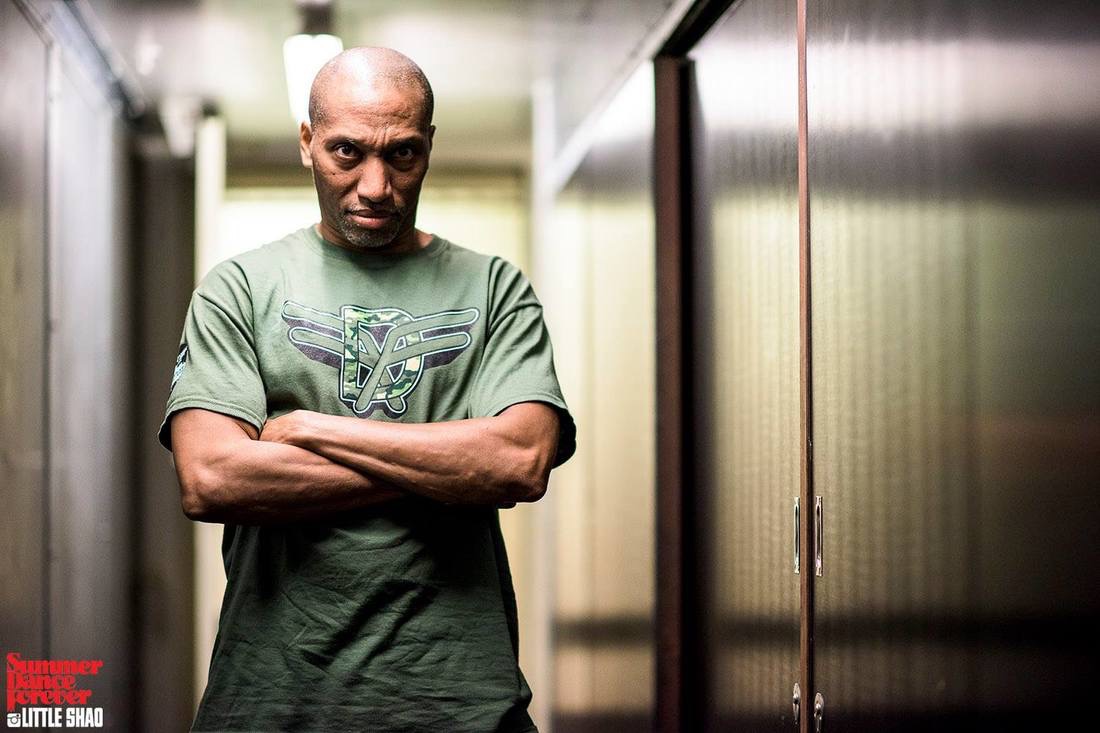
On August 23, 2025, inside Paradiso in Amsterdam, Tony “Tone” McGregor walked into House Dance Forever with nothing in the rulebook protecting his reputation. The festival is built on a demanding idea: history may earn respect, but the floor still asks what you can do today. The music comes on. The circle opens. You answer.
Tone answered. He beat Sekani in the Top 24, Zach Swagga in the Top 12 and Miyu in the Top 6. The official Summer Dance Forever archive preserves those rounds: a dancer whose career reaches back through the commercial-dance era and the international spread of house, still willing to let the music judge him in real time.
One year later, in August 2026, he returned to Paradiso from the other side of the circle, as one of three judges for House Dance Forever’s Warrior Edition. The next day his house workshop sold out. Competitor, judge, teacher, carrier of history: the sequence explains him better than a list of credits.
That is the thesis of this feature, and the reason Dance Mogul Magazine is tracking him now. Tony McGregor is not a finished chapter. He is one of the living sources of New York and New Jersey house dance, a Newark dancer whose knowledge traveled with Dance Fusion NYC around the world and who still treats every year as another year of training. Years earlier he told DMM the whole philosophy in three words.
“We still train. … You gotta train.”
— Tony “Tone” McGregor, Dance Mogul Magazine 36 Chambers interview
Tony McGregor at a Glance
File // At a Glance
Name — Tony “Tone” McGregor
Roles — House and hip-hop dancer, teacher, international battle judge, competitor
Origin — Newark, New Jersey; began dancing young
Trained — Funk styles, breaking, hip-hop and house; Kali, Arnis/Escrima and Pencak Silat since childhood, with grandmasters in the Philippines’ Negros region
Crews — Dance Fusion NYC: original-era, longtime member of the group formed in 1997
Signature — Heel-toe and jacking, with martial-arts control, timing and economy of motion
Worked with — EPMD, LL Cool J, the Fugees, Whitney Houston, CeCe Peniston, Teddy Riley, Too Nice, MC Serch (published bios)
Screen & stage — New Jack City, 25th Hour; videos including “Pump Up the Jam” and “Here It Comes”
Battles & judging — House Dance Forever runner-up 2017; HDF judge 2014, 2018, 2026; Juste Debout judge 2019
Reach — Documented activity in 9 countries on 3 continents
Current work — Peridance house faculty; sold-out workshops in Amsterdam and Luxembourg, 2026
DMM connection — DMM 36 Chambers interview on training, history, specialization and intergenerational knowledge
1997
Dance Fusion NYC forms
2017
House Dance Forever finalist
3
Rounds won at HDF 2025
2
Sold-out workshops, Aug–Sep 2026
Newark Before the Passport
Tone’s published Dance Fusion biography starts simply: a native of Newark, New Jersey, who began dancing young. Beside the international career that followed, that sounds modest. For Dance Mogul Magazine it is the center of the story.
Newark sits inside a New Jersey social-dance history too often treated as a footnote to New York. DMM’s own archival work documents a city shaped by house parties, DJs, clubs, crews and dancers who learned by being present. House music and house dance did not arrive in New Jersey as a syllabus. They were lived.
Tone’s generation trained across eras, as he described it to DMM: funk styles, breaking and b-boying, hip-hop, and then house. One form prepared the body for the next. Dancers carried old information into new rooms.
“The newer generation should try to embrace as much information as they possibly can.”
— Tony “Tone” McGregor, Dance Mogul Magazine interview
A Dancer Built From More Than One Style
His published biography connects him to work with EPMD, LL Cool J, the Fugees, CeCe Peniston, Too Nice, Teddy Riley and MC Serch, and to films and videos including New Jack City, 25th Hour, “Jingling Baby,” “Stayin Alive,” “Here It Comes,” “Ice Cream Dream,” “Court Is Now in Session” and “Pump Up the Jam.” A 2026 program biography from KnowEdge in Luxembourg adds early-1990s music videos for LL Cool J, Whitney Houston and the Fugees, and notes he recently taught at Princeton University.
Those credits place him in the era when club and street dancers became visible to the entertainment industry, which needed bodies that looked like the culture because they came from it. But commercial visibility was one lane. Since childhood he has studied Kali, Arnis/Escrima and Pencak Silat, and later traveled to the Philippines to study with grandmasters in the Negros region. Balance, timing, weight transfer, spatial awareness and economy of motion: martial arts and freestyle ask different questions, but both punish a body that only memorizes shapes.
House Was “Like Going to College”
When Tone talks about house in the DMM archive, he does not describe it as a replacement for what came before. He describes progression. Breaking puts the body through impact; funk styles demand control; hip-hop asks for groove, attack and character. Then house asks the dancer to reorganize again: fast footwork, jacking, shifting rhythms and long stretches of improvisation.
He compared that stage to “kind of like going to college.” College does not erase what came before; it builds on it. That is why he resists the idea that young dancers should only learn the newest layer of a style. Enter at the end of the sentence, and you may learn the words without understanding the language.
Dance Fusion NYC: When a Crew Became a Global Classroom
Dance Fusion NYC formed in New York in 1997. Historical listings name a generation that included Caleaf Sellers, Marjory Smarth, Tony “Sekou” Williams, Shannon Mabra, Shannon Selby, Tony McGregor and Hiroyuki Suzuki. A 2017 Japanese feature marking the group’s twentieth anniversary lists Tone among its original members; DMM describes him as an original-era, longtime member rather than a founder.
Dance Fusion became part of the human infrastructure through which New York house traveled. Its dancers taught, judged, demonstrated foundations and carried the social logic of the dance far from the clubs that formed it. Exporting a step is easy. Exporting context is harder: why the movement feels the way it does, what music shaped it, who developed it, how people exchanged it. The teacher becomes a living bridge between movement and memory.
36 Chambers: Every Teacher Carries a Room
One of the most valuable parts of Tone’s DMM interview is not a credit. It is a model for organizing knowledge without pretending one person knows everything. Each teacher has a chamber, an area of technique, history or physical understanding developed over a lifetime. But chambers are not walls; teachers exchange information. Tone identifies heel-toe and jacking with his specialty. The larger lesson: mastery is distributed.
“A secret compartment personalized by the individual teacher.”
— Tony “Tone” McGregor, explaining 36 Chambers to Dance Mogul Magazine
His own chamber holds more than house: hip-hop, martial arts, commercial experience, Newark, international battles, age and adaptation. Students receive all of it, not as a costume to copy but as information to transform.
Japan: When the Dancer Became the Reason for the Trip
Tone’s international story is closely tied to Japan. Fly People preserved a feature titled Tony McGregor’s Story of Japan, with a biography supplied by Dance Fusion. For an earlier generation, overseas work meant standing behind a recording artist. House helped create another path: the dancer as the reason people bought the ticket or registered for the workshop.
When Dance Fusion marked twenty years with a major anniversary program in Tokyo in December 2017, the lineup of Tone, Caleaf, Sekou, Shan S, Whichway Sha, Hiro, Cebo, Norico and the memory of Marjory Smarth was presented as cultural history to a Japanese house community that had studied the form for years. The knowledge had become bookable, and with that came responsibility: to give students enough foundation to know house did not begin when they discovered it.
House Dance Forever: The Floor Keeps the Record Honest
In 2017 Tone reached the House Dance Forever final in Amsterdam. Summer Dance Forever’s official archive names Frankie J the winner and Tone the runner-up, with Hiro, Sekou and Orb judging; another official video shows Tone beating Hiro in a judge battle on the way. This was not a heritage showcase. It was a battle.
He kept returning to that standard. Paradiso lists him as a house judge in 2014 and 2018, and Juste Debout records show him judging house selections in Barcelona, Vienna and Geneva in 2019 while teaching workshops. Then came 2025, when he entered the competition again, survived three rounds and reached a semifinal team round with Meech de France against Hiro and Rachad. For DMM, that run makes his old interview words measurable.
The Credit Record, Kept Honest
DMM separates what is documented for Tone individually from Dance Fusion’s collective work, and from credits that appear only in program or artist biographies.
| Artist / project | Credit type | Source |
|---|---|---|
| EPMD, LL Cool J, the Fugees, CeCe Peniston, Too Nice, Teddy Riley, MC Serch | Listed in published bio; role not specified | Society Dance Academy / Dance Fusion bio |
| New Jack City, 25th Hour; “Pump Up the Jam,” “Here It Comes” and other videos | Listed appearances | Society Dance Academy / Dance Fusion bio |
| LL Cool J, Whitney Houston, the Fugees (early-1990s videos); Princeton teaching | Program-biography claims | Rotondes / KnowEdge (2026) |
| House Dance Forever 2017 final; 2025 Top 24, 12, 6 wins | Individual: competitor | Summer Dance Forever official videos |
| House Dance Forever 2014, 2018, 2026; Juste Debout 2019 | Individual: judge | Paradiso; Summer Dance Forever; Juste Debout |
| International teaching in Russia, Ukraine, France, Hong Kong | Collective: Dance Fusion NYC | and8.dance Dance Fusion history |
Biography credits are reported as published and have not been independently matched to production credits.
“We Do It for the Love”
There is a point in every long career when applause becomes dangerous, when recognition convinces an artist the past is enough. Tone’s language pushes the other way. Love, for him, is not sentiment. It is maintenance: of the body, of curiosity, of the relationship to the music, of respect for those who came before, and of the humility to learn from someone born after your first international trip.
“We do it for the love. I mean, we still train. We eat off this.”
— Tony “Tone” McGregor, Dance Mogul Magazine 36 Chambers interview
Watch: Tone McGregor on the House Dance Forever Floor
Two official Summer Dance Forever videos, eight years apart, show the same dancer still answering the music.
2017 · Amsterdam final. House Dance Forever final, Tony McGregor vs Frankie J. Frankie J won; Tone finished runner-up. Video: Summer Dance Forever via YouTube.
2025 · Still training. House Dance Forever Top 6, Tony McGregor vs Miyu, his third round win of the tournament. Video: Summer Dance Forever via YouTube.
DMM Oral History Archive
Tone McGregor’s 36 Chambers interview is part of the Dance Mogul Magazine video archive. Watch the DMM interview collection on YouTube.
The Teaching & Travels Tracker
DMM built this tracker so readers can follow a living legacy date by date. Every row has a published source. It is a floor, not a ceiling: his biography describes teaching and judging across North America, Japan, Asia and Europe since 1997, far more than the dated listings online.
| Date | Event | Place | Role |
|---|---|---|---|
| Sep 29, 2026 | Rotondes / KnowEdge House Dance series opener: workshop and jam (sold out) | Luxembourg | Teacher |
| Aug 30, 2026 | Summer Dance Forever house workshop (sold out) | Amsterdam, Netherlands | Teacher |
| Aug 29, 2026 | House Dance Forever, Warrior Edition, Paradiso | Amsterdam, Netherlands | Judge |
| Ongoing | Peridance Center house faculty | New York, USA | Faculty |
| Aug 23, 2025 | House Dance Forever: wins Top 24, Top 12, Top 6 | Amsterdam, Netherlands | Competitor |
| 2019 | Juste Debout house selections and workshops | Barcelona; Vienna; Geneva | Judge / teacher |
| 2018 | House Dance Forever; Amsterdam house workshops | Amsterdam, Netherlands | Judge / teacher |
| Dec 2017 | Dance Fusion NYC 20th anniversary program | Tokyo, Japan | Performer |
| 2017 | House Dance Forever final (runner-up) | Amsterdam, Netherlands | Competitor |
| 2014 | House Dance Forever | Amsterdam, Netherlands | Judge |
| 1997 | Dance Fusion NYC forms | New York, USA | Original-era member |
| Undated | Grandmaster training, Negros region; Princeton teaching | Philippines; Princeton, USA | Student; teacher |
Sources: Rotondes; Summer Dance Forever; Peridance; Paradiso; Juste Debout; WEB The Television; and8.dance; Society Dance Academy; KnowEdge.
Documented listings per year · bars drawn to scale
Counts are dated listings in DMM’s research set, not a full record. Years without a bar have no surviving dated listing, not no activity. 2019 counts three Juste Debout cities.
The Teaching Tree: How the Knowledge Became Work
In the DMM interview Tone said something most legends leave out: the dance is love, and it is also how they live. He teaches house at Peridance; KnowEdge notes he recently taught at Princeton; he judges at Juste Debout and Summer Dance Forever and teaches the workshops around those events. Each booking pays more than one person. A battle hires judges, DJs, hosts and camera crews; a workshop rents a room and gives local dancers a reason to organize a scene. The Bureau of Labor Statistics notes that nearly all choreographers begin as dancers. Tone’s generation built the rungs above that.
How the knowledge became work
1. Newark. Hip-hop, funk styles and breaking build the foundation.
2. The video set. Music-video work with LL Cool J, Whitney Houston, the Fugees and others pays the early bills.
3. The crew goes global. Dance Fusion turns teaching and judging into international work from 1997 on.
4. The judge’s chair. Juste Debout and Summer Dance Forever bookings create work for whole event teams.
5. The faculty. Peridance, Princeton and sold-out workshops show the classroom is still growing.
The Lineage: Who Shaped Tone, and Who He Shaped
Shaped by
Newark, New Jersey
house parties, clubs, crews
Funk, breaking, hip-hop
the eras he trained through
Kali, Arnis, Pencak Silat
since childhood
Negros grandmasters
Philippines
↓
Tony “Tone” McGregor
Newark · house dance
↓
Crews & collaborators
Caleaf Sellers
Dance Fusion NYC
Sekou Heru
Dance Fusion NYC
Marjory Smarth
Dance Fusion NYC
Hiro
Dance Fusion; HDF judge and rival
Shannon Mabra & Shannon Selby
Dance Fusion NYC
Summer Dance Forever
competitor, judge, teacher
↓
Students & next generation
Peridance students
New York house classes
Japan’s house community
Dance Fusion workshops
European workshop dancers
Amsterdam, Juste Debout cities, Luxembourg
Relationships drawn only from published sources: Society Dance Academy, and8.dance, Summer Dance Forever, Juste Debout, Rotondes. Individual students are not named because no source documents them.
Worldwide Impact: House Traveled Through People
Dance history is often written as if culture moves because somebody uploads it. Tone’s career belongs to an older, more demanding system: a person got on a plane, a DJ played, students watched, and somebody learned the heel-toe and also heard where it came from.
Worldwide Impact // Documented Reach
| Country / region | What happened | Year | Evidence |
|---|---|---|---|
| USA | Newark roots; film and video work; Dance Fusion; Peridance; Princeton | 1990s–2026 | Bios; Peridance; KnowEdge |
| Canada | Teaching, judging and performance | from 1997 | Published bio |
| Japan | Workshops; Dance Fusion 20th anniversary, Tokyo | Dec 2017 | Fly People; WEB The Television |
| Philippines | Martial-arts study with grandmasters, Negros region | undated | Published bio |
| Netherlands | House Dance Forever judge, finalist, competitor; workshops | 2014–2026 | Paradiso; Summer Dance Forever |
| Spain | Juste Debout house judge, Barcelona | 2019 | Juste Debout |
| Austria | Juste Debout house judge, Vienna | 2019 | Juste Debout |
| Switzerland | Juste Debout house judge, Geneva | 2019 | Juste Debout |
| Luxembourg | Rotondes / KnowEdge workshop and jam | 2026 | Rotondes |
9
countries with a source
3
continents
29
years, 1997 to 2026
Dance Fusion’s collective travel also reached Russia, Ukraine, France and Hong Kong, and recent descriptions mention Africa; with no dated Tone listing, those are not counted.
By the Numbers: The Economy Around Tony McGregor’s Art
House dance is culture, and it is also work. DMM keeps these figures in tiers, because a battle result is not a paycheck and a national industry is not one dancer’s output. No workshop prices, capacities or personal earnings are published for Tone, and DMM does not estimate them.
Tier 1 · Tone’s documented results
| Measure | Figure | Scope | Source |
|---|---|---|---|
| House Dance Forever final | Runner-up | Amsterdam, 2017 (winner Frankie J) | Summer Dance Forever |
| House Dance Forever rounds won | 3 | Top 24, Top 12, Top 6, 2025 | Summer Dance Forever |
| Sold-out workshops | 2 | Amsterdam (Aug 30) and Luxembourg (Sep 29), 2026 | Summer Dance Forever; Rotondes |
| House Dance Forever judging seats | 3 | 2014, 2018, 2026 | Paradiso; Summer Dance Forever |
These describe documented results and demand, not Tone’s earnings. A sold-out room is the clearest public signal that a teacher’s name brings people in.
Tier 2 · The industries this art form feeds
$5.0B
U.S. dance studio revenue, 14,622 businesses (2025) · IBISWorld
Markets where house dance works · bars drawn to scale
Context only. These are whole industries, not the value of house dance or of any one dancer. Bar widths: 35.1 = 100%; 31.7 ÷ 35.1 = 90.3%; 15.1 ÷ 35.1 = 43.0%; 5.0 ÷ 35.1 = 14.2%.
$26.73/hr
Median U.S. choreographer wage, May 2024 · BLS
$23.97/hr
Median U.S. dancer wage, May 2024 · BLS
+5%
Projected dancer & choreographer jobs, 2024–34 · BLS
Tone’s own words explain the chart better than any analyst: “we eat off this.” Behind every number are teachers, judges and dancers whose rent is paid by a culture that started on club floors in New York and New Jersey.
How House Traveled, and What Belongs to Everyone
House was never built by one body, and the 36 Chambers idea is Tone’s own proof. DMM does not call him a founder of Dance Fusion or an inventor of house. His record is more specific: a Newark dancer of the original Dance Fusion era, one of the New York and New Jersey dancers house-history resources repeatedly name among those who carried the culture abroad, and a judge who still steps onto the floor himself.
Where Is Tony McGregor Now?
In 2026 his record is not that of a retired pioneer called back for anniversary photos. Peridance lists him as current house faculty. He judged House Dance Forever’s Warrior Edition at Paradiso on August 29, and his workshop there the next day sold out. On September 29 the Rotondes cultural center in Luxembourg presented him as the opening guest of a house series teaching both technique and cultural history, and that workshop and jam sold out too. Rotondes described him as a pioneer who helped internationalize house as both technique and community expression rooted in the New York and New Jersey scenes. He did not only spread what house looks like. He carried the idea that house is something people do together.
A Living Legacy, and Why DMM Is Tracking It
Accuracy: a program bio already overstated his Dance Fusion tenure as “over 35 years” for a group formed in 1997, the kind of error a living source can correct. Access: his rooms keep selling out, which means young dancers can still learn heel-toe and jacking from the source. Value: documented results such as finals, judging seats and sold-out workshops are what festivals and universities book against. A legacy artist is not someone whose past is impressive enough to stop. It is someone whose practice keeps making the past useful.
The DMM Archive Connection
Tone’s DMM interview belongs to the 36 Chambers series with Caleaf Sellers, Sekou Heru, Ejoe Wilson and Massiah “Peekaboo”. His Newark roots connect to DMM’s New Jersey street dance and Jersey Club history, his battles to our feature on Summer Dance Forever, and his lineage to House Dance: From Chicago to the World Stage.
Career & Cultural Timeline
CULTURE = the scene around him · CAREER = his work · TEACHING = passing it on
EARLY YEARS · CULTURE
Grows up in Newark, New Jersey; begins dancing young through funk styles, breaking, hip-hop and house.
CHILDHOOD ONWARD · CULTURE
Studies Kali, Arnis/Escrima and Pencak Silat; later trains with grandmasters in the Philippines’ Negros region.
EARLY 1990s · CAREER
Music-video and film work connected to LL Cool J, Whitney Houston, the Fugees, EPMD, CeCe Peniston, New Jack City and more.
1997 · TEACHING
Dance Fusion NYC forms; Tone is an original-era member. Teaching, judging and performing across North America, Japan, Asia and Europe follow.
2014 · TEACHING
House Dance Forever judge, Amsterdam.
2017 · CAREER
House Dance Forever runner-up to Frankie J; Dance Fusion’s 20th anniversary in Tokyo.
2018 · TEACHING
Returns to judge House Dance Forever; teaches Amsterdam workshops.
2019 · TEACHING
Judges Juste Debout house selections in Barcelona, Vienna and Geneva.
2025 · CAREER
Enters House Dance Forever and wins Top 24, Top 12 and Top 6 rounds.
2026 · TEACHING
Peridance faculty; HDF Warrior Edition judge; sold-out workshops in Amsterdam and Luxembourg; profiled in DMM’s Legacy series.
Why Tony McGregor’s Legacy Matters to Dance Mogul Magazine
Tone’s story matters to Dance Mogul Magazine for reasons both cultural and personal. He comes from Newark, and so does the lived perspective that helped create DMM. For too long the story of American street and club dance has been told as if New Jersey sat outside the frame. Tone’s life makes that connection visible on a global scale.
He also carries DMM’s values. Character before celebrity: he entered a battle he could have judged. Contribution before attention: decades of workshops and judging seats. People before popularity: his 36 Chambers model gives students many teachers instead of one guru.
What Dance Would Be Missing Without Tony McGregor
• A Newark voice in global house, proof that New Jersey belongs at the center of the story.
• An original-era Dance Fusion dancer who helped turn a crew into a global classroom.
• The 36 Chambers model, a way to share mastery without pretending one person owns a culture.
• A competitor’s example, back on the House Dance Forever floor in 2025, winning three rounds.
• A teacher still in demand, with two sold-out workshops in two countries in 2026.
What Future Generations Can Learn From Tony McGregor
1. Learn the style, then learn what came before it. Technique without lineage becomes imitation without understanding.
2. A specialist should still exchange information. Go deep, and still learn from the teacher in the next chamber.
3. Cross-training does not dilute identity. Martial arts and hip-hop made him more of a house dancer, not less.
4. Reputation cannot replace conditioning. In 2025 a legend still had to survive rounds.
5. Teaching is cultural guardianship. Give students enough to avoid mistaking a fragment for the whole story.
6. Love is something you practice. “We do it for the love” only matters if it shows up as training.
7. Get the information. Embrace as much of it as you possibly can, as he told DMM.
Legacy Is Practice
It started in Newark with a young dancer moving through every style his era offered. It traveled with Dance Fusion, through Tokyo, Barcelona and Amsterdam, and it came back to the Paradiso floor in 2025, where a pioneer still had to win his rounds.
When DMM asked what the next generation should understand, his answer was not complicated: get the information, get the history, keep training. That is the legacy. Not a museum case. A practice.
Tony McGregor: Frequently Asked Questions
Who is Tony McGregor?
Tony “Tone” McGregor is a Newark, New Jersey-born house and hip-hop dancer, teacher, judge and Dance Fusion NYC member whose career spans commercial entertainment, martial-arts-informed movement, international house education and major battle circuits.
Is Tony McGregor a member of Dance Fusion NYC?
Yes. Dance Fusion NYC formed in 1997, and documentation of its twentieth anniversary lists him among its original members. DMM describes him as an original-era, longtime member rather than a founder.
What martial arts has Tony McGregor studied?
Published biographies list Kali, Arnis/Escrima and Pencak Silat, and say he trained with grandmasters in the Negros region of the Philippines.
What does Tony McGregor mean by 36 Chambers?
In his DMM interview he describes a chamber as a personalized area of knowledge held by an individual teacher. Teachers exchange information, giving students many foundations instead of one person claiming an entire culture.
Did Tony McGregor win House Dance Forever?
He was runner-up to Frankie J in the 2017 final. In 2025 he returned and won rounds against Sekani, Zach Swagga and Miyu, advancing through the Top 6.
Is Tony McGregor still teaching and judging?
Yes. In 2026 he is Peridance house faculty, judged House Dance Forever’s Warrior Edition in Amsterdam, and taught sold-out workshops in Amsterdam and Luxembourg.
Why is Tony McGregor important to house dance history?
He is among the New York and New Jersey dancers who carried house internationally, combining club lineage, Dance Fusion’s global teaching, major judging, continued competition and long-term education.
The Legacy // New York Dance Pioneers Collection
Henry Link · Elite Force founder, hip-hop freestyle
Buddha Stretch · Elite Force co-founder, DMM exclusive interview
Ejoe Wilson · Elite Force “Twelve,” house dance pioneer
Caleaf Sellers · Mop Top, Dance Fusion, 36 Chambaz
Massiah “Peekaboo” · Misfitss freestyle, Wreckin’ Shop
Sekou Heru · Dance Fusion, RhythmMetrics, “movement is medicine”
Tony McGregor · Newark house dance pioneer · You are here
Shock-a-Lock · New York locking pioneer
Mr. Wiggles · Rock Steady and Electric Boogaloos
Darrin Henson · choreographer, “Bye Bye Bye”
Dave Scott · You Got Served, Stomp the Yard
Boogaloo Shrimp · Breakin’ icon
The Legacy · The American Social Dance Movement · House Dance: From Chicago to the World Stage
Sources & Further Viewing
Society Dance Academy: Tony McGregor biography
Peridance Center: Tony McGregor faculty page
and8.dance: Dance Fusion NYC history
Fly People: Tony McGregor’s Story of Japan
WEB The Television: Dance Fusion 20th Anniversary in Japan (2017)
Paradiso: House Dance Forever 2014
Paradiso: House Dance Forever 2018
Summer Dance Forever: Tony McGregor vs Frankie J, 2017 final
Summer Dance Forever: Tony McGregor vs Miyu, 2025 Top 6
Summer Dance Forever: Tony McGregor artist page
Summer Dance Forever: House Dance Forever 2026, Warrior Edition
Summer Dance Forever: Workshops, Aug 30, 2026
Rotondes / KnowEdge: House Dance with Tony McGregor, Sep 29, 2026
Resident Advisor: Why Did House Dancing Leave the Club?
Economic context: IBISWorld, Dance Studios in the US (2025); U.S. Bureau of Labor Statistics, Occupational Outlook Handbook, Dancers and Choreographers (May 2024 wages); IFPI Global Music Report 2026; IMS Business Report 2026; NYC Mayor’s Office of Media and Entertainment, nightlife economic-impact study (2016 data).
© 2026 Dance Mogul Magazine LLC · The Legacy Series · A Black-owned dance and empowerment publication since 2010