
Dance Mogul Magazine · The Legacy · House Dance
Brian Footwork Green: The Rhythm, the Roots, and the Responsibility of Legacy
From a church block in Harlem to Paradise Garage, from Mýa’s “Free” to the House Dance Conference, the New York house dancer who turned club knowledge into a world classroom, and then asked who gets paid when a culture becomes an industry.
November 10, 2026 · Dance Mogul Magazine · Legacy Feature
Save it to come back to the videos, the timeline and the sources.
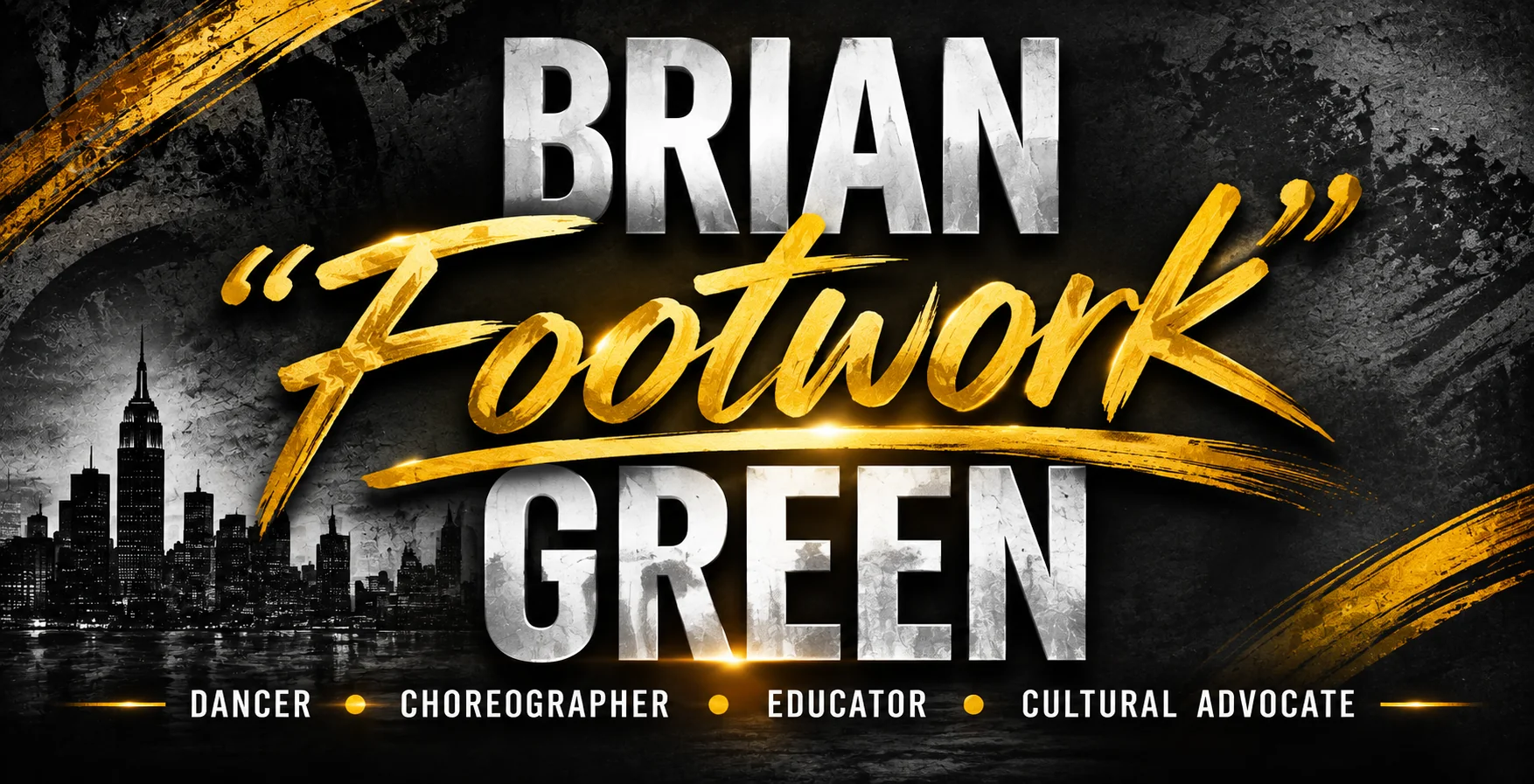
Before the nickname, there was a boy from Bayside watching his mother dance.
Brian Green has told the story more than once. He was a shy kid from a residential, upper-middle-class corner of Queens whose family drove into Harlem on Sundays for church and during the week so he could help his grandmother. The block parties outside that church were a different world from Bayside, louder and rougher, and inside his own family the music never stopped. His mother danced salsa and hustle and freestyle hustle steps with a funky groove; she knew dances from several African traditions and put reel-to-reel tapes and television specials in front of him before he understood what he was watching. His older brother Oscar rocked, did electric boogie, snaked and waved. A cousin studied ballet, tap and jazz. Decades later, asked for the most memorable moment of his dancing life, Green did not name an award show or a music video. He named the first time he watched his mother dance.
That is the right place to begin, because Brian Footwork Green is a legacy about receiving before it is a legacy about inventing. He received rhythm from tap and from his mother’s hustle, the boogie from his brother, the club from older dancers who let a teenager stand close enough to learn. What he built from it, a footwork style fast enough to become his name, an award-winning music video, a conference that put the pioneers of five dance styles on one floor, a teaching life that runs through four continents, and an argument about money that most of the dance world would rather not have, is the subject of this feature.
Dance Mogul Magazine is writing it now, while he is still teaching, still travelling, still arguing, because a legacy documented while the source can correct it is worth more than a tribute written after the fact. This is not a finished chapter. It is a living source, and we have tried to separate what the record proves from what Green himself remembers, and to give the people around him, Dance Fusion, Ron Paisley, Damien and Spanky, Ana “Lollipop” Sanchez and Tyrone Proctor, the credit the history requires.
I dance each dance as if I were living a part of my life. Dance and life are intertwined.
— Brian “Footwork” Green, to The Middlebury Campus, February 2007
Brian Footwork Green at a Glance
File // At a Glance
Name — Brian Green, known as Brian “Footwork” Green
Roles — House and hip-hop freestyle dancer, choreographer, teacher, event organizer, cultural advocate
Origin — Bayside, Queens; church and family roots in Harlem
Trained — Tap and jazz with Phil Black; tap with Honi Coles and Buster Brown; modern and ballet through Alvin Ailey and Joffrey programs; African dance from his mother and community teachers (his own training record)
Scene — New York’s underground hip-hop and club culture from 1983–84: Roseland, 4Ds, Paradise Garage, the Tunnel
Signature — Very fast, syncopated house footwork built from tap rhythm, hustle and salsa feet, and the club dancers who shaped him
Founded — World Soul (by his account, 1992); House Dance Conference (with Dance Fusion and Ron Paisley, August 1999); online classes at They Barely Understand Hello (from 2014)
Award — 2001 American Choreography Award, Outstanding Achievement in Music Video (Hip-Hop), Mýa’s “Free”
Waacking — Taught the style in New York in the early 2000s; invited Los Angeles pioneer Ana “Lollipop” Sanchez to the House Dance Conference in 2003; first waacking teacher of Princess Lockerooo
Reach — Taught and judged across the U.S., Europe, Asia and Africa; ImPulsTanz Vienna 2002 and 2003; Milan open class November 2025
Advocacy — “Economic Wisdom for Dancers,” a voluntary payment proposal for the creators and innovators of street dance styles
DMM connection — Appears in DMM’s 2013 Tyrone Proctor feature as host of the conference where Proctor judged the first waacking competition (2007); first DMM legacy feature on Green
1983
entered New York’s underground
1999
House Dance Conference begins
2001
American Choreography Award
4
continents taught, by his bios
A Shy Kid From Bayside and a Church Block in Harlem
Green’s published biographies do not agree on when he started dancing. The Peridance Center faculty page and his own House Dance Conference history say eight. Broadway Dance Center and his official site say seven. The ImPulsTanz festival archive in Vienna, written in 2003, says five, with African dances taught by his mother. DMM does not pretend to settle this. What every version shares is the household: a mother who danced socially and seriously, a brother in the first wave of New York’s electric boogie, and formal study layered on top.
His own training record, published on his website, is more specific than any school bio. Ten years of tap and jazz with Phil Black. Two years each of tap with Honi Coles, Buster Brown and Bettye Morrowe. Six years of modern and seven of ballet through Alvin Ailey and Joffrey programs. West African dance, popping, locking and house listed as learned “in the community,” with a year of locking study under Fred “Mr. Penguin” Berry and Greg “Campbellock Jr.” Campbell and five years of popping with Jazzy J. A 2014 tour biography adds that the tap began after his mother showed him films of Bill “Bojangles” Robinson, the Nicholas Brothers, the Berry Brothers and Honi Coles, and that he asked to learn it.
Green has said his brother introduced him to the boogie and snaking style in the late 1970s, around 1978 or 1979, and that Oscar’s creativity, fearlessness, angles, glides and hand play stayed with him. Peridance’s bio describes electric boogie as New York’s response to California’s locking and popping, and says Green chose it. That choice is where the formal child and the street child meet: a boy with a decade of tap under his feet, chasing a dance his brother brought home from the block.
Why does the training matter to a house dance story? Because the speed that later became his name did not come from nowhere. Tap is rhythm in the feet. Hustle and salsa are weight changes and turns. African dance is the groove under all of it. Green has said as much in his own words on the House Dance Conference page: his rhythm from tap and his mother’s intricate hustle, salsa and African steps, plus the inspiration of the club dancers, “eventually spawned a unique very fast footwork style.”
Roseland, 4Ds, Paradise Garage, the Tunnel: The Underground Classrooms
Between 1983 and 1984, by his account, Green went looking for more popping and found the New York underground. By the end of 1984 he says he understood hip-hop and club culture and was part of it. From 1984 to 1986 he found the freestyle and loft scene and the club and house scene at Roseland, 4Ds, Paradise Garage, the Tunnel and other rooms whose names now carry the weight of myth.
Two dancers changed his direction. His school biographies say he met Damien and Mike in 1986, and that in 1987 Spanky and Story became his “full inspirations” to immerse himself in house. His 2010 interview with the Liquid Metal blog places the Damien encounter in late 1986 or early 1987 and Spanky roughly two years later. The dates drift by a year or two depending on who is writing them down; the people do not. Damien, Green recalled, stood six foot nine or taller, could spin, work the floor and travel the whole club with smooth, syncopated footwork, and his skating became an influence from 1986 to 1988. Spanky was fifteen when they met, and his polyrhythmic footwork, precise isolations and coordinated arms, “a crazy freestyle” in Green’s words, shaped him from 1988 to 1992.
DMM has not been able to document fuller names or careers for Damien, Mike, Spanky or Story. We name them anyway, because Green names them every time, and because a history of house dance that only records the dancers who later became teachers is a history that forgets who taught the teachers.
For a lot of us, the club is family.
— Brian “Footwork” Green, in Check Your Body at the Door
That line comes from Check Your Body at the Door, the documentary that dance historian Sally R. Sommer spent decades producing with Archie Burnett about New York’s underground house dancers of the 1990s, directed by Charles Atlas and Michael Schwartz and released in 2011–12. Green is one of its profiled dancers, alongside Willi Ninja, Barbara Tucker and Burnett. The film’s title is the dancers’ own phrase: leave the body’s baggage at the door so the spirit can move. For a teenager from a quiet part of Queens, Green has said, the club was everything home was not: a family, a life, and for some of the wild kids he came up with, the thing that kept them out of jail.
How Footwork Became Footwork
Nobody handed Brian Green a nickname at a ceremony. It attached itself to him in the rooms above, where dancers were known by what they did. By the late 1980s the thing he did was move his feet faster and more intricately than the people around him, and “Footwork” followed him out of the clubs and, eventually, around the world.
This is the chapter where a legacy feature has to be careful. House dance was not invented by one person in one city. The music came out of Chicago, where “jacking” named both a movement and an experience; the dance in New York grew out of the 1970s loft and disco floors, out of Black and Latino social dances, out of hustle, salsa, tap, African dance, b-boying and the freestyle hip-hop clubs, and out of a generation of club dancers who were called “clubheads” before anyone called them house dancers. Green himself has said that the clubhead generation came a little before the generation of Marjory Smarth, Caleaf Sellers, Ejoe Wilson and Shan S, and that those dancers taught him their ways of moving to house music. On his own site he lists the people who carried the dance out of New York in the late 1980s: Voodoo Ray, Ejoe Wilson, Peter Paul, Caleaf Sellers, himself, Marjory “Larj Marj” Smarth, Sekou Williams, Joey Anderson, Justice, Brooklyn Terry, World Soul, Dance Fusion “and many more.”
So what, precisely, belongs to Green? Not house dance. Not house footwork as a category. What belongs to him is a way of doing it: a tempo and texture of footwork recognizable enough that other dancers named him for it, and later, a way of teaching it. Peridance’s bio describes him as one of the major contributors to the spread of house hip-hop around the world since 1992, with international dancers seeking him out in the United States. Fellow Peridance faculty member Huu Rock lists Green among the pioneers whose movement he studied, alongside Tone McGregor, Sekou Heru, Marjory Smarth, Buddha Stretch, Kim Holmes, Jazzy J, Mike Ufouria, Caleaf and Shan S. A dancer appears on lists like that for one reason: people learned from watching him.
Innovation inside a tradition is still innovation. The distinction DMM draws is between a style someone developed and a dance someone invented, and Green, in his own writing, draws the same one. His economic proposal, which we come to later, names Dance Fusion, Ejoe Wilson and himself as house dance innovators, and names no creator at all. That is an unusually honest piece of self-placement, and it sets the tone for how this feature treats him.
1992: World Soul and Dancing for the Room
In 1992, by his account, Green created World Soul. He described it in 2010 as a dance group formed to show the world the different feelings and grooves behind dance styles and to bring people together through dance. His school biographies call it a company focused on “the passion, history, and techniques” of various styles, and a 2014 tour biography says it performed in Europe and the United States.
What survives of World Soul in the public record is thin: a name, a founding year he has given consistently, a YouTube link in an old bio, and the fact that when he was asked in 2010 about inspiring moments with recording artists, he said his real inspiring moments came from choreographing for World Soul and the House Dance Conference crew. DMM has not found a membership list, a repertory or a performance history, and we flag that as an open question for the archive. What the record does show is that the idea behind World Soul, demonstrate the styles, teach the history, unite the room, is the same idea that produced the conference seven years later.
Mýa, “Free,” and the Night at the El Capitan
Mýa’s “Free” was released as a single on November 21, 2000, from the Bait soundtrack and the reissue of her album Fear of Flying. The video, directed by Dave Meyers, is a roller rink full of party dances, locking and waacking. Mýa told the music site LAUNCH at the time that those concepts were hers, that she found an underground dancer and choreographer named Brian Green and that the two of them put the routines together on their own. Working with someone from the underground, she said, was a fight, and also the best thing about the project, because she knew what he had to offer.
On Sunday, October 14, 2001, at the El Capitan Theatre in Hollywood, the seventh annual American Choreography Awards honored Green with Outstanding Achievement in Music Video, Hip-Hop, for “Free.” Tina Landon received the same honor in the same category for Mýa’s “Case of the Ex.” Variety and Backstage both carried the winners’ list that week; John O’Connell took the feature-film award for Moulin Rouge!, Michael Rooney won twice for Fatboy Slim’s “Weapon of Choice” and an Exxon/Mobil commercial, and Bob Mackie received the Governor’s Award. It was a room of more than a thousand people, with Carol Burnett and Debbie Allen in the seats. A club dancer from Queens walked out with the trophy for a video built on club dances.
The award is the most independently documented fact in Green’s career, and it is worth being precise about what it honors. It honors the choreographer. It does not measure the record: “Free” reached the top 50 of the Billboard Hot 100, number 4 in Australia and number 11 in Britain, and those are Mýa’s numbers, Jimmy Jam and Terry Lewis’s numbers, Interscope’s numbers. What the award says is that in 2001, the people who judge choreography for the camera looked at a video that put the New York underground on a national screen and said: that is the best hip-hop dance on video this year.
Green’s own resume lists other commercial work around the same period, all of which DMM records as his account rather than independently confirmed credits: Lil’ Kim’s “Crush on You,” Lil’ Mo for BET’s Spring Bling, Foxy Brown on Showtime at the Apollo, Elsie Muniz, a Warner Bros. promo tour for Terri Dexter, Mýa at the Soul Train Awards, and the feature film Like Mike, where he lists himself as assistant to Lil’ Bow Wow. His bios add that he has choreographed for or danced with Mariah Carey, Missy Elliott, Salt-N-Pepa, Busta Rhymes, Barbara Tucker, Eve, Kraze and Masters at Work, and later versions add Gwen Stefani and Fergie. The Credit Record below separates what is verified from what is attributed.
Asked in 2010 what surprised him about the commercial side, his answers were not about glamour. As a choreographer, it was the lack of seriousness among dancers toward other dance styles and among artists toward learning dance at all. As a dancer, it was being treated as expendable. He praised Mýa and Barbara Tucker as performers who deserved more support, and said the experience was one reason he teaches more than he choreographs: “in hopes of raising the level in dance, physically and mentally.”
August 1999: Building the House Dance Conference
The House Dance Conference did not start as a brand. According to the history Green keeps on his own site, it started in conversations among prominent New York dancers who wanted an event that showed the power of dance and the education of dance while respecting lineage. The fuel, in his telling, came from three places: the dance group Dance Fusion, the organizer Ron Paisley, and Green himself, who performed with Dance Fusion between his choreography jobs. The first edition took place in August 1999.
Green became its talent coordinator for most shows and, by his account, its financier, which made him its public face. He has described the event as “edutainment” with the same premise as World Soul: pioneers flown in to perform, judge and teach, resident DJs playing deep and soulful house, workshops in the day and the party at night. Over the years its guest roster, as he lists it, included Don “Campbellock” Campbell, Sam “Boogaloo Sam” Solomon, Greg Campbellock Jr., Willi Ninja, Archie Burnett, Bravo, Klown, Flomaster, Adesola, DOC, Shaky Shake, Shock-a-Lock, Jazzy J, Disco Dave, Steve Glavin, Shallow, Stretch, Link and Ana “Lollipop” Sanchez. Those names belong to different years; DMM does not claim they all stood on the floor at the founding event. What the list shows is the conference’s reach: locking’s creator, popping’s creator, vogue’s most famous ambassador and New York’s hip-hop freestyle royalty, all under a house roof.
By 2010 he said the conference had run about ten years in New York and was now travelling. His 2014 bio counted twelve years “and counting.” Flyer credits on the archive page thank crews in San Francisco, France and Detroit for the years “HDC came to your town,” and a Bay Area edition ran over three days in April 2014. In 2007, according to DMM’s own 2013 feature on Tyrone “The Bone” Proctor, Proctor judged the first waacking competition at the conference, a detail that connects this chapter to the next one.
The honest framing is that the House Dance Conference was collaborative at birth and became Green’s to carry. Both halves are true. Dance Fusion, Caleaf Sellers, Sekou Heru and Tone McGregor among them, are already part of this magazine’s legacy archive; Ron Paisley is a name DMM would like to document further. The conference is the place where their generation’s idea of what a house event should be, education first, lineage respected, elders paid and honored, became a format that other cities copied.
2003: Reconnecting Generations Through Waacking
Punking and waacking were born in the 1970s in the gay clubs of Los Angeles, Black and Latino clubs where men danced to disco with a theatricality borrowed from silent-film sirens and a ferocity borrowed from the street. Soul Train carried it to television. The AIDS epidemic of the 1980s took many of its originators. By the late 1990s the dance was close to vanishing from public view, and Brian Green had nothing to do with any of that history. He has said so himself.
What he did, in the early 2000s, is documented in a 2023 article in the Nordic Journal of Dance by the dancer and researcher Alyssa Briteramos, who arrived in New York in January 2003 and spent two decades tracing the style. Green began folding waacking into his house classes at Fazil’s, the old, dusty Manhattan studio once used by tap legends. Interest grew into weekly classes and workshops at Broadway Dance Center and Peridance. Students asked where the dance came from. Green’s answer, over the next few years, was to bring the people who knew.
In 2003 he personally invited Ana “Lollipop” Sanchez, the Los Angeles locker and punking pioneer who had learned directly from the dance’s 1970s originators, to judge the House Dance Conference. Briteramos records that this is when the name “Punking” first reached the New York scene. From 2003 to 2007 Green and Sanchez collaborated: she taught workshops, performed, and passed on the history and the Los Angeles roots of the style. Tyrone Proctor, the Soul Train dancer who helped carry waacking around the world, judged the conference’s first waacking competition in 2007.
Green’s own account on his website is about restraint. Asked to teach the style when it first caught on, he says he answered, “I don’t know that style or the history that well,” and went to the originals first. He writes that each of them initially told him no, and that he then stepped back for close to ten years, taking classes and privates with the pioneers to be sure of what he was seeing before he taught it widely. A choreographer with an American Choreography Award could have packaged a hot style and sold it. He says he chose not to.
The students speak to what came out of that. Samara Cohen, known worldwide as Princess Lockerooo, found waacking in Green’s class at Broadway Dance Center in 2004, at nineteen; she has said he was the only person teaching it in New York then and that he introduced her to her mentor, Tyrone Proctor. The Works & Process series at the Guggenheim, presenting her company in 2022, described the 2000s waacking revival as “ignited by Brian ‘Footwork’ Green and pioneered by the late Tyrone ‘The Bone’ Proctor.” That is the right order of credit, and it is the order Green keeps himself.
The essential distinction: Green helped make waacking visible again in New York and helped a new generation find its elders. The dance’s origins belong to the Los Angeles communities who created it, its survival to Sanchez, Proctor, Viktor Manoel, Billy Goodson and others who kept it alive, and its global revival to a network of teachers and students far larger than one man. DMM’s features on Ana “Lollipop” Sanchez and Tyrone “The Bone” Proctor tell those stories.
Teaching Across Continents
The teaching life is the longest chapter and the hardest to count. Green’s bios say his classes have focused for years on the history of funk, hip-hop and house dance, spread through the United States, Europe, Asia and Africa, and that he has judged contests in those countries, including an appearance as a judge on So You Think You Can Dance in Singapore. His resume lists Hunter College and Queensborough Community College in New York, Howard University in Washington, UCLA in Los Angeles and Makki University in Tokyo; the Boys Choir of Harlem; studios from Broadway Dance Center, Peridance, Steps and Paul Pellicoro’s in New York to Millennium, Edge and Debbie Reynolds in Los Angeles; Studio Faith in Tokyo, Studio One in Hiroshima, Bounce in Sweden, Ones to Watch in Hong Kong; companies in Paris, San Francisco, Tokyo and Fukuoka; advisory staff for Red Bull Beat Riders; and panels and tours from a Savoy Ballroom tribute to Monsters of Hip-Hop. DMM records that list as his own, not as independently confirmed.
What is independently confirmed is enough to show the shape. The ImPulsTanz festival in Vienna, one of the largest dance festivals in the world, lists him teaching Hip Hop and House in 2002 and HipHop/House in 2003, with a bio that already called him one of the leading practitioners and teachers of house dance of the late 1980s and beyond. A student newspaper at Middlebury College recorded a February 2007 workshop in which he dismantled the word “hip-hop” as a label for the dances, taught popping, house footwork, the Fresno, the twist-o-flex and the original moonwalk, and told students that diligent practice was the key. A 2012 summer intensive filmed his house class. In April 2014 he judged Respect My Talent in St. Petersburg, Russia; that summer he toured Asia; in February 2017 an event in France listed him as a featured artist. In 2016 he and Princess Lockerooo waacked on stage during Robyn’s set at the Governors Ball festival in New York. In November 2025 the DanceHaus academy in Milan hosted a three-hour open class with him, billed as hip-hop and house with “the icon.”
His teaching philosophy, as he describes it, is history first. The Broadway Dance Center listing for his hip-hop class promises the names of the movements as they were called in New York’s underground clubs, how the dance travelled to the rest of the country, and the differences between hip-hop and the street jazz and funk that get mistaken for it. His house class begins with “jacking” as the foundation of the 1980s club movement. Since 2014 that curriculum has lived online at They Barely Understand Hello, where footwork series, isolations and grooves, and beginner and intermediate waacking classes sell for $25 to $40 each, and where, in 2024, he promised a series of dance critiques for students who want honest feedback.
The mistake we all make is when we think we have arrived.
— Brian “Footwork” Green, Liquid Metal interview, August 2010
Who Owns a Movement? The Brian Turn
Somewhere in Japan, a dancer watched Brian Green freestyle to hip-hop music, isolated one turn out of what he was doing, and taught it. The turn acquired a name. According to Green’s own website, the move is now known across Asia as the “Brian Turn,” and it was named, in his words, “unknown to Brian.”
DMM cannot tell you who named it or when; no independent documentation of the Brian Turn exists that we could find, and this account is his. But it is worth including because of the question it raises, which is the question underneath this whole feature. Movement travels faster than attribution. A dancer in Tokyo can learn a turn, name it, and teach it to a hundred students who will never know whether the man it is named for agreed, or was paid, or even knew. Green’s reaction has not been to claim the turn. It has been to use it as an example: if a move can carry someone’s name around the world without his knowledge, what else is moving around the world without the people who made it?
Economic Wisdom for Dancers
On the home page of his website, above the biography and the class store, Green has published a proposal he calls Economic Wisdom for Dancers. The argument is simple and uncomfortable. Street dance styles, locking, popping, breaking, hip-hop freestyle, house, waacking, vogue, are taught in studios on every continent, judged at paid competitions, used by choreographers for paying clients, and the people who created and innovated those styles mostly receive nothing from any of it. He has written elsewhere on the site that street dance has no union and that he has been “on this mission since 1990.”
The proposal is a voluntary monthly payment, per student, from anyone who teaches a style commercially. As published: $5 per student per month to the style’s designated creator (Boogaloo Sam for Fresno boogaloo and popping; the family of Don Campbell for locking; Danielle Polanco for heels; Jeff Selby for New Style Hustle); $3 per student per month to designated innovators (the Electric Boogaloos; the living Lockers; the Rock Steady Crew; Elite Force; Dance Fusion, Ejoe Wilson and Green himself for house; Viktor Manoel, Billy Goodson, Shabba-Doo and Ana Sanchez for waacking); and $1 per student per month to the resident teacher who keeps a style alive locally. Choreographers and judges would add something over $5 per job. For a style with a living creator, that is $9 per student per month. When a creator has died, the payment goes to children, then parents, then stops.
Three qualifications are essential. First, these are proposed payments, not royalties, not law, and not an operating program; the page says it would be sent to studios by the end of April 2023 and names no participating school, and DMM found no evidence of payments made. Second, the classifications are Green’s framework: who counts as creator or innovator of a collectively made dance is exactly the kind of question that has started feuds for fifty years, and the page does not say how disputes would be settled. Third, Green names himself as an innovator recipient in house, hip-hop freestyle and fusion, which a reader is entitled to weigh. He does not hide it.
Readers should also know what the law actually does. United States copyright protects choreographic works that are fixed and original, but the Copyright Office is explicit that social dance steps, simple routines and the basic building blocks of a dance are not protected. A dancer can own a filmed routine. Nobody owns the jack, the skate, the heel-toe or the waack. That is why Green’s model is moral rather than legal, and why he frames it as a commitment rather than a contract: the law offers street dance creators almost nothing, so he is asking the people who profit to offer something themselves.
Is it practical? A studio with a hundred street-dance students paying $9 a month per style would be sending $900 a month, $10,800 a year, out of a tuition base that in most American studios is already thin. Multi-style programs would multiply that. Collective innovations, the ones with no single creator, do not fit the model well. Those are serious objections, and DMM raises them because the proposal deserves to be taken seriously rather than dismissed. What the proposal does, regardless of whether a single studio adopts it, is state the ledger out loud: a lineage of mostly Black and Latino dancers built forms that now support a global teaching economy, and almost none of the money reaches them. Dance Mogul Magazine has spent sixteen years making the same argument from the other direction, by documenting who did what. Green is making it in dollars.
The Person Behind the Accomplishments
Green talks about faith without being asked and about competition only when pushed. In 2010 he described God as life itself, dance as his life’s expression and Jesus as the example, and he signs his House Dance Conference history with three Bible verses. He has also been unusually candid about what the battle culture did to him. He loved dance for its own sake as a kid, he said; entering battles exposed him to anger, showing off and violence, and those things fuelled his skill while, in his words, corrupting his mind through his late teens and twenties. He read the Bible on tours to check himself. His conclusion was not that ego, competition and aggression should be banished from dance, but that they are human, and that once they have done their work a dancer should return to the love that started it.
He stretches every day, at least an hour before he goes out to dance, and says his training has become more disciplined with age, not less. Asked how age affects dancing, his whole answer was: “It doesn’t.” On the DanceSpeak podcast in 2021 and again in an episode recorded in August 2025 and released in February 2026, the subjects were musicality, lineage, the difference between a competition and a convention, what he calls “auto-tuned” movement, the dance economy, race and representation in dance spaces, and the difference between moving and being a dancer. The 2026 episode runs an hour and nineteen minutes. He has not run out of things to say.
The Legacy Beyond the Individual
Set the pieces side by side and the shape is clear. Green did not create house dance; he developed a footwork within it that other dancers named. He did not create the House Dance Conference alone; he co-founded it with Dance Fusion and Ron Paisley and then carried it, financially and publicly, for more than a decade. He did not create waacking; he taught it, went quiet to learn it properly, and brought its pioneers to New York so a new generation could learn from them instead of from him. He won an award in Hollywood for putting the underground on screen, and he spent the next twenty-five years in studios and festivals explaining where that underground came from. Then he wrote down what he thinks it should cost.
Every one of those contributions is shared with someone. That is not a weakness of the record. It is the record. The lesson of this life, for the young dancer who knows the steps but not the people, is that a legacy in a community art form is measured by how much you passed through, not how much you kept.
The Credit Record, Kept Honest
DMM separates credits that independent reporting or scholarship confirms, credits that come from Green’s own bios and resume, and roles that belong to a group he was part of.
| Credit | Type | Status | Source |
|---|---|---|---|
| 2001 American Choreography Award, Music Video (Hip-Hop), Mýa “Free” | Individual | Verified | Variety, Backstage, Oct 2001 |
| Choreography of the “Free” video, dir. Dave Meyers (2000) | Individual, with Mýa’s concepts | Verified (award) / attributed (process) | ACA record; Mýa’s LAUNCH interview as quoted |
| Co-founder, House Dance Conference (Aug 1999), with Dance Fusion and Ron Paisley | Collective, then organizer | Attributed (his HDC history) | theybarelyunderstandhello.com |
| Talent coordinator and financier of HDC | Individual | Attributed | His HDC history; 2010 interview |
| Taught waacking at Fazil’s in the early 2000s; invited Ana Sanchez to HDC in 2003; collaboration 2003–07 | Individual | Verified (scholarship) | Nordic Journal of Dance 14(2), 2023 |
| First waacking teacher of Princess Lockerooo; introduced her to Tyrone Proctor | Individual | Verified (her account) | Document Journal 2021 |
| Founder, World Soul (1992) | Individual | Attributed; details unresolved | 2010 interview; bios |
| ImPulsTanz Vienna faculty, 2002 and 2003 | Individual | Verified | ImPulsTanz artist archive |
| Lil’ Kim “Crush on You”; Lil’ Mo; Foxy Brown on Showtime at the Apollo; Like Mike (assistant) | Individual | Attributed; not independently confirmed | His resume |
| Worked with Mariah Carey, Missy Elliott, Salt-N-Pepa, Busta Rhymes, Barbara Tucker, Eve, Masters at Work, Gwen Stefani, Fergie | Individual, roles unspecified | Attributed; roles unverified | Peridance / BDC / his bios |
| Red Bull Beat Riders advisory staff; So You Think You Can Dance Singapore judge; Nike instructional house DVD (2008) | Individual | Attributed | His bios and resume |
| The “Brian Turn” named after him in Japan | Individual | Attributed only | His website |
Attributed means Green or an institution he supplied a bio to says it; DMM has not found an independent record. Nothing in this table is disputed by any source we opened.
Watch: Brian Footwork Green on Film
In arc order: the underground profile, the earliest footage, the award-winning video, the conference, World Soul, the waacking generation, the judging seat and the classroom. YouTube cannot be opened from DMM’s production environment, so every embed is listed here from a traceable page and is checked by hand in the WordPress preview before publishing.
The profile. “House Dance Legends: Brian ‘Footwork’ Green,” from the Check Your Body at the Door documentary project’s channel: house freestyle and the dancer-teacher-historian in his own words.
The early footage. A clip titled “Brian footwork Green (2002),” uploaded by a fan account around 2009: the speed the nickname describes.
The award-winning video. Mýa’s “Free” (2000), directed by Dave Meyers, the music video associated with Green’s 2001 American Choreography Award. Official artist upload.
The conference. The first recording on Green’s own House Dance Conference archive page, where the event’s history and flyers are kept.
World Soul. The World Soul link Green included in his 2014 tour biography, the company he says he formed in 1992.
Teacher and student. Green and Princess Lockerooo waacking during Robyn’s set at the Governors Ball festival, New York, 2016.
The judging seat. Judge demonstration at Respect My Talent 2014, St. Petersburg, Russia, April 4–6, 2014.
The classroom. His house class at the FNF Summer Dance Intensive, 2012.
The Teaching & Travels Tracker
Every dated, located listing DMM could source, newest first. It is a floor, not a count: Green’s own resume lists dozens of schools and studios without dates, and most workshops of the 1990s and 2000s were never posted online.
| Date | Event | Place | Role |
|---|---|---|---|
| Nov 18, 2025 | DanceHaus Milano open class, 3 hours, hip-hop and house | Milan, Italy | Teacher |
| Aug 2025 (rel. Feb 9, 2026) | DanceSpeak podcast ep. 222, recorded live | Podcast | Guest |
| Dec 12, 2021 | DanceSpeak podcast ep. 157 | Podcast | Guest |
| Feb 7–20, 2017 | Event listed on and8.dance | France | Featured artist |
| 2016 | Governors Ball, Robyn set, with Princess Lockerooo | New York, NY | Performer |
| Aug 2014 | Brian “Footwork” Green Asia Tour | Japan and Asia | Teacher |
| Apr 4–6, 2014 | Respect My Talent 2014 International | St. Petersburg, Russia | Judge |
| Apr 2014 | House Dance Conference Bay Area, three days | San Francisco Bay Area | Organizer |
| 2014 | They Barely Understand Hello online classes launch | Online | Teacher |
| Summer 2012 | FNF Summer Dance Intensive, house class | United States | Teacher |
| 2007 | House Dance Conference: first waacking competition, judged by Tyrone Proctor | New York, NY | Organizer |
| 2007 onward | House Dance International faculty (listed among instructors) | New York, NY | Teacher |
| Feb 2007 | Middlebury College hip-hop and house workshop (RIDDIM World Dance Troupe) | Middlebury, VT | Teacher |
| 2004 | Waacking classes at Broadway Dance Center (Princess Lockerooo’s first class) | New York, NY | Teacher |
| 2003–2007 | Collaboration with Ana “Lollipop” Sanchez: workshops, performances, history | New York, NY | Organizer / teacher |
| Summer 2003 | ImPulsTanz Vienna International Dance Festival: HipHop/House | Vienna, Austria | Teacher |
| 2003 | Ana Sanchez invited to judge the House Dance Conference | New York, NY | Organizer |
| Summer 2002 | ImPulsTanz: Hip Hop, House | Vienna, Austria | Teacher |
| Early 2000s | Waacking folded into house classes at Fazil’s | New York, NY | Teacher |
| Oct 14, 2001 | American Choreography Awards, El Capitan Theatre | Hollywood, CA | Honoree |
| Aug 1999 | First House Dance Conference | New York, NY | Co-founder |
Documented listings per year · bars drawn to scale
Years with at least one dated, sourced listing. 2014 is the best-documented year because his Asia tour, a Russian judging seat, the Bay Area conference and the online launch all left public traces.
The Teaching Tree: How Club Knowledge Became a Living
Nobody paid Green to learn Damien’s skate or Spanky’s isolations. The economy came later, and it came through teaching. The pattern below is the one his career traces, and it is the pattern DMM sees in nearly every house pioneer we document.
How the knowledge became work
1. The club. 1983–1992. Knowledge is free and unwritten: older dancers, loft parties, battles, the Garage and the Tunnel. Nobody is paid; everybody is learning.
2. The name. Late 1980s. A style becomes recognizable enough to be named. “Footwork” is a reputation before it is a brand.
3. The commercial door. 1990s–2001. Music videos, tours and award shows pay a club dancer for the first time, and the 2001 award turns a reputation into a credential studios can print.
4. The classroom. 1992 onward. World Soul, then studio faculty at Broadway Dance Center and Peridance, then festivals like ImPulsTanz. Each listing is a fee, and each fee is also an endorsement that fills the next room.
5. The institution. 1999 onward. The House Dance Conference, online classes, podcasts, a written economic proposal. The knowledge now outlives any single class, and students (Princess Lockerooo, the Waack Dancers, every Asian house dancer who learned the Brian Turn) become teachers and employers in turn.
The Lineage
Shaped by
His mother
salsa, hustle, African dance
Oscar Green
brother: rocking, electric boogie
Phil Black
tap and jazz, 10 years
Honi Coles
tap
Damien & Mike
the club, 1986
Spanky & Story
house immersion, 1987
↓
Brian “Footwork” Green
house footwork · teacher · organizer
↓
Crews & collaborators
Dance Fusion
performed with; HDC co-founders
Ron Paisley
HDC co-founder
World Soul
his company, 1992
Ana “Lollipop” Sanchez
waacking, 2003–07
Tyrone Proctor
HDC waacking judge, 2007
Mýa
“Free,” 2000
↓
Students & next generation
Princess Lockerooo
first waacking teacher, BDC 2004
Huu Rock
studied his movement (Peridance bio)
They Barely Understand Hello
online students worldwide
HDC generations
New York, Bay Area, France, Detroit
Names drawn from Green’s own interviews and bios, the Nordic Journal of Dance, Peridance faculty pages and Princess Lockerooo’s published accounts. Damien, Mike, Spanky and Story are given as Green names them; DMM has not documented their full names.
Worldwide Impact
Worldwide Impact // Documented Reach
| Country / region | What happened | Year | Evidence |
|---|---|---|---|
| Austria | ImPulsTanz Vienna faculty, Hip Hop and House | 2002, 2003 | Festival artist archive |
| Italy | DanceHaus Milano three-hour open class | 2025 | Academy event page |
| Russia | Judge, Respect My Talent 2014, St. Petersburg | 2014 | Event video listing |
| France | Event faculty (and8.dance); HDC “came to your town” flyer credit | 2017; undated | and8 listing; HDC archive |
| Japan | Studio and company teaching in Tokyo, Hiroshima, Fukuoka; Asia Tour; the Brian Turn | undated; 2014 | His resume; 2014 tour bio |
| Singapore | Judge, So You Think You Can Dance | undated | His bios (attributed) |
| Sweden, Hong Kong | Studio teaching (Bounce; Ones to Watch) | undated | His resume (attributed) |
| United States | New York, Los Angeles, Boston, Minneapolis, San Francisco, Washington, Vermont; HDC Bay Area | 1999–2025 | Resume; press; event listings |
8
countries with a source
4
continents, by his bios
23
years, 2002 to 2025, first to latest documented trip
Uncountable: the students in rooms that never posted a flyer, and every dancer who learned the Brian Turn without knowing whose it was.
By the Numbers: The Economy Around Brian Footwork Green’s Art
DMM shows the money in tiers so that no figure pretends to be something it is not.
Tier 1 · The project he worked on
| Measure | Figure | Scope | Source |
|---|---|---|---|
| Mýa, “Free” single release | Nov 21, 2000 | U.S., Interscope | Single listings |
| Billboard Hot 100 peak | Top 50 (No. 41–42) | U.S., 2001 | Billboard chart via Wikipedia |
| ARIA Singles peak | No. 4 | Australia, July 2001 | ARIA chart via Wikipedia |
| UK Singles peak | No. 11 | United Kingdom, 2001 | Official Charts via Wikipedia |
| American Choreography Awards attendance | 1,000+ guests | El Capitan, Oct 14, 2001 | Backstage |
These describe the record and the ceremony, not Green’s share. A choreographer’s fee on a music video is a one-time payment and is not published.
Personal pay points
Green has never published what he was paid for “Free,” a workshop or a judging seat, and DMM does not estimate it. His only published prices are his own online classes: $25 to $40 per class at They Barely Understand Hello, listed in 2026.
One-class scenario · hypothetical
100 online purchases × $35 = $3,500. That is the maximum theoretical gross if a hundred dancers bought his $35 “Footwork Advanced Series 1” class. Platform fees, production (a music producer and a subtitler are credited on the class), and taxes come out before he sees anything, and the actual number of purchases is unpublished. The point is the chain: a reputation built in free clubs is the only thing that makes a stranger in another country pay for a class.
His proposal, in numbers · hypothetical
$5 + $3 + $1 = $9 per student per month for one style with a living creator, under Economic Wisdom for Dancers. A studio with 100 street-dance students: $900 a month, $10,800 a year, voluntary, to a creator, an innovator and a resident teacher. Two styles taught: double it. No studio has publicly reported adopting the model.
Bars drawn to scale: $5 : $3 : $1. Proposed, voluntary, unenforced.
Tier 2 · The industries this art form feeds
$5.0B
U.S. dance studio revenue, 14,622 businesses (2025) · IBISWorld
Markets where house dance works · bars drawn to scale
Context only. These are whole industries, not the value of house dance or of any one dancer. Bar widths: 35.1 = 100%; 31.7 = 90.3%; 15.1 = 43.0%; 5.0 = 14.2%.
$26.59/hr
Median U.S. choreographer wage, May 2025 · BLS
$24.80/hr
Median U.S. dancer wage, May 2025 · BLS
+5%
Projected dancer & choreographer jobs, 2024–34 · BLS
Tier 4 · What DMM does not know
Green’s personal earnings, his lifetime student count, the House Dance Conference’s budgets and the economic footprint of the dancers he trained are unpublished. DMM does not estimate them, and neither should anyone else.
How House Dance Traveled, and What Belongs to Everyone
House dance left New York through many doors at once. Ejoe Wilson, Voodoo Ray and Sekou Heru started the first house classes in 1988 at Fazil’s. Dance Fusion and World Soul gave it companies. Brooklyn Terry and Elite Force carried it with hip-hop. Marjory Smarth, Caleaf Sellers, Shan S, Tone McGregor and Kim Holmes taught it on five continents. Festivals in France, the Netherlands, Italy, the Czech Republic and Japan gave it battles, and Chicago never stopped reminding everyone where the music came from. The Check Your Body at the Door project filmed the 1990s so the dancing itself would survive.
Green’s share of that is specific: a footwork with his name on it, a conference that became a model, a waacking generation that found its elders, and a classroom that reached Vienna by 2002 and Milan in 2025. What is not his alone, and what this feature refuses to assign him, is house dance itself, the House Dance Conference as a sole creation, the revival of waacking, or the international house scene. He would tell you the same. His website does.
Where Is Brian Footwork Green Now?
Teaching, mostly, and talking. His most recent dated engagement DMM could source is the November 18, 2025 open class at DanceHaus in Milan. His most recent long interview is DanceSpeak episode 222, recorded live in August 2025 and released February 9, 2026. His online school, They Barely Understand Hello, is active, with classes credited to his collaborators C Minor and Max Woo, and his YouTube channel promised dance critiques beginning in late 2024. The Economic Wisdom for Dancers page has carried its April 2023 target dates since they passed; whether the proposal has moved since is a question DMM would like to put to him directly. He has not yet given Dance Mogul Magazine an interview. The invitation is open.
A Living Legacy, and Why DMM Is Tracking It
There are three reasons to document a legacy while the artist is still working. Accuracy: the starting-age conflict, the Damien dates, the World Soul roster and the Brian Turn can all be settled by the one person who knows, if someone asks while he can answer. Access: a dancer reading this in Milan, Tokyo or Newark can still take his class, in a room or online, and learn the history from the source instead of from a secondhand video. Value: a documented record turns a contribution into professional standing. Every festival listing, every faculty page, every scholarly footnote is a line on a resume that studios and funders can read. DMM’s job is to put those lines in one place, with their sources, so the next person does not have to rebuild the research from scratch.
The DMM Archive Connection
Green has not been the subject of a DMM feature before this one, but he is already in the archive. DMM’s 2013 feature on Tyrone “The Bone” Proctor records Proctor judging the first waacking competition at Green’s House Dance Conference in 2007; the rebuilt Tyrone Proctor legacy page and the Ana “Lollipop” Sanchez feature carry the Los Angeles side of the waacking story. His House Dance Conference collaborators in Dance Fusion are covered in Caleaf Sellers, Sekou Heru and Tony McGregor; the conference’s guest list runs through Don Campbell, Shock-a-Lock, Buddha Stretch and Henry Link. Ejoe Wilson started the first house classes at the studio where Green later taught waacking. For the wider story, see House Dance: From Chicago to the World Stage and The American Social Dance Movement.
Career & Cultural Timeline
CULTURE = the scene around him · CAREER = his work · TEACHING = passing it on
1970s · CULTURE
Punking and waacking take shape in Los Angeles gay clubs; disco and loft culture in New York; house music begins in Chicago.
c. 1978–79 · CAREER
Brother Oscar introduces him to electric boogie, snaking and waving (his account). Formal tap, jazz, ballet, modern and African training underway; starting age given as five, seven or eight in different bios.
1983–84 · CAREER
Enters New York’s underground scene looking for popping; by the end of 1984 is part of hip-hop and club culture (bios).
1984–86 · CULTURE
Freestyle, loft and house culture at Roseland, 4Ds, Paradise Garage and the Tunnel.
1986–87 · CAREER
Meets Damien and Mike, then Spanky and Story; immersion in house (bios); his 2010 interview places Damien in late 1986–early 1987 and Spanky about two years later.
1988 · CULTURE
Ejoe Wilson, Voodoo Ray and Sekou Heru start the first house dance classes at Fazil’s.
Late 1980s · CAREER
His fast, syncopated footwork earns the name “Footwork” in the clubs.
1990 · CAREER
Start of the mission he describes: honesty about where styles come from and who should be paid (his site).
1992 · CAREER
Creates World Soul (his account); bios date his contribution to the spread of house hip-hop abroad from this year.
Aug 1999 · CAREER
First House Dance Conference, with Dance Fusion and Ron Paisley.
Nov 21, 2000 · CAREER
Mýa’s “Free” released; video directed by Dave Meyers with Green’s choreography.
Oct 14, 2001 · CAREER
American Choreography Award, Outstanding Achievement in Music Video (Hip-Hop), El Capitan Theatre, Hollywood.
2002–03 · TEACHING
ImPulsTanz Vienna faculty, Hip Hop and House.
Early 2000s · TEACHING
Folds waacking into house classes at Fazil’s; weekly classes follow at Broadway Dance Center and Peridance.
2003 · CULTURE
Invites Ana “Lollipop” Sanchez to judge HDC; the name “Punking” reaches New York; collaboration runs to 2007.
2004 · TEACHING
Princess Lockerooo takes his waacking class at Broadway Dance Center; he introduces her to Tyrone Proctor.
2007 · CULTURE
Tyrone Proctor judges the first waacking competition at the House Dance Conference; House Dance International founded in New York with Green among its instructors.
Feb 2007 · TEACHING
Middlebury College workshop: “Dance and life are intertwined.”
Aug 2010 · CAREER
Liquid Metal interview: World Soul, HDC after ten years in New York, faith, ego and competition.
2011–12 · CULTURE
Check Your Body at the Door released, with Green among its profiled dancers.
2014 · TEACHING
Asia Tour; judge at Respect My Talent, St. Petersburg; HDC Bay Area; launches online classes.
2016 · CAREER
Governors Ball, New York: waacking on stage with Princess Lockerooo during Robyn’s set.
Apr 2023 · CAREER
Economic Wisdom for Dancers published with a send-out date for studios (his site).
2023 · CULTURE
Nordic Journal of Dance publishes the scholarly account of his role in waacking’s New York revival.
Nov 18, 2025 · TEACHING
Three-hour open class, DanceHaus Milano.
Feb 9, 2026 · CAREER
DanceSpeak episode 222 released: “The Difference Between Moving and Being a Dancer.”
Why Brian Footwork Green’s Legacy Matters to Dance Mogul Magazine
Dance Mogul Magazine was founded in 2010 by a father and son from Newark who believed the people who carry a culture deserve to be documented before the culture forgets them. Green’s life is that belief with a dance attached. He learned from people whose full names history did not keep, and he has spent thirty years making sure the next names are kept: on his conference flyers, on his economic proposal, on his website’s list of who taught him what. Character before celebrity: he put ten years between learning waacking and teaching it widely. Contribution before attention: the award is one line in a resume that is mostly classrooms. People before popularity: his proposal pays the originators first and names himself only where the record puts him. That is the DMM standard, and he was living it before we wrote it down.
What Dance Would Be Missing Without Brian Footwork Green
• A footwork with a name. A speed and syncopation in house dance that other dancers recognized, named and studied, from Huu Rock in New York to the students who named a turn after him in Japan.
• The House Dance Conference. The 1999 format, pioneers taught and honored, education by day and the party by night, that other cities copied and that he carried for more than a decade.
• Waacking’s New York bridge. Classes at Fazil’s, Ana Sanchez at HDC in 2003, Tyrone Proctor judging in 2007, Princess Lockerooo in his class in 2004: the links that reconnected a new generation to the Los Angeles originals.
• “Free.” The 2001 American Choreography Award, the first time a New York club dancer’s vocabulary was honored by Hollywood’s choreography academy in the hip-hop video category.
• The history class. Twenty-five years of teaching that begins with the names of the moves and the names of the people, in Vienna, Tokyo, Milan and online.
• The ledger. Economic Wisdom for Dancers: the only published attempt DMM knows of to put dollar figures on what the dance world owes street dance’s creators.
What Future Generations Can Learn From Brian Footwork Green
1. Watch your mother dance. The most memorable moment of his career was not the award. Start with the people in your house.
2. Learn the names before you teach the moves. “I don’t know that style or the history that well” is the sentence that made him trustworthy to the waacking pioneers.
3. You never arrive. “The mistake we all make is when we think we have arrived.” He still stretches at least an hour before he goes out to dance.
4. Innovate inside the tradition, and say so. He calls himself a house innovator, not a creator, on his own website. Credit given is credit kept.
5. Build the room, not just the routine. World Soul and the House Dance Conference outlasted any single performance because they were designed to teach.
6. Treat it as a business, and know what the business does to you. His advice to choreographers is to be humble, versatile and businesslike; his warning is that ego and aggression will fuel you and then cost you. Return to the love.
7. Ask who gets paid. Whether or not a studio ever adopts his $9-a-month model, the question is now in writing. Keep asking it.
The Room Keeps Getting Bigger
A boy from Bayside watched his mother dance and decided to learn tap. Forty-some years later, a dancer in Milan is paying for three hours with him, a dancer in Tokyo is teaching a turn with his name on it, a company at the Guggenheim credits him with igniting a revival, and a scholar in Scandinavia has footnoted the classes at Fazil’s. He will tell you, correctly, that none of it was his alone. That is the point. Brian “Footwork” Green received more than he invented and passed on more than he kept, and the room he first walked into in 1983 has not stopped growing since.
Brian Footwork Green: Frequently Asked Questions
Who is Brian “Footwork” Green?
Brian Footwork Green is a New York house and hip-hop freestyle dancer, choreographer, teacher and organizer from Bayside, Queens, with family roots in Harlem. He came up in New York’s underground clubs from 1983–84, developed the fast footwork style that gave him his name, won the 2001 American Choreography Award for Mýa’s “Free,” co-founded the House Dance Conference in 1999, helped bring waacking back to New York in the early 2000s, and has taught across the U.S., Europe, Asia and Africa.
What is Brian Green known for in house dance?
A very fast, syncopated footwork style built from tap rhythm, hustle and salsa feet and the club dancers Damien, Mike, Spanky and Story; the House Dance Conference; and decades of teaching the history of house, hip-hop and funk styles. Peridance’s faculty bio calls him one of the major contributors to the spread of house hip-hop around the world since 1992.
Did Brian Green invent house footwork?
No, and he does not claim to. House dance grew from Chicago house music, New York’s loft and club culture and a generation of dancers; Green developed a recognizable footwork within that tradition and names Dance Fusion, Ejoe Wilson and himself as house innovators, not creators, on his own website.
What music video earned Brian Green an American Choreography Award?
Mýa’s “Free” (2000), directed by Dave Meyers. He received Outstanding Achievement in Music Video, Hip-Hop, at the seventh annual American Choreography Awards on October 14, 2001, at the El Capitan Theatre in Hollywood; Tina Landon received the same honor for Mýa’s “Case of the Ex.”
What was the House Dance Conference?
An education-first house dance event that began in New York in August 1999, fuelled by Dance Fusion, Ron Paisley and Brian Green, who became its talent coordinator and financier. It brought pioneers of house, hip-hop, locking, popping, vogue and waacking to teach, perform and judge, ran about a decade in New York and later travelled to the Bay Area, France and Detroit.
What role did Brian Green play in the revival of waacking?
He taught waacking inside his house classes at Fazil’s in the early 2000s, invited Los Angeles pioneer Ana “Lollipop” Sanchez to judge the House Dance Conference in 2003 and collaborated with her through 2007, and was Princess Lockerooo’s first waacking teacher, introducing her to Tyrone Proctor. He did not create the dance, which belongs to 1970s Los Angeles, and he credits its pioneers first.
What is the Brian Turn?
According to Green’s own website, a move that dancers in Japan isolated from his hip-hop freestyle and named after him, “unknown to Brian,” and which is now taught across Asia under that name. DMM has found no independent documentation; the account is his.
What is Economic Wisdom for Dancers?
A voluntary payment proposal published on Green’s website: $5 per student per month to a street dance style’s creator, $3 to designated innovators and $1 to the local resident teacher, paid by studios, workshops, judges and choreographers who profit from teaching the style. It is a proposal, not a royalty system or law, and no participating studios are listed.
The Legacy // New York Dance Pioneers Collection
Henry Link · Elite Force founder, hip-hop freestyle
Buddha Stretch · Elite Force co-founder, DMM exclusive interview
Ejoe Wilson · Elite Force “Twelve,” house dance pioneer
Brian “Footwork” Green · house dance, House Dance Conference, waacking’s New York revival · You are here
Caleaf Sellers · Mop Top, Dance Fusion, 36 Chambaz
Massiah “Peekaboo” · Misfitss freestyle, Wreckin’ Shop
Sekou Heru · Dance Fusion, RhythmMetrics, “movement is medicine”
Tony McGregor · Newark house dance pioneer
Shock-a-Lock · New York locking pioneer
Mr. Wiggles · Rock Steady and Electric Boogaloos
Darrin Henson · choreographer, “Bye Bye Bye”
Dave Scott · You Got Served, Stomp the Yard
Boogaloo Shrimp · Breakin’ icon
The Legacy · The American Social Dance Movement · House Dance: From Chicago to the World Stage
Sources & Further Viewing
Liquid Metal, “Interview: Brian ‘Footwork’ Green,” August 9, 2010
Peridance Center faculty biography, Brian Green
Broadway Dance Center teacher bio, Brian Green
House Dance Conference history and archive (They Barely Understand Hello)
Check Your Body at the Door, dancer profile: Brian Green
Variety, “Hoofers fete Mackie with Governor’s nod,” October 2001
Backstage NewsWire, Choreography Awards, 2001
The Middlebury Campus, “Hip-hop dance workshop pops and beguiles,” February 27, 2007
Document Journal, “Princess Lockerooo and Rich James are leading the Waacking revival,” March 2021
Works & Process at the Guggenheim: Princess Lockerooo & The Fabulous Waack Dancers (program note)
DanceSpeak podcast, episode 222 (Feb 9, 2026) and episode 157 (Dec 12, 2021)
DanceHaus Milano, Open Class with Brian Green, November 18, 2025
Brian “Footwork” Green Asia Tour 2014, English biography
“Free” (Mýa song), release, chart and video details
U.S. Copyright Office, Circular 52: Copyright Registration of Choreography and Pantomime
U.S. Bureau of Labor Statistics, Occupational Outlook Handbook: Dancers and Choreographers
Dance Mogul Magazine, Tyrone “The Bone” Proctor: Honoring Our Legacy (2013)
Economic context: IBISWorld, Dance Studios in the US (2025); U.S. Bureau of Labor Statistics, Occupational Outlook Handbook, Dancers and Choreographers (May 2025 wages; 2024–34 projections); IFPI Global Music Report 2026; IMS Business Report 2026; NYC Mayor’s Office of Media and Entertainment, nightlife economic-impact study (2016 data). Economic Wisdom for Dancers figures from brianfootworkgreen.com, read November 10, 2026.
© 2026 Dance Mogul Magazine LLC · The Legacy Series · A Black-owned dance and empowerment publication since 2010