
Dance Mogul Magazine · The Legacy · Hip-Hop Freestyle
Henry Link: The Elite Force Groove That Taught the World Hip-Hop Freestyle
From Brooklyn talent shows to the set of Michael Jackson’s “Remember the Time” to judges’ tables in twenty-two countries, Henry “Link” McMillan turned a feeling into a curriculum — and he is still teaching it.
October 11, 2026 · Dance Mogul Magazine · Legacy Feature
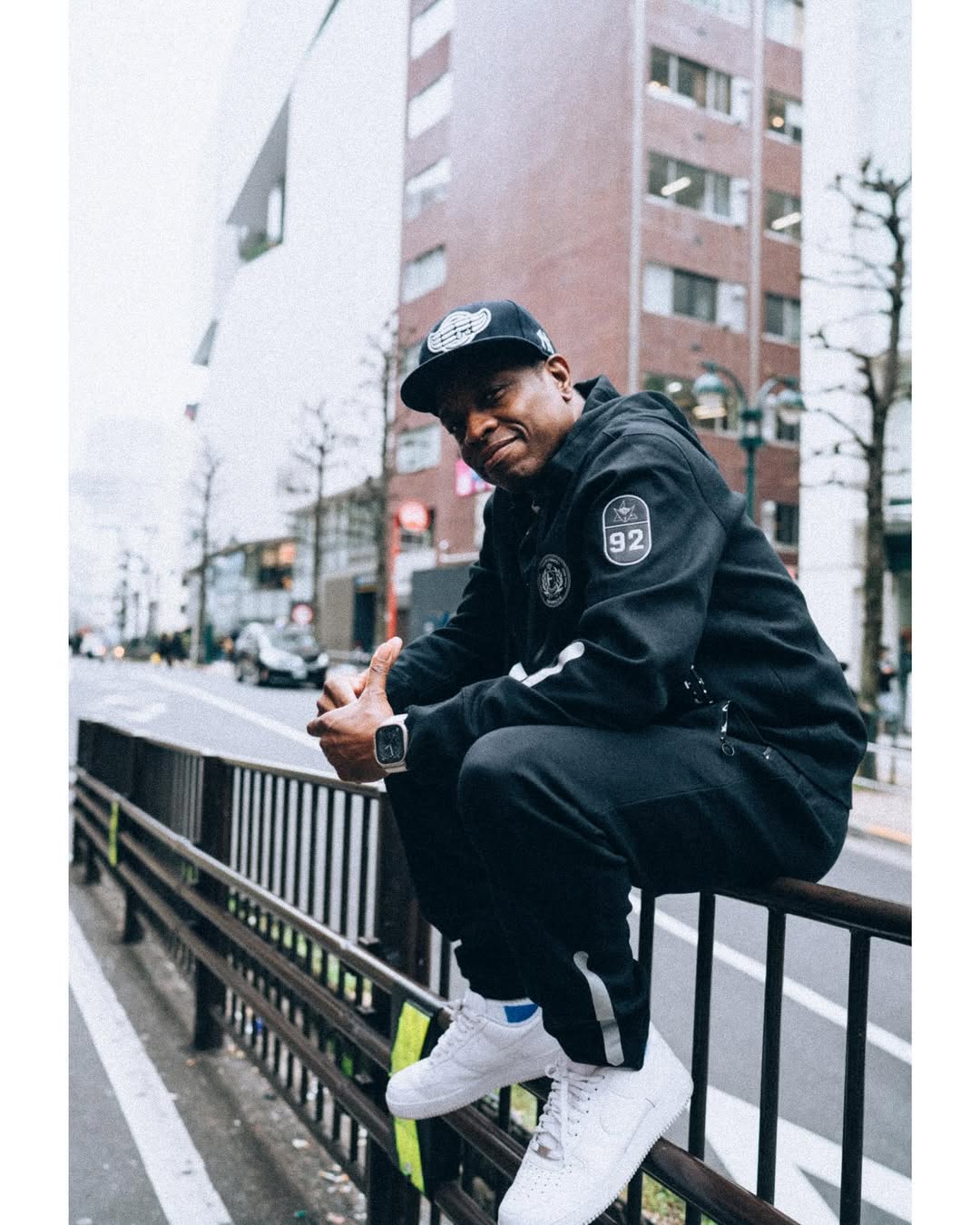
The way Henry Link tells it, the night that changed everything began like a thousand other nights at The Tunnel: music loud, floor crowded, a Brooklyn kid dancing because that is what he did. A woman watching from the edge of the floor came over and asked whether he wanted to be in a music video. He did not yet know her as Rosie Perez. He did not yet know the video would belong to Diana Ross. He only knew that he said yes.
He arrived on set as an extra. By his own account, he left as a principal dancer, and the day rate he remembers jumped from $250 to $1,500. It was 1989. He was eighteen.
Three years later, on a Hollywood backlot where Michael Jackson was filming “Remember the Time,” Link and his longtime partners Emilio “Buddha Stretch” Austin Jr. and Jamel “Loose Joint” Brown came together as Elite Force. More than three decades on, the crew’s own history names Link and Loose Joint as the dancers who “form the basic foundation for the group’s philosophy,” and lists Link, with Stretch, among its members still active today.
That is the thesis of this feature, and the reason Dance Mogul Magazine is tracking him now. Henry Link is not a finished chapter. He is one of the living sources of New York hip-hop freestyle, a dancer whose groove became a vocabulary, whose vocabulary became a curriculum, and whose curriculum now moves through studios, battles and camps from Tokyo to Torremolinos. His story is still being written, in real time, one workshop at a time.
“Biggest teacher in the room is the student.”
— Henry Link, Dance Chat podcast, May 2026
Henry Link at a Glance
File // At a Glance
Name — Henry “Link” McMillan, known worldwide as Henry Link or simply Link
Roles — Dancer, choreographer, master teacher, international battle judge
Origin — Brooklyn, New York; raised in public housing; Canarsie High School graduate
Trained — Self-driven study of locking, popping, freestyle and breaking; Brooklyn talent shows; New York clubs
Crews — Elite Force (founding member, 1992); the Mop Top family
Signature — Groove-first hip-hop freestyle; musicality; the “new school” party-dance vocabulary
Worked with — Michael Jackson, Mariah Carey, Diana Ross; with Elite Force and Mop Top, Will Smith and TLC
Screen & stage — “Workin’ Overtime” (1989); “Remember the Time” (1992); music videos, tours and television
Reach — Documented activity in 22 countries on 4 continents
Current work — Teaching and judging worldwide; Camp of Hip-Hop Spain Edition (Feb 2026)
DMM connection — Mapped with Buddha Stretch in DMM’s American Social Dance Movement archive
1992
Elite Force formed
22
Countries documented
23+
Years on the world circuit
59
Archived performance films
A Brooklyn Kitchen, a Hustle and an Older Sister
Before there was a stage, there was a household. Link has described growing up in Brooklyn in a home where music was part of everyday life, playing while the family cleaned and filling the room whenever people gathered. The first partner dance he ever learned was the hustle, and his first partner was his mother.
The person who pulled him all the way in was his older sister. His Peridance Center faculty biography says Link fell for dance by watching her, then became fascinated with the styles moving through New York in those years: locking, popping, freestyle and breaking. He practiced them relentlessly, won talent shows around the neighborhood and graduated from Canarsie High School. The same biography notes he grew up in the projects of Brooklyn, the kind of place where a cardboard floor and a radio could be a whole education.
His sister, Katrina, also gave him the rule he still teaches. On the Dance Chat podcast in May 2026, he repeated it plainly: “You dance for yourself. You don’t dance for anybody else.” Thank people whether they like your dancing or not, he added, and when someone criticizes you, ask them what you can improve instead of assuming they mean harm.
There is a second lesson from that household, and it gave the podcast episode its title. When his mother caught him practicing in front of a mirror and asked why he was “dancing with yourself,” something clicked. Outside of rehearsals, video shoots and classes, he stopped dancing to the mirror. Dance, for Link, would be about the room: the music, the people and the exchange between them.
The Tunnel, Rosie Perez and a $1,500 Day
New York’s clubs in the late 1980s were the city’s real dance academies, and The Tunnel was one of the most important rooms in that system. It is where, Link recalls, he was spotted in 1989 by a woman he later learned was Rosie Perez, then a dancer and choreographer on her way to becoming a household name. She invited him to a shoot. The record was Diana Ross’s “Workin’ Overtime,” released by Motown on April 24, 1989; it climbed to No. 3 on Billboard’s R&B chart.
Link’s memory of that day is precise. He was booked as an extra at $250 and promoted to principal dancer at $1,500, a sixfold jump in a single shoot. Those are his recollections, not studio payroll records, and DMM presents them that way. But they matter beyond the dollar amounts. They capture the moment when New York’s street and club dancers stopped being background texture and started being hired as the feature.
The Diana Ross work also carried him overseas, to London. His father agreed to help him get a passport on one condition, which Link has passed along ever since: that he “do it 100 percent.” That trip was the first entry in what would become one of the longest travel logs in hip-hop dance.
“If flow had a name, it would be called Henry Link.”
— Styles J2K, Laval, France (2020), translated from French
1992: The Set Where Elite Force Was Born
In January 1992, director John Singleton filmed Michael Jackson’s “Remember the Time” on the Universal Studios Hollywood backlot, with an ancient-Egypt setting, a cast that included Eddie Murphy, Iman and Magic Johnson, and choreography credited to Fatima Robinson. The nine-minute short film premiered on February 2, 1992, on Fox, BET and MTV; the Fox broadcast alone drew a 13.1 Nielsen rating.
For dance history, the more lasting event happened among the dancers. Elite Force’s official history says the crew formed on that set. The name, it explains, came from the “elite” dancers placed at the front of the formation. The three founders were Buddha Stretch, Link and Loose Joint. Link adds one more detail from his side of the story: when a Japanese organizer later asked what the crew was called, the name “Elite Force” came out almost instantly, a reminder that the crew was already a working unit before anyone wrote it down.
Link has also described auditioning for the video while fighting the flu. He recalls that Singleton wanted to feature him more prominently and that some of his movement ideas made their way into the choreography. DMM reports that as Link’s first-person recollection; it sits alongside, and does not replace, Fatima Robinson’s choreography credit. (A 2014 Vietnamese news profile went further and described Link as the video’s choreographer. That overstates the public record, and DMM does not repeat it.)
The crew grew from three members to six. Ejoe “Twelve” Wilson debuted in 1995. Terry “Brooklyn Terry” Wright joined on a Mariah Carey tour in 1996, and Bobby “Mileage” Barnette followed on another Mariah Carey tour in 1998. With the extended Mop Top family, Elite Force backed Mariah Carey, Will Smith, TLC “and many more,” in the crew’s words, across music videos, television, documentaries and concerts.
What Link Actually Does: Groove as a Language
Hip-hop freestyle is easy to name and hard to explain. It grew out of the party dances of New York clubs and block parties, and it is a distinct style: it is not breaking, it is not the California funk styles of popping and locking, and it is not house, even though the dancers who built it often studied all of those. What set Elite Force apart was the idea that a social dance could be rigorous. The crew describes its approach as moving in unified motion with every beat and sound in the music, while still leaving room for each dancer’s individual freestyle.
Link’s piece of that system is groove. A Tokyo organizer’s 2025 profile credits him, alongside Buddha Stretch and Loose Joint, with helping build the “new school” concept around the world, and with making dancers everywhere recognize how much rhythm and musicality matter. A Prague workshop listing reduced it to an equation: “Groove, musicality, technique = Link.”
Watch him judge-demo and the description makes sense. His body seems to sit inside the drum pattern rather than on top of it. The steps are recognizable party-dance vocabulary, yet the timing, texture and bounce are unmistakably his. That is why so much of his archive is filmed at judges’ showcases. Organizers on four continents have handed him the microphone moment because his freestyle is itself the lesson.
The Credit Record, Kept Honest
Crew culture is collective, and credits get blurred over three decades. DMM separates what is confirmed for Link individually from what belongs to Elite Force and Mop Top as groups, and from claims that appear only in event-organizer biographies.
| Artist / project | Credit type | Source |
|---|---|---|
| Diana Ross, “Workin’ Overtime” (1989) | Individual: extra, then principal dancer | Link, Dance Chat (2026) |
| Michael Jackson, “Remember the Time” (1992) | Individual dancer; Elite Force formed on set | Peridance bio; Elite Force history |
| Mariah Carey | Individual music videos; crew tours 1996, 1998 | Peridance bio; Elite Force history |
| Will Smith, TLC | Collective: Elite Force with the Mop Top family | Elite Force history |
| Pet Shop Boys, Doug E. Fresh, Keisha Jackson, Boyz II Men, LL Cool J, Coco Lee, Wyclef Jean, Jermaine Dupri | Listed in organizer biographies; role not specified | HIP-HOP Stuttgart; Revolution Dance Academy; Hanoi Times |
Organizer-biography credits are reported as published and have not been independently matched to production credits.
The Student Is the Teacher
If the 1990s made Henry Link a professional, the 2000s and 2010s made him a teacher of teachers. The archive his crew maintains is dominated by one kind of footage: Link at the judges’ table, then Link on the floor showing the room what the judges were listening for. Juste Debout in Paris in 2003. Styles Crash in Poland in 2010. Now That’s Legit in Singapore in 2012. Taiwan’s battle circuit in 2013. ISDS in Astana, Kazakhstan, in 2014. Heat in Hanoi, Vietnam, that same spring.
His classroom philosophy is the opposite of the drill-sergeant cliché. “Biggest teacher in the room is the student,” he told Dance Chat, explaining that he watches how students interpret a move and learns new ways to do it from them. A writer who sat in on his two-day workshop in Lima, Peru, documented in March 2013, asked him whether someone without natural rhythm and attitude could learn hip-hop. Link said yes: rhythm can be built through practice, and attitude comes from understanding how the music is meant to make people feel. He added that a dancer doesn’t need to copy a move perfectly, and that he enjoys seeing his steps come back slightly different.
German organizers note that younger dancers know him from the “Hip Hop Dictionary” videos on YouTube, short teaching films that named and demonstrated foundational steps. For dancers in places with no New York club scene, videos like those were the club scene. A step learned on a phone in Hanoi or Lima traces back through the screen to Brooklyn.
Watch: Henry Link in Motion
Seven films that trace the arc: the 1992 set where Elite Force was born, the world circuit, and the teaching that keeps the vocabulary alive.
1992 · Where it began. Michael Jackson’s “Remember the Time,” directed by John Singleton, choreographed by Fatima Robinson. Elite Force formed on this set. Video: Michael Jackson / Sony Music via YouTube.
2003 · Paris. Judges’ showcase at Juste Debout, the earliest international footage in Link’s archive. Video via YouTube; archived by Elite Force Crew.
Two traditions, one floor. Link of Elite Force with Popin Pete of the Electric Boogaloos in an exhibition at KOD9: New York freestyle meets California popping. Video via YouTube; archived by Elite Force Crew.
2014 · Astana, Kazakhstan. Judge demo at ISDS, one of dozens of judges’ showcases that carried his groove across Asia and Europe. Video via YouTube; archived by Elite Force Crew.
The signature. A compilation of Link’s showcase rounds. Video via YouTube; archived by Elite Force Crew.
The teacher. “Musicality by Henry Link”: the idea at the center of his workshops. Video via YouTube.
In the classroom. “Let Henry Link teach us how to dance.” Video via YouTube; archived by Elite Force Crew.
The Teaching & Travels Tracker
DMM built this tracker so readers can follow a living legacy the way it actually unfolds: city by city, date by date. Every row has a published source. It is a floor, not a ceiling; it captures listings that survive online, not every class he has taught.
| Date | Event | Place | Role |
|---|---|---|---|
| Feb 20–27, 2026 | Camp of Hip-Hop, Spain Edition | Torremolinos, Spain | Featured artist |
| Oct 27–Nov 2, 2025 | Street Style LAB 2025 | Orlando, USA | Featured artist |
| Oct 12, 2025 | UNION × NOA Dance Academy workshop | Tokyo, Japan | Teacher |
| Mar 21–23, 2025 | Common Ground – The Battle | Switzerland | Featured artist |
| Sep 14–15, 2024 | Freestyle Session Europe qualifier | Bologna, Italy | Featured artist |
| Jul 22–28, 2024 | Camp of Hip-Hop, 20-year anniversary | Near Tallinn, Estonia | Featured artist |
| Jul 29–31, 2022 | Street Style LAB 2022 | New York, USA | Featured artist |
| Apr 23–26, 2020 | Versa-Style 15th Anniversary Festival | Los Angeles, USA | Featured artist |
| Jul 2019 | The Week; Camp of Hip-Hop; Street Style LAB | Cesenatico, Italy; Estonia; USA | Featured artist |
| Sep–Oct 2018 | Red Bull BC One Camp; Flavourama Vol. 10 | Zurich, Switzerland; Salzburg, Austria | Featured artist |
| 2017 | Back To The Style; Popin Pete & Henry Link Camp; Urban Dance Festival; BDS Academy; Revolution Dance Academy; Freestyle Session World Finals | Pisa; Freising, Germany; Gmunden, Austria; Prague; Colorado Springs; Los Angeles | Teacher / featured artist |
| 2016 | Freestyle Battlegrounds; The Week; Street Style Lab; Summer Dance Forever | Burnaby, Canada; Cesenatico; NYC; Amsterdam | Featured artist |
| May 2014 | Heat 2014 | Hanoi, Vietnam | Judge |
| 2014 | ISDS; Juste Debout | Astana, Kazakhstan; Paris | Judge |
| 2013 | Two-day workshop; judges’ showcase; Hurricanes Battle-ISM | Lima, Peru; Gdańsk, Poland; Taiwan | Teacher / judge |
| 2012 | Now That’s Legit | Singapore | Judge |
| 2010 | Styles Crash | Poland | Featured artist |
| 2003 | Juste Debout | Paris, France | Judge |
Sources: and8.dance event listings; NOA Dance Academy; BDS Academy; Revolution Dance Academy; Hanoi Times; Samantha Bangayan (Lima, 2013); Elite Force Crew video archive. “Featured artist” means the organizer listed him without naming a specific role.
Documented listings per year · bars drawn to scale
Counts are dated, located listings found online for each year, not a full record of his teaching. Years with no bar have no surviving dated listing, not no activity. The 2017 spike reflects a year of unusually complete online listings.
The Teaching Tree: How a Groove Became Work
Dance knowledge does not survive in museums. It survives in bodies, and it travels when someone is paid to carry it. Every workshop Link teaches is a small economy: a studio rents the room, an organizer books the flight, local dancers pay a fee, and the dancers who absorb his vocabulary go home and teach it in their own classes, crews and battles. The U.S. Bureau of Labor Statistics notes that nearly all choreographers begin their careers as dancers. Link’s career is a working model of the next step: dancers who become the reason other dancers get hired.
How the knowledge became work
1. The floor. Brooklyn talent shows and New York clubs turn a teenager’s practice into a recognizable style.
2. The booking. A 1989 music video turns that style into paid work, from extra to principal.
3. The crew. Elite Force and the Mop Top family turn individual talent into a brand that tours with major artists.
4. The judges’ table. Battles on four continents hire him to define the standard, and the standard becomes the curriculum.
5. The next teachers. Workshop students in 22 countries carry the vocabulary into their own studios, crews and classes.
The Lineage: Who Shaped Link, and Who He Shaped
Shaped by
His mother
first hustle partner
Katrina
older sister, first inspiration
Rosie Perez
discovered him, 1989
NYC clubs
The Tunnel and the club circuit
↓
Henry “Link” McMillan
Brooklyn · hip-hop freestyle
↓
Crews & collaborators
Buddha Stretch
Elite Force co-founder
Loose Joint
Elite Force co-founder
Ejoe “Twelve” Wilson
Elite Force, 1995; Mop Top
Brooklyn Terry & Mileage
Elite Force, 1996 & 1998
Caleaf Sellers
Mop Top family
Popin Pete
co-teacher, 2017 camp
↓
Students & next generation
Camp & lab students
Street Style LAB, Camp of Hip-Hop, The Week
Battle generations
dancers judged in 22 countries
Online learners
“Hip Hop Dictionary” viewers, and many more
Relationships drawn only from published sources: Dance Chat (2026), Peridance, Elite Force Crew, and8.dance, HIP-HOP Stuttgart. Individual students are not named because no source documents them.
Worldwide Impact: From Brooklyn to Twenty-Two Countries
Worldwide Impact // Documented Reach
| Country / region | What happened | Year | Evidence |
|---|---|---|---|
| USA | Home base; music videos; Street Style LAB, Versa-Style, master classes | 1989–2025 | Peridance; and8.dance |
| United Kingdom | London trip tied to Diana Ross work | 1989 | Link’s recollection |
| France | Juste Debout, Paris | 2003, 2014 | Archive footage |
| Poland | Styles Crash; Gdańsk judges’ showcase | 2010, 2013 | Archive footage |
| Singapore | Now That’s Legit judge | 2012 | Archive footage |
| Peru | Two-day workshop, Lima | 2013 | Eyewitness account |
| Taiwan | Hurricanes Battle-ISM; Ocean Battle Session judge | 2013 and other years | Archive footage |
| Kazakhstan | ISDS judge, Astana | 2014 | Archive footage |
| Vietnam | Heat 2014 judge, Hanoi | 2014 | Hanoi Times |
| China | Demos in Changsha; performance in Guangzhou | undated | Archive footage |
| South Korea | Showcase | undated | Archive footage |
| Ukraine | Adrenaline Fest; Ukrainian Open Battle judge | undated | Archive footage |
| Canada | Freestyle Battlegrounds, Burnaby | 2016 | and8.dance |
| Netherlands | Summer Dance Forever, Amsterdam | 2016 | and8.dance |
| Italy | The Week; Back To The Style; FSS Europe qualifier | 2016–2024 | and8.dance |
| Germany | Popin Pete & Henry Link Camp, Freising; Stuttgart guest teacher | 2017 | and8.dance; HIP-HOP Stuttgart |
| Austria | Urban Dance Festival; Flavourama | 2017, 2018 | and8.dance |
| Czech Republic | Workshop, BDS Academy, Prague | 2017 | and8.dance |
| Switzerland | Red Bull BC One Camp Zurich; Common Ground | 2018, 2025 | and8.dance |
| Estonia | Camp of Hip-Hop, incl. 20-year edition | 2019, 2024 | and8.dance |
| Japan | Workshop, NOA Dance Academy, Tokyo | 2025 | NOA listing |
| Spain | Camp of Hip-Hop, Torremolinos | 2026 | and8.dance |
22
countries with a source
4
continents
37
years, London 1989 to Spain 2026
Influence beyond these countries, through online teaching films and the students who learned from him, is real but cannot be counted, so it is not included in the totals.
By the Numbers: The Economy Around Henry Link’s Art
Hip-hop freestyle is culture, and it is also work. The numbers below show the scale of the projects and industries Link’s dancing has moved through. DMM keeps them in separate tiers, because a hit record’s sales are not a dancer’s paycheck and a national industry is not one artist’s output. No one has published Link’s personal earnings, student totals or economic footprint, and DMM does not estimate them.
Tier 1 · Projects Link danced in
| Measure | Figure | Scope | Source |
|---|---|---|---|
| “Remember the Time” U.S. certification | 3× Platinum | 3,000,000 U.S. units (certified 2022) | RIAA |
| “Remember the Time” chart peaks | No. 3 / No. 1 / No. 3 | Hot 100 / U.S. R&B / UK, 1992 | Billboard; OCC |
| Video premiere audience | 13.1 rating | Fox broadcast, Feb 2, 1992 (Nielsen) | Nielsen via Wikipedia |
| “Remember the Time” UK certification | Gold | 400,000 UK units | BPI |
| “Workin’ Overtime” chart peak | No. 3 | U.S. R&B, 1989 (UK No. 32) | Billboard; OCC |
These figures describe the records and videos, not Link’s share of them. They show the audience his dancing reached.
The 1989 pay jump · Link’s recollection · bars drawn to scale
$1,500 ÷ $250 = 6×. Figures are Link’s first-person memory (Dance Chat, 2026), not payroll records, and are not adjusted for inflation.
Inside one workshop · illustrative scenario
On October 12, 2025, NOA Dance Academy in Tokyo listed a 90-minute Henry Link workshop with a capacity of 55 and a visitor fee of ¥4,400.
Maximum theoretical gross per session: 55 × ¥4,400 = ¥242,000.
Hypothetical. Studio members paid less, actual attendance is not published, and the studio’s revenue is not Link’s fee. The point is the chain: one teacher’s name filled a room that a studio, an organizer and local dancers all built income around. For comparison, a Colorado Springs studio listed his 2017 master class at $15.
Tier 2 · The industries this art form feeds
$5.0B
U.S. dance studio revenue, 14,622 businesses (2025) · IBISWorld
Markets where hip-hop dance works · bars drawn to scale
Context only. These are whole industries, not the value of hip-hop freestyle or of any one dancer. Bar widths: 31.7 = 100%; 15.1 ÷ 31.7 = 47.6%; 5.0 ÷ 31.7 = 15.8%.
$26.73/hr
Median U.S. choreographer wage, May 2024 · BLS
$23.97/hr
Median U.S. dancer wage, May 2024 · BLS
+5%
Projected dancer & choreographer jobs, 2024–34 · BLS
How the Groove Traveled, and What Belongs to Everyone
Hip-hop freestyle was built by a generation of New York dancers, not by one person. Buddha Stretch, Loose Joint, the Mop Top family, the club regulars who never appeared in a video: all of them shaped the vocabulary Link teaches. DMM does not call him the inventor of the style, and neither does he. What the record does show is narrower and more impressive. He is one of the founding pillars of the crew that made the style legible to the world, and for more than two decades he has been one of the people the world invites to define it.
That role matters because hip-hop dance spread faster than its history. Around the world, students learned the steps from music videos and online clips long before they learned the names of the people who made them. Teachers like Link close that gap. When he stands in front of a room in Tokyo, Bologna or Lima, the steps arrive with their source, their feeling and their etiquette attached.
Where Is Henry Link Now?
As of October 2026, Link is still on the road. His most recent dated listing is the Camp of Hip-Hop Spain Edition in Torremolinos, February 20–27, 2026, after a 2025 that took him to Common Ground in Switzerland, a workshop in Tokyo and Street Style LAB in Orlando. Elite Force’s official site lists him, with Buddha Stretch, as one of the crew’s active members. In May 2026 he sat for a two-and-a-half-hour conversation on the Dance Chat podcast, his most detailed public account yet of his family, his first break and the founding of Elite Force.
A Living Legacy, and Why DMM Is Tracking It
Most legacy writing arrives too late. It is written after the classes have stopped, after the travel logs are lost, after the people who could correct the record are gone. DMM’s Legacy series exists to do the work while the artist is still working. For Henry Link that means the record keeps growing, and this page will grow with it.
A living legacy is worth tracking for three practical reasons. First, accuracy: an artist who is still active can confirm dates, credits and spellings that will otherwise harden into myth, like the claim that Link choreographed “Remember the Time.” Second, access: every new workshop listing is a door for a young dancer somewhere who can still learn from the source in person. Third, value: when a pioneer’s work is documented, festivals, studios, universities and brands can see it, cite it and pay for it. Documentation is how cultural contribution becomes recognized professional standing.
The DMM Archive Connection
Henry Link already sits on DMM’s map of the culture. In The American Social Dance Movement, he appears beside Buddha Stretch as one of the dancers, choreographers and educators who carried New York club movement into professional studios and onto the world stage. DMM’s exclusive interview with Buddha Stretch tells the Elite Force story from his co-founder’s side, and our Legacy features on Ejoe Wilson and Caleaf Sellers trace the Mop Top family into house dance. This feature completes the circle with the dancer at the center of the groove.
Career & Cultural Timeline
CULTURE = the scene around him · CAREER = his work · TEACHING = passing it on
CHILDHOOD · CULTURE
Grows up in Brooklyn public housing; dances the hustle with his mother; follows his older sister into locking, popping, freestyle and breaking; wins local talent shows; graduates from Canarsie High School.
1989 · CAREER
Spotted at The Tunnel by Rosie Perez (his account); dances in Diana Ross’s “Workin’ Overtime,” rising from extra to principal. The work takes him to London.
JAN–FEB 1992 · CAREER
“Remember the Time” filmed in Hollywood; Elite Force forms on set with Buddha Stretch and Loose Joint. The video premieres February 2.
1995–1998 · CULTURE
Elite Force grows to six: Ejoe “Twelve” Wilson (1995), Brooklyn Terry (1996) and Mileage (1998), the last two joining on Mariah Carey tours.
1990s · CAREER
With the Mop Top family, Elite Force backs Mariah Carey, Will Smith and TLC in videos, television and concerts.
2003 · TEACHING
Judges’ showcase at Juste Debout, Paris: the start of his documented international circuit.
2010–2014 · TEACHING
Judges and teaches across Poland, Singapore, Peru, Taiwan, Kazakhstan, Vietnam and France.
2016–2019 · TEACHING
Faculty at Street Style Lab; The Week in Italy; Summer Dance Forever in Amsterdam; a joint camp with Popin Pete in Germany; Red Bull BC One Camp Zurich.
2020 · CULTURE
Guest at Versa-Style’s 15th anniversary festival in Los Angeles. A French dance site salutes him: “If flow had a name, it would be called Henry Link.”
2024–2025 · TEACHING
Camp of Hip-Hop’s 20th anniversary in Estonia; Freestyle Session Europe in Bologna; Common Ground in Switzerland; Tokyo workshop; Street Style LAB Orlando.
2026 · CAREER
Teaches Camp of Hip-Hop Spain Edition (February); tells his story on Dance Chat (May); profiled in DMM’s Legacy series (October).
Why Henry Link’s Legacy Matters to Dance Mogul Magazine
Dance Mogul Magazine was founded on a simple conviction: dance is a bridge to a better life, and the people who build that bridge deserve to be documented by their own community. Henry Link’s story is that conviction in motion. A kid from Brooklyn public housing followed his sister into dance, took a chance on a stranger’s invitation, and kept saying yes until his name meant something in rooms he had never imagined.
His story also carries the values DMM puts first. Character before celebrity: Link talks about thanking people who don’t like his dancing. Contribution before attention: he has spent more than two decades judging and teaching, the least glamorous and most generous work in the culture. And people before popularity: his teaching philosophy starts from the student, not the star.
What Dance Would Be Missing Without Henry Link
• One of Elite Force’s three founding pillars, and one of the two dancers the crew credits with its core philosophy.
• A groove-first standard that organizers on four continents have hired him to demonstrate from the judges’ table.
• A documented teaching footprint in 22 countries, from Lima to Astana to Tokyo.
• An archive of 59 performance and teaching films that young dancers still study.
• A teaching philosophy, “the biggest teacher in the room is the student,” that treats every class as an exchange.
What Future Generations Can Learn From Henry Link
1. Dance for yourself first. His sister’s rule kept him grounded through every stage of a long career.
2. Say yes, then go 100 percent. One invitation at The Tunnel opened the door; his father’s condition taught him how to walk through it.
3. Learn from your students. The teacher who keeps watching keeps growing.
4. Treat criticism as information. Ask what to improve instead of assuming the worst.
5. Build with a crew. Elite Force turned three dancers into a name the world recognizes.
6. Rhythm can be built. As he told a room in Lima, practice develops it, and feeling the music creates the attitude.
7. Protect your record. Keep your credits, dates and stories documented so the history stays accurate.
The Groove Goes On
It started with a radio in a Brooklyn apartment, a mother teaching her son the hustle, and a sister showing him that the dance belonged to him. It picked up speed under the lights of The Tunnel, found its name on a Hollywood backlot in 1992 and then did what great New York dance has always done: it traveled.
Thirty-seven years after that first music video, Henry Link is still walking into rooms full of strangers and leaving them a little more in time with the music. He still isn’t dancing for the mirror. He is dancing for the room, and the room keeps getting bigger.
Henry Link: Frequently Asked Questions
Who is Henry Link?
Henry “Link” McMillan is a Brooklyn-born hip-hop freestyle dancer, choreographer, teacher and international battle judge. He is a founding member of Elite Force and part of the Mop Top family.
When was Elite Force founded?
In 1992, on the set of Michael Jackson’s “Remember the Time.” The founders were Buddha Stretch, Henry Link and Loose Joint; the crew later grew to six members.
Did Henry Link choreograph “Remember the Time”?
No. The video’s choreography is credited to Fatima Robinson. Link danced in it, and he recalls that some of his movement ideas were added during production.
How did Henry Link get his start?
By his account, Rosie Perez spotted him at The Tunnel nightclub in New York in 1989 and invited him to Diana Ross’s “Workin’ Overtime” video, where he went from extra to principal dancer.
Which artists has Henry Link worked with?
Michael Jackson, Mariah Carey and Diana Ross, and, with Elite Force and the Mop Top family, Will Smith and TLC. Organizer biographies list many others.
Is Henry Link still teaching?
Yes. His most recent dated listing is Camp of Hip-Hop Spain Edition in Torremolinos in February 2026, after teaching in Japan, Switzerland and the United States in 2025.
What style does Henry Link dance?
Hip-hop freestyle, the New York party-dance style sometimes called “new school,” built on groove and musicality. He also studied locking, popping and breaking, which are separate styles.
The Legacy // New York Dance Pioneers Collection
Henry Link · Elite Force founder, hip-hop freestyle · You are here
Buddha Stretch · Elite Force co-founder, DMM exclusive interview
Ejoe Wilson · Elite Force “Twelve,” house dance pioneer
Caleaf Sellers · Mop Top, Dance Fusion
Peekaboo · house and club dance
Sekou Heru · house dance educator
Tony McGregor · house dance pioneer
Shock-a-Lock · New York locking pioneer
Mr. Wiggles · Rock Steady and Electric Boogaloos
Darrin Henson · choreographer, “Bye Bye Bye”
Dave Scott · You Got Served, Stomp the Yard
Boogaloo Shrimp · Breakin’ icon
Sources & Further Viewing
Elite Force Crew, official history · Henry Link video archive
Dance Chat: “Henry Link: I Don’t Dance to Look at Myself in the Mirror” (May 21, 2026)
Peridance Center, faculty biography: Link
and8.dance, Henry McMillan aka Link: event history
NOA Dance Academy, Henry Link workshop, Oct 12, 2025
Hanoi Times, “Hip-hop artist to judge competition in Hanoi” (May 15, 2014)
Samantha Bangayan, “The Peru Hip Hop Scene: Lessons from Henry Link” (2013)
HIP-HOP Stuttgart, guest teacher: Henry Link · Revolution Dance Academy (2017)
Styles J2K, “Mr Henry Link” (2020)
“Remember the Time”: release, video and certification history · “Workin’ Overtime” (song)
Economic context: IBISWorld, Dance Studios in the US (2025); U.S. Bureau of Labor Statistics, Occupational Outlook Handbook, Dancers and Choreographers (May 2024 wages); IFPI Global Music Report 2026; IMS Business Report 2026.
© 2026 Dance Mogul Magazine LLC · The Legacy Series · A Black-owned dance and empowerment publication since 2010